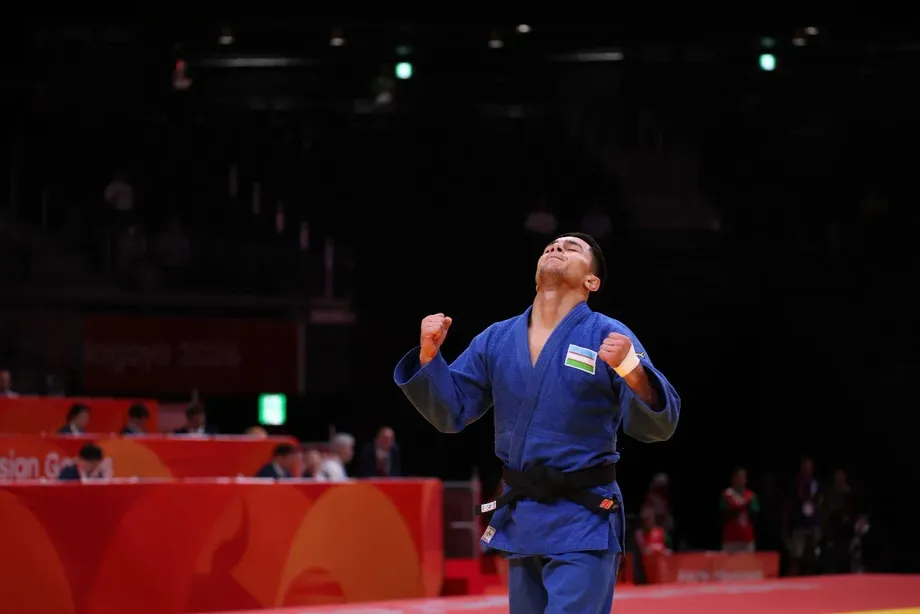
Four victories bring Mongolia its first gold
Yolk Kazirbyek won Mongolia's first gold medal of the 2026 Asian Games on September 30, defeating Uzbekistan's Abdurakhim Nutfulloev in the men's under 66 kg judo final in Aichi-Nagoya, Japan. His victory by ippon through a pin ended Mongolia's wait for an Asian Games judo title stretching back to 2014.
Contents
- Four victories bring Mongolia its first gold
- The route through a field of 20
- A title after a world bronze and two missed podiums
- Narantsetseg adds judo bronze to her sambo gold
- Fifth and seventh after narrow routes to the podium
- From a rural childhood to the world stage
- The historical milestone needs careful counting
- Mongolia stands 26th with five medals
- Key Points
The International Judo Federation's official athlete profile records Kazirbyek's first place at the 20th Asian Games on that date. The result followed four victories after an opening bye, with opponents from Afghanistan, Tajikistan, Kazakhstan and Uzbekistan standing between him and the title.
Mongolia also won bronze through Narantsetseg Ganbaatar in the women's under 48 kg competition. She defeated India's Asmita Dey after losing her semifinal to Japan's Mitsuki Kondo. Two other Mongolian judoka finished close to the medals: Uranzaya Bayanmunkh placed fifth in the women's under 52 kg category, while Ariunbold Enkhtaivan finished seventh in the men's under 60 kg event.
Kazirbyek's gold made him the eighth Mongolian judoka to win an Asian Games title. It also moved a world bronze medalist to the top of a continental podium after two earlier competitions in 2026 had ended without a medal.
The route through a field of 20
The men's under 66 kg category featured 20 competitors. Kazirbyek received a bye in the first round, then beat Afghanistan's Hikmatullah Rahmani in the round of 16. He followed that with a quarterfinal victory over Tajikistan's Nurali Emomali and a semifinal win against Kazakhstan's Gusman Kyrgyzbayev, both described in competition reports as World Championships silver medalists.
The JudoTV contest record lists all four of his Asian Games bouts on September 30, including the final against Nutfulloev. That record provides the sequence behind the title: one day, four contested rounds and a championship secured in the final.
Kazirbyek ended the gold medal bout with a pin that earned ippon. In judo, ippon is a decisive score that immediately ends a contest. It can be awarded for a qualifying throw, a sustained hold or a submission. His winning action therefore settled the final outright rather than leaving the result to a smaller scoring advantage.
The accounts do not give the duration of the final or the name of the hold. They identify the decisive method as a pin, followed by Mongolia's national anthem at the medal ceremony in Nagoya.
A title after a world bronze and two missed podiums
Kazirbyek arrived with a major achievement already on his record: bronze at the 2025 World Senior Championships in Hungary. The IJF lists that result on June 13, 2025, and its subsequent account describes the tournament as his first World Championships.
His next listed results show that the Asian Games title did not follow an uninterrupted run of podium finishes. He placed seventh at the Asian Senior Championships on April 16, 2026, and fifth at the Ulaanbaatar Grand Slam on June 19. In Nagoya, he converted another opportunity into gold.
The progression across those events is useful context, although the fields and competition formats differ. Seventh place at the continental championships and fifth at a Grand Slam were followed by first place at the Asian Games. The results show a change in tournament outcome, not enough evidence on their own to explain what changed in his preparation or technique.
A short timeline puts the championship in sequence:
- June 13, 2025: Kazirbyek wins bronze at his first World Senior Championships.
- April 16, 2026: He finishes seventh at the Asian Senior Championships.
- June 19, 2026: He places fifth at the Ulaanbaatar Grand Slam.
- September 30, 2026: He wins the Asian Games men's under 66 kg title.
- October 1, 2026: Mongolia is reported to have one gold and four bronze medals.
- October 11, 2026: The IJF ranking lists him 76th in the under 66 kg category with 578 points.
The October 11 ranking is a later snapshot, not his position entering the Asian Games. Both the IJF and JudoTV also list him in the under 60 kg rankings, where he stood 55th. Those separate category records should not be confused with the weight division in which he won in Nagoya.
Narantsetseg adds judo bronze to her sambo gold
Narantsetseg Ganbaatar's bronze gave Mongolia a second medal on the opening day of judo competition. Seeded first in Pool A, she received a first round bye and defeated a Tajik opponent in the quarterfinals before losing to Mitsuki Kondo in the semifinal.
She then beat Asmita Dey by waza-ari in the bronze medal contest. Waza-ari is a score below ippon. A single waza-ari can decide a contest when the opponent does not match it or secure a decisive score. The result account does not identify the technique that earned her winning score.
For Narantsetseg, the medal extended an Asian Games record across two sports. She won sambo gold at the 2018 Games in Jakarta and, eight years later, reached the judo podium in Japan. Sambo and judo both involve grappling, but they are separate sports with different rules, so the two medals represent distinct competitive achievements.
Her bronze also helps distinguish Mongolia's national breakthrough from its judo results that day. Kazirbyek supplied the delegation's first gold of the Games; Narantsetseg added another podium finish in a separate weight category. Together, they accounted for two of the five Mongolian medals reported in the October 1 standings.
Fifth and seventh after narrow routes to the podium
Uranzaya Bayanmunkh reached the women's under 52 kg semifinal against Uzbekistan's Sita Kadamboeva. She lost after the contest went into extra time, despite an earlier advantage while Kadamboeva had received two penalties.
The account does not specify whether Uranzaya's advantage came from a technical score or how the deciding score was earned. Penalties and technical scores are different parts of judo scoring, so the two penalties alone do not establish the full match situation. Her final placing was fifth, but details of her bronze medal contest are not given.
Ariunbold Enkhtaivan, a World Championships silver medalist, lost his men's under 60 kg quarterfinal to Kazakhstan's Olympic champion Yeldos Smetov. Smetov won by ippon from a pin. Ariunbold then lost to Tajikistan's Loik Kudbudinov in repechage and finished seventh.
Repechage is a route that gives eligible defeated competitors another chance to reach a bronze medal contest. Ariunbold's second defeat ended that opportunity. His result and Uranzaya's fifth place show that Mongolia had four judoka progressing into the later stages of their individual events, although only Kazirbyek and Narantsetseg reached the podium.
From a rural childhood to the world stage
The IJF's June 2025 profile, written by Nicolas Messner, traces Kazirbyek's beginnings to the area near Darkhan, about 230 km north of Ulaanbaatar. The federation describes Darkhan as having fewer than 90,000 residents and places his family in the surrounding rural community.
Kazirbyek started judo at 13 after a friend encouraged him to join. During a summer camp, he met visitors from the IJF and Mongolia's national federation and received a judogi, the uniform worn in judo. Messner recalled children training on grass near traditional ger dwellings and cattle during the visit.
Speaking to the IJF after his 2025 world bronze, Kazirbyek described the scale of that first championship result:
It's unimaginable. It is my first ever world championship and I won a medal. I'm living in a dream.
That statement belongs to his World Championships experience, not the Asian Games final. It documents how he understood his first major international medal more than a year before becoming an Asian Games champion.
Khaltmaagiin Battulga, the former Mongolian president and president of the Mongolian Judo Association, connected Kazirbyek's progress to visits supporting children in rural communities. He also cited Baasankhuu Bavuudorj, who became world champion and Olympic silver medalist in 2024, as another athlete encountered during those efforts.
Battulga described the purpose of that support in personal terms:
It was and still is my dream to offer young people a future.
The same IJF account records Kazirbyek helping Brazil's Michel Augusto after Augusto was injured at the end of their world bronze medal contest. Kazirbyek explained why he assisted his opponent:
Competition is competition, we are fighters but once it's over we are members of the same family.
The historical milestone needs careful counting
Kazirbyek's place as Mongolia's eighth Asian Games judo champion is supported by a list of seven previous winners: Kh. Boldbaatar, Kh. Erdene-Od, D. Nyamkhuu, Kh. Tsagaanbaatar, N. Tuvshinbayar, M. Urantsetseg and D. Tumurkhuileg. His title ended the reported 12 year gap since Mongolia last won Asian Games judo gold in 2014.
Reports differ, however, in how they describe the wider national milestone. One calls him the 28th Mongolian athlete to win Asian Games gold. Another calls his victory Mongolia's 27th Asian Games gold medal. Those statements count different things, individual athletes and medals, and neither provides a complete historical ledger that would allow the numbers to be reconciled.
His age also differs between records. The IJF and JudoTV profiles list him as 25, while a competition report describes him as 26. A birth date is not included in those records, so the discrepancy cannot be resolved from them.
The central result is more firmly documented than either disputed detail: the IJF records first place on September 30 in the men's under 66 kg event. The historical athlete count and his exact age should therefore be kept separate from the verified championship result.
Mongolia stands 26th with five medals
By October 1, Mongolia was reported to be 26th in the medal standings with one gold and four bronze medals. Alongside the two judo medals, its podium finishes came through cyclist S. Jambaljamts in the road mass start, boxer Kh. Bilguunsaikhan in the men's 55 kg division and the Mobile Legends: Bang Bang esports team.
Judo therefore supplied two of Mongolia's five medals, or 40 percent of that reported total, and its only gold. That is a substantial contribution to the delegation's position, although the standings describe one moment during the Games rather than a final national result.
The same standings account says 40 countries had won medals and 26 had secured at least one gold. China led with 277 medals, including 151 gold, while host Japan had reached 200 medals. Mongolia's five medals were far fewer, but Kazirbyek's title placed it among the delegations with a champion.
The immediate result account describes Narantsetseg's medal as Mongolia's third bronze, while the October 1 breakdown lists four bronze medals across the named sports. The precise order of those bronze results is not established, so the later total should not be used to reconstruct the sequence of medal ceremonies.
No next competition date for Kazirbyek is identified. His confirmed achievement is the September 30 title, supported by the official result and contest records, with the later ranking providing a separate measure of his standing on the international circuit.
Key Points
- Yolk Kazirbyek won Mongolia's first gold of the 2026 Asian Games on September 30.
- He defeated Abdurakhim Nutfulloev by ippon from a pin in the men's under 66 kg final.
- The title ended Mongolia's reported 12 year wait for Asian Games judo gold.
- Narantsetseg Ganbaatar won women's under 48 kg bronze, adding to her 2018 sambo gold.
- Uranzaya Bayanmunkh finished fifth and Ariunbold Enkhtaivan seventh.
- Mongolia was reported 26th on October 1 with one gold and four bronze medals.
- Reports differ on Kazirbyek's age and the numbering of Mongolia's historical gold milestone.