Five routes, a 2030 target and a vast investment commitment
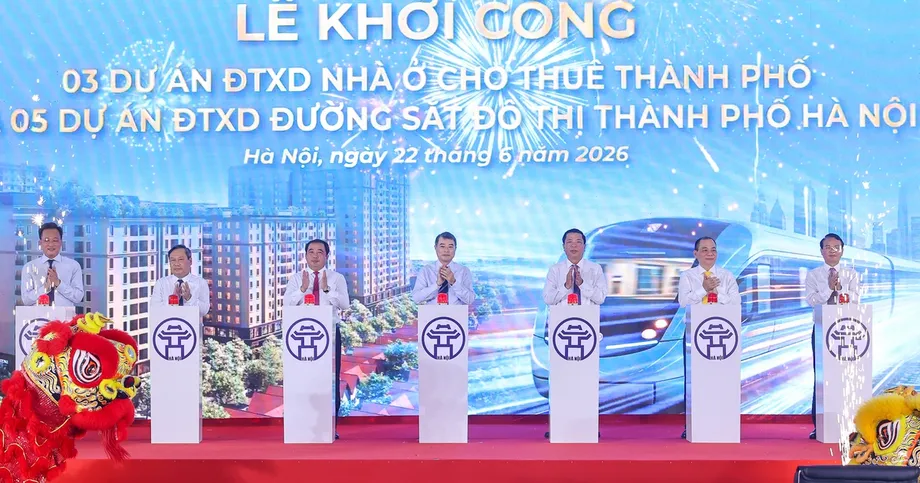
Hanoi launched construction of five metro lines on June 22, 2026, with a combined length of about 303.5 kilometres and preliminary investment of VND1,315.256 trillion. The programme would connect Noi Bai International Airport, Hanoi railway station, the Ngoc Hoi station complex and major development areas, with the city aiming to substantially complete the routes by 2030.
Contents
- Five routes, a 2030 target and a vast investment commitment
- Where the five lines will run
- From separate routes to an interconnected network
- Who will build the projects?
- How funding and advance payments will be controlled
- A 200 trainset deal brings production to Vietnam
- The 2030 deadline has several meanings
- Rail and housing are part of the same development push
- What the larger plan still leaves open
- Key Points
The investment estimate is equivalent to VND1.315256 quadrillion. Lines 1, 2, 8, 10 and 14 together represent about 31% of the capital's planned 979 km urban railway network. Their combined length also amounts to roughly 61% of the approximately 500 km that Hanoi intends to complete by 2035, showing how much of the city's near term rail ambition depends on this single programme.
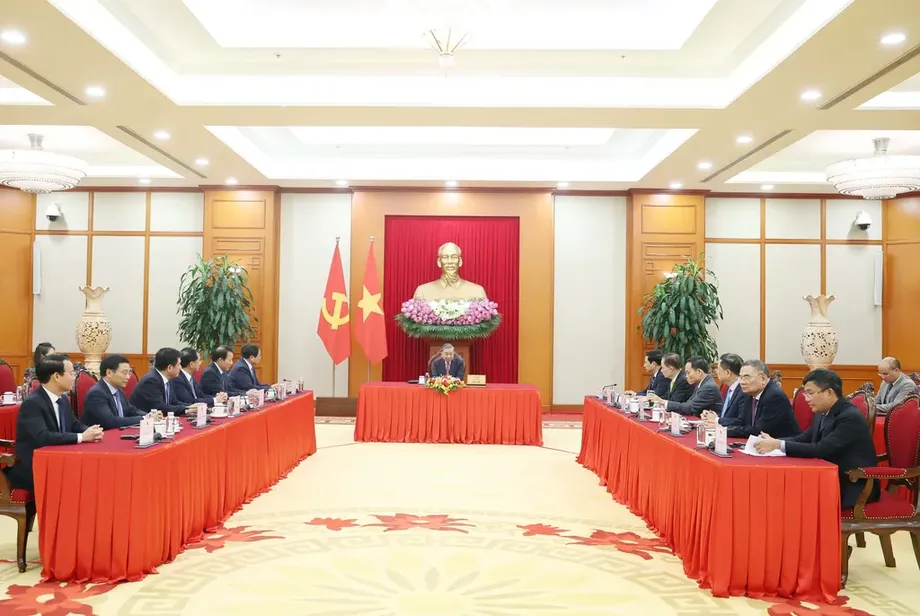
Prime Minister Le Minh Hung attended the June groundbreaking. Hanoi People's Committee Chairman Vu Dai Thang described the programme as the city's largest urban railway investment to date and a shift from building individual routes to developing a connected network across the capital.
Subsequent developments in October added important details about contracts, funding safeguards and trains. An October 5 resolution backed negotiations and advance payments for turnkey construction contracts, while an October 6 agreement between Vingroup and Alstom covered 200 metro trainsets and a substantial manufacturing role for Vietnam.
These announcements do not settle every delivery question. Reports differ on the construction consortium, some route descriptions and whether the 2030 milestone means substantial completion or passenger operation. Those distinctions matter for a programme expected to move from groundbreaking to delivery in roughly four years.
Where the five lines will run
Line 1 is the largest project by reported investment, with an estimated cost of VND389.53 trillion and a length of about 81 km. That budget represents approximately 29.6% of the preliminary investment for all five lines. Its central purpose is to connect southern Hanoi, Ngoc Hoi, Hanoi station and the northern airport corridor.
The detailed June route description runs from Thuong Tin through Tam Hung, Thuong Phuc, Dan Hoa, a railway industrial park, Ngoc Hoi, Hanoi station, Yen Vien and the Thu Lam urban development area to Noi Bai. Another account identifies the Hung Vuong Stadium area and Gia Lam along the route. The descriptions share the main transport hubs but do not provide an identical list of places served.
Line 2, about 56.5 km long, would provide another connection to Noi Bai, passing through Nam Thang Long, the Hoan Kiem Lake area, Tran Hung Dao and Thuong Dinh before reaching southern districts. A more detailed description extends the southern route through Thuong Tin, Tam Hung, Thuong Phuc and Dan Hoa.
At approximately 91 km, Line 8 is the longest of the five. It would link Hoa Lac, including its technology development area, with Son Dong, Mai Dich, Ring Road 3, Linh Nam and Duong Xa. Its corridor connects western growth areas with industrial, logistics and eastern urban zones.
Line 10 is described as a roughly 43 km circular route linking Dong Anh or Co Loa with Vo Chi Cong, Ring Road 3, Ring Road 2.5 and Times City before returning north. Line 14, about 32 km, is described as running from Thang Long Bridge through Hong Ha to Gia Lam. Another description identifies Ciputra, central Hanoi and Ocean Park as places served.
The five published lengths add up to 303.5 km. However, several are approximate, and the differing place lists should not be treated as a final station schedule. Detailed station locations and confirmed interchange arrangements are not established in the announcements.
From separate routes to an interconnected network
Hanoi currently operates the Cat Linh to Ha Dong line and the elevated Nhon to Cau Giay section of Line 3, which is planned to reach Hanoi station. The five new routes are intended to connect with Lines 3 and 5 as those projects advance, rather than function as isolated services.
The airport connections on Lines 1 and 2, together with access to Hanoi station and Ngoc Hoi, would bring urban rail closer to the capital's main transport gateways. Line 1 is also intended to connect the metro network with national rail and planned high speed rail services. Such connections could let passengers transfer between systems, although operating arrangements and transfer times have not been announced.
The network would also reach development areas including Hoa Lac, Thu Lam, Co Loa, Gia Lam and Ocean Park. Line 10's circular layout is intended to reduce pressure on the inner city by creating connections around it, while Line 8 would provide a major corridor between western and eastern districts.
The practical benefit depends on more than track length. The announced aim is a connected public transport system, but fares, service frequencies, opening sequences and arrangements for transferring between the new and existing lines have yet to be detailed.
Who will build the projects?
The Hanoi Metropolitan Railway Management Board has been assigned as project owner. June reports identify a consortium of Vinhomes and VinSpeed, both within Vingroup, as the engineering, procurement and construction contractor for all five lines. This arrangement, usually shortened to EPC, places responsibility for design, equipment purchasing and construction within one contracting structure.
October accounts name a different consortium. Reports describing Hanoi Party Committee Resolution No. 30-NQ/TU, issued on October 5, identify Vinhomes and SGC Investment and Construction as the business group ready to commit maximum resources to meeting the 2030 target. The resolution supported further procedures to consider contractor selection, negotiate agreements and sign turnkey contracts.
A turnkey contract generally requires the contractor to deliver a completed facility ready for use, with the precise responsibilities determined by the agreement. The October decision therefore concerns the contractual route to delivery, not simply a repetition of the June groundbreaking announcement.
The difference between Vinhomes and VinSpeed in June and Vinhomes and SGC in October is unresolved in the published accounts. They do not explain whether the contractor structure changed, whether the companies have different responsibilities, or whether the earlier descriptions were incomplete. It would be premature to describe the October consortium as a confirmed replacement.
VinSpeed was founded in 2025 and is also involved in the Ben Thanh to Can Gio railway in Ho Chi Minh City and a high speed route connecting Hanoi with the Quang Ninh and Ha Long area. These projects show the expanding role of private groups in railway construction, while Hanoi's five metro lines remain projects advanced through the public investment framework.
How funding and advance payments will be controlled
Expected financing channels include central and local government budgets, concessional loans, local government bonds and other mechanisms approved for urban railway development. Concessional loans typically carry more favourable terms than ordinary commercial borrowing. The announcements do not specify how much each funding source would contribute to the VND1,315.256 trillion estimate.
The October resolution gives priority to funding advance payments and implementation, including allocations from Hanoi's 2026 budget. It also requires a review of available resources, total capital needs and any funding gap, with requests for central government support where necessary.
Advance payments can allow contractors to mobilise staff, order equipment and begin work before construction milestones generate regular payments. The resolution requires guarantees and mechanisms to recover those advances, alongside controls intended to ensure money is used for the agreed purposes.
Inspection and auditing are to cover capital management, payments, disbursement and construction quality. The Hanoi People's Council is assigned oversight of the mobilisation, allocation, use and recovery of advance funds, while Party inspection and internal affairs bodies are also tasked with supervision.
The spending programme comes amid a national push to accelerate public investment. As of June 11, 2026, disbursement across Vietnam had exceeded VND245 trillion, or 24.2% of an annual plan above VND1,000 trillion. Those are national figures, not Hanoi metro expenditure, but they explain the wider pressure to turn approved budgets into completed infrastructure.
A 200 trainset deal brings production to Vietnam
Vingroup and Alstom signed a rolling stock contract and a Technology License Agreement on October 6 for 200 metro trainsets for Hanoi. Alstom is to design and manufacture the first 83 at its Valenciennes Petite-Foret facility in France. Vingroup is to manufacture and assemble the remaining 117 in Vietnam with technology, engineering assistance, tooling support and key components from Alstom.
The Vietnamese manufacturing share is 58.5% of the total, compared with 41.5% for the initial French production. Each trainset consists of five cars, making the agreement equivalent to 1,000 cars. The announcement does not establish how those trains will be allocated among the five new routes or other Hanoi metro projects.
The trains are Metropolis models with aluminium bodies intended to reduce weight and track wear, and wider interiors intended to provide more passenger space. Their braking systems combine disc brakes with regenerative braking, which recovers some energy as a train slows down.
The planned automation standard is Grade of Automation 4, or GoA4. This means trains can operate without drivers. It does not remove the need for control centres, maintenance staff, station operations or emergency procedures.
Martin Sion, Alstom's chief executive, described the partnership as supporting both Hanoi's metro expansion and the development of local railway capabilities. He also highlighted the role of French technology:
This agreement also demonstrates the strength of French rail technology and reinforces Alstom’s position as a trusted partner for major mobility projects across the region
Nguyen Viet Quang, Vingroup vice chairman and chief executive, placed the agreement within the group's infrastructure strategy, which includes urban rail, high speed rail, bridges, ports and logistics. The train announcement does not provide a delivery calendar, contract price or detailed commissioning schedule.
The 2030 deadline has several meanings
The June launch was described in some accounts as aiming for substantial completion by 2030 and in others as targeting completion that year. The October resolution goes further by setting an objective of completing the five lines and putting them into operation in 2030. Construction completion and passenger service are different milestones because testing, safety approval and operational preparation must also take place.
The schedule is ambitious compared with Hanoi's earlier experience. The Cat Linh to Ha Dong line took more than a decade to finish, whereas the new programme targets five lines and 303.5 km in roughly four years from the June 2026 launch. That comparison does not prove the new timetable cannot be met, but it shows the scale of the acceleration being sought.
Reports attribute faster investment preparation to special legal mechanisms, including the ability to separate land clearance into independent projects. One account says preparation time was reduced by at least 50%. That claim concerns the preparation stage, not a demonstrated reduction in the time required to build, test and open the railway.
The main announced milestones are:
- May 13, 2026: Hanoi approved its capital master plan through Decision No. 2512/QD-UBND.
- June 22, 2026: The city held the simultaneous groundbreaking for Lines 1, 2, 8, 10 and 14.
- October 5, 2026: Resolution No. 30-NQ/TU backed procedures for turnkey contracts and advance payments.
- October 6, 2026: Vingroup and Alstom signed agreements covering 200 metro trainsets.
- 2030: The target year for substantial completion, with October accounts also specifying operation.
- 2035: Hanoi aims to complete approximately 500 km of urban railway.
- 2045: The city aims to complete the planned 979 km urban railway network.
Rail and housing are part of the same development push
Hanoi identifies urban rail as the framework for a city with several centres of growth rather than a single dominant core. The approach includes transit oriented development, commonly called TOD, which places housing, employment and services around public transport stations. The objective is to direct urban expansion towards places where rail can serve daily travel.
The June event also launched three rental housing projects. Two publicly funded schemes would provide 1,176 apartments at Phap Van to Tu Hiep in Yen So ward and 1,166 apartments in Viet Hung ward, a combined 2,342 units. Their estimated investments are VND1.396 trillion and VND3.563 trillion respectively.
At Phap Van to Tu Hiep, buildings A2 and A3 are being converted from student accommodation into rental housing, with completion expected in 2026. A new A4 building is expected to enter use in 2027. The Viet Hung project, with Vinhomes as construction contractor, is scheduled for completion during 2026 to 2028.
A separate Him Lam Long Bien proposal would use more than 11 hectares for about 6,000 apartments, including approximately 4,000 for long term rental, with estimated investment of VND29 trillion. Its rental component is expected to be ready in the fourth quarter of 2028. The announcements do not establish that each housing project will have direct access to a station on the five new lines.
Prime Minister Le Minh Hung called for rental housing to serve workers, students, public employees and other groups needing reasonably priced accommodation. He requested a review of underused public land and buildings, with results to be reported in June 2026. The project figures do not yet establish rents or detailed eligibility rules.
What the larger plan still leaves open
The five lines sit within a plan for 18 urban railway routes totalling approximately 979 km. Including national and interregional railways would bring the broader rail system to nearly 1,200 km, but that larger figure should not be presented as the length of Hanoi's metro network.
Hanoi aims to complete around 500 km by 2035 and the remaining 479 km during 2036 to 2045. One account describes the later investment period as 2035 to 2045 instead. The difference concerns the boundary between phases, while the stated final network length remains the same.
The legal framework cited for the programme includes the 2026 Capital Law, National Assembly Resolution No. 188/2025/QH15 on special mechanisms for urban rail in Hanoi and Ho Chi Minh City, and Resolution No. 258/2025/QH15 on special mechanisms for Hanoi's development.
Several decisive details still need clarification: final contracts and contractor responsibilities, funding shares, confirmed stations, train delivery dates and the sequence in which routes will open. The June launch, October contracting decision and train agreement mark separate steps towards delivery. None, by itself, establishes that all five routes are ready for full construction or guarantees passenger service by 2030.
Key Points
- Hanoi launched five metro projects on June 22, 2026, covering approximately 303.5 km.
- Preliminary investment is VND1,315.256 trillion, with 2030 set as the main delivery target.
- The routes would connect the airport, major railway hubs and developing urban districts.
- June reports name Vinhomes and VinSpeed as EPC contractors; October reports identify Vinhomes and SGC for proposed turnkey contracts.
- The October funding decision requires advance payment guarantees, recovery mechanisms and stronger auditing.
- A separate October 6 agreement covers 200 five car trainsets, with 117 to be manufactured and assembled in Vietnam.
- The five routes represent about 31% of Hanoi's planned 979 km urban railway network.
- Final funding allocations, station details, train delivery dates and opening schedules have not been established in the announcements.