Seven permits would reshape the cannabis market
Thailand's proposed Cannabis Control Act would introduce seven licence categories, quarterly digital reporting and a system linking cannabis flowers to patient prescriptions. The 77 section draft seeks to regulate cultivation, production and trade around medical treatment and research, while farmers and small businesses warn that laboratory testing alone could cost 10,000 to 20,000 baht per test.
Contents
- Seven permits would reshape the cannabis market
- What changes for patients and sellers?
- How cannabis would be traced from farms to prescriptions
- Testing costs may outweigh the licence fee
- Thousands of shops face a staged transition
- Age limits, advertising bans and enforcement powers
- A separate public bill has different rules
- Exports and ownership checks add pressure
- The dates and decisions still to come
- Key Points
The Cabinet approved the draft on September 22, 2026. The account presented at the Forum for Change discussion places its submission for scrutiny by the Council of State on October 6, 2026. Parliamentary approval and more than 15 supporting regulations would still be needed before the framework could operate fully. Approval by the Cabinet does not make the bill law.
The Department of Thai Traditional and Alternative Medicine published its draft law outline on July 31, 2026, describing a plan to strengthen supervision, protect society and direct cannabis toward medical and health purposes. The proposed licensing system would cover cultivation, production, import, export, sale, occasional import and occasional export. Licences are described as lasting three years.
The central shift is from regulating isolated businesses to tracking the movement of cannabis throughout the market. A grower, processor, seller and prescriber would become connected through records that officials could check. Whether small operators can afford to participate is a separate question from whether they can obtain a permit.
What changes for patients and sellers?
Under the framework discussed at the forum, patients would obtain cannabis flowers only from authorised establishments: medical facilities, modern pharmacies, herbal product shops and recognised workplaces of traditional folk healers. Purchases would require a Phor Thor 33 prescription form, also written as ภ.ท.33, and could not exceed the amount needed for 30 days of use.
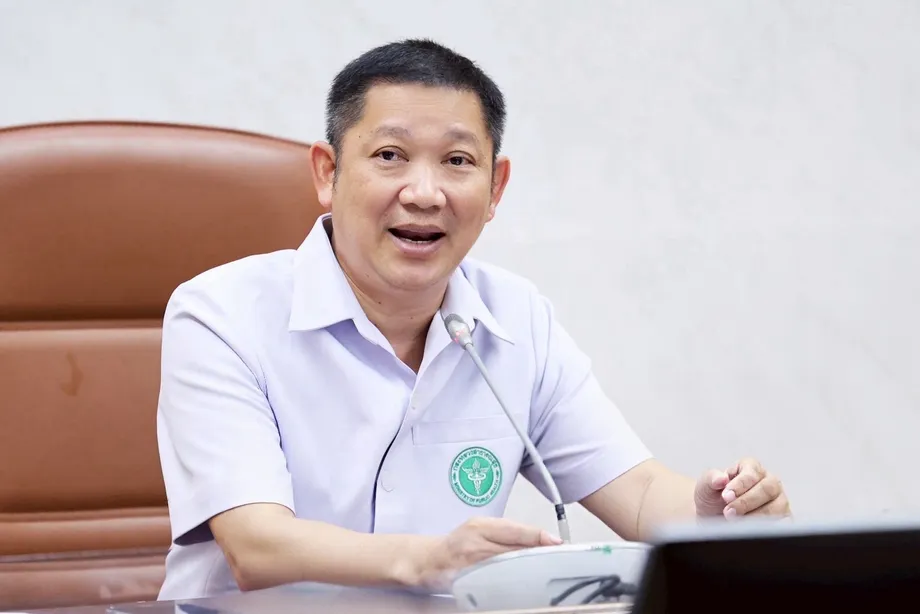
Public Health Minister Pattana Promphat described the Cabinet draft as limiting cannabis and cannabis extracts to treatment by medical professionals and research. He said it followed a regulatory impact assessment, which examines the likely effects of proposed rules, and public hearings.
Pattana explained the government's purpose in terms of public protection:
"This is to protect the health of people, especially children and youth, and prevent cannabis abuse," he said.
His account of the retail transition places stronger demands on ordinary dispensaries. Shops seeking renewal would need to meet medical facility requirements, including having a doctor based at the premises. Prescriptions would require a document signed by a doctor.
That leaves a distinction requiring clarification in the final rules. The forum account describes several authorised dispensing settings, while Pattana's comments focus on converting existing shops into medical facilities. The precise renewal conditions for each type of establishment have not been settled in the information released. Operators should not treat every description of the proposed system as an identical licensing route.
How cannabis would be traced from farms to prescriptions
Licence holders would have to maintain records of cannabis received and supplied, then report through a digital system every three months. Each batch would carry a Lot ID, an identifying code intended to connect its cultivation source with subsequent transactions and the prescription used to supply it to a patient.
This approach would make it possible to follow a batch rather than merely confirm that a shop holds a permit. Officials could compare what a farm produced, what a business received and what was dispensed. The planned central database would also show the coordinates of authorised shops and connect flower records with prescription systems and government applications used to verify patient identity.
Pattana said a map of shops and cultivation sites already contained about 10,000 locations, which he believed represented more than 95% coverage. Another account puts the registered total above 10,000. These figures combine retail and growing locations, so they cannot be directly compared with estimates of the number of dispensaries alone.
Reports of forged medical certificates and falsified Phor Thor 33 forms discovered in June 2026 show why prescription checks matter. Digital verification is intended to detect duplicate or invalid prescription codes. A registered seller and a valid batch number do not, by themselves, prove that the medical authorisation for a purchase is genuine.
Testing costs may outweigh the licence fee
The forum discussion identified a proposed licence fee of 3,000 baht for three years. That is much smaller than the reported cost of obtaining a certificate of analysis, or COA, which records laboratory test results for a cannabis sample. Small operators put that cost at between 10,000 and 20,000 baht per test.
Using those figures, one laboratory test would cost about 3.3 to 6.7 times the proposed three year licence fee. This comparison does not establish an annual compliance bill, because the testing frequency and number of samples required have not been specified. It does show why a modest permit fee would not necessarily make the new system affordable.
Growers also raised the cost of adapting farms to the GSCP cultivation standard discussed at the forum. Officials said requirements would be adjusted by plot size: small farms of no more than five rai, medium farms above five and up to 20 rai, and large farms above 20 and up to 400 rai. A rai is a Thai land measure equal to 1,600 square metres.
Those categories correspond to small farms of up to 0.8 hectares, medium farms above 0.8 and up to 3.2 hectares, and large farms above 3.2 and up to 64 hectares. The released account does not explain how holdings larger than 400 rai would be treated.
Officials suggested using government research institutions or the Department of Agriculture to help with analysis. Participants called for costs and standards to reflect business size and risk, with specific testing assistance for small operators. No confirmed subsidy amount, laboratory price schedule or testing timetable has been announced in these accounts.
Thousands of shops face a staged transition
Existing shop licences last three years, with expiry dates spread across 2026, 2027 and 2028. Pattana said businesses still trading under those licences would face the new requirements when applying for renewal. The change is therefore described as a transition through permit expiry, not an immediate closure of every ordinary cannabis shop.
Estimates suggest 5,000 to 6,000 licences expire in 2026, another 4,000 to 5,000 in 2027, and about 1,000 in 2028. These are reported estimates rather than a published licence register. Their combined range is 10,000 to 12,000, consistent with the broad scale of the retail market described in government comments, but not an exact count.
Estimates of active dispensaries also differ. Pattana put the total at about 11,000 earlier in the year, while an earlier ministry figure cited in another account was around 12,000. He projected that about 2,000 would meet clinic requirements within three years. Compared with 11,000, that would mean roughly 18% meeting the requirements, or about 82% fewer outlets if the projection became the final market count.
In separate comments, Pattana estimated that more than half of shops would need to become medical facilities to renew. These statements measure different things: the share needing conversion and the number expected to qualify. Neither is a confirmed closure total. Staffing, premises, laboratory costs and the final renewal rules will determine what individual businesses can do.
Age limits, advertising bans and enforcement powers
The Cabinet draft would prohibit sales to people under 20, pregnant women and breastfeeding women. It would also bar sales in specified locations, including temples, schools, dormitories, public parks, zoos and amusement parks. Advertising and promotion of cannabis flowers, resin and smoking equipment would be restricted.
A national committee chaired by the public health minister would set policy and supporting measures. The director general of the Department of Thai Traditional and Alternative Medicine would issue licences. Reported exemptions include sales of roots, stems, branches, leaves and seeds, as well as cannabis use by medical professionals for treatment.
The proposed penalties distinguish illegal commercial activity from misuse by consumers. Unlawful production, import, export and sale could bring imprisonment and fines, while cannabis misuse would attract fines only. The accounts do not provide the final penalty amounts or prison terms.
At the forum, officials described powers to inspect premises, collect samples, search where reasonable grounds exist, seize or freeze items, and request documentary evidence. They also described coordination involving more than 200,000 officials. That figure should not be read as a dedicated cannabis inspection force; the account concerns personnel brought together across enforcement arrangements.
Pattana said an order issued in the preceding three to four months designated officers from relevant agencies for inspections, including checks in tourist centres and major cities. He suggested that absence from the registration map could indicate an unregistered operation. A map entry is a useful screening tool, but the legal basis for action against an individual business would still need to be established.
A separate public bill has different rules
The government Cannabis Control Act is not the only proposal under consideration. Parliament's public bill consultation concerns a separate Cannabis and Hemp Bill submitted by Watcharapong Phumchuen and 17,343 eligible voters. Its consultation ran from July 7 to August 6, 2025. The listed status says consultation has closed and the bill awaits the prime minister's certification.
Parliament classifies that proposal as a money bill, making certification a procedural step before it can advance. Its consultation questions cover provisions in Sections 3 through 40. Those section references should not be confused with the government's reported 77 section draft.
The public proposal would separate cannabis licences from hemp licences and give licensing authority to the secretary general of the Food and Drug Administration, or an authorised delegate. That differs from the Cabinet draft's assignment of licensing to the traditional medicine department.
It also describes exemptions for medical facilities growing cannabis for their patients, subject to prior registration, and for patients or carers cultivating for an individual patient's treatment rather than commerce, subject to ministerial rules. A separate hemp exemption would protect established cultivation by ethnic communities producing fibre through traditional practices.
Its restrictions extend to possession for consumption, smoking, food containing cannabis or hemp ingredients, advertising, coercing others to consume cannabis and driving after consumption. It would allow courts to revoke a driving licence where specified cannabis consumption and driving caused another person's death. The proposal also addresses smoking or consuming nonmedical extracts in front of people under 18. These measures belong to the public bill, not automatically to the Cabinet draft.
Exports and ownership checks add pressure
Farmers and small businesses at the forum raised concerns about foreign investors using Thai nominees to gain access to the industry. Participants sought stronger ownership checks alongside assistance for legitimate local operators. The accounts identify this as a concern, but do not quantify how many businesses use such arrangements or set out the final ownership verification procedure.
The export licence category would provide another point of supervision. Earlier debate over the cannabis smuggling crackdown linked Thailand's expanding market with attempts to move cannabis to countries where it remains illegal. A Thai permit cannot replace the destination country's import authorisation.
A separate British case described in the September reporting involved four couriers sentenced over 460 kilograms of cannabis packed in 22 suitcases, with a stated value of £13.8 million. That case does not establish how much cannabis leaves Thailand unlawfully, but it illustrates why commercial export controls and checks on passenger baggage address different routes.
Forum participants also proposed developing cannabis medicines to reduce reliance on imported conventional drugs. That is an industrial and medical policy aim, not evidence that cannabis products can replace particular medicines. The accounts provide no clinical comparison or calculation of import savings.
The dates and decisions still to come
Thailand's policy debate follows the expansion of recreational sales after cannabis was removed from the narcotics list. Accounts differ on the date of that change: the forum narrative places it in Buddhist year 2564, equivalent to 2021, while the September reports and earlier coverage identify June 2022. The discrepancy should not be silently merged into a single chronology.
The main dated steps in the legislative process are:
- July 7 to August 6, 2025: Parliament held consultation on the separate public Cannabis and Hemp Bill.
- June 2026: Reports described discoveries of forged medical certificates and Phor Thor 33 forms.
- July 31, 2026: The Department of Thai Traditional and Alternative Medicine published its outline of the government draft.
- September 22, 2026: The Cabinet approved the Cannabis Control Act draft.
- October 6, 2026: The forum account places the 77 section draft before the Council of State for scrutiny.
- 2026 to 2028: Existing dispensary licences expire in successive groups.
The Council of State reviews draft legislation for legal consistency; Parliament must still consider and pass the bill. Reports following Cabinet approval describe the House of Representatives as the next legislative destination, while the forum account also identifies the legal review stage. Neither establishes a scheduled parliamentary vote.
Officials at the forum estimated one to two years for the full process, including more than 15 supporting regulations, and promised communication and adjustment time for farmers, businesses and the public. That estimate is not a fixed commencement date. Testing requirements, medical facility conversion, prescription verification and support for small farms remain central details to resolve before operators can calculate the cost of staying in the market.
Key Points
- The Cabinet approved a Cannabis Control Act draft on September 22, 2026; it is not yet law.
- The framework proposes seven licence categories, three year permits and quarterly digital reporting.
- Lot IDs would connect cannabis batches with cultivation records and patient prescriptions.
- The forum proposal limits flower dispensing to authorised establishments, with a prescription and a maximum 30 day supply.
- Reported laboratory costs of 10,000 to 20,000 baht per test exceed the proposed 3,000 baht licence fee.
- Existing shop licences expire across 2026 to 2028, with medical facility requirements expected to shape renewals.
- A separate public Cannabis and Hemp Bill has different licensing authorities and exemptions.
- Parliamentary approval and supporting regulations remain necessary, with no confirmed date for full implementation.