
Three Bangkok searches widen scrutiny of ownership and money
Thai investigators searched three Bangkok locations on October 8, 2026, expanding an inquiry into suspected nominee shareholders, property transactions and business funding. Documents concerning more than 61 companies were found at one address, while officials separately identified 33 businesses for examination over possible concealed foreign ownership.
Contents
- Three Bangkok searches widen scrutiny of ownership and money
- How the investigation reached Bangkok
- What makes a shareholder a suspected nominee?
- A small foundation office and a much larger corporate file
- Donations, construction funding and tax checks
- Employment allegations are separate from ownership questions
- Chabad denies a connection to the companies
- The Chon Buri charges and the wider property inquiry
- Island searches show the scale of the broader crackdown
- What remains undecided
- Key Points
The Department of Special Investigation (DSI), under the Justice Ministry, said operation Yuttharat examined links between individuals, companies, foundations, associations, assets and financial transactions. Its central questions are who actually controls the businesses, who benefits from them and whether their ownership and operations comply with Thai law.
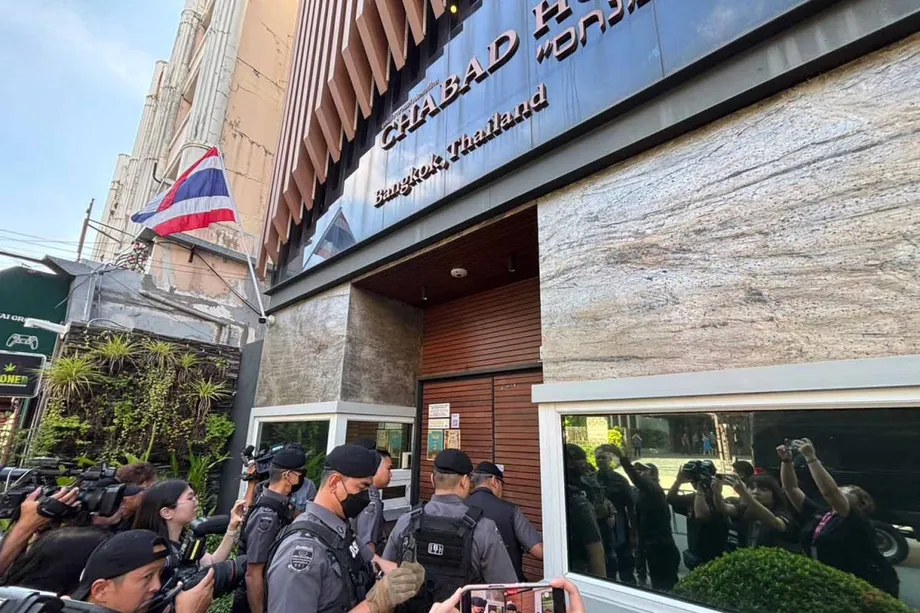
The searches covered the Chabad foundation on Phra Athit Road in Phra Nakhon district, Gan Chabad Co., Ltd. in Bang Rak district and the Jewish Association of Thailand on Sukhumvit 22 in Khlong Toei district. Justice Minister Rutthapol Naowarat said officers had obtained four search warrants for the operation.
The inquiry also reaches beyond company registrations. DSI financial investigator Keerati Boonchoti said investigators were examining foundation donations of approximately 100 million baht annually. Officials are reviewing land holdings, construction projects, tax records and the acquisition of Thai citizenship by some people appearing in corporate records.
These remain investigations, not findings of guilt. Officials have not established that the donations were unlawful, and the DSI statement did not accuse the religious institutions themselves of financial, property or business offences. No arrests of Israeli nationals were reported during the Bangkok operation. Separate proceedings were initiated against two employers over alleged employment of foreign workers without permits.
Chabad representatives said they cooperated with the inspections and denied that the companies documented at an accounting office belonged to their organisation. That distinction matters: shared addresses and repeated names can justify further checks, but do not by themselves establish an illegal ownership arrangement.
How the investigation reached Bangkok
The Bangkok searches followed several investigations into property and business ownership elsewhere in Thailand. Some belong to a specific DSI case in Chon Buri; others concern island businesses or Interior Ministry inspections of land and religious sites.
- July 10, 2026: The DSI searched five locations on Koh Samui and Koh Phangan after receiving information about 34 companies suspected of using Thai nominee shareholders.
- August 21, 2026: Investigators searched three Chon Buri locations under Special Case No. 135/2569, concerning Cosy Beach View Co., Ltd. and associated parties.
- September 2026: A separate inquiry examined Gan Chabad related businesses, land holdings and possible nominee arrangements following an investigation into a cemetery in Chachoengsao.
- October 7, 2026: The DSI said it formally notified Cosy Beach View, an Israeli director and a Thai shareholder of charges.
- October 8, 2026: The Bangkok searches expanded checks into corporate relationships, funding, property and employment.
- October 9, 2026: Details of the Department of Business Development examination identified two foreign entities and 33 additional businesses requiring explanations.
The DSI said evidence from Bangkok would help expand its investigation and would be forwarded to agencies empowered to consider action under the relevant laws.
What makes a shareholder a suspected nominee?
A nominee arrangement, in this investigation, means a Thai person allegedly holds shares on behalf of a foreign investor rather than acting as a genuine investor. Investigators therefore need to look beyond names in a company register to the source of investment money, control of decisions and the destination of profits.
The Department of Business Development (DBD) identified two foreign entities for closer examination. One had foreign shareholdings of 51%, with Thai shareholders holding 49%, and operated in property trading. The department described that activity as prohibited for foreigners under List One of the Foreign Business Act 1999.
The other company had foreign shareholdings of 99.99% and Thai shareholdings of 0.01%. It developed computer programs for customers, an activity officials placed within the service category under List Three. A search of the e-Foreign Business system found no relevant business licence or certificate.
The 33 businesses flagged for possible nominee arrangements had foreign shareholdings below 50%. Their activities included property rental, investment advice and tourism. A Thai majority on paper does not resolve whether Thai shareholders supplied their own investment or were holding shares for someone else.
DBD director general Kittiwat Patchimnan said directors and shareholders were being called to explain their investments and operations. The department also identified Thai shareholders connected to accounting offices who appeared as shareholders in several target companies. Those relationships are under examination, rather than established offences.
A small foundation office and a much larger corporate file
At the Phra Nakhon foundation, officials described the registered office as a room measuring about 2.5 by 3 metres, or 7.5 square metres. The same address was registered to five other companies.
Deputy Interior Minister Polapee Suwunchwee questioned the absence of records explaining the foundation and its activities at that location.
"There are many questions about why they were registered there. There was not a single document about the foundation, its operations, work processes, financial transactions or financial statements," Mr Polapee said.
Officials were told the records had been moved to an office in Bang Rak. There, investigators found foundation and association registrations, donation records, membership lists, land purchase and sale documents, construction files and tax filings. They also found records concerning Chabad House operations, restaurant licences and hotel or accommodation businesses.
Reports differ on the precise company count. The DSI described documents concerning more than 61 companies registered at the address, while other accounts gave the number as 61, approximately 50 of them associated with Israeli nationals. The premises were described as the 17th floor of ITF Tower, also identified as ITF Silom Palace.
Preliminary checks found the same people appearing as directors or shareholders across several companies, including people who had acquired Thai citizenship through naturalisation. Officials had previously said Gan Chabad itself was registered as a Thai legal entity and that its authorised directors held Thai citizenship. Questions about nominees concerned other companies and transactions still being examined.
Donations, construction funding and tax checks
Keerati Boonchoti, the DSI financial investigator, put annual donations to the Chabad Foundation at approximately 100 million baht. Investigators have obtained donor information and are tracing where funds came from and where they went.
The Anti-Money Laundering Office is examining whether transactions involve proceeds from illegal activity. Its involvement does not establish that money laundering occurred, and officials have not determined that the donations were unlawful.
Investigators are also examining funding for an eight storey Chabad House project in Bangkok and possible property ownership irregularities, including land in Phuket. These checks connect financial records with the buildings and land they may have funded.
The Revenue Department separately identified approximately 600 companies that may have paid tax incompletely. Officials described these as companies involving foreign nationals who obtained Thai citizenship through naturalisation. No companies were named and no findings were announced against them.
That figure should not be treated as a count of Chabad companies. Nor can it be added to the 33 businesses under DBD examination or the companies recorded at the Bang Rak address: officials have not established the overlap between those groups.
Acting Revenue Department director general Salakjit Pongsirichan said proven intent to evade tax carries imprisonment of three months to seven years and fines of 2,000 to 200,000 baht. She also said failures to file returns can affect business licence renewal. Those penalties describe possible consequences, not sentences imposed in this investigation.
Employment allegations are separate from ownership questions
The DSI said investigators found three Myanmar nationals at the Phra Nakhon foundation allegedly working without permits. Authorities also alleged that they had entered and remained in Thailand without authorisation.
The department cited the 2017 emergency decree governing foreign workers' employment, as amended, and the Immigration Act 1979. Proceedings were initiated against one employer at those premises for allegedly employing foreigners without work permits.
At the Jewish Association of Thailand, investigators found two Lao nationals allegedly working without permits. Proceedings were also initiated against an employer there under the foreign employment decree.
A separate account said officers identified approximately 40 foreign workers across the institutions and expected the three Myanmar nationals to be deported. That does not mean all 40 were accused of violations, and no completed deportations were reported.
Immigration officers also reported failures to register the stays of two Israeli nationals at Chabad premises and two Lao nationals at the Jewish Association. An accommodation registration failure is a different allegation from entering or remaining in the country illegally. The accounts do not establish that the Israeli nationals lacked permission to stay.
Chabad denies a connection to the companies
Rabbi Nechemya Wilhelm, the Chabad emissary in Bangkok, said staff cooperated fully and supplied the documents investigators requested. He said the records involving numerous businesses were found at an accountant's office that served multiple clients, rather than demonstrating Chabad ownership.
It is natural for an accountant to work with other companies," he said. "That does not mean they are our companies or companies connected to us.
Wilhelm said religious and community activities continued after the searches, with approximately 500 people expected for Shabbat.
We are continuing our activities as usual," he said. "About 500 people are expected to come here this Shabbat, and there is nothing preventing that.
Rabbi Yosef Chaim Kantor separately explained during the inspection that the foundation supported religious activities and tourists visiting Thailand. Officials said he had legally obtained Thai citizenship approximately 12 years earlier. Examining naturalisation records is therefore not the same as establishing that a person's citizenship was improperly acquired.
One account also described a search at the Beth Elisheva construction site in Sukhumvit. The Jewish Association manages that site, while Chabad oversees religious activities there. A replacement synagogue is being built after the original building was demolished because it could no longer accommodate community needs. The DSI's principal account listed three Bangkok locations, so the construction site should not automatically be counted as a separate fourth target.
The Chon Buri charges and the wider property inquiry
The clearest formal charges described by the DSI concern Cosy Beach View Co., Ltd. in Chon Buri, not the religious institutions searched in Bangkok. The department said three suspects were notified on October 7 under Special Case No. 135/2569.
The company was accused of operating as a foreign entity without required authorisation. An Israeli director was accused of knowingly consenting to the alleged offence or failing to take reasonable preventive measures while acting as a director or authorised representative.
A Thai shareholder was accused of unlawfully assisting, supporting or jointly conducting a foreigner's business. These allegations illustrate the inquiry's distinction between a company allegedly operating without permission and a Thai shareholder allegedly helping it do so. No convictions were reported.
The Interior Ministry is also examining a land purchase in Pattani worth nearly 100 million baht. Polapee said several members of parliament had raised concerns about companies associated with Israeli nationals buying the land. He planned to inspect ownership and intended use.
Polapee explained that the ministry wanted to establish the origin and purpose of the investment.
"We need to know where the money came from, what company is involved and what its intention is," he said.
The Pattani purchase value and the approximately 100 million baht in annual foundation donations describe separate matters. No financial connection between them has been established.
The ministry is reviewing approximately eight or nine Chabad sites nationwide, including a site in Krabi. Governors in southern provinces have been instructed to check construction permits, ownership and funding. In Phuket, operators were given 30 days to submit construction permits and related documents or face possible demolition. No exact deadline date was specified.
Island searches show the scale of the broader crackdown
The July operation on Koh Samui and Koh Phangan followed a DBD referral concerning 34 suspected nominee companies. Its five targets included businesses associated with both Chinese and Israeli nationals, showing that the wider enforcement effort extends beyond one nationality.
A villa development in Bo Phut on Koh Samui was linked to 15 land plots covering nearly 89 rai, valued at 1.57 billion baht. One rai equals 1,600 square metres, putting that land area at approximately 14.2 hectares. Investigators found shareholding, property transaction, construction and financial records.
The development was connected to at least five companies involved in property development, construction, marketing and sales. Officials said Chinese nationals participated in management and business decisions.
A law office on Koh Samui was linked to more than 150 companies. More than 100 held property and other assets worth approximately 795 million baht, while roughly 103 used the office address as their registered headquarters.
The villa development's stated land value was nearly twice that 795 million baht asset figure. The figures describe different groups and should not be combined into a total without establishing whether holdings overlap.
Other island searches examined businesses associated with Israeli nationals operating hotels, accommodation, wellness centres and rental properties. As in Bangkok, investigators focused on funding, effective control and whether Thai shareholders were genuine investors. Shared professional offices recur in both inquiries, but shared premises alone do not prove nominee ownership.
What remains undecided
The next steps include explanations from company directors and shareholders, examination of seized records and coordination between agencies. The operation involved business registration, revenue, land, immigration, employment, provincial administration, police and money laundering authorities.
Reports differ on participation totals, describing eight agencies, DBD working with nine other agencies, or more than 10 bodies. These accounts agree that the inquiry involves several separate legal responsibilities, rather than a single allegation applying to every organisation searched.
An Interior Ministry account said Bangkok inspections had so far found no irregularities. That statement sits alongside DSI reports of suspected employment offences and continuing corporate checks. It cannot be read as a final clearance of every business, worker or transaction examined.
No hearing date, trial date or deadline for the Bangkok company explanations was announced. Polapee said another meeting with the DSI was planned, without giving a date. The Phuket document requirement is the only specific response period reported.
Polapee said the investigation was not directed at a particular nationality. The DSI also said Thailand remained open to foreigners who reside, invest and conduct business lawfully, while warning against using Thai legal mechanisms to evade restrictions. The unresolved issue is whether particular ownership and funding arrangements breached the law, not whether foreign investment or religious activity is inherently unlawful.
Key Points
- The October 8 Bangkok operation searched three principal locations and expanded an investigation into ownership, funding, property and tax compliance.
- Documents concerned more than 61 companies at one address; DBD separately identified 33 businesses for possible nominee checks.
- Approximately 100 million baht in annual foundation donations is under examination, with no finding that the money was unlawful.
- Five Myanmar and Lao nationals allegedly worked without permits, and proceedings were initiated against two employers.
- Chabad denied a connection to the companies recorded at the accounting office and said religious activities continued.
- Three suspects in the separate Cosy Beach View case were notified of charges on October 7. No convictions were reported.
- Further reviews extend to island businesses, a Pattani land purchase and construction documentation in Phuket.