
A first solo flight from Surat Thani
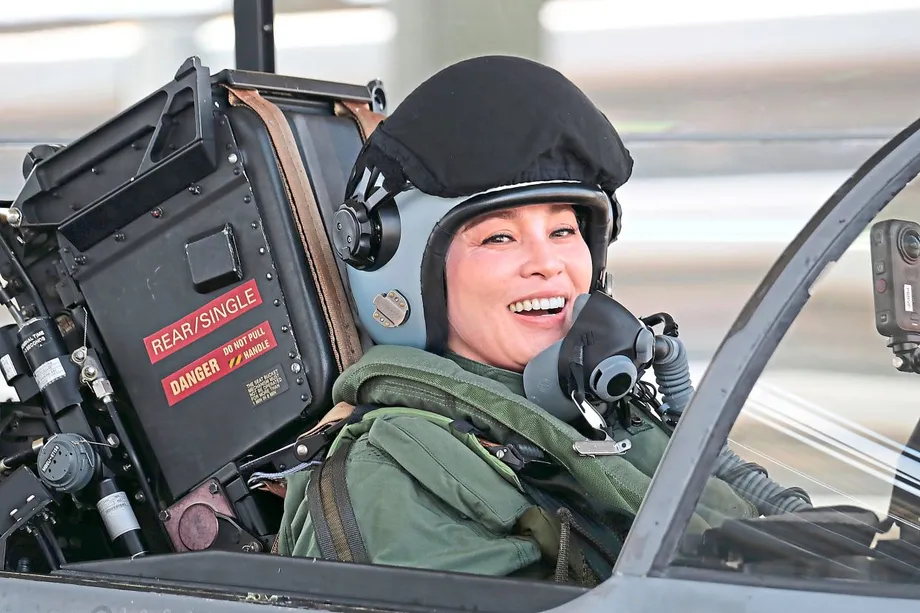
Queen Suthida of Thailand flew a Saab JAS 39C Gripen fighter alone for 41 minutes on 8 October 2026, taking off at 10:06 a.m. from Runway 22 at the Royal Thai Air Force's Wing 7 base in Surat Thani. The Bureau of the Royal Household identified her as Thailand's first female Gripen pilot, following a course that included 45 academic and emergency procedure subjects, 20 simulator sessions and supervised flying in the aircraft's version with two seats.
Contents
- A first solo flight from Surat Thani
- What happened before takeoff
- Four months from classroom to cockpit
- What the Gripen recognition means
- A flying career dating to 2010
- The flight hours contain an unresolved gap
- A royal flight using the regular squadron fleet
- Fifteen years of Thai Gripen operations
- Four newer fighters are due by 2030
- Key Points
King Maha Vajiralongkorn watched the flight at the base in Phun Phin district, alongside Royal Thai Air Force commander Air Chief Marshal Seksan Kantha and Wing 7 commander Group Captain Phasin Sombatthawee. After the Queen landed, the King presented her with flowers and attached a Golden Gripen Order Patch to her left sleeve.
The flight brought together two developments: the Queen's progression from light aircraft and royal passenger flights to a fighter cockpit, and Thailand's continuing investment in Swedish combat aircraft. She flew a Gripen C belonging to 701 Squadron, while Thailand is preparing to receive four newer Gripen E/F aircraft under an agreement signed in August 2025.
Suthida was 48 at the time of the flight, having been born on 3 June 1978. The 41 figure refers to the flight's duration in minutes, not her age. Reports making broader claims about a world first require more caution than the palace's specific description of her achievement in Thailand.
What happened before takeoff
The King arrived at Wing 7 at about 10 a.m., according to an account of the visit. A briefing covered the Queen's flight plan before the royal couple went to the aircraft's parking bay. Suthida inspected the Gripen herself, then taxied to Runway 22 for departure.
The aircraft had one seat, meaning no instructor was beside her during the sortie. One account says two other Gripens accompanied the flight. That does not conflict with its description as a solo flight: in aviation, solo means the pilot is the only person aboard the aircraft, not necessarily that no other aircraft are nearby.
The fighter carried special tail artwork marking 15 years of Gripen service in the Royal Thai Air Force. Wing 7 celebrated that anniversary on 20 July 2026, placing the Queen's flight in the same year as a milestone for the squadron that trained her.
No detailed account of the sortie's route, altitude or manoeuvres has been established here. The reported sequence describes the briefing, inspection, takeoff and landing, rather than a weapons exercise or combat mission.
Four months from classroom to cockpit
The Queen undertook the Gripen conversion course at the air force's invitation. A conversion course teaches an already trained pilot to operate a different aircraft type, including its systems, controls and emergency responses. Her previous flying experience did not remove the need for training specific to the fighter.
The palace account places the start of academic instruction in June and July 2026, with 45 subjects covering aircraft operations and emergency procedures. Twenty simulator sorties followed, with some simulator training reported at Don Mueang in Bangkok. Flying at Wing 7 began on 20 August, rather than marking the beginning of the entire course.
The reported training sequence was:
- June and July 2026: academic study and emergency procedure exercises covering 45 subjects.
- Before progression to aircraft training: 20 simulator sorties, including reported sessions at Don Mueang.
- 20 August to 4 September: the first training block at Wing 7.
- 25 September to 8 October: the second training block at Wing 7.
- 8 October: the 41 minute solo flight in a JAS 39C.
Between simulator work and the solo sortie, Suthida flew with air force instructors in the JAS 39D, which has two seats. One detailed account gives that supervised time as 10 hours and 13 minutes. Other reports reproduce a figure of 10.13 hours, a notation that should not automatically be treated as equivalent to 10 hours and 13 minutes.
What the Gripen recognition means
After landing, the Queen received the Golden Gripen Order Patch awarded by the Gripen Order, a Swedish honorary aviation association. The palace account says the association accepted her as a full member, recognising that she had flown and controlled the Gripen herself.
The recognition marks a specific flying achievement. It does not, by itself, establish that she completed every phase required for operational combat duties. Reports describe the solo as the culmination of her conversion training, but do not establish whether she will proceed to advanced instruction in using the aircraft's weapons and carrying out combat missions.
That distinction matters because operating a fighter alone and employing it in combat are different stages of training. The first requires safe control of the aircraft and its systems. Combat instruction adds the use of sensors, weapons and tactics alongside other aircraft.
The palace's description, Thailand's first female Gripen pilot, is narrower than claims that she was the first royal or first queen anywhere to fly a fighter solo. Those wider claims have not been verified. Suthida is a queen consort, the wife of the monarch, rather than a queen regnant who holds the throne in her own right, so describing her as a reigning queen is also inaccurate.
A flying career dating to 2010
Suthida's first flight was on 13 May 2010 in a Cessna T-41D with 604 Squadron at Wing 6 in Bangkok. Her subsequent experience spans light aircraft, military trainers, passenger jets and now the Gripen. The palace reported a total of 1,188.48 flying hours before the solo sortie.
Her aviation career followed work as a flight attendant, including service with Thai Airways. She studied communication arts at Assumption University, entered military service in 2010 and became deputy commander of the King's Guard Battalion in 2012. She married King Vajiralongkorn in May 2019, shortly before his coronation.
Reports describe German private and commercial pilot qualifications, a Boeing 737 type rating and a Thai airline transport pilot licence. A type rating is a qualification to fly a particular aircraft type or an approved group of related models. The Thai aviation authority reportedly renewed her rating covering Boeing 737 models from the 737-300 to the 737-900 in September 2026.
She has served as co-pilot alongside the King on domestic and international royal flights aboard Boeing 737-400 and 737-800 aircraft. Those duties included the royal visit to Bhutan in April 2025, when the couple flew into Paro, an airport known for its demanding terrain and approach.
The flight hours contain an unresolved gap
The detailed aircraft breakdown gives a more precise picture of her experience than the rounded description of nearly 1,190 hours. The published entries are:
- Cessna T-41: 315.33 hours.
- CT-4E Airtrainer: 38.35 hours.
- Pilatus PC-9: 105.59 hours.
- Mooney M20M: 98.40 hours.
- Piper PA-34 Seneca: 137.50 hours.
- Boeing 737-400: 27.09 hours.
- Boeing 737-800: 453.11 hours.
- JAS 39D Gripen: 10.13 hours.
Read as decimal hours, these eight entries add up to 1,185.50 hours, which is 2.98 hours below the stated total of 1,188.48. The reason for that difference has not been explained. The separate description of Gripen training as 10 hours and 13 minutes also leaves uncertainty about how that entry was recorded.
The two Boeing entries total 480.20 hours when read as decimals, about 40.4% of the stated 1,188.48 hour total. That comparison shows how much of her recorded experience came from passenger jets, even though her flying began on smaller aircraft.
Some accounts also say she trained in the L-39 jet trainer. That aircraft does not appear in the palace's published hours breakdown, and the claim has not been confirmed. It should therefore be kept separate from the eight aircraft types with listed hours.
A royal flight using the regular squadron fleet
A separate account of preparations says the Queen asked the air force not to reserve a particular Gripen exclusively for her use. She reportedly trained in three aircraft across the C and D variants and was willing to fly whichever aircraft was assigned.
The reported reason was to keep the aircraft available for normal 701 Squadron duties. Designating one as a permanent royal aircraft, the account says, might have discouraged other pilots from using it. This detail describes her reported request, rather than a publicly documented change in fleet policy.
Wing 7 houses 701 Squadron's 11 Gripen C/D fighters and 702 Squadron's two Saab 340 airborne early warning and control aircraft. The latter carry radar equipment that helps crews detect and track activity over a wider area, then share information with other aircraft.
The Gripen C is the version with one seat, while the D has two. Moving from instructor flights in the D to a solo in the C was therefore a concrete change in responsibility: the Queen had to operate the fighter without another pilot in the cockpit.
Fifteen years of Thai Gripen operations
Thailand's Gripen fleet entered service in 2011. The more detailed acquisition history describes an initial order for six aircraft in 2008, followed by six more in 2010. The first six arrived in February 2011 and the remaining six in 2013.
Reports differ on that history. One says Thailand received all 12 aircraft in 2011, while another describes the 12 as ordered in 2008. The account separating the two orders and delivery batches distinguishes the start of service from completion of the fleet. A Thai account also refers to a procurement project approved in 2010 to replace ageing F-5 aircraft.
The original fleet comprised eight Gripen C aircraft and four Gripen D aircraft. A Gripen C crashed in January 2017, killing its pilot and leaving 11 aircraft. That is one fewer than the 12 delivered, a reduction of about 8.3% in the original fleet.
The aircraft are also operational assets rather than ceremonial equipment. Gripens participated in the 2025 border clashes with Cambodia, with one account describing deployments to Korat Air Base, about 130 kilometres from the border, and strikes on Cambodian targets. The Queen's flight took place within that wider military setting, but was reported as a training sortie.
Four newer fighters are due by 2030
Thailand signed an agreement in late August 2025 for three Gripen E aircraft and one Gripen F with two seats. These are newer variants than the Gripen C/D fleet at Wing 7. Saab has stated that deliveries under the agreement will take place by 2030.
In May 2026, an air force delegation led by Air Chief Marshal Seksan reviewed the start of assembly of the first Thai Gripen E at Saab's facility in Linköping, Sweden. That gives the acquisition a reported production milestone beyond the signing of the contract.
Reports differ on the agreement's value, giving either about US$500 million or about US$556 million. The difference is US$56 million, but there is no established explanation for it. Air Chief Marshal Napadet Dhupatemiya separately estimated a per aircraft cost of US$86 million, excluding logistics support and associated expenses. That estimate is not directly comparable with a complete contract price.
The newer aircraft are intended for 102 Squadron to replace older F-16s. Accounts also differ on the eventual scale of that acquisition: one describes a plan for 12 Gripen E/F aircraft, while another says more than 12. Neither description changes the confirmed initial order of four.
Saab congratulated the Queen and highlighted the longstanding defence relationship between Sweden and Thailand. The solo flight provides a visible moment in that relationship, while the next stated procurement deadline is delivery by 2030. No date has been announced for further Gripen training by the Queen or a decision on her participation in advanced combat instruction.
Key Points
- Queen Suthida, 48, completed a 41 minute solo Gripen C flight at Wing 7 on 8 October 2026.
- The palace identified her as Thailand's first female Gripen pilot; broader world first claims are unverified.
- Her course included 45 subjects, 20 simulator sorties and about 10 hours of supervised Gripen D flying.
- The King presented flowers and a Golden Gripen Order Patch after she landed.
- The published aircraft hours do not exactly match the stated total of 1,188.48 hours.
- Thailand operates 11 Gripen C/D fighters and has ordered three Gripen E aircraft and one Gripen F for delivery by 2030.
- Reports differ on the new contract's value and the size of the eventual planned fleet.