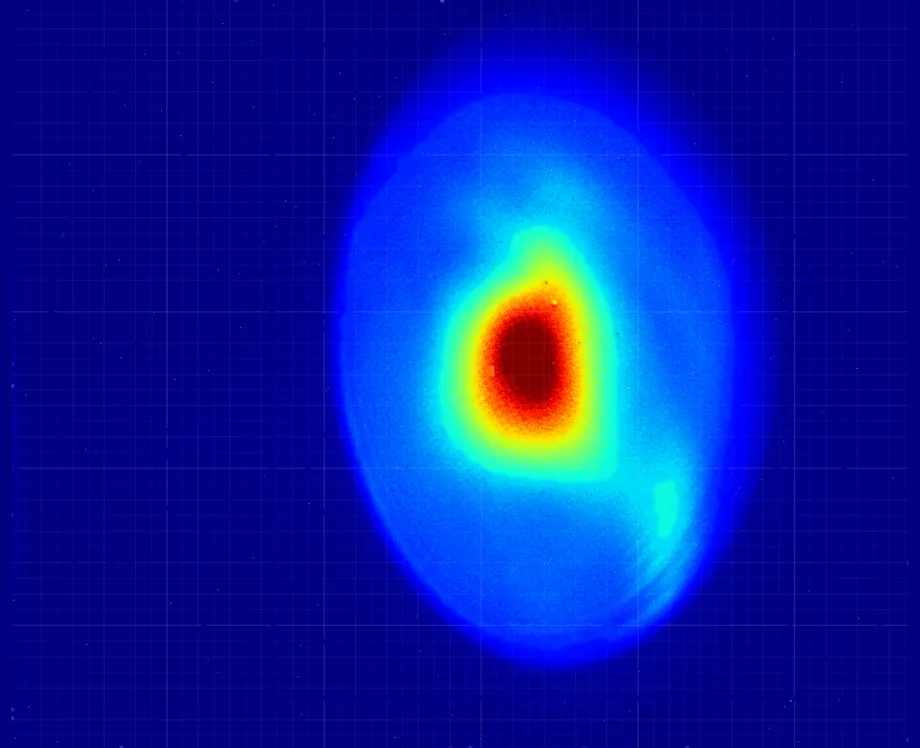
A 4 GeV beam brings a major Shanghai project closer to operation
China's SHINE research facility in Shanghai has produced its first free-electron laser light using an electron beam at 4 gigaelectronvolts (GeV), half the energy planned for the completed accelerator. ShanghaiTech University announced the breakthrough on October 21, marking a major step toward the project's target of completion and operation by the end of 2027.
Contents
- A 4 GeV beam brings a major Shanghai project closer to operation
- How moving electrons produce an X-ray laser
- Three beamlines, with different energy ranges
- What scientists could see with such short pulses
- More control over the light itself
- A 100-petawatt laser for extreme conditions
- Coordinating a machine more than 3 kilometers long
- Who is building SHINE, and what comes next
- Key Points
The first light was generated with 18 undulator modules, each 4 meters long and containing a magnetic pattern that repeats every 55 millimeters. Together, those modules provide 72 meters of magnetic structures that steer fast electrons along a winding path, causing them to emit light that builds into an intense laser pulse.
SHINE, short for Shanghai High repetition rate XFEL and Extreme light facility, is designed to help scientists examine structures at the scale of nanometers and changes lasting femtoseconds. A nanometer is one billionth of a meter; a femtosecond is one millionth of one billionth of a second. Those scales allow researchers to investigate the tiny structures and rapid movements of atoms and molecules.
Construction began in April 2018. When complete, the superconducting linear accelerator is expected to reach 8 GeV, with some operating modes delivering up to one million X-ray pulses per second. The first two undulator lines are expected to cover photon energies from 0.2 to 15 kiloelectronvolts (keV).
The immediate achievement is the production of laser light during commissioning, the process of bringing equipment into working order and checking its performance. Routine experiments for visiting researchers remain part of the planned transition to operation in 2027. ShanghaiTech has not announced an exact opening date or an application schedule for researchers.
How moving electrons produce an X-ray laser
SHINE starts with electrons rather than the light producing material found inside many familiar lasers. Its linear accelerator gives those electrons energy, then sends them through undulators, where alternating magnetic fields make them move from side to side and radiate.
The electrons and the radiation interact as they travel through successive modules. Under suitable conditions, the electrons arrange themselves into tiny groups that emit together, strengthening the light into a powerful pulse. The energy of the electrons and the spacing of the magnetic structures help determine the energy of the resulting photons, the individual packets that make up light.
The 4 GeV figure describes the electron beam used for first light. The 0.2 to 15 keV range describes the photons expected from the first two lines. These are measurements of different parts of the machine: GeV refers here to the particles driving the process, while keV refers to the X-rays delivered for experiments.
SHINE uses a continuous wave superconducting accelerator. Superconducting components operate at very low temperatures and carry electrical currents with very little resistance. Continuous wave operation allows the accelerator's radio frequency fields to operate continuously, supporting frequent electron bunches rather than relying on widely separated bursts.
Three beamlines, with different energy ranges
The broader first phase is larger than the equipment used in the first light milestone. The project's 2024 progress paper, presented at the International Particle Accelerator Conference, describes three undulator lines, three X-ray transport beamlines and 10 experimental stations, covering a baseline photon energy range of 0.4 to 25 keV.
FEL-I is designed for 3 to 15 keV, FEL-II for 0.4 to 3 keV, and FEL-III for 10 to 25 keV. FEL-II produces the lowest energy, or softest, X-rays. The other two lines produce harder X-rays, which have greater photon energy and shorter wavelengths.
The latest announcement's 0.2 to 15 keV range concerns the first two lines. The wider 0.4 to 25 keV baseline includes FEL-III. The 2024 paper also describes an added bypass that would deliver a 5 GeV electron beam to FEL-II, extending its output down to 0.2 keV.
The same paper specifies 42 planar undulators for FEL-I and 32 for FEL-II, plus four downstream undulators that can adjust polarization, the direction in which the light's electric field oscillates. The 18 modules used for first light represent one commissioning configuration within this larger planned installation.
Performance also varies by line. The design gives FEL-I and FEL-II pulse durations of about 30 femtoseconds and repetition rates up to 1 MHz, meaning one million pulses per second. A 2023 technical study lists FEL-III at up to 0.1 MHz, or 100,000 pulses per second.
What scientists could see with such short pulses
Life science, quantum materials and future energy research are among SHINE's intended uses. The combination of small spatial scales and very short exposures is central to those ambitions: researchers want to learn both how matter is arranged and how that arrangement changes.
A short X-ray pulse can capture a stage in a rapid process. Repeating an experiment with different delays between starting the process and probing it can help researchers assemble a sequence of changes, much like separate frames forming a movie. Frequent pulses provide more opportunities to collect measurements, which can be especially useful when individual signals are weak.
The initial experimental stations are planned to use coherent diffraction imaging, ultrafast X-ray spectroscopy, photoelectron measurements and serial femtosecond crystallography. Diffraction imaging reconstructs structure from the pattern made when X-rays scatter from a sample. Spectroscopy examines how matter absorbs or emits radiation, revealing information about its electronic structure.
Serial femtosecond crystallography collects diffraction patterns from many tiny crystals exposed to very short pulses. Photoelectron techniques measure electrons released by light, helping researchers investigate how electrons behave inside materials. Together, the planned methods give SHINE several ways to connect microscopic structure with rapid physical or chemical changes.
More control over the light itself
SHINE's soft X-ray line is being designed to offer several operating modes, rather than a single type of pulse. A 2023 beamline study published in Frontiers in Physics describes self-amplified spontaneous emission, self-seeding, external seeding and polarization control as its baseline options.
In self-amplified spontaneous emission, commonly shortened to SASE, the laser grows from the electrons' own initial radiation. Seeding instead uses a more controlled starting signal. Self-seeding filters part of the X-ray radiation and uses it to drive further amplification; external seeding begins with a separate laser. These methods aim to produce light with a more precisely controlled spectrum and timing structure.
The study describes a soft X-ray radiator with 32 modules, each 4 meters long, using a main magnetic period of 55 millimeters. Fourteen upstream modules were designed with switchable periods of 55 and 75 millimeters. That flexibility supports different operating conditions and techniques for converting a seed laser's radiation to shorter wavelengths.
Some related technology had already been tested at the separate Shanghai soft X-ray Free-Electron Laser facility, known as SXFEL. The study records lasing at the 47th and 54th harmonics using echo-enabled harmonic generation, a method that organizes electrons to emit at multiples of a seed laser's frequency. It also records a signal at the 61st harmonic.
A monochromator, an optical instrument that selects a narrow range of photon energies, was tested at SXFEL at the end of 2022. It achieved resolving power above 5,300 at 520 electronvolts. Such development work supports the effort to deliver more precisely selected X-ray pulses at SHINE. The study also discusses future possibilities including pulses lasting attoseconds, each one thousand times shorter than a femtosecond.
A 100-petawatt laser for extreme conditions
SHINE also plans a Station of Extreme Light that would combine its free-electron laser with an ultrashort laser rated at 100 petawatts. The project describes this as the world's first experimental station combining a laser of that power with a free-electron laser.
A petawatt is one quadrillion watts. The 100-petawatt figure refers to the peak power during an extremely brief pulse. Concentrating energy into such a short interval creates powerful electromagnetic fields for experiments on matter under extreme conditions.
The 2024 progress paper identifies strong field quantum electrodynamics as a research goal for the station. Quantum electrodynamics describes how light and electrically charged particles interact. Extremely strong fields allow researchers to investigate that interaction in conditions far beyond those encountered in ordinary laboratory experiments.
The combined installation is also intended to support high energy density physics, which studies matter with a large amount of energy concentrated into a small volume. Bringing an intense optical laser and an X-ray probe into the same experiment would let researchers create extreme conditions and examine what happens within them.
Coordinating a machine more than 3 kilometers long
SHINE extends approximately 3.1 kilometers and is built about 29 meters underground. Its scale makes timing, equipment control and rapid protection essential parts of the scientific instrument, alongside the accelerator and magnets.
A control system paper in Nuclear Engineering and Technology describes a system intended to control up to 10,000 devices. These include power supplies, lasers, vacuum equipment and other components spread across the accelerator complex.
The system uses the Experimental Physics and Industrial Control System framework, known as EPICS, to connect equipment controls with operator interfaces, data collection and monitoring. A timing network based on White Rabbit technology distributes clock signals across the facility. The injector timing system had been installed and successfully used, distributing signals at 1.003086 MHz.
Machine protection is another demanding task. The design monitors about 5,000 fault signals and uses programmable electronics to reduce or stop the beam when equipment conditions require it. The paper gives response times below one microsecond within a station and below 30 microseconds between stations. Rapid protection helps limit damage if a powerful beam travels outside its intended conditions.
At the time that paper was submitted, only the injector was operationally functional and the full accelerator control system was still being developed. The subsequent first light announcement marks a later stage in commissioning. Integrating the accelerator, radiation transport, protection systems and experimental stations remains central to the planned transition into routine scientific use.
Who is building SHINE, and what comes next
ShanghaiTech University is the legal entity responsible for construction. Its duties include project planning, engineering oversight, quality and safety management, and future operation and open access. It is also responsible for civil engineering, five experimental stations and part of the beamline construction.
The Shanghai Advanced Research Institute of the Chinese Academy of Sciences is responsible for the accelerator, undulators, utilities and some beamlines. The Shanghai Institute of Optics and Fine Mechanics is building the extreme photophysics beamline station. This division places the accelerator, experimental equipment and future user operation across several institutions.
The project's published milestones show the progression from underground construction to beam commissioning:
- April 2018: Civil construction began in Shanghai.
- End of 2022: A monochromator test at SXFEL achieved resolving power above 5,300 at 520 electronvolts.
- April 2023: Installation of SHINE's injector began.
- End of 2023: All shafts and tunnels had been completed, according to the 2024 progress paper.
- October 21 announcement: ShanghaiTech disclosed first light using a 4 GeV electron beam and 18 undulator modules.
- End of 2027: SHINE targets completion and operation.
Earlier technical schedules evolved as construction advanced. The 2023 beamline study anticipated FEL-II commissioning in spring 2025. The 2024 progress paper described first lasing by the end of 2025 as possible but challenging, while expecting user experiments in 2027. The latest announcement gives the end of 2027 as the completion and operation target.
SHINE is described as one of two facilities of this particular type combining frequent pulses with hard X-ray free-electron laser capability. The other is the Linac Coherent Light Source II high energy upgrade under construction in the United States. For researchers, the practical value of the Shanghai project will come from access to its planned energy ranges, pulse modes and experimental stations once commissioning is complete.
Key Points
- SHINE has achieved first light in Shanghai using a 4 GeV electron beam and 18 undulator modules.
- The completed accelerator is designed to reach 8 GeV, twice the electron energy used for this milestone.
- The first two lines are expected to cover 0.2 to 15 keV; the broader three line baseline extends to 25 keV.
- Some operating modes aim to deliver one million X-ray pulses per second, with pulses lasting tens of femtoseconds.
- The first phase plans 10 experimental stations, including a station combining X-rays with a 100-petawatt laser.
- ShanghaiTech University leads the project, with completion and operation targeted for the end of 2027.