Two flares point to one surviving star
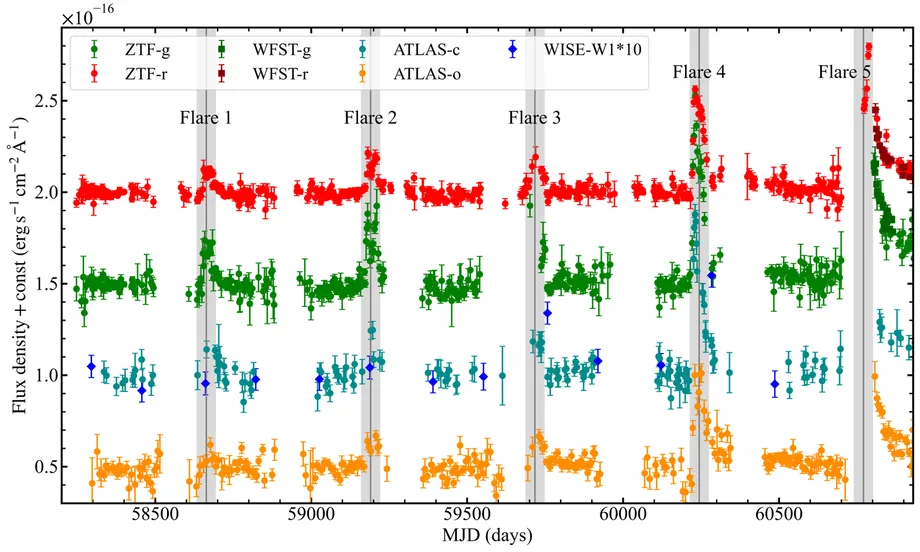
A star appears to have survived a close encounter with a supermassive black hole, only to return and lose more of its material. Astronomers at the University of Science and Technology of China (USTC) identified the repeated event, AT 2022dbl, after it began brightening again in January 2024. Their strongest clue was a striking similarity in the light emitted during its two flares.
Contents
The findings were published on August 9, 2024, in The Astrophysical Journal Letters. In its research announcement, USTC described AT 2022dbl as the first repeated partial tidal disruption event confirmed through spectroscopy, the study of light separated into its component wavelengths.
A tidal disruption event, or TDE, happens when a star passes close enough to a massive black hole for gravity to tear material from it. The material produces a bright flare as it moves toward the black hole. In a partial disruption, some of the star survives, making another encounter possible.
AT 2022dbl matters because the researchers obtained more than a record of an object becoming bright twice. The two flares displayed closely matching emission features, including those associated with nitrogen. Those features support the team's conclusion that the material involved in both episodes very likely came from the same star.
The discovery also changes how astronomers may interpret apparently ordinary stellar disruptions. According to the team, each of AT 2022dbl's flares looked like a typical TDE when considered on its own. Following the object over time revealed a more complicated story: a star apparently losing material in successive encounters, rather than disappearing in a single event.
How a black hole can strip a star
A black hole pulls more strongly on the side of a nearby star closest to it than on the side farther away. When that difference becomes strong enough, it stretches the star and can tear away stellar material. This difference in gravitational pull is the tidal force behind the event's name.
The word accretion describes material gathering around and moving toward an object under gravity. In a TDE, stellar debris becomes hot and releases radiation during that process. Astronomers detect the resulting flare, which provides a way to investigate an encounter happening far beyond the reach of direct observation.
USTC explains that a typical TDE brightens rapidly over tens of days, then fades over months or years. A partial disruption can follow a similar pattern. Its distinctive feature is the surviving star, which may remain on an orbit that brings it close to the black hole again.
For AT 2022dbl, the researchers interpret the renewed flare and matching spectra as evidence of that repeated process. The light carries information about the material being stripped away, while the return to brightness shows that the activity resumed.
Why the matching spectra matter
A spectrum separates light by wavelength, much as a prism spreads visible light into different colors. Atoms and ions produce features at particular wavelengths. Astronomers use these features to investigate the composition and physical conditions of the material producing the light.
The two AT 2022dbl flares had extremely similar emission line characteristics. USTC highlighted features indicating an unusually high abundance of elements associated with nuclear reactions inside stars. Among the matching features were N III emission lines, produced by nitrogen atoms that have lost two electrons.
The research team interpreted this chemical resemblance as a key indication that both episodes involved material from the same star. Their reasoning connects the timing of renewed activity with the composition revealed by the light: the object flared again, and its emission carried a closely matching chemical signature.
Earlier candidates for repeated tidal disruption had mainly been supported by light curves, which plot brightness over time. USTC said those cases lacked comparably strong evidence beyond their changing brightness and had not gained broad acceptance. AT 2022dbl added a spectral comparison between the flares, giving the repeated partial disruption explanation a firmer observational basis.
How the second flare was caught
The USTC team had been regularly updating the light curves of known tidal disruption events, looking for renewed activity. That continuing attention allowed the researchers to recognize AT 2022dbl's brightening in January 2024 and arrange observations while the new flare was still developing.
They triggered monitoring with the Swift satellite and the Las Cumbres Observatory Global Telescope network, known as LCOGT. Those observations measured the event in multiple wavelength bands, giving the team a broader record of its changing radiation than a single band could provide.
The researchers also obtained a high quality early spectrum with the Hale telescope, known as P200, at Palomar Observatory in the United States. That spectrum helped identify the new outburst as a tidal disruption event and enabled the crucial comparison with the first flare.
The main steps were:
- January 2024: The team detected renewed brightening from AT 2022dbl and began observations with Swift, LCOGT and Palomar's Hale telescope.
- August 9, 2024: The study was published in The Astrophysical Journal Letters under the title The Unluckiest Star: A Spectroscopically Confirmed Repeated Partial Tidal Disruption Event AT 2022dbl.
Detecting the return early mattered because a flare changes as it develops. Rapid observations gave the researchers a spectrum from the early stage of the second episode, alongside measurements tracking how its brightness evolved.
A possible origin in a pair of stars
The researchers propose that the surviving star may originally have belonged to a binary system, meaning two stars orbiting one another. A close encounter with the black hole could have separated the pair and left one star bound to the black hole.
In that explanation, the captured star follows an ellipse with very high eccentricity. Eccentricity describes how stretched an orbit is: a nearly circular orbit keeps an object at a fairly steady distance, while a highly elongated one takes it much farther away before bringing it close again.
Each close passage could then expose the star to strong tidal forces, stripping away more material and producing another flare. This offers a physical explanation for how a star could survive one encounter and later return to lose material again.
The binary origin and proposed orbit remain the team's interpretation of the observations. The announcement gives no confirmed date for another flare. Continued monitoring would allow astronomers to look for further activity and compare any future episode with the first two.
What changes for studies of stellar disruption
AT 2022dbl presents a practical problem for astronomers who classify these events: a flare from partial stellar disruption can look like one from an ordinary TDE. The researchers said the behavior of each episode was indistinguishable from that of typical events.
Studies that observe only one flare may therefore include surviving stars among objects interpreted as having undergone a single disruption. USTC said research on optical TDEs has largely overlooked repeated partial disruptions, while this discovery suggests such events may be more common than previously assumed.
The difference matters when researchers count events and study how stars lose material near black holes. A population containing stars that return repeatedly has a different history from a population in which each flare represents a separate star's final encounter. AT 2022dbl gives researchers a concrete case to examine when reconsidering those counts and physical models.
The observing strategy is equally relevant. Regular checks of known objects can reveal activity that a discovery observation alone would miss. In this case, the combination of continued brightness measurements, a rapid response and spectroscopy produced the central evidence.
The team and the search for more examples
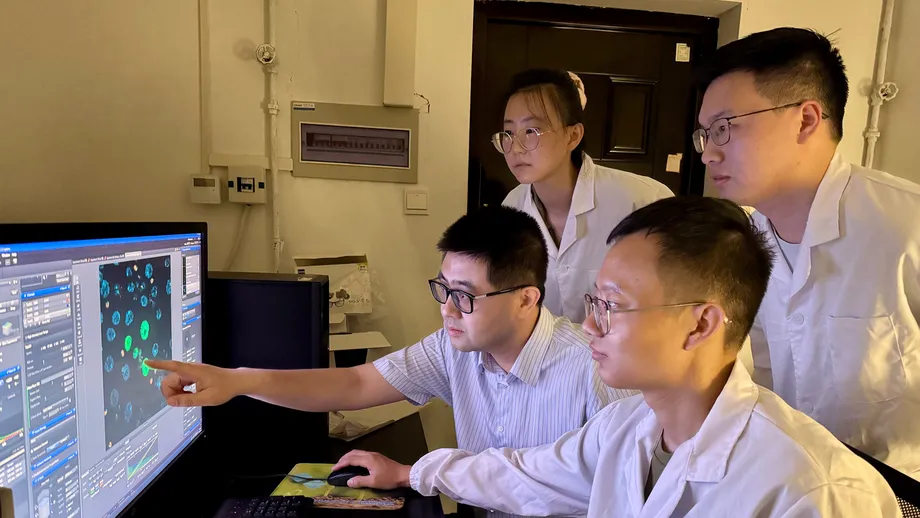
The paper's first author is USTC doctoral student Zheyu Lin, jointly supervised by Professor Xu Kong and Associate Researcher Ning Jiang. Jiang, Professor Tinggui Wang and Kong are the corresponding authors. Collaborating institutions include the National Astronomical Observatories of the Chinese Academy of Sciences, Wuhan University, Hiroshima University, Kyoto University and the Indian Institute of Astrophysics.
The project received support from organizations including the National Natural Science Foundation of China, the Ministry of Science and Technology, the Chinese Academy of Sciences, China's human spaceflight program, the Tang Foundation and Anhui provincial authorities.
The researchers expect to use the Wide Field Survey Telescope, or WFST, also known as the Mozi Survey Telescope, to find more events like AT 2022dbl. USTC and the Purple Mountain Observatory jointly developed the telescope, and tidal disruption events are among its core scientific targets.
Finding additional examples would give astronomers more stars and flares to compare. AT 2022dbl shows the value of combining searches for new events with continued attention to known ones: an object that has faded may still have another observable episode ahead.
Key Points
- USTC researchers detected renewed brightening from AT 2022dbl in January 2024.
- Similar spectra from two flares support the conclusion that a black hole stripped material from the same star twice.
- The team describes it as the first repeated partial tidal disruption event confirmed through spectroscopy.
- Swift, LCOGT and Palomar's Hale telescope supplied observations of the second flare.
- The study was published on August 9, 2024, in The Astrophysical Journal Letters.
- The researchers propose a captured star on an elongated orbit and plan to seek more examples with WFST.