Two objects found 10 kilometres apart
Two large metal objects discovered on October 19 and 20, 2026, in an oil palm plantation in Indonesia's Central Kalimantan are suspected debris from a Chinese ZhuQue-2E rocket, according to the National Research and Innovation Agency (BRIN). The second object, a dome roughly four metres across, was found about 10 kilometres from the first.
Contents
- Two objects found 10 kilometres apart
- What plantation workers discovered
- How BRIN connected the debris to a rocket
- From launch to recovery
- What ZhuQue-2E carried into space
- Why a rocket body returns to Earth
- Why the landing point is difficult to predict
- A similar discovery in Minnesota
- Earlier debris events in Indonesia
- Key Points
BRIN's analysis places the suspected rocket body near Sampit at about 17:36 Western Indonesian Time (WIB) on October 18, travelling from north to south. Residents heard a boom and rumbling that afternoon. Plantation workers found torn metal the following morning.
Thomas Djamaluddin, a senior researcher in astronomy and astrophysics at BRIN, said the objects probably came from the same rocket. The suspected body carries the tracking number NORAD 101070 and the international designation 2026-234L, identifiers that allow researchers to distinguish it from other objects in orbit.
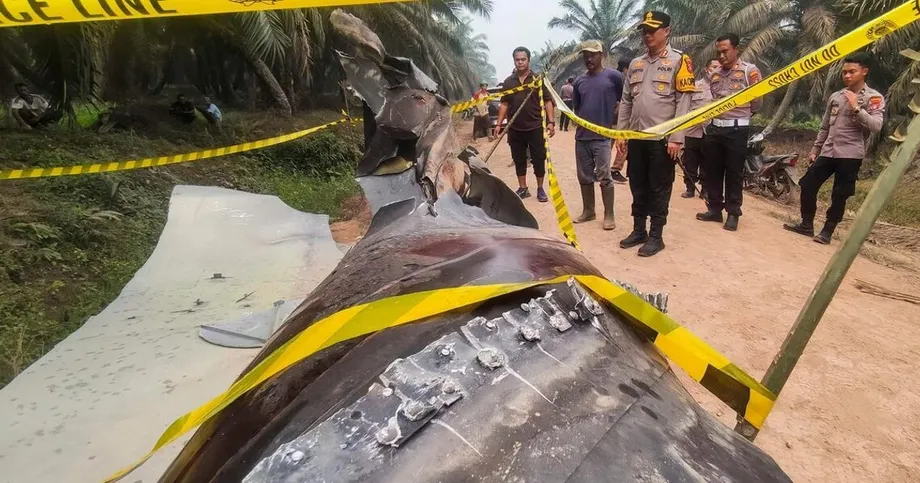
The first fragment has been moved to Iskandar Air Base in Pangkalan Bun for further identification. Police cordoned off the location of the second discovery. BRIN says a physical examination comparing the objects' shape, materials and markings with rocket specifications is still needed to confirm their identity.
What plantation workers discovered
PT Agro Bukit's plantation at Kilometre 26 in Kotawaringin Timur regency became the focus of the investigation after an employee spotted the first object while passing through block G38-39. The worker alerted a plantation supervisor.
The location lies near the boundary between Rongkang hamlet in Natai Baru village, Mentaya Hilir Utara district, and Pasir Putih village in Mentawa Baru Ketapang district. The first fragment was estimated to measure four by three metres. Its surface appeared burned, its metal was torn, and cables remained attached.
The second object, found on October 20 within the same company's plantation, had a curved, dome shaped surface and a faded yellow colour. Rows of rivets, cables and metal components were still visible. It lay among scattered oil palm fronds.
Thomas said a rocket breaking apart can leave pieces of its outer body and internal components, including fuel tanks, scattered along its final flight path. The discoveries about 10 kilometres apart fit that explanation of debris reaching several locations rather than landing together.
How BRIN connected the debris to a rocket
BRIN traced the orbital paths of objects that could have crossed Kalimantan when residents heard the noise. Thomas said the ZhuQue-2E body's last recorded pass moved south over the island and was near Sampit at approximately 17:36 WIB on October 18.
Residents' reports used by BRIN placed the rumbling at around 17:30 WIB. Other plantation workers and residents placed a boom at about 18:00 WIB. Those approximate recollections put the sound in the same part of the afternoon as the tracked pass.
Thomas identified the match between the trajectory and the reported noise as the main reason for linking the discoveries to ZhuQue-2E. BRIN's analysis also identified that passage as the rocket body's final orbit before atmospheric reentry.
Another clue appeared on the metal itself: the marking 2ZQE31-20-15 240256KY. Indonesia's National Transportation Safety Committee (KNKT) noted a resemblance between part of that code and the ZhuQue-2E name, then coordinated with BRIN's Aeronautics and Space Research Organization. The examination will bring together those markings and the orbital evidence.
From launch to recovery
The suspected debris reached Indonesia four days after the ZhuQue-2E Y4 mission launched from Dongfeng in northwestern China. The rocket lifted off at 19:40 Beijing time on October 14, carrying 10 satellites. The mission was declared successful after placing all of them into their intended orbits.
The sequence of events connects that launch with the later discoveries:
- October 14, 2026: ZhuQue-2E Y4 launches from Dongfeng with 10 satellites.
- October 18: Residents hear a boom and rumbling over Kotawaringin Timur. BRIN places the suspected rocket body near Sampit at approximately 17:36 WIB.
- October 19: A plantation employee finds the first large metal fragment in PT Agro Bukit's block G38-39.
- October 20: A second object, approximately four metres in diameter, is discovered about 10 kilometres away.
- October 21: Thomas explains that both objects are suspected pieces of the same rocket, scattered along its final path.
Zachrudien, the official responsible for the Civil Aviation Publication Team at Haji Asan Sampit Airport, said the findings had been shared with KNKT and BRIN. Airport personnel helped investigate the plantation discoveries, while the first fragment was transferred to the air base in neighbouring Kotawaringin Barat regency.
What ZhuQue-2E carried into space
LandSpace, a Chinese commercial space company, developed ZhuQue-2E as a rocket with two stages, or sections that perform different parts of the climb into space. It uses liquid methane as fuel and liquid oxygen to support combustion, a combination known as methalox.
Eight of the 10 satellites on the October 14 mission belonged to the second group of ADAspace's star compute project. The company plans a network of 2,800 computing satellites, intended to put computing equipment and artificial intelligence infrastructure in space.
The eight satellites were designed for a dawn to dusk orbit and carried powerful computers, laser communications equipment and cameras for low light conditions. Their planned experiments included training foundation AI models in orbit. These are models trained on large amounts of information that can support a range of tasks.
ADAspace also planned tests of a liquid cooling system operating at a power level of 10,000 watts and large panels that unfold to release heat into space. Computers produce heat as they work, so cooling is a practical requirement for running them aboard satellites. The project's first group launched in May 2025, and a third group was scheduled for 2026.
Why a rocket body returns to Earth
Thomas explained that rocket parts can remain in orbit after their work is finished. An orbit is a continuous path around Earth: an object moves forward fast enough that, as gravity pulls it down, it keeps travelling around the planet.
Thin traces of atmosphere create drag, a resistance that gradually removes energy from an orbiting object. Its orbit becomes lower until it enters denser air. For an unused rocket body, that process can eventually bring it back toward the ground.
High speed interaction with the atmosphere produces extreme heating. Metal and other materials can burn, melt or break into smaller pieces. Some components resist the heat long enough to survive and reach Earth's surface.
Thomas said reentry can also produce bright light and a boom or rumble as shock waves form in the atmosphere. His explanation connects the sound reported over Kotawaringin Timur with the possibility of large fragments surviving the descent. He described the suspected plantation debris as pieces of the rocket body and its internal components, including fuel tanks.
Why the landing point is difficult to predict
BRIN can reconstruct an object's orbital path more readily than it can predict exactly when and where surviving fragments will hit the ground. Thomas said the trajectory can be determined, while the precise impact time and location are difficult to forecast accurately.
A body that breaks apart during reentry can distribute pieces across several locations along its last path. In Kotawaringin Timur, the two discoveries give investigators physical sites to compare with the orbital track, alongside residents' observations and the markings on the metal.
Thomas said Indonesia has previously received space debris originating from the Soviet Union or Russia, China and the United States. Most falling space debris reaches oceans, forests and deserts, he said. The plantation discoveries bring that process into a place where people work, requiring local coordination to secure and examine the objects.
A similar discovery in Minnesota
A separate Zhuque-2E mission has also been linked to a large object found in a Minnesota cornfield. That rocket launched on September 15, 2026, and deployed 10 Qianfan communications satellites. Its upper stage then fired its engine to leave orbit, with the flight lasting about 75 to 80 minutes without completing a full circuit of Earth.
A farmer later found a circular metal object approximately 11 feet, or 3.35 metres, in diameter in Scott Township. That matched the reported diameter of the rocket's upper stage. The Stevens County Sheriff's Office said deputies confirmed the discovery and were working with state and federal agencies.
The sheriff's office described the next steps in a public statement:
The Sheriff's Office is working closely with several state and federal agencies to identify and notify the owner of the debris and to plan for removal from the field.
The Minnesota mission involved an engine firing intended to bring the stage out of orbit. In Indonesia, Thomas described atmospheric drag as the mechanism by which unused rocket parts can return. The two incidents connect the same rocket family with large fragments found on agricultural land, but involve different launches and timelines.
The September payload also served a different satellite project. Qianfan had launched 258 satellites since 2024 toward an initial target of 1,296, about one fifth of that planned total. The October mission linked to Sampit carried eight ADAspace computing satellites among its 10 payloads.
Earlier debris events in Indonesia
Central Kalimantan has encountered Chinese rocket debris before. A section of a Long March 8 payload cover was found on its southern coast on January 4, 2021. Thomas identified it as part of the rocket launched on December 22, 2020, after information was received from a recovery team and the China National Space Administration.
The cover was made from reinforced plastic material capable of floating at sea. In 2022, debris from a Long March 5B was found in Sanggau, West Kalimantan. BRIN astronomy and astrophysics researcher Rhorom Priyatikanto confirmed that identification on August 1, 2022.
In April 2026, a bright object breaking into pieces over Banten and Lampung drew public attention. Thomas identified it as debris from a Chinese CZ-3B rocket travelling from the direction of India toward the Indian Ocean.
The Sampit investigation now adds recovered metal, production markings and a tracked orbital passage to Indonesia's record of such events. For the plantation discoveries, the immediate work is concrete: examine the secured fragment, compare its construction with technical information and determine which rocket components reached the ground.
Key Points
- Two large metal objects were found on October 19 and 20, 2026, in PT Agro Bukit's plantation in Central Kalimantan.
- The second object was about four metres across and approximately 10 kilometres from the first discovery.
- BRIN traced a suspected ZhuQue-2E rocket body's final passage near Sampit to approximately 17:36 WIB on October 18.
- The suspected body is listed as NORAD 101070, with international designation 2026-234L.
- The first fragment was moved to Iskandar Air Base, while police cordoned off the second discovery site.
- Physical examination of the fragments' shape, materials and markings is needed to confirm their identity.