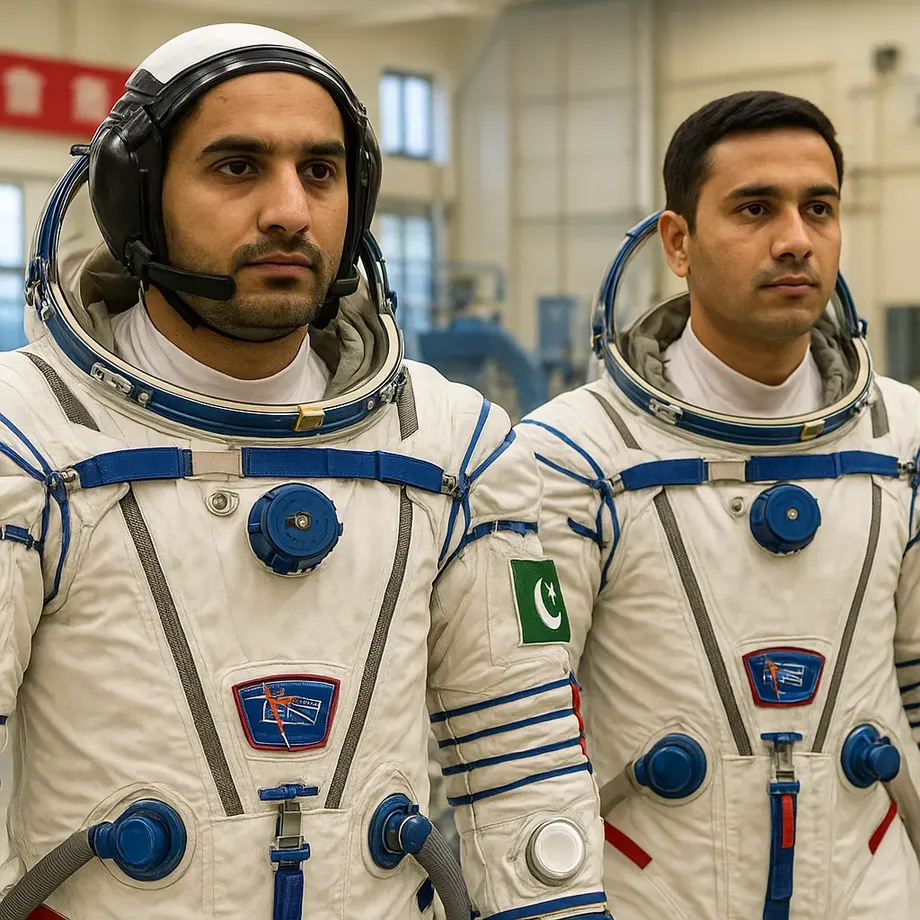
Two candidates, one place aboard Tiangong
Pakistan is preparing to send its first astronaut into orbit, with military pilots Muhammad Zeeshan Ali and Khurram Daud training in Beijing for a mission expected to last about one week aboard China's Tiangong space station. The final choice is expected in mid to late October 2026, according to Amer Gilani, who leads human spaceflight cooperation at Pakistan's Space and Upper Atmosphere Research Commission (SUPARCO).
Contents
- Two candidates, one place aboard Tiangong
- How the mission reached this stage
- What separates the final two candidates
- Training for launch and daily life in orbit
- Four experiments from more than 300 proposals
- A research role within a larger station
- The return plan depends on China's crew rotation
- Access to space, without an independent launch system
- A broader partnership, but no Pakistani Moon flight agreement
- What still needs confirmation
- Key Points
The successful candidate would become the first Pakistani national to travel into orbit and the first foreign astronaut to visit China's operational space station. Pakistan's Ministry of Information and Broadcasting has identified late 2026 as the intended launch period, but China has not announced an exact launch date or named the astronaut who will fly.
The mission's scientific assignment is more specific than its symbolic ambition. Chinese institutions have selected four biotechnology experiments from more than 300 proposals submitted by Pakistani universities. The chosen astronaut would serve as a scientific payload specialist, carrying out research intended to support work on food security and climate change rather than piloting the spacecraft.
China Manned Space Agency officials have made the flight conditional on completion of training and successful assessments. Two candidates reaching the final stage therefore does not mean either has yet secured a seat. The programme combines a national first for Pakistan with a new step for China's astronaut operations, which have previously carried Chinese crews.
It also separates access to human spaceflight from the ability to launch people independently. Pakistan would contribute an astronaut and research experiments, while China would provide the spacecraft, launch facilities, training systems and orbital laboratory.
How the mission reached this stage
The programme began with a cooperation agreement signed by SUPARCO and the China Manned Space Agency in Islamabad on February 28, 2025. Prime Minister Shehbaz Sharif attended the ceremony. The agreement envisaged training two Pakistani candidates and selecting one to conduct scientific work aboard Tiangong, with flight timing tied to the station's operating plans.
The sequence since then shows how an initial diplomatic commitment became an active astronaut training programme:
- February 28, 2025: Pakistan and China signed the astronaut cooperation agreement in Islamabad.
- April 2025: SUPARCO said preliminary selection had begun in Pakistan, followed by further selection in China.
- February 2026: SUPARCO reported completion of the secondary selection phase.
- Early April 2026: China's first selection process for foreign astronaut candidates concluded, leaving Ali and Daud as the two final candidates.
- April 22, 2026: Pakistan's information ministry announced their selection and the planned launch period of late 2026.
- April 24, 2026: The candidates entered the Astronaut Center of China in Beijing to train alongside Chinese astronauts.
- October 7, 2026: Yang Liwei, deputy chief designer of China's manned space programme, said the candidates were progressing well.
- Mid to late October 2026: SUPARCO expects the final astronaut selection.
The original agreement set a target of completing selection by 2026 rather than guaranteeing a particular flight date. The later launch target is more precise, but remains a plan rather than a confirmed departure schedule.
What separates the final two candidates
The selection process involved preliminary screening in Pakistan, followed by secondary and final stages in China. Candidates underwent medical, psychological and aptitude assessments at the Astronaut Center of China. SUPARCO said those evaluations followed international human spaceflight standards.
Descriptions of the candidate pool differ. In April 2025, SUPARCO deputy director general Amjad Ali outlined an anticipated group of about 10 to 15 candidates. Later accounts described Ali and Daud emerging from about 20 finalists drawn from a larger group of Pakistani pilots and scientists. These figures refer to different stages and dates, and do not establish a single confirmed total for everyone considered.
Amjad Ali explained the intended progression from initial selection to a single flight assignment:
We will select about 10 to 15 candidates. And then they will be further shortlisted to two before they undergo through trainings in China for six months to a year. After the training there will be one candidate to fly into space,
SUPARCO officials said pilots were favoured because experience of fast flight could help them withstand substantial acceleration forces. That experience did not replace the medical and psychological requirements. Earlier selection criteria also called for physical fitness, research ability and analytical skills, reflecting a mission built around laboratory work as well as the demands of launch.
Training for launch and daily life in orbit
Ali and Daud are learning Mandarin, studying spacecraft systems and practising emergency procedures. Their preparation includes centrifuge tests, which reproduce the acceleration forces experienced during launch and other demanding flight phases. Such forces are often described in multiples of g, the acceleration associated with gravity at Earth's surface.
The training also covers ordinary tasks that become unfamiliar in orbit: eating, sleeping, handling equipment and making repairs. In microgravity, astronauts and loose objects float because they are falling around Earth together. Working safely requires different habits from those used in a laboratory on the ground.
Language preparation is an operational requirement, not simply a cultural exercise. The Pakistani astronaut will train and work within a Chinese mission system, where understanding instructions, technical terminology and emergency communications will be essential.
At the International Astronautical Congress in Turkey in October, Yang Liwei said both candidates had performed well during joint training with Chinese astronauts. His assessment indicates progress, but it was not an announcement that either candidate had passed every requirement or received a final flight assignment.
According to Gilani, the selected astronaut would remain in China for launch rather than return to Pakistan beforehand. After landing, the astronaut would undergo recovery before travelling home. The preparation and recovery periods therefore extend well beyond the planned week aboard the station.
Four experiments from more than 300 proposals
SUPARCO collected university proposals over a year, including submissions from Karachi, Lahore and Islamabad. Chinese institutions chose four biotechnology experiments, which are being assembled and tested in SUPARCO laboratories before review by Chinese engineers.
Four selections from more than 300 proposals represent less than 1.34 percent of submissions. That narrow selection places particular weight on the preparation of the chosen research hardware. A place aboard a crewed spacecraft requires equipment to meet the host programme's technical and safety requirements, as well as having a scientific purpose.
Pakistan's information ministry described a broader range of possible research areas in April 2026: materials science, fluid physics, life sciences and biotechnology, with potential applications in climate resilience, food security and industrial innovation. The 2025 agreement also listed medical science, radiation, ecology and astronomy.
Those broad descriptions should not be mistaken for confirmation that the astronaut will conduct experiments in every field. The more specific account identifies four biotechnology projects. Their names, detailed methods and expected measurements have not been disclosed in the mission descriptions.
Microgravity can allow researchers to examine biological processes without the same settling, buoyancy and fluid movement seen on Earth. That explains the interest in orbital experiments, but does not establish that these particular projects will produce a new crop, medicine or industrial process. Their practical value will depend on their results and subsequent research.
A research role within a larger station
The astronaut's payload specialist role centres on conducting Pakistan's experiments. China Manned Space Agency spokesperson Lin Xiqiang has also said the visitor would perform regular crew responsibilities. A specialist assignment therefore does not remove the need to understand station procedures or respond safely during an emergency.
Tiangong consists of three modules, Tianhe, Wentian and Mengtian, with a combined mass of about 77 metric tons. Its roughly 14 experimental racks support work in areas including life sciences, materials, fluid physics, combustion and radiation exposure. Experimental racks are dedicated installations that house research equipment and provide the services needed to operate it.
Some payloads are mounted outside the station, allowing materials and biological systems to be exposed directly to the space environment. The Pakistani experiments would enter an established research programme rather than a laboratory created solely for this visit.
Figures cited by SUPARCO credit Tiangong with more than 180 experiments, over 500 research papers and 150 patents. Those totals describe the wider station programme, not the output expected from Pakistan's four experiments. They also measure different things: experiments are research activities, papers communicate findings, and patents concern claimed inventions.
The planned visit is much shorter than the roughly six months commonly spent aboard Tiangong by Chinese career astronauts. That makes preparation on the ground especially important, since only a limited period would be available for the visitor to carry out the assigned work.
The return plan depends on China's crew rotation
The mission is expected to use a return seat made available by an extended Chinese stay in orbit. Pakistani officials describe the visitor returning with two Chinese astronauts who arrived at Tiangong in May, while a third remains aboard for a year to support research into prolonged spaceflight.
A separate account identifies Shenzhou-24 as the expected outward flight and places it in the autumn. Pakistan's ministry has used the broader target of late 2026. These descriptions do not amount to a confirmed launch manifest, particularly while China has not announced the final Pakistani crew member or an exact date.
The distinction matters because the visitor's journey depends on more than passing training. An outward seat, a return seat, station staffing and the research schedule must fit together. The expected week in orbit is part of a larger Chinese rotation plan, rather than a separate Pakistani flight operating on its own timetable.
Access to space, without an independent launch system
The programme gives Pakistan access to a working orbital laboratory and experience in preparing research for human spaceflight. It does not provide Pakistan with an independent crewed spacecraft or launch capability. China will supply the transport, launch site, training infrastructure and station.
That division of responsibilities is central to the debate over the mission's lasting value. Yarjan Abdul Samad, an assistant professor of aerospace engineering at Khalifa University who is also associated with Cambridge University, has argued that Pakistan should aim to contribute on equal terms rather than remain a recipient of services.
His concern is that access alone can deliver the requested mission without producing much domestic technological growth. He has also argued that sending an astronaut should be judged by whether the work addresses technical problems that cannot be handled adequately through uncrewed vehicles or experiments on Earth.
Carlo Iorio, director of the space technology research and engineering centre at the Free University of Brussels, has similarly called for stronger support for research inside Pakistan. He warned that weak domestic support could encourage talented researchers to move abroad, including to China.
The university proposal process and laboratory assembly work provide concrete Pakistani participation beyond the astronaut's presence. Whether that becomes lasting capability will depend on the research results, the experience retained by participating institutions and continued support after the flight. None of those outcomes is guaranteed by the mission's historic status.
A broader partnership, but no Pakistani Moon flight agreement
The astronaut programme extends a relationship that already includes satellite launches, navigation cooperation and lunar research. China's Chang'e-6 mission carried Pakistan's ICUBE-Q satellite to lunar orbit in 2024, and China launched a Pakistani communications satellite several weeks later.
Pakistan is also developing an autonomous rover for China's Chang'e-8 lunar mission, expected around 2028. The rover is intended to use artificial intelligence and stereo imaging to identify obstacles, estimate distances, assess terrain and choose routes across the lunar surface.
Stereo imaging uses views from different positions to estimate depth, much as two eyes help a person judge distance. Combined with autonomous navigation, it can reduce the need for controllers on Earth to direct every movement despite communication delays.
The rover programme is separate from sending a Pakistani astronaut to the Moon. Gilani has said there is no formal agreement or confirmed discussion for such a crewed mission. China's own ambition to land astronauts on the Moon before 2030 should not be read as an invitation or commitment for a Pakistani crew member.
Yang Liwei has described plans for a lunar research station and wider international exchanges. Key tests have also been reported for China's Long March-10 rocket, Mengzhou spacecraft and Lanyue lunar lander. Those developments concern China's lunar programme, not a confirmed extension of Pakistan's Tiangong assignment.
What still needs confirmation
The next expected decision is the choice between Ali and Daud in mid to late October 2026. Completion of training and assessments remains a condition for flight. China must still announce the selected astronaut and the exact launch schedule.
Further details are also needed about the four experiments, including their scientific questions and how success will be measured. The stated goals of supporting food security and climate research describe intended applications, not findings already achieved.
China has discussed possible astronaut participation with other countries, while Yang has described Tiangong as a platform for wider scientific cooperation, training and flight opportunities. Reports also describe a proposed expansion from three station modules to six to accommodate more activity. That expansion is not a prerequisite announced for the Pakistani visit, nor does it confirm any additional foreign mission.
For Pakistan, the immediate test is narrower and concrete: select a qualified astronaut, prepare four experiments for Chinese review and fit a short research visit into Tiangong's crew schedule. A successful flight would establish a national first. Its scientific value would be measured through the work completed and what Pakistani researchers can build from it afterward.
Key Points
- Muhammad Zeeshan Ali and Khurram Daud entered astronaut training in Beijing on April 24, 2026.
- SUPARCO expects the final selection in mid to late October 2026.
- Pakistan targets a launch in late 2026, but China has not announced an exact date.
- The selected astronaut would spend about one week aboard Tiangong as a payload specialist.
- Four biotechnology experiments were selected from more than 300 Pakistani university proposals.
- China will provide the spacecraft, launch facilities, training systems and station infrastructure.
- Pakistan's rover planned for Chang'e-8 around 2028 is separate from the astronaut mission.
- No agreement has been confirmed to send a Pakistani astronaut to the Moon.