More than 90 rescues bring a missing primate back into scientific view
More than 90 Bangka slow lorises rescued between 2015 and 2025 have confirmed that a venomous primate feared extinct still survives across the Indonesian island of Bangka. The animals came from all four of the island's regencies and the city of Pangkal Pinang. After treatment and recovery, 86 were released at seven forest sites.
Contents
- More than 90 rescues bring a missing primate back into scientific view
- How local knowledge reached the scientific record
- A century of records, recognition and rescue
- What the rescue locations reveal
- A rescue in Batu Rusa shows the danger of power lines
- How two lorises returned to Mount Maras
- A small primate with a dangerous bite
- Forest loss puts survival under pressure
- What conservation teams want to do next
- Key Points
The findings, published in the scientific journal Spixiana and announced by conservation organization Re:wild on October 20, 2026, draw on a decade of work by the Alobi Wildlife Rescue Center. Residents and local authorities had been calling rescuers when they found the small primates in gardens, houses, plantations, along roads and on electrical wires.
For scientists, those records close a gap stretching back to the 1930s. For people living on Bangka, off the southeastern coast of Sumatra, the animal had remained a familiar, if increasingly vulnerable, neighbor.
Re:wild's rediscovery announcement describes how Alobi joined researchers from the Haus des Meeres Aqua Terra Zoo in Vienna and Indonesia's Taman Safari Prigen Conservation Breeding Ark to analyze the records. Their findings put the species back into scientific view while revealing the dangers it faces outside the island's shrinking forests.
Timon Glaw, a study author and graduate student in nature conservation and biodiversity management at Haus des Meeres, expressed the central finding plainly:
The Bangka slow loris is still alive.
The immediate task is to keep it that way. Forest destruction, electrical injuries, roads, expanding settlements and the pet trade threaten animals that have survived decades with little scientific attention.
How local knowledge reached the scientific record
Alobi's rescue records became the foundation of the study through a conversation in Java. During a visit to the Taman Safari Prigen Conservation Breeding Ark, Glaw learned from conservationist Jochen Menner that the Bangka slow loris was listed as critically endangered and possibly extinct.
Menner connected Glaw with Alobi. The rescue center already held documented encounters with the species, including where animals had been found and what happened during their care. Bringing those records together allowed the collaborating organizations to describe survival across several parts of Bangka.
Benji Barca, Re:wild's exploration program manager, credited the rescuers and the people who alerted them:
The team at Alobi has spent more than a decade quietly rescuing, healing and releasing these animals, and their careful records are what have finally now brought this primate back into scientific view.
Bangka is home to more than 1 million people. Glaw described it as about an hour's flight from Jakarta, making the long scientific silence especially striking. The discovery emerged from connecting existing local knowledge with researchers able to analyze and publish it.
A century of records, recognition and rescue
The Bangka slow loris was first scientifically described in 1906, but recognition of it as a distinct species came in 2013. Scientists had previously grouped several forms of Bornean slow lorises together. Differences in their facial markings helped support separating them.
Glaw dates the last historical scientific records from Bangka discussed in the new study to 1930–1932; 1937 is also cited as the last historical record in other published summaries. Alobi's documented rescue history now reaches back to 2015, earlier than the 2023 sightings sometimes identified as the species' return.
- 1906: The Bangka slow loris was first scientifically described.
- 2013: It was recognized as a distinct species.
- 2015–2025: Alobi documented more than 90 rescued individuals across Bangka.
- 2020: The International Union for Conservation of Nature classified it as critically endangered and possibly extinct.
- July 29, 2025: Alobi and government conservation staff released two rehabilitated lorises at Mount Maras National Park.
- October 20, 2026: Re:wild announced the study documenting the species' continued survival.
What the rescue locations reveal
Alobi received animals from all four Bangka regencies and Pangkal Pinang, giving the study evidence of survival across much of the island. Regencies are administrative areas, broadly comparable to districts or counties.
The total wild population is still unknown. Systematic surveys are needed to estimate how many lorises remain, identify the forests they occupy and assess whether those populations are connected. Rescue records identify places where animals encounter people; field surveys would also look for animals living deeper inside suitable habitat.
Researchers have already begun work on distribution. Randi Syafutra of Flora Fauna Bangka has led a project to map the species and estimate its population since 2018. Connecting such fieldwork with rescue locations could help direct attention toward surviving groups and forests under pressure.
Alobi selected the seven release sites from larger forest fragments with suitable habitat and some degree of legal or practical protection. For a primate that travels through trees, the quality and arrangement of those remaining forests directly affect access to food, shelter and other lorises.
A rescue in Batu Rusa shows the danger of power lines
On July 31, 2024, Alobi and the South Sumatra Natural Resources Conservation Agency, known as BKSDA, received a report of a Bangka slow loris injured by electricity in Batu Rusa village, Merawang district, Bangka Regency.
A resident named Havis had cared for the animal for several days before contacting Alobi because he had been unsure where to take it. According to Alobi's Batu Rusa rescue account, the loris had a badly damaged right hand, eye injuries and wounds to its abdomen.
Rescuers took it to a clinic. Alobi said amputation of the right hand was likely to be considered and that the animal had little chance of returning to the wild. Its eventual treatment outcome was not given.
Alobi linked such electrical injuries to shrinking habitat, which pushes wildlife toward cables while searching for food or moving between areas. For an animal that depends on gripping branches, a severe hand injury can remove the ability to travel and feed independently. Glaw said a few animals in the wider rescue record died despite treatment.
How two lorises returned to Mount Maras
On July 29, 2025, Alobi and BKSDA released two rehabilitated Bangka slow lorises in Mount Maras National Park, at Berbura village in Riau Silip district, Bangka Regency. The operation provides a detailed example of how rescuers prepare animals for release.
Alobi's Mount Maras release account says both animals underwent health checks and behavioral observation at its wildlife rescue center in Kampoeng Reklamasi Timah Air Jangkang. Staff assessed whether they were ready to resume life in the forest.
The lorises were released at separate locations because male slow lorises tend to be territorial. Alobi said separating them would reduce dominance problems and improve their chances of adapting.
Staff chose places with dense tree canopy. Closely connected branches allow lorises to move through the forest above the ground, provide cover from predators and make natural food easier to reach. The release illustrates why rehabilitation requires both a healthy animal and a carefully chosen destination.
A small primate with a dangerous bite
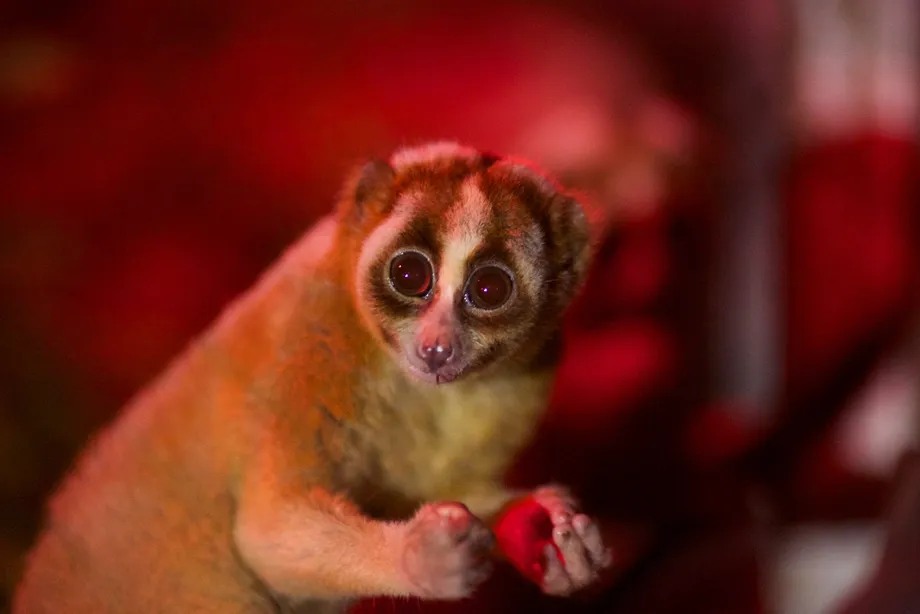
The Bangka slow loris, Nycticebus bancanus, has reddish brown fur, large eyes and a pale facial mask. A published species profile gives its length as about 25.8 centimeters. It moves slowly and deliberately, gripping branches rather than leaping between them.
Its large eyes help it forage at night. In evolutionary terms, it is more closely related to Madagascar's lemurs and Africa's galagos than to monkeys, apes or people.
Slow lorises are the only primates known to be venomous. They produce a secretion from glands near their elbows and lick it, mixing it with saliva. A bite can then deliver venom that causes pain, swelling and potentially severe allergic reactions in people.
Glaw explained the risks and what research on related species suggests about its purpose:
The venom can cause severe allergic reactions in humans, potentially even life-threatening ones. Research on other slow loris species suggests that the venom is used primarily in conflicts with other lorises, although it may also serve defensive functions against predators and parasites.
The species also has a toothcomb, a group of forward pointing lower teeth used for grooming and accessing tree gum, as well as during bites. A small second tongue beneath the main tongue helps clean those teeth.
Forest loss puts survival under pressure
Tin mining and clearing for oil palm plantations have reduced the Bangka slow loris's habitat. Langka Sani, director of the Alobi Wildlife Rescue Center, warned that confirming its survival leaves an urgent conservation problem:
We are glad to contribute to the scientific record to show that the Bangka slow loris is not lost, but the species is still very close to extinction.
Sani identified illegal tin mining and extensive clearing for oil palm as major causes of habitat loss. Conservation estimates put remaining suitable habitat at less than 20% of its former extent and suspect a population decline of at least 80% over 24 years. Those estimates describe a severe contraction, alongside the need for a current population survey.
Mining damages more than the trees removed at a working site. Tin and iron mining on Bangka has also been associated with reduced soil fertility, damaged vegetation and the spread of invasive species, making forest recovery more difficult.
The loris's diet adds another reason to protect functioning forest. Glaw said it likely eats insects, tree gums, nectar and other plant material, as other slow lorises do. Detailed feeding studies of the Bangka species are still needed, so maintaining a varied natural habitat preserves the range of foods it may require.
What conservation teams want to do next
The study's authors recommend population surveys, genetic research, habitat protection and monitoring of animals after release. Genetic studies could help resolve relationships among slow lorises, whose classification has changed repeatedly. Research published in 2023 suggested that their diversity may include about nine species rather than the five previously recognized.
Monitoring would help rescuers learn whether released animals survive, settle into suitable areas and continue using the habitat selected for them. The authors recommend conducting releases under International Union for Conservation of Nature Species Survival Commission guidelines.
A conservation breeding program is also proposed, both to support protection efforts and to improve knowledge of the species' biology and behavior. No timetable was announced for that proposal or the wider survey program.
Glaw said protecting the remaining forests is the most urgent priority, alongside finding out where the animals survive and how large their populations are. The rescue record gives conservation teams locations from which to begin that work, while the seven release sites provide places to investigate survival after rehabilitation.
Key Points
- Alobi documented more than 90 Bangka slow lorises between 2015 and 2025, confirming survival across all four Bangka regencies and Pangkal Pinang.
- After recovery, 86 animals were released at seven sites in larger forest fragments.
- Local residents and rescue workers supplied the records behind the study published in Spixiana.
- Tin mining, oil palm expansion, roads, power lines, settlements and the pet trade threaten the species.
- A July 2024 electrical injury case shows how habitat loss can leave lorises facing severe harm near people.
- Researchers recommend population surveys, genetic studies, monitored releases and protection of remaining natural forest.