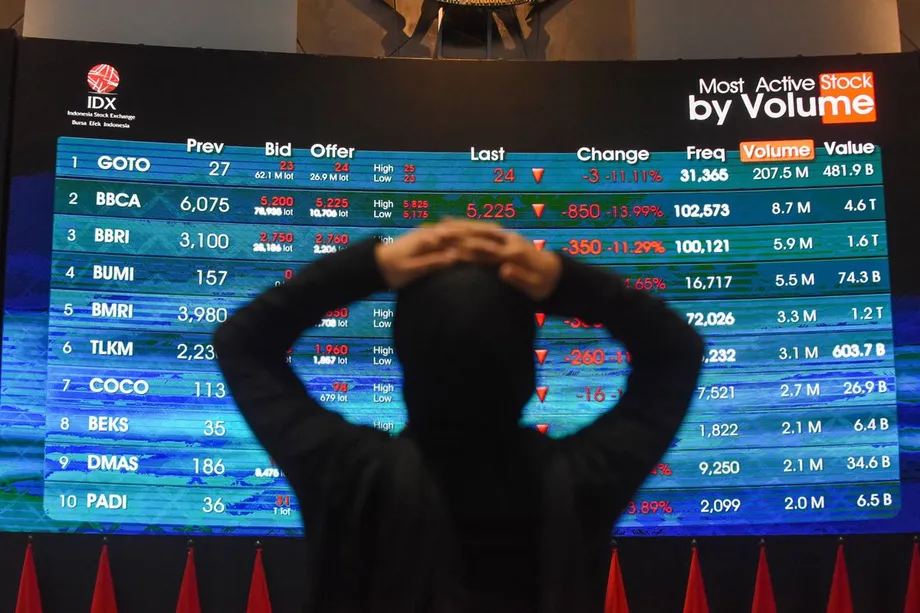
A market crash puts enforcement under scrutiny
Indonesia's stock market lost about $60 billion in value on October 16, 2026, as global index provider MSCI proposed moving the country from emerging market status to a standalone category. The Jakarta benchmark fell 11.57%, its steepest daily decline since January 1998. On the same day, the Financial Services Authority, known as OJK, announced Rp 2.1 trillion in administrative fines involving three listed companies.
Contents
- A market crash puts enforcement under scrutiny
- What happened on October 16?
- Why MSCI's classification matters
- Why a rising index can hide an uneven recovery
- Who really owns the shares available to trade?
- What the Rp 2.1 trillion penalties cover
- How far does enforcement extend?
- When does an influencer's message become a recommendation?
- What investors need to see before April
- Key Points
The collision between a market collapse and major enforcement action has sharpened a central question for Indonesia: are changes to ownership disclosure and trading rules producing prices that investors can trust?
OJK has identified indications of possible criminal capital market violations in 31 of the 61 stocks on its list of companies with highly concentrated ownership. That is slightly more than half of the list. Its investigations into Dian Swastatika Sentosa, Barito Renewables Energy and Petrindo Jaya Kreasi connect two concerns now facing the wider market: allegedly coordinated trading and shares allocated to people linked to controlling shareholders.
Capital market analyst Satrio Utomo argues that Indonesia must look beyond whether its headline stock index rises. He wants regulators to examine who controls shares, how traders are connected and how investment messages influence buying and selling.
MSCI's proposed reclassification would remove Indonesian shares from widely followed international index products. Authorities now face a consultation period extending into April 2027, with pressure to show measurable improvements before a possible change around the middle of that year.
What happened on October 16?
The Indonesia Composite Index, commonly called the IHSG, dropped from a previous closing level of about 5,863 to about 5,185. A fall exceeding 8% triggered a trading halt lasting 30 minutes. The benchmark lost 14.91% over the week.
The rupiah also weakened. Bank Indonesia's JISDOR reference exchange rate stood at Rp 18,052 per US dollar on October 16, while the currency reached an intraday market level of Rp 18,070. JISDOR is a reference rate, while intraday prices show where currencies trade during the session.
Indonesia's equity market had already lost more than $350 billion in capitalisation since a January freeze affecting MSCI indexes. Capitalisation means the combined market value of listed shares, calculated from their prices and the number of shares issued.
The main developments stretch across several months:
- January 2026: A freeze affecting MSCI indexes intensified scrutiny of ownership transparency and trading behaviour.
- October 16, 2026: MSCI proposed standalone status, the IHSG fell 11.57%, and OJK announced Rp 2.1 trillion in fines.
- October 18, 2026: OJK and market institutions met analysts, economists and financial influencers at the Indonesia Stock Exchange.
- April 2027: MSCI's consultation is due to run through this month. University of Indonesia economist Kiki Verico identified April 30 as the deadline for implementing recommendations.
- Mid-2027: Reclassification could follow unless MSCI finds clear improvement in market governance and functioning.
Why MSCI's classification matters
MSCI builds indexes that investment funds use as shopping lists or performance benchmarks. A passive fund follows an index's composition, so removing a country's shares can require the fund to sell them. Active managers choose their investments, although many also measure their performance against MSCI indexes.
Standalone status would place Indonesia outside MSCI's emerging and frontier market index products. MSCI said its concerns about ownership opacity and trading behaviour were serious enough that moving Indonesia to the frontier category would be insufficient.
MSCI, the global index provider, explained its assessment in its October 16 statement:
Significant concerns remain around market dysfunction.
UBS estimated that reclassification could trigger about $4 billion in sales by passive investors and a further $15 billion by active investors. Together, that potential $19 billion is roughly four times the $4.7 billion in net sales already made by foreign investors in Indonesian stocks during 2026.
Indonesia Stock Exchange chief executive Jeffrey Hendrik said he would seek clarification from MSCI about the basis for its announcement. Senior economic minister Airlangga Hartarto also questioned why the standalone proposal had not been discussed during a meeting in Bangkok that week. The final classification decision is still pending.
Why a rising index can hide an uneven recovery
Satrio's concern begins with how the IHSG moves. A company with a large market value can exert considerable influence on the benchmark, so gains in a few large stocks can lift the index even when many other shares struggle.
He points to the IHSG's rise after a ceasefire agreement involving Iran, the United States and Israel, arguing that comparisons with the LQ45 and IDX30 indexes offer a fuller picture. Those indexes track smaller groups of major shares. Satrio says large companies trading at high prices relative to their earnings can become important drivers of the headline benchmark.
A price to earnings ratio compares a company's share price with the profit attributable to each share. A high ratio means investors are paying more for a given amount of current earnings. Satrio wants attention paid to the companies behind an index rally and the trading that produces their prices.
John Rachmat, an independent commissioner at Pinnacle Investment Indonesia, offers another measure of the concern. In his assessment, only about five or six of the 22 stocks contributing heavily to the April 2025 to January 2026 rally had strong business fundamentals. For the June to September 2026 rally, he put the figure at eight of 21.
John estimated that the IHSG, which stood at 6,071 at the end of September, would have been around 4,700 without contributions from 20 stocks he considered speculative. That calculation describes his assessment of the rally's composition. His categories are personal judgments about companies and trading, rather than legal classifications.
Who really owns the shares available to trade?
Indonesia has expanded ownership disclosure to around the 1% level, mapped companies with concentrated ownership and moved to tighten free float requirements. Earlier reform efforts also included leadership departures at the exchange and OJK, alongside action involving stock influencers.
Free float is the portion of a company's shares available for public trading, rather than held by controlling owners or other restricted holders. Indonesia plans to raise the minimum requirement to 15%. The practical task is to identify which shares are genuinely available to independent investors.
Satrio argues that a register showing many shareholders can still hide coordinated control. People holding shares under different names may act together through social media groups, seminars or other networks. Heavy trading can also occur among connected parties, creating an appearance of activity while ownership stays within the same circle.
Ultimate beneficial ownership transparency addresses a related problem. It seeks to identify the people who ultimately own or control investments behind companies, accounts and other legal structures. Nafan Aji Gusta, senior market analyst at Mirae Asset Sekuritas, says international investors need evidence that these changes work:
Global investors need evidence that ownership structures are becoming more transparent, free float genuinely reflects shares available for trading, and market manipulation is consistently addressed when proven.
John also says suspected coordinated trading is the central problem, beyond ownership concentration alone. He estimates that Indonesia's weight in a regional index fell from nearly 3% at its peak to roughly 0.35% to 0.5% by the end of September 2026.
What the Rp 2.1 trillion penalties cover
OJK announced fines of Rp 1.5 trillion for Dian Swastatika Sentosa, traded as DSSA; Rp 500 billion for Barito Renewables Energy, or BREN; and Rp 100 billion for Petrindo Jaya Kreasi, or CUAN. The three amounts total Rp 2.1 trillion.
The DSSA investigation examined share trading from 2023 to 2026. OJK described suspected manipulation as planned and structured, involving individual and institutional clients operating through several exchange members. The regulator said the activity caused a substantial increase in the share price.
Investigators requested trading documents, traced flows of money and sought information from 12 securities company directors, 15 individuals and 11 foreign legal entities. OJK identified suspected violations of Articles 91 and 92 under the P2SK financial sector reform framework and said it had traced illicit gains linked to DSSA transactions.
The BREN and CUAN cases concern their initial public offerings, or IPOs, when shares were first sold to public investors. OJK said allocations had been planned to favour groups connected to controlling shareholders, with identities concealed or obscured. It examined suspected violations of Article 107 of the Capital Market Law.
BREN offered 3% of its shares when it listed on October 9, 2023. CUAN offered 15.03% when it listed on March 8 that year. OJK's findings focus on who received the allocations: it said concentration among connected groups limited the shares available for market trading.
The IPO investigation drew on records from four exchange members acting as underwriters, three custodian banks and flows of money involving related parties. Underwriters organise share sales, while custodian banks hold securities for investors. OJK summoned five securities company directors, three custodian banks and seven parties involved in fixed allocations.
How far does enforcement extend?
OJK's initial examination of 61 stocks with high shareholding concentration identified possible criminal violations involving 31. The findings extend the scrutiny beyond the three companies receiving the largest announced fines, while placing transaction records and links between investors at the centre of further investigations.
Hasan Fawzi, OJK's chief executive for capital market supervision, said the October 16 sanctions resulted from investigations already under way. At the October 18 dialogue, he described enforcement as part of continuing reform rather than simply a reaction to the market's latest fall.
OJK also gave a separate January to October enforcement tally covering 835 parties and sanctions worth more than Rp 390 billion. The scope of that tally relative to the newly announced Rp 2.1 trillion penalties was not specified.
National Police chief Suyudi Ario Seto said the Criminal Investigation Agency, known as Bareskrim, would assist and act on evidence of suspected capital market crimes. The administrative penalties therefore sit alongside investigations that may require further criminal enforcement.
Didik J. Rachbini, rector of Paramadina University and a senior economist at INDEF, argues that confidence depends on how institutions behave each day. He called for consolidated ownership data, identification of extreme concentrations and examination of suspected coordinated transactions, backed by verifiable disclosure standards.
When does an influencer's message become a recommendation?
Satrio's second proposed reform concerns the meaning of a stock recommendation. He wants rules to explain whether they cover only explicit instructions to buy or sell, or also implied messages using abbreviations, symbols and picture puzzles.
A promotional message can identify a stock without stating its name directly. Satrio argues that supervision should examine what the communication conveys and how it affects investment decisions, including the trading positions of the person spreading it and any connected parties.
His concern includes possible conflicts of interest when someone circulates a positive message while holding a selling position, directly or through an affiliate. He also wants the definition of affiliation broadened and clarified so regulators can identify relationships expressed through coordinated conduct, as well as formal ownership links.
OJK brought financial influencers into its October 18 meeting alongside analysts and economists. Chair Friderica Widyasari Dewi said the regulator wanted open input, including information it might not yet know. Exchange development director Iding Pardi identified ownership disclosure, investor classifications and ownership concentration as priorities.
The meeting brought communication and market supervision into the same discussion. Satrio's proposals would require regulators to connect a public message with the people, positions and transactions behind it.
What investors need to see before April
Nafan says reform must produce results that international investors can verify. His priorities are more transparent ownership structures, genuine free float and consistent action against proven manipulation. Kiwoom Sekuritas Indonesia has also identified opaque ownership, suspected coordinated trading and limited visible enforcement as continuing investor concerns.
Kiki Verico, the University of Indonesia economist, says authorities have until April 30, 2027, to implement MSCI's recommendations. He has called for ownership transparency, improved market access and neutral enforcement. He also raised concerns about a Bayan Resources share acquisition involving a businessman described as close to the authorities, arguing that government must act as a neutral referee.
Responsibility spans OJK, the Indonesia Stock Exchange, the Indonesia Central Securities Depository, known as KSEI, and the government. Their tasks overlap: ownership records must identify connected holdings, trading surveillance must follow suspicious patterns and enforcement must produce outcomes investors can examine.
Didik warns that persistent distrust could increase companies' financing costs and lead institutional investors to reduce their holdings. For businesses, that would make raising money through the stock market more expensive. For ordinary investors, the immediate concern is whether quoted prices arise from genuine buying and selling among independent participants.
Indonesia's next test is therefore concrete. By the end of the consultation period, investors will be looking for clearer ownership records, credible evidence of shares available to trade and progress in cases involving coordinated activity. MSCI has tied its proposed reclassification to whether governance and market functioning visibly improve.
Key Points
- The IHSG fell 11.57% on October 16, 2026, erasing about $60 billion in market value.
- MSCI proposed moving Indonesia from emerging market to standalone status, with consultation continuing through April 2027.
- OJK announced Rp 2.1 trillion in fines involving DSSA, BREN and CUAN.
- OJK identified indications of possible criminal violations in 31 of 61 stocks with highly concentrated ownership.
- Indonesia plans a 15% minimum free float requirement, while investors are demanding clearer evidence of independent ownership.
- Satrio Utomo wants stronger definitions of affiliation and stock recommendations to address coordinated trading and coded promotional messages.
- UBS estimated potential outflows of $19 billion if reclassification proceeds.