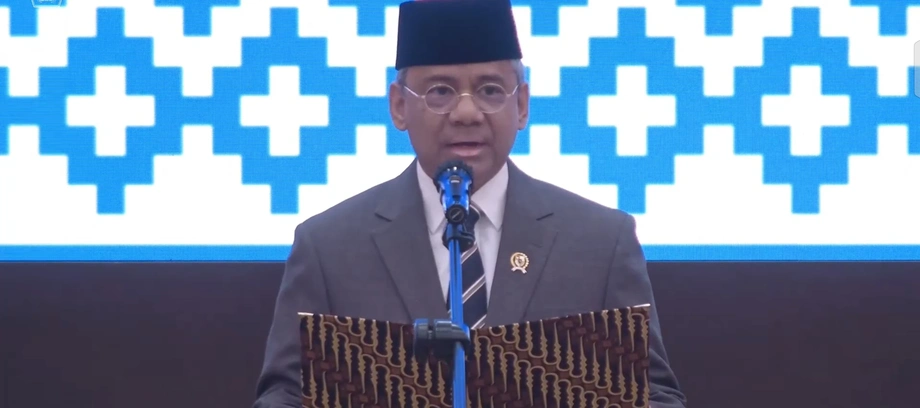
Suahasil promises payment soon, without setting a date
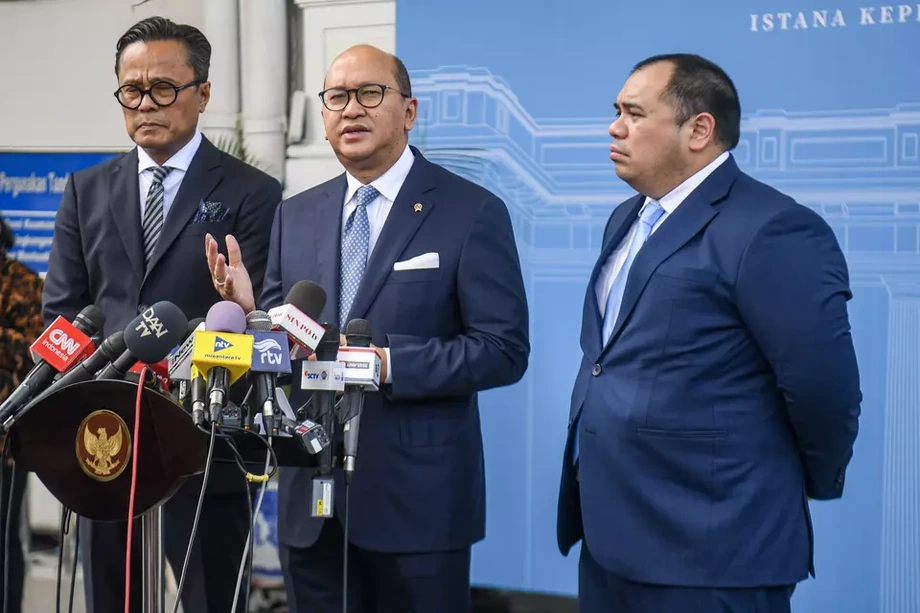
Finance Minister Suahasil Nazara on Friday, 27 November 2026, assured Indonesian workers that the latest Bantuan Subsidi Upah, or BSU, would be paid soon. He spoke after attending the 2026 Bank Indonesia Annual Meeting at Grha Bhasvara Icchana, Bank Indonesia's headquarters in Jakarta. When pressed for a date, he gave no calendar commitment.
Contents
- Suahasil promises payment soon, without setting a date
- Why has BSU not entered the payment stage?
- How the Rp900,000 package was designed
- Who qualifies under the 2026 rules?
- Why workers cannot apply on their own
- When will the NIK recipient checker open?
- The sequence from announcement to assurance
- How is the Rp900,000 expected to reach recipients?
- The false 2027 claim and the fraud risks around BSU
- What workers should watch for next
- Key Points
Suahasil's brief answer was the clearest public assurance yet from the finance ministry that the money would come. Asked about the subsidy after the event, he said:
BSU will be disbursed, it will be disbursed. When? Soon.
The payment at stake is Rp900,000 for each eligible worker. It represents Rp300,000 a month for October, November and December 2026, combined into one disbursement rather than three separate monthly transfers. The government is targeting about 13.3 million workers and has estimated the budget requirement at almost Rp12 trillion.
For people waiting for the money, the operational position remained unchanged. The Ministry of Manpower had not set an exact payment date, the final recipient list had not been announced, and the service for checking a worker's status had not opened. The ministry's planned distribution window was November and December, but its 25 November explanation placed the program firmly in the budgeting stage.
Why has BSU not entered the payment stage?
The Ministry of Manpower, commonly called Kemnaker, has submitted its proposed BSU budget and is coordinating with the Ministry of Finance to complete it. Finishing that financial work is necessary before recipients can be formally determined and money can be sent.
The ministry has described the route to payment in four stages:
- Establishing the regulation for BSU 2026. This stage has been completed.
- Submitting and settling the budget. Coordination between Kemnaker and the finance ministry was still continuing in late November.
- Determining recipients after their records have been checked against the program's requirements.
- Distributing the Rp900,000 payment to workers named as eligible recipients.
Manpower Minister Yassierli explained on 9 November that the available names were still preliminary. BPJS Ketenagakerjaan, the agency that administers employment social security, supplies the worker records. Those records must be cleaned, validated and verified before they can produce a final list. Yassierli said:
That is preliminary data. The process is still at the Ministry of Finance for finalization. The data will be validated and verified again. From there, we will obtain the final data.
Data cleansing, in this context, means tidying and checking the records before matching them with the eligibility rules. Validation and verification then establish whether the information is accurate and whether each worker meets the requirements. This is why an appearance in preliminary employment data does not amount to an official recipient decision.
Cris Kuntadi, Secretary General of Kemnaker, gave the same sequence on 26 November. He said the ministry was waiting for financial finalization before completing its own examination of prospective recipients. Cris explained:
BSU 2026 is still being processed. We are still waiting for finalization from the Ministry of Finance, followed by validation and verification of prospective recipient data by the Ministry of Manpower.
Cris added that Kemnaker would communicate developments through its official channels. He also acknowledged that workers and labourers were waiting for certainty, but gave no date for completing the checks or announcing the final number of recipients.
How the Rp900,000 package was designed
Coordinating Minister for Economic Affairs Airlangga Hartarto announced the plan on 30 September 2026 after a restricted meeting with President Prabowo Subianto at the Presidential Palace in Jakarta. The subsidy formed part of the government's fourth quarter economic stimulus and was intended to support workers' purchasing power and household economic resilience.
Airlangga supplied the two figures that define the scale of the program: approximately 13.3 million workers and almost Rp12 trillion in funding. Announcing the plan, he said:
This will be given to 13.3 million workers, and the budget requirement is estimated at almost Rp12 trillion.
The arithmetic closely matches that estimate. Paying Rp900,000 to 13.3 million people would cost Rp11.97 trillion. For a worker earning exactly Rp3.5 million a month, the full subsidy would equal about 26 percent of one month's pay, although it is calculated as three monthly installments of Rp300,000 and paid together.
The legal basis is Minister of Manpower Regulation Number 16 of 2026, known as Permenaker 16/2026. It is the second amendment to Minister of Manpower Regulation Number 10 of 2022, which contains guidelines for government wage subsidies for workers. Article 3 of the 2026 regulation sets out the recipient conditions.
Indah Anggoro Putri, Director General for Industrial Relations Development and Workers' Social Security at Kemnaker, confirmed both the eligibility principle and the payment structure in an official statement. She said:
BSU is given to workers who meet the criteria and requirements under the regulations. The Rp900,000 assistance is paid in one disbursement.
The regulation and the amount are therefore settled. The unfinished work concerns the budget process, recipient determination and the practical payment announcement.
Who qualifies under the 2026 rules?
The current criteria use an August 2026 membership cutoff. Workers reading older material should check the date carefully, because guidance for BSU 2025 referred to an earlier participation period.
- A recipient must be an Indonesian citizen with a Nomor Induk Kependudukan, or NIK, which is the national identity number.
- The worker must have been an active BPJS Ketenagakerjaan participant in the Penerima Upah category through August 2026. Penerima Upah, often shortened to PU, covers people participating as wage recipients.
- Monthly pay must generally be no more than Rp3.5 million, or fall within the applicable provincial or regency and city minimum wage arrangement.
- In areas where the minimum wage exceeds Rp3.5 million, the income ceiling is adjusted under that framework and rounded upward to a full Rp100,000.
- Priority is given to workers who were not receiving Program Keluarga Harapan, or PKH, during the period before BSU distribution. PKH is a separate social assistance program for families.
- Civil servants, members of the Indonesian National Armed Forces and members of the Indonesian National Police are excluded.
The wage used for the assessment is the latest salary reported by the employer to BPJS Ketenagakerjaan. It includes the basic wage and fixed allowances. Accurate employer reporting therefore affects both the income test and the integrity of the recipient data.
Workers dismissed after August 2026 can still receive BSU if they satisfy the regulation, including the requirement for active PU participation through August. The official frequently asked questions on the BSU portal explicitly preserve that eligibility for workers affected by a termination of employment after the cutoff.
Eligibility also carries an obligation after payment. Anyone later found not to meet the requirements must return the money to the state treasury. A bank credit alone does not remove that obligation if the underlying recipient data is subsequently found to be ineligible.
Why workers cannot apply on their own
BSU is built around employment and social security records, not an open public application. Kemnaker states that workers cannot register themselves at either a BPJS Ketenagakerjaan branch office or a manpower ministry office. There is no registration fee and no legitimate link offering to enrol someone for a payment.
A company's human resources department may contact workers who appear to meet the conditions so that their information can be completed or updated. Once included in that data process, workers can update information themselves or with help from their employer. Available channels include BPJS Ketenagakerjaan's JMO mobile application and its BSU information service.
BPJS Ketenagakerjaan initially opened its data updating window from 10 to 17 November 2026. It subsequently extended the opportunity without announcing a new closing date. On 23 November, the agency confirmed through its official Instagram communication that updates could still be made.
Employers have also been asked to ensure that worker information reflects actual conditions. For employees, the useful steps are to respond to genuine communication from their workplace, check that their personal and employment details are consistent, and keep any bank account information accurate. None of these steps requires paying an intermediary.
Older online instructions can add to the confusion. On 1 October, the official BSU pages still displayed material for the 2025 period. The later November guidance completed the 2026 regulatory stage and used the August 2026 participation cutoff, replacing earlier references to the previous program's dates.
When will the NIK recipient checker open?
The official monitoring portal is bsu.kemnaker.go.id. At 08:49 Western Indonesian Time on 27 November, it still said that the mechanism for checking BSU 2026 recipient status would be announced officially. A check on 26 November had similarly found no active field for entering a worker's NIK.
Agatha Widianawati, Secretary of the Directorate General for Industrial Relations Development and Workers' Social Security at Kemnaker, had already explained why the service was unavailable. Speaking on 15 November, she linked the checker directly to the unfinished program process:
Because BSU is still being processed, NIK checking cannot be opened yet.
The portal remains the place to watch for the formal checking mechanism, the payment schedule and official announcements. Workers can also monitor Kemnaker's verified social media accounts, use JMO for relevant employment data services, or contact the ministry's service centre at 1500 630.
Instructions from BSU 2025 describe entering a NIK and security code before selecting a status check button. They illustrate how the earlier service worked, but Kemnaker had not activated or announced that procedure for the 2026 program by 27 November. Workers should wait for the current announcement before treating any displayed result as an official 2026 recipient decision.
The sequence from announcement to assurance
Several announcements between September and November show why the payment promise and the payment date have appeared at different times.
- 30 September: Airlangga announced Rp900,000 for each eligible worker, a target of 13.3 million recipients and a budget estimate of almost Rp12 trillion after the meeting with Prabowo.
- 9 November: Yassierli said the initial data was still being finalized at the finance ministry and would undergo further validation and verification.
- 10 to 17 November: BPJS Ketenagakerjaan ran its initial data updating window, later extending it without setting a new deadline.
- 15 November: Yassierli said administrative processing was continuing at the finance ministry and warned workers to rely on official ministry information.
- 25 November: Kemnaker said on Instagram that budgeting was still underway and that no exact distribution date had been set.
- 26 November: Cris Kuntadi said recipient determination would follow financial finalization and the completion of data checks.
- 27 November: The government denied a circulating claim about payment at the end of 2027, while Suahasil said after the Bank Indonesia event that BSU would be paid soon.
No deadline for finishing the budget stage had been published by the end of that sequence. Nor was there an announced date for opening the status checker, issuing the final recipient list or making the first transfer.
How is the Rp900,000 expected to reach recipients?
Kemnaker's implementation schedule points to distribution during November and December 2026. Material associated with the regulation lists banks belonging to Himbara, the association of banks owned by the state, together with PT Pos Indonesia as distribution channels.
Airlangga has described a stronger operational emphasis on bank accounts. He said payments were being directed into recipients' accounts, following Prabowo's instruction to encourage wider bank account ownership, rather than relying on post offices as before. The five banks he named were Bank Mandiri, Bank Rakyat Indonesia, Bank Negara Indonesia, Bank Tabungan Negara and Bank Syariah Indonesia.
The final operational announcement will need to tell workers which route applies to them and when distribution starts. Workers using a bank account should ensure that it remains active and that its ownership details agree with their personal records. They should only supply such information through a confirmed employer or government process.
Distribution in 2025 took place in several batches, so recipients could receive their money at different times. Kemnaker has not announced a batch schedule for 2026. Once payment begins, the strongest confirmation will be an official distribution announcement accompanied by a Rp900,000 credit and a corresponding entry in the recipient's account transaction history. A workplace human resources department may also confirm that its employees' payments have been processed.
The false 2027 claim and the fraud risks around BSU
A viral message claimed that Yassierli had apologized because BSU could not be paid until the end of 2027. It attributed the supposed delay to declining economic conditions and rising state losses. The Government Communication Agency, known as Bakom, labelled the claim a hoax and stated that Yassierli had never made that announcement.
Kemnaker issued its own denial through its official Instagram account on 27 November. Using Rekanaker, its customary greeting to its online audience, the ministry said:
BSU 2026 will only be disbursed at the end of 2027? Hoax, Rekanaker! As of now, the schedule for distributing BSU 2026 has not been set.
The official position on that day was precise. Administrative and financial preparations were continuing at the central government level, the budget proposal was under discussion with the finance ministry, and no official distribution schedule had been adopted. The claim of a fixed delay until late 2027 was false.
Officials have also identified several fraud methods that exploit the wait for information:
- Chain messages promising that BSU can be released through an unofficial registration link.
- Websites offering recipient checks outside the announced government mechanism.
- Requests for personal information in exchange for a promise of payment.
- Demands for an administrative fee, a bank PIN or a one time password, commonly called an OTP.
BSU requires no independent registration and charges no fee. Workers should not send identity numbers, account details, PINs or OTPs through unsolicited messages. The safe reference points are the official BSU portal, Kemnaker's verified communication channels, BPJS Ketenagakerjaan's services and the 1500 630 service centre.
What workers should watch for next
For workers, the practical position after Suahasil's statement was straightforward: prepare accurate data, but do not pay anyone or attempt to register through a circulating link. The next government milestone is completion of the budget process. Kemnaker must then finish validation and verification, formally determine recipients and announce the distribution arrangements.
Suahasil's assurance expresses the finance ministry's intention to pay, while the manpower ministry's checklist shows the work still required before money can move. No exact date had been supplied for either the first transfer or the opening of recipient checks. Until those announcements arrive, Rp900,000 remains the total planned payment for the three months from October to December, not an amount that will arrive every month.
Key Points
- Finance Minister Suahasil Nazara said on 27 November 2026 that BSU would be paid soon, but he gave no date.
- Each eligible worker is to receive Rp900,000 in one payment, covering Rp300,000 a month for October through December.
- The program targets about 13.3 million workers, with an estimated budget of almost Rp12 trillion.
- Kemnaker was still completing budgeting with the finance ministry; recipient determination and payment had not begun.
- Eligibility is governed by Permenaker 16/2026, including active BPJS Ketenagakerjaan PU participation through August 2026 and the applicable wage ceiling.
- Workers cannot register themselves and must not pay a fee; recipient selection uses employment and BPJS data.
- The official NIK status checking mechanism had not opened by 27 November.
- The government denied as a hoax the claim that BSU would be delayed until the end of 2027.
- Workers should monitor bsu.kemnaker.go.id and official ministry channels, and never disclose PINs or OTPs to people promising payment.