600 tonnes connect renewable energy to ship fuel
South Korea completed the world's first commercial port-to-ship green ammonia refuelling at Ulsan Port on April 23, 2026, transferring approximately 600 tonnes from storage on land into a vessel's fuel systems. The operation connected renewable fuel production in China, bulk imports into South Korea and delivery to a commercial ship in a single working supply chain.
Contents
- 600 tonnes connect renewable energy to ship fuel
- How the fuel travelled from China to Ulsan
- A cold liquid with demanding handling requirements
- Safety systems remained ready throughout the transfer
- Antwerpen brings ammonia into the engine room
- Investors respond to a completed supply chain
- Ulsan's special zone supports new procedures
- Shipping targets create demand for new fuel infrastructure
- Other ports are preparing ammonia networks
- The investment needed extends beyond the dock
- The Essentials
Lotte Fine Chemical imported the ammonia in March from an Envision Energy facility in China's Inner Mongolia Autonomous Region. Wind and solar power supplied the energy used to produce it. The shipment was South Korea's first bulk import of green ammonia, before becoming fuel for the vessel at Ulsan.
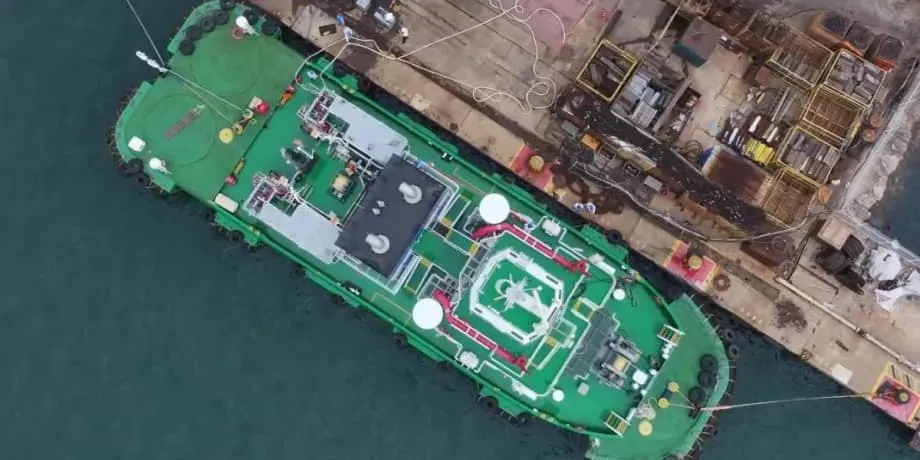
The receiving ship, Antwerpen, was built by HD Hyundai Heavy Industries at its Ulsan shipyard. Its engine can operate on a blend containing up to 95% ammonia, with conventional fuel making up the remainder. The refuelling brought together a new fuel, a vessel designed to use it and a terminal equipped to deliver it.
Ulsan Port Authority oversees the only port designated as a green ship fuel supply port in the Republic of Korea. The April 23 operation demonstrated that ammonia could be supplied through existing commercial port infrastructure, moving the fuel beyond planning and into a completed commercial transfer.
Shipping produces approximately 3% of global greenhouse gas emissions. The International Maritime Organization's goal of carbon neutrality by 2050 is pushing the industry to find alternatives to heavy fuel oil. Ulsan's achievement provides a practical example of how one of those alternatives can reach a ship, while also showing the equipment and precautions required to handle it.
How the fuel travelled from China to Ulsan
Envision Energy's Chefeng facility in Inner Mongolia has a production capacity of 320,000 tonnes a year. It uses renewable electricity to split water and produce hydrogen, a process called electrolysis. The hydrogen is then combined with nitrogen through the Haber-Bosch synthesis process to make ammonia.
Green ammonia is distinguished by how it is produced. At the Envision facility, wind and solar electricity drive the production process without associated carbon dioxide emissions. Conventional grey ammonia is produced using natural gas. The chemical becomes a cleaner fuel option when the energy used to make it comes from renewable sources.
Lotte Fine Chemical operates Asia's largest ammonia terminal near Ulsan. Its March import created the first part of the commercial supply chain demonstrated the following month: renewable production in China, transport to South Korea, terminal storage and delivery into a ship's fuel system.
The main steps leading to the April 23 transfer were:
- In 2025, Lotte Fine Chemical registered as South Korea's first ammonia ship fuel supplier and prepared its terminal infrastructure for marine fuel applications.
- In 2025, national authorities designated Ulsan as a regulatory free special zone for ammonia bunkering.
- In March 2026, Lotte Fine Chemical imported South Korea's first bulk cargo of green ammonia from Envision Energy in Inner Mongolia.
- On April 23, approximately 600 tonnes were transferred from storage at Ulsan Port into Antwerpen's fuel systems.
- On April 24, Lotte Fine Chemical shares rose more than 13% in early trading following the operation.
The completed chain matters because producing a new fuel is only one part of replacing oil in shipping. Ports also need to receive it, store it and deliver it safely to vessels. Ulsan brought those stages together at commercial scale.
A cold liquid with demanding handling requirements
The ammonia moved from a dome-shaped storage tank about 900 meters from the dock, through a white pipeline system and into a loading arm resembling a robotic apparatus. Workers communicated by radio and repeatedly checked the connections as the transfer proceeded.
Liquid ammonia must be kept at minus 33 degrees Celsius to remain liquid at atmospheric pressure. Liquid hydrogen requires a much lower temperature, minus 253 degrees Celsius. Ammonia therefore has less demanding cooling requirements, although its toxicity creates a different set of handling risks.
Ammonia in liquid form offers approximately 1.7 times the storage density of liquefied hydrogen at equivalent volumes. Its storage characteristics make it suitable for transport in large quantities and for voyages over long distances, both essential requirements for commercial shipping.
Ammonia is toxic to people and aquatic life. A leak can therefore threaten workers at the terminal and the surrounding water. The Ulsan operation required equipment to detect escaping gas, contain releases and support an emergency response throughout the transfer.
Safety systems remained ready throughout the transfer
Workers at Ulsan monitored safety conditions and inspected connection points repeatedly while the fuel flowed to the vessel. An ammonia gas detector provided continuous leak monitoring, while an ammonia purge recovery unit was designed to capture potential releases before they reached the atmosphere or water.
Absorption equipment at the spill control tower stood ready alongside wastewater treatment facilities. A fire truck remained on standby for the duration of the procedure. Together, these arrangements provided several ways to detect a problem and respond to it.
The transfer was completed without incident. That result validated the safety protocols developed for the operation and gave the port practical experience in handling ammonia as a marine fuel.
Ulsan's infrastructure reflects years of planning and investment. Lotte Fine Chemical's registration as an ammonia ship fuel supplier in 2025 prepared the business for a role beyond importing and storing the chemical: delivering it directly for use aboard vessels. The April operation put that preparation into commercial practice.
Antwerpen brings ammonia into the engine room
Antwerpen measures 190 meters in length and 30.4 meters in width, with a cargo capacity of 46,000 cubic meters. HD Hyundai Heavy Industries constructed the vessel at its Ulsan shipyard, linking the local shipbuilding industry with the port's developing fuel supply business.
The vessel has an engine that injects ammonia at high pressure and can run on a mixture containing up to 95% ammonia blended with conventional fuel. Its dual fuel system allows the ship to use ammonia as part of its propulsion fuel mix.
A selective catalytic reduction system reduces nitrogen oxide emissions, one of the main environmental concerns associated with burning ammonia. This equipment treats exhaust gases, addressing pollution from the engine alongside the effort to reduce the carbon footprint of the fuel supply.
Arlon, a sister vessel built to identical specifications, is scheduled to join the fleet in the coming months. Both ships will be managed by Exmar LPG France, a subsidiary of Belgium's Exmar shipping group. They will carry liquefied gases, including ammonia and liquefied petroleum gas, while operating with their new dual fuel systems.
Investors respond to a completed supply chain
Lotte Fine Chemical shares rose more than 13% in early trading on April 24 on the Korea Composite Stock Price Index. The shares reached a one year high of 64,400 won before settling at 63,600 won.
The market response reflected enthusiasm for the company's completion of the supply chain for ammonia marine fuel. Lotte Fine Chemical had demonstrated import logistics, terminal storage and final delivery to a ship, the stages needed to turn green ammonia production into a usable shipping service.
The company aims to become the dominant participant in South Korea's ammonia bunkering business. Bunkering is the shipping industry's term for supplying fuel to a vessel. Analysts project that the domestic market could reach 3 trillion won by 2050 as the country moves toward shipping fuels with no carbon emissions.
The International Energy Agency projects that ammonia could account for 8% of marine fuel demand by 2030 and 46% by 2050. Those figures describe an increase of 38 percentage points, taking ammonia from a relatively small share to nearly half of marine fuel demand under that projection.
Seok-Min Hwang, managing director of Lotte Fine Chemical's ammonia business division, said Ulsan could take a larger role if future demand leads to fuel delivery by ship:
If ship based fuel supply is introduced in the future to meet demand, the Port of Ulsan will play a more active role as a hub for eco friendly ship fuels such as ammonia fuel.
His statement points to a possible expansion beyond the transfer from land demonstrated on April 23. Lotte Fine Chemical is positioning its terminal operations to benefit as shipping companies seek alternatives to fossil fuels.
Ulsan's special zone supports new procedures
South Korean authorities designated Ulsan as a regulatory free special zone for ammonia bunkering in 2025. The designation allows faster development of safety standards and operating protocols, reducing the usual administrative constraints that could slow testing.
Port authorities can use the zone to test equipment and procedures in a controlled environment. The resulting practices can serve as templates for other ports as ammonia fuel use expands. The commercial refuelling is therefore part of a wider effort to establish repeatable ways of handling the fuel.
South Korea is also pursuing alternative fuel projects at other coastal locations. Hyundai Motor Group recently entered a multilateral memorandum of understanding with Pyeongtaek City and port authorities to develop hydrogen port initiatives. The plans include ammonia bunkering facilities and alternative maritime power systems.
The Pyeongtaek initiative aligns with the Ministry of Oceans and Fisheries' Hydrogen Port policy and the Ministry of Land, Infrastructure and Transport's Hydrogen City policy. It links port development with a broader effort to build hydrogen infrastructure.
Ken Ramirez, head of Hyundai Motor Group's Global Energy and Hydrogen Business Division, described the partnership and its intended role:
Hyundai is honored to jointly drive this important collaboration as a public private partnership aimed at delivering real world hydrogen applications to achieve the goals of both the Ministry of Oceans and Fisheries Hydrogen Port policy and the Ministry of Land, Infrastructure and Transport Hydrogen City policy. It represents the first domestic initiative to establish a broad hydrogen ecosystem for port decarbonization, using the advanced infrastructure of Pyeongtaek Port.
Ulsan and Pyeongtaek show South Korea's intention to develop more than one port as a regional hub for alternative marine fuels. Multiple locations would reduce dependence on a single terminal and provide additional supply options.
Shipping targets create demand for new fuel infrastructure
Shipping companies face increasing regulatory pressure to move away from heavy fuel oil. Recent emissions levies apply to most vessels docking at European Union ports. Global carbon pricing frameworks have faced delays, while international regulation continues to move toward operations with no carbon emissions.
The International Maritime Organization's 2050 carbon neutrality goal gives the Ulsan operation a wider commercial setting. Shipowners need vessels capable of using alternative fuels, and ports need the infrastructure to supply them. The April 23 transfer demonstrated both sides of that relationship in one place.
The Mission Innovation Zero Emission Shipping initiative has set a goal of 600 large vessels running on fuel with no emissions by 2030. Its infrastructure target is 20 key ports across three continents offering the corresponding bunkering facilities.
Ulsan's operation represents the first concrete realization of that vision through a complete commercial green ammonia chain, from renewable production to ship refuelling. It provides a practical example as other countries develop their own facilities.
Hyejeong Kim, director general for shipping and logistics at South Korea's Ministry of Oceans and Fisheries, said the operation could encourage wider use of clean fuels:
We hope the fuelling would serve as a catalyst for introducing clean fuels into ports and demonstrate the viability of these technologies for commercial maritime operations worldwide.
Other ports are preparing ammonia networks
Singapore is working with Vopak and Air Liquide to establish ammonia import and cracking facilities on Jurong Island. Ammonia cracking separates the chemical into hydrogen and nitrogen. The planned facilities are intended to support Singapore's National Hydrogen Strategy.
Japan's IHI Corporation is investigating ammonia supply hubs in Hokkaido and Fukushima. It is working with regional power companies and chemical manufacturers to study supply chains based in Tomakomai and Soma.
Europe's North Sea Port is preparing to supply ammonia alongside hydrogen, methanol and liquefied natural gas. Those facilities remain in development rather than active commercial service.
The projects illustrate the different functions ammonia infrastructure may serve. Ulsan has demonstrated delivery into a ship's fuel system, while Singapore's plans also include recovering hydrogen from imported ammonia. Japan's studies focus on establishing regional supply chains, and North Sea Port is preparing for several fuel types.
The investment needed extends beyond the dock
Research published in the Journal of Physics Energy estimates that decarbonizing shipping through green ammonia would require investment approaching US$2 trillion globally by 2050. The study uses a spatial modeling framework, examining how production and supply could be organized across different locations.
Half of the estimated investment would be needed in countries with low and middle incomes. Applied to the nearly US$2 trillion total, that represents roughly US$1 trillion. The transition would therefore require large investments far beyond the wealthy ports where fuel might ultimately be delivered.
The study predicts that Australia, Chile and Western Africa will become major production hubs because of their solar resources and available land. Asian ports such as Ulsan would serve as major demand centers and bunkering locations, linking production regions with vessels that need fuel.
Ammonia production also involves energy losses, and ports need new safety protocols for handling a toxic fuel. Ulsan's successful transfer establishes a practical starting point for commercial use, while those production and safety requirements remain central to wider adoption.
As of April 25, no exact delivery date had been given for Arlon, beyond the coming months. The next fleet development identified is its arrival alongside Antwerpen, while Ulsan's completed operation provides a working example for the larger port and supply networks under development.
The Essentials
- Ulsan Port completed the world's first commercial port-to-ship green ammonia refuelling on April 23, 2026, transferring approximately 600 tonnes.
- Envision Energy produced the fuel using wind and solar power in Inner Mongolia. Lotte Fine Chemical imported it into South Korea in March.
- Antwerpen was built by HD Hyundai Heavy Industries and can run on a fuel mixture containing up to 95% ammonia.
- The transfer was completed without incident, with gas detection, recovery equipment, wastewater treatment facilities and emergency support ready.
- Lotte Fine Chemical shares rose more than 13% in early trading on April 24, reaching 64,400 won before settling at 63,600 won.
- The International Energy Agency projects ammonia could supply 8% of marine fuel demand in 2030 and 46% in 2050.
- South Korea is developing alternative fuel infrastructure at Ulsan and Pyeongtaek, while projects are also being pursued in Singapore, Japan and Europe.
- Research estimates that a global shipping transition using green ammonia would require nearly US$2 trillion in investment by 2050.