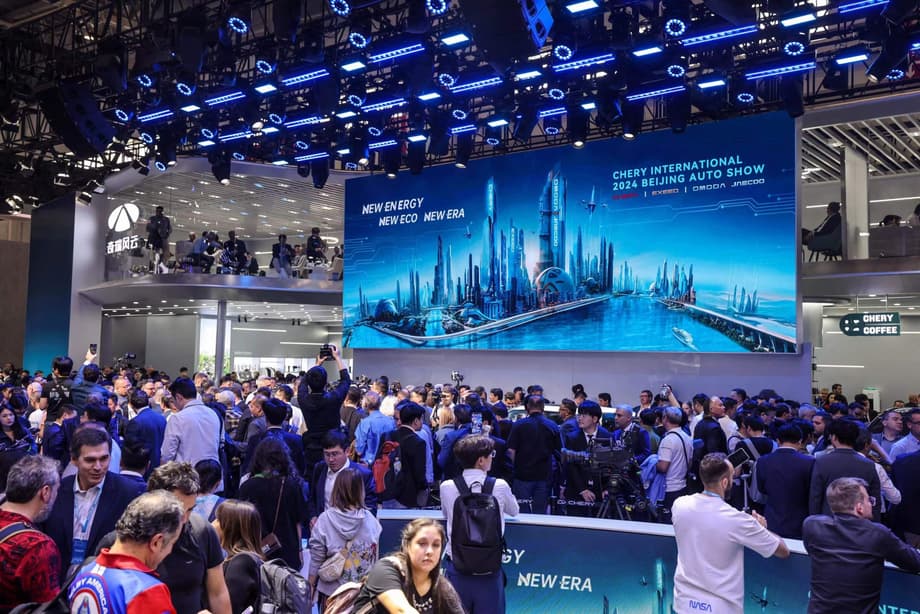
The Beijing Auto Show Announcement
Chinese tech giant Alibaba unveiled one of the most ambitious integrations of artificial intelligence into the automotive sector at the opening of the Beijing Auto Show 2026, announcing partnerships with nine major automakers to embed its Qwen large language model directly into vehicle systems. The collaboration extends beyond domestic Chinese brands to include German luxury manufacturer BMW and SAIC Volkswagen, signaling a significant shift in how global automakers approach the Chinese market.
The announcement encompasses BYD, Geely, Li Auto, Changan, Dongfeng, BAIC, Great Wall Motor, SAIC Volkswagen, and SAIC IM Motors. Each will integrate Qwen into their intelligent cockpit systems, allowing drivers to control an expanding ecosystem of digital services through natural voice commands. This deployment represents Alibaba’s most aggressive move yet to convert vehicles from simple transportation devices into fully integrated commerce and service platforms.
Alibaba Cloud already provides computing services to over 70 percent of China’s domestic vehicle manufacturers, giving the company established infrastructure relationships across the industry. The Qwen integration builds upon this foundation, leveraging years of cloud computing partnerships to embed AI directly into the driving experience.
How the Technology Works
The Qwen automotive system operates on a hybrid architecture that combines on-device processing with cloud-based computing, running specifically on Nvidia’s automotive chip platform. This dual approach addresses one of the persistent challenges of in-car AI: maintaining functionality when network connectivity is limited or unavailable. The on-device component handles basic voice interpretation and intent recognition, while heavier computational tasks and complex multi-step planning shift to Alibaba’s cloud servers when connections permit.
Drivers can execute sophisticated tasks through simple voice commands. The system supports food delivery orders through Ele.me, Alibaba’s food delivery platform; hotel reservations via Fliggy, its travel service; attraction ticket purchases; package tracking through Cainiao logistics; and navigation via Amap. Payment processing occurs seamlessly through Alipay and Alipay AI Pay biometric flows, creating a closed-loop commercial ecosystem within the vehicle.
Earlier this year, FAW Group’s Hongqi brand became among the first to integrate Qwen into production vehicles, debuting the system in the Hongqi HS6 plug-in hybrid model. This initial deployment provided real-world testing data that informed the broader rollout announced at the Beijing show.
Alibaba’s Ecosystem Advantage
What distinguishes Alibaba’s automotive strategy from competitors is vertical integration across commerce, logistics, and payments. While Western automakers typically partner with multiple third-party providers for voice services, navigation, and payment processing, Alibaba offers a unified stack that connects directly to its existing consumer platforms.
This integration allows the AI assistant to access contextual data across Alibaba’s services. The system can reference a driver’s previous food orders, travel history, and shopping patterns to provide personalized recommendations rather than generic responses. A driver who frequently orders from specific restaurants or prefers particular hotel chains will find the system anticipating these preferences during voice interactions.
The commercial implications extend beyond convenience features. By embedding Qwen into vehicle dashboards, Alibaba shifts user attention and transactions from smartphones to the car cockpit, creating new retention and monetization channels. For Chinese automakers facing margin pressures in a slowing electric vehicle market, this partnership offers sophisticated AI capabilities without the massive development costs of building proprietary large language models from scratch.
International Automakers Join the Trend
The integration of Chinese AI models into vehicles extends well beyond domestic brands. At the Shanghai Auto Show, German luxury automaker BMW announced its upcoming Neue Klasse electric vehicles will incorporate Alibaba’s Qwen AI models into their intelligent systems. Alibaba described this partnership as “a significant step forward in AI-driven mobility,” marking the first major German luxury brand to commit deeply to a Chinese AI ecosystem.
Mercedes-Benz showcased its long-wheelbase electric CLA sedan featuring AI capabilities powered by ByteDance’s Doubao model, with the assistant activating within 0.2 seconds according to Volcano Engine, ByteDance’s cloud computing unit. The vehicle represents the first mass production model from this partnership, established in August 2024.
Japanese manufacturers are also participating in this localization trend. Nissan Motor and Honda Motor both announced plans to integrate DeepSeek’s AI models into their cockpit systems to enhance chatbot and voice interaction functions. Meanwhile, American brands are adapting to local preferences. Cadillac displayed new models with voice assistants connecting to ByteDance’s Doubao AI, while Audi’s China-specific operations announced its E7X electric SUV will incorporate features from both Doubao and iFlyTek.
Tesla’s Localized Response
The competitive pressure from Chinese AI integration has prompted even Tesla to adapt its strategy for the local market. The American EV manufacturer recently completed regulatory filings in Shanghai for its in-car voice assistant system, with reports indicating the system will connect to ByteDance’s Doubao and DeepSeek models through encrypted API interfaces accessed via Volcano Engine.
According to Tesla China’s updated vehicle voice assistant terms of use, Doubao will handle voice command functions including navigation setup, media playback, and climate control, while DeepSeek enables broader conversational interactions. This dual-model approach allows Tesla to maintain its brand identity while accessing locally optimized AI capabilities that understand Chinese language nuances and consumer behaviors.
Tesla’s China-made vehicle sales rose 23.5 percent year-on-year in the first quarter, but the company faces increasing pressure from domestic competitors offering superior localized digital experiences. By integrating Chinese AI models, Tesla attempts to close gaps in smart features while maintaining regulatory compliance and user engagement in its most important international market.
Market Forces Driving AI Integration
The rush to embed sophisticated AI assistants reflects fundamental shifts in China’s automotive market. Electric vehicle sales growth has moderated after years of explosive expansion, forcing manufacturers to seek differentiation through software and services rather than battery range or acceleration specifications alone.
Chinese EV makers such as Nio, XPeng, and BYD have already integrated voice-powered AI assistants into their vehicles, establishing consumer expectations that international brands must match to remain competitive. As cars become essentially computers on wheels, the quality of digital interaction increasingly influences purchasing decisions among tech-savvy Chinese consumers.
This trend aligns with Beijing’s broader “AI Plus” initiative, which supports artificial intelligence integration across sectors including manufacturing and transportation. Chinese policymakers have specifically targeted “embodied AI” including autonomous vehicles and smart cockpit systems in the country’s latest five-year economic plan, creating regulatory and policy tailwinds for these deployments.
Technical and Regulatory Challenges
Despite the promise of AI-powered vehicles, significant challenges remain regarding safety, data governance, and driver distraction. Rich service chaining requires cross-service user data and real-time authorization, increasing the attack surface for potential security breaches while raising questions about who controls customer data and model updates.
The hybrid on-device and cloud architecture, while addressing latency concerns, introduces complexity around compute, thermal management, and power budgets in production vehicles. Automotive-grade AI systems must maintain responsiveness during high-temperature operations and power fluctuations while processing multiple sensor inputs and voice streams simultaneously.
Regulatory scrutiny is intensifying as these systems move beyond simple voice commands to execute financial transactions and access personal data. Chinese cyberspace regulators have implemented filing requirements for AI-powered functionalities, as demonstrated by Tesla’s recent registration in Shanghai. These requirements ensure compliance with data localization laws and content moderation standards specific to the Chinese market.
Implications for Global Markets
It remains unclear whether AI features developed for Chinese markets will appear in vehicles exported to international markets. Regulatory differences, data privacy laws, and the absence of Alibaba’s consumer ecosystem outside China complicate global deployment. European and North American markets lack the integrated super-app environment that makes Qwen’s commerce capabilities valuable in China.
However, the partnerships signal a broader industry shift toward outsourcing AI complexity to specialized technology providers rather than building proprietary systems. For global automakers, partnerships with established Chinese AI firms offer faster time-to-market and superior localization compared to adapting Western AI models for Chinese consumers.
Li Qiang, general manager for vehicle and energy industry at Alibaba Cloud, emphasized the company’s commitment to automotive applications: “In the automotive field, Alibaba Cloud will continue to promote the application of AI in various industries to better serve customers’ business innovations.” This statement reflects the company’s strategy to extend beyond cloud infrastructure into the application layer of vehicle software.
Key Points
- Alibaba announced Qwen AI integration with nine automakers at Beijing Auto Show 2026, including BYD, Geely, Li Auto, Changan, Dongfeng, BAIC, Great Wall Motor, SAIC Volkswagen, and SAIC IM Motors
- BMW became the first major German luxury brand to commit to Qwen, integrating the AI into its upcoming Neue Klasse electric vehicles for the Chinese market
- The system enables voice-controlled food delivery, hotel bookings, ticket purchases, and package tracking through Alibaba’s ecosystem including Ele.me, Fliggy, and Cainiao
- Technology runs on Nvidia automotive chips using hybrid on-device and cloud processing to maintain functionality with limited connectivity
- Competitors including ByteDance’s Doubao and DeepSeek have secured partnerships with Mercedes-Benz, Audi, Nissan, Honda, and Tesla’s localized Chinese systems
- Integration reflects slowing EV market growth pushing automakers to differentiate through software and digital services rather than hardware specifications alone
- Chinese regulatory requirements and consumer preferences are driving international automakers to adopt local AI models for the market