
A Record Reserve Brings New Responsibilities
Indonesia's government rice reserves reached 5,000,198 tons on April 23, 2026, the highest level since independence in 1945, according to Deputy Agriculture Minister Sudaryono. The milestone surpasses the previous record of 2.6 million tons set in 1984, during the country's first era of rice self-sufficiency, and brings the stockpile close to twice that historical peak.
Contents
- A Record Reserve Brings New Responsibilities
- How Indonesia Moved Away From Imports
- Warehouses Struggle to Keep Up
- The Harvest Behind the Stockpile
- Why More Rice Did Not Mean Lower Prices
- Stock Releases and the Price Response
- Rice Exports and Humanitarian Shipments
- Food Supply Beyond Rice
- A Buffer Against Drought, With More Rice Expected
- The Milestones Behind the Change
- Key Points
Bulog, the state logistics agency, manages the Government Rice Reserve as both an emergency food buffer and a source of rice for social assistance. Its expanding stocks reflect months of intensive purchasing from domestic producers and stronger agricultural output. For Southeast Asia's largest economy, the achievement marks a sharp change from recent dependence on imported rice.
Indonesia imported approximately 7 million tons of rice during 2023 and 2024, at a cost of roughly Rp 100 trillion. President Prabowo Subianto, who took office in October 2024, has set a target of zero rice imports for 2026. The government is also pursuing exports and humanitarian shipments while continuing to buy local harvests.
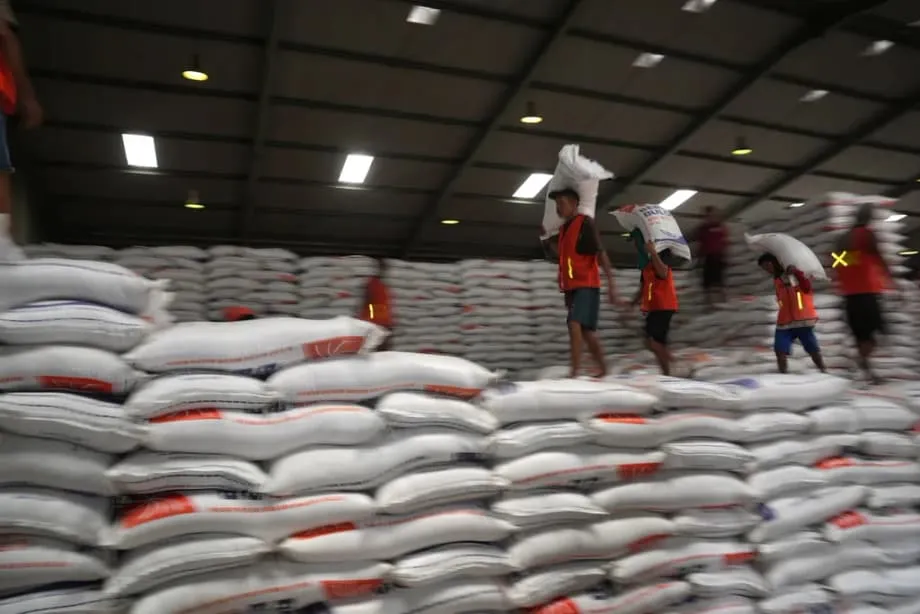
The immediate challenge is finding enough space for the rice and moving it to people who need it. Bulog's approximately 3 million tons of owned warehouse capacity falls well below the reserve total. Another 2 million tons of rented capacity is already full, and the agency plans to rent space for a further 1 million tons.
Consumer prices present another test. Rice reached record prices during 2025 despite rising production, prompting releases from government stocks and investigations into milling companies. Indonesia's experience shows why food security involves several connected tasks: growing enough grain, buying it from farmers, keeping it in good condition and distributing it at prices households can afford.
How Indonesia Moved Away From Imports
President Prabowo's administration has made domestic food production a priority following the heavy rice imports of 2023 and 2024. Those purchases used foreign exchange, the money needed to pay overseas suppliers, and exposed Indonesia to changing international prices and supplies.
Agriculture Minister Andi Amran Sulaiman has described food self-sufficiency as essential to economic sovereignty. His argument draws on the behavior of exporting countries during global emergencies: governments commonly put their own populations first and restrict shipments abroad. Producing enough food domestically reduces Indonesia's exposure to those decisions.
Indonesia's withdrawal from international rice buying has also affected markets beyond its borders. Analysts attributed part of a 21.5% fall in Thai rice prices through August 2025 to the loss of Indonesian import demand. A country that had been a major buyer was purchasing less rice from overseas.
Lower import spending can ease pressure on the rupiah, which has faced volatility amid elevated global oil prices. Money previously spent on foreign rice could support agricultural infrastructure or other development priorities. The roughly Rp 100 trillion spent in 2023 and 2024 provides a measure of the scale of that earlier dependence.
The government's goal for 2026 is to maintain zero rice imports while expanding opportunities to sell abroad. The speed of the change, from one of the world's largest rice importers toward surplus production, has made rice a central part of the administration's economic and national security agenda.
Warehouses Struggle to Keep Up
Minister Amran's inspection in Makassar, South Sulawesi, showed how sharply regional stocks have expanded. Warehouses in the province held 761,000 tons, compared with a maximum of 300,000 tons in previous years. The new total is more than double that earlier capacity benchmark.
National reserves stood at about 1.5 million tons during the same period last year. Officials described the current expansion as a 200% increase, with stocks now exceeding 5 million tons. The rapid accumulation has turned warehouse availability into an immediate operational concern.
Karawang in West Java illustrates the pressure at an individual facility. Its total capacity is 102,000 tons, and it currently holds approximately 80,000 tons. Continued procurement could push national reserves to 6 million tons within the next two months, requiring more space even as existing facilities fill.
Bulog has already combined roughly 3 million tons of its own capacity with 2 million tons rented from private operators. With the rented facilities completely filled, plans call for another 1 million tons of leased storage. Emergency options include using idle land belonging to the military and police for temporary storage sites.
President Prabowo has ordered the immediate construction of emergency facilities so that locally produced rice can continue to be absorbed. Storage matters to farmers as well as warehouse managers: without room for government purchases, farmers could be forced to sell to private buyers at lower prices.
Sudaryono also inspected the condition of stored rice, including sacks containing grain kept for up to a year. He requested that randomly selected sealed sacks be opened for quality checks and reported no pest infestation or deterioration. His inspection addressed the practical requirement that a large reserve remain usable throughout its time in storage.
The Harvest Behind the Stockpile
Indonesia's Central Statistics Agency put national rice production at 34.69 million tons in 2025, an increase of 13.29% from the previous year. Larger harvested areas and intensive government support contributed to the growth. The United States Department of Agriculture forecast production of 34.6 million tons for 2025, potentially placing Indonesia ahead of other rice producers in Southeast Asia.
The government has pursued several ways to grow more rice. A cropping program allows three harvests a year in suitable regions. More frequent harvests increase the amount a field can produce over a year, provided that local conditions support repeated planting.
Irrigation expansion covered 500,000 hectares through pump systems known locally as pompanisasi. These systems bring water to land that previously depended on rainfall. Other measures optimized 800,000 hectares of existing agricultural land and converted 200,000 hectares into new rice fields.
The programs combine additional farmland with more intensive use of existing land and better access to water. Their contribution goes beyond increasing the planted area: reliable irrigation can allow farmers to plant when rainfall alone would be insufficient.
Approximately 11 million tons of rice ready for harvest remained in the fields, providing another layer of supply alongside warehouse reserves. Through April 2026, Bulog had purchased 1.6 million tons of rice and 131,000 tons of corn directly from farmers.
Those purchases support rural incomes while building public stocks outside the spikes in distribution associated with religious holidays. The rice procurement level already exceeds Bulog's average annual absorption over the past five decades, showing the scale of the current effort to bring domestic production into government reserves.
Why More Rice Did Not Mean Lower Prices
Indonesian consumers paid record rice prices during 2025 even as production expanded. Benchmark medium rice reached Rp 15,950 per kilogram, approximately $0.96, in August. That matched the earlier record during the 2024 El Nino drought, although domestic output had risen nearly 16% in the first seven months of 2025.
The government's purchasing policy helped explain the pressure. In January 2025, the official purchase price for unhusked rice rose from Rp 6,000 to Rp 6,500 per kilogram. Unhusked rice is grain that still has its outer covering and must be processed before it becomes the rice sold for cooking.
Bulog was ordered to buy 3 million tons domestically, nearly triple its local procurement in the previous year. In March, President Prabowo directed that the government price apply to rice of any quality, rather than only grain meeting specified moisture and broken grain standards.
Sutarto Alimoeso, chief of the Association of Rice Millers and Rice Entrepreneurs, explained that farmers rushed to harvest before the grain was fully ripe to secure the guaranteed Rp 6,500 price. Thousands of mills then competed for unhusked grain, offering prices above Bulog's level to keep their operations supplied.
Higher buying prices supported farmers but raised costs for businesses processing and selling rice. Mills competing with a large government buyer had to pay more for available grain, and those costs moved through the supply chain. The result was a price squeeze for consumers despite abundant rice in public storage.
The Indonesian Ombudsman, the independent body supervising public services, assessed the situation after finding no rice available at eight of 35 supermarkets surveyed in the Jakarta area. It described the problem in these words:
The recent increase in rice prices is not due to stock shortages, but rather to suboptimal rice management.
Stock Releases and the Price Response
The Ombudsman urged the immediate release of Bulog reserves to stabilize markets. Authorities subsequently ordered the agency to release 1.3 million tons by the end of 2025. By September 20, deliveries to markets had reached 210,791 tons.
Police also accused 30 officials from milling companies of consumer protection violations. The allegations included labeling rice of medium quality as premium rice so that it could be sold at higher prices. Such practices added another concern to a market already under pressure from competition for grain.
Prices began easing late in 2025 as interventions took effect. Social media posts nevertheless continued to describe limited availability of premium rice in supermarkets. Government reserves and the rice available on a particular shop shelf depend on different stages of storage, processing and distribution.
Esther Sri Astuti, executive director of the Institute for Development of Economics and Finance, linked rising food prices to broader protest movements across Indonesia during that period. The episode connected rice policy with household budgets and public discontent, rather than leaving it solely as a question of agricultural output.
The National Food Agency's Retail Price Ceiling remains in effect. Traders are expected to comply now that supply constraints have been resolved. For the government, the task is to make its large reserve work alongside distribution and market oversight so that support for farmers also produces affordable rice for consumers.
Rice Exports and Humanitarian Shipments
Indonesia has completed its first shipment of premium rice to Saudi Arabia, exporting 2,280 tons valued at Rp 38 billion, or $2.2 million. The shipment demonstrated that Indonesian rice could meet rigorous international standards and gave the country an export outlet as domestic stocks expanded.
Sudaryono has pointed to neighboring markets as attractive destinations because geographic proximity offers logistical advantages. Negotiations with Malaysia have reached the implementation phase, with plans to export 2,000 tons of rice outside the premium category each month.
Malaysia produces only 40% to 50% of the rice it needs and faces high domestic prices. The proposed trade marks a change in regional patterns for Indonesia, which historically relied on Malaysian supplies of other commodities while struggling to meet its own rice needs.
Talks with the Philippines and Papua New Guinea are continuing. Indonesia is also considering requests from other countries facing food insecurity. The Malaysian plan and those discussions sit alongside the completed Saudi shipment as different stages in the effort to develop overseas sales.
Humanitarian plans include 10,000 tons of rice for Palestine. Indonesia has also approved its first urea fertilizer export to Australia, totaling 250,000 tons. The fertilizer decision extends the export push from food itself to an agricultural input used in crop production.
Minister Amran has linked these developments to the need to reduce dependence on outside food supplies. Countries producing food tend to prioritize domestic needs during global crises, he has argued. Maintaining substantial domestic reserves while arranging commercial and humanitarian shipments gives Indonesia a different regional role from its recent position as a major importer.
Food Supply Beyond Rice
The National Food Agency confirmed that Indonesia stopped importing corn entirely during 2025 because domestic production was sufficient for national needs. Bulog's purchases of 131,000 tons of corn through April 2026 form part of the wider procurement effort alongside rice.
Indonesia has also achieved self-sufficiency in consumer sugar, shallots, chili peppers, chicken meat and eggs. The reported remaining food imports are limited to soybeans, garlic and beef, whose demand levels do not dominate domestic consumption patterns.
I Gusti Ketut Astawa, deputy head of the National Food Agency, known as Bapanas, has stressed that food security is strong across staple categories, rather than only in grains. Production across several foods reduces exposure to international price shocks affecting any one commodity.
Rice still receives particular attention because it is the national staple for 280 million people. Bulog's management of rice reserves and Bapanas's monitoring of other commodities give the government connected responsibilities: maintaining an emergency grain supply while tracking the availability of a wider range of foods.
A Buffer Against Drought, With More Rice Expected
Minister Amran has described the current reserves as providing approximately five months of national rice consumption and said Indonesia is positioned to withstand even an extreme El Nino event. El Nino can bring drought conditions that disrupt rice production, as Indonesia experienced in 2024 when lower output forced reliance on imports.
The roughly 11 million tons of rice ready for harvest adds to that protection. Officials expect continuing procurement to lift warehouse reserves to 6 million tons within two months, making additional storage a pressing requirement rather than a distant construction goal.
Sudaryono's assessment that even rice stored for a year remained in excellent condition supports the government's confidence in its reserve. Keeping quality controls in place will matter as volumes grow and more rented or temporary facilities enter use.
The administration intends to maintain zero rice imports through 2026 while expanding exports. Its ambition is to replace the import dependence that shaped Indonesian food policy for decades with sustained domestic supply. Storage capacity, consumer prices and the movement of rice from warehouses into markets remain central to making that ambition work.
The Milestones Behind the Change
Indonesia's rice policy has moved through several stages, from heavy imports and drought pressure to larger domestic purchases and record reserves. The sequence helps explain why the April milestone arrived alongside debates about prices and warehouse space.
- 1984: Rice reserves reached the previous record of 2.6 million tons during Indonesia's first era of self-sufficiency.
- 2023 and 2024: Indonesia imported approximately 7 million tons of rice worth roughly Rp 100 trillion.
- October 2024: Prabowo Subianto took office as president.
- January 2025: The government raised its purchase price for unhusked rice to Rp 6,500 per kilogram and ordered 3 million tons of domestic procurement.
- March 2025: Prabowo directed that the guaranteed price apply regardless of rice quality.
- August 2025: Medium rice reached Rp 15,950 per kilogram despite increased production.
- September 20, 2025: Market deliveries under the reserve release program reached 210,791 tons.
- April 23, 2026: Government rice reserves reached 5,000,198 tons.
As of April 25, the government faces the practical work that follows the record: accommodating continuing harvest purchases, preserving stored grain and keeping rice accessible to households. Its growing export activity adds a regional dimension to that domestic task.
Key Points
- Government rice reserves reached a record 5,000,198 tons on April 23, nearly twice the 1984 peak.
- Indonesia targets zero rice imports in 2026 after importing about 7 million tons during 2023 and 2024.
- Bulog plans another 1 million tons of rented storage as officials project reserves of 6 million tons within two months.
- Rice production reached 34.69 million tons in 2025, up 13.29% from the previous year.
- Record consumer prices in 2025 prompted reserve releases and action over alleged rice mislabeling.
- A rice shipment to Saudi Arabia is complete; plans include monthly exports to Malaysia and humanitarian rice for Palestine.
- Indonesia also reports self-sufficiency in corn, consumer sugar, shallots, chili peppers, chicken meat and eggs.