The Future Arrives in Beijing
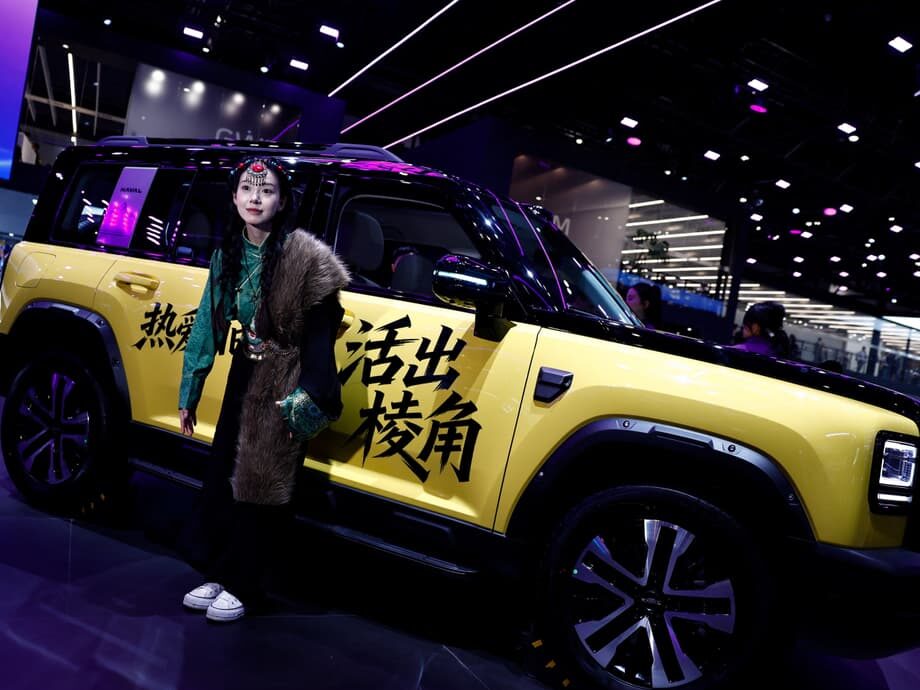
Hundreds of manufacturers gathered this month at the Beijing Auto Show, covering 380,000 square metres on the outskirts of the Chinese capital. More than 1,000 vehicles gleamed under exhibition lights while hundreds of thousands of enthusiasts streamed through the halls. Yet one detail stood out in this temple of automotive ambition: hardly anyone was behind a wheel.
The world’s largest automotive exhibition has become a showcase for a radical transformation. Chinese car companies, having already cornered the domestic electric vehicle market, are now racing toward what they believe represents the next frontier of mobility. Autonomous driving technology dominated the event, with manufacturers displaying intelligent systems that promise to reshape how humans interact with their vehicles.
Xpeng unveiled an AI model that allows drivers to issue conversational commands such as “park near the entrance to the shopping centre” rather than selecting specific map coordinates. Xiaomi, the appliance and smartphone giant turned automaker, demonstrated an operating system that detects driver stress levels and adjusts home lighting and music accordingly before the car even reaches the driveway. The vehicle can make restaurant reservations, compile notes during transit, and place coffee orders through voice integration.
This technological showcase arrives at a critical moment for the industry. Domestic passenger vehicle sales in China dropped 17% during the first quarter of this year as government subsidy programmes phased out. BYD, the sector’s bellwether, has reported seven consecutive months of declining sales. Faced with shrinking margins on hardware, manufacturers are pivoting toward software and artificial intelligence as potential revenue lifelines.
From Metal to Software
The economics of automobile manufacturing in China have shifted dramatically. Tu Le, managing director of Sino Auto Insights, a consultancy focused on the Chinese automotive market, explains that selling passenger vehicles domestically is no longer a viable standalone business model given the intense competition.
The fact that almost every automaker has some version of intelligent driving makes it different to almost any market in the world.
Le notes that Chinese companies now compete to offer additional perks and find new ways to generate revenue beyond the initial vehicle sale. Leasing AI-powered software represents one such avenue, transforming cars into platforms for subscription services and recurring income.
Huawei, the telecommunications giant that has aggressively expanded into automotive technology, announced plans to invest up to 80 billion yuan (approximately £8.7 billion) over the next five years to develop autonomous driving software and computing infrastructure. This massive commitment signals the seriousness of the sector’s technological pivot.
The transformation extends to commercial vehicles. Pony.ai, a Beijing-based autonomous driving startup, unveiled what it described as the world’s first fully-compliant Level 4 autonomous light-duty truck at the exhibition. Developed jointly with battery manufacturer CATL, the vehicle targets urban delivery and intercity freight operations. The company also announced that its fourth-generation autonomous heavy-duty trucks have entered mass production, with cargo operations scheduled to commence later this year.
Regulatory Barriers and Safety Realities
Despite the optimism on display, the path toward widespread autonomous driving remains complicated by technical failures and regulatory caution. Chinese authorities have adopted a safety-first strategy, tightening rules and clarifying responsibility before allowing broader deployment.
In Wuhan last month, several Baidu Apollo Go robotaxis experienced system failures that caused them to stall in traffic, leaving passengers stranded for hours on expressways as trucks hurtled past. Police received multiple reports of immobilised vehicles blocking lanes. Video footage circulated on social media showed one vehicle stopped in a live traffic lane rather than on the shoulder, with a passenger visible inside as heavy vehicles passed nearby.
A more serious incident occurred in Zhuzhou, where a Hello autonomous vehicle struck two pedestrians, leaving them hospitalised in intensive care. Bystanders were forced to collectively lift the vehicle to rescue one victim trapped beneath it. The vehicle, operating under a testing programme approved just months earlier, was subsequently suspended from service.
These incidents follow a fatal crash in March involving a Xiaomi SU7 equipped with assisted-driving technology. The vehicle collided with a concrete barrier on a highway in Anhui Province, killing three occupants. According to company statements, the car was travelling at 72 miles per hour when it detected construction-related lane closures and issued warnings. The driver took control one second before impact.
The crash prompted unusual public scrutiny in a sector where such incidents are typically suppressed by censors. It also catalysed regulatory action. In April, the Ministry of Industry and Information Technology banned misleading marketing terms such as “autonomous driving” and “hands-free driving” for Level 2 vehicles, following evidence that drivers were over-relying on assistance features.
Recent approvals for Level 3 technology reflect this cautious approach. The Ministry granted limited permissions to just two of nine applicants: Beijing Automotive Group and Changan Automobile. Even these approvals were narrowly tailored, restricting operation to designated highway sections in their respective hometowns while prohibiting lane changes under computer control. On any other road, the vehicles must remain under human control.
What looked like an imminent L3 rollout was, in hindsight, a marketing-led acceleration running ahead of governance, insurance frameworks and public trust.
Bill Russo, an electric vehicle consultant based in Shanghai, observes that the government’s decision formalises a pause intended to slow progress, narrow scope, and establish guardrails rather than stopping development entirely.
Global Ambitions Meet Geopolitical Realities
While domestic sales contract, Chinese manufacturers are accelerating overseas expansion, particularly in markets less restrictive than the United States or European Union. Exports surged more than 60% during the first quarter, with companies targeting the United Kingdom, Canada, and select European nations.
Chery, China’s largest car exporter, has emerged as one of the fastest-growing brands in Britain since launching there in August 2025. The company sold 13,500 vehicles between September 2025 and March 2026, and announced ambitious goals for 10 million global annual sales by 2030, up from 5 million in 2025.
This exceptional growth underlines Chery UK’s position as a key contributor to the overall business growth by 2030.
Farrell Hsu, UK country director for Chery, emphasised the strategic importance of the British market. Industry professionals note that the UK appears culturally agnostic regarding Chinese electric vehicles compared to other nations that have blocked entry on national security grounds.
Autonomous technology partnerships are following trade routes. Baidu has announced collaborations with Lyft and Uber to deploy its Apollo Go robotaxis in London, Germany, and other European cities by 2026. Geely revealed plans to deploy thousands of driverless taxis globally next year through its ride-hailing subsidiary, Caocao.
These expansions face significant headwinds. Faced with tariffs in major Western markets, Chinese companies are navigating complex regulatory environments regarding data sovereignty and safety standards. WeRide, another autonomous driving startup, has opened a compliance office in Frankfurt and pledged to store all European user data locally in response to privacy concerns.
The Global Competition Intensifies
The technological rivalry extends beyond vehicle exports to encompass direct competition with established Western automakers. BYD shook the industry earlier this year by offering its “God’s Eye” driver-assistance package at no additional cost, undercutting Tesla’s Full Self-Driving software, which retails for nearly $9,000 in China.
Taylor Ogan, an American investor based in Shenzhen who has driven vehicles from both manufacturers, argues that BYD’s system proves more capable than Tesla’s offering in Chinese urban environments. This assessment reflects fundamental differences in approach: Chinese systems typically employ sensor-fusion architectures incorporating radar and lidar, while Tesla relies exclusively on cameras and artificial intelligence.
Analysis by A2MAC1, a Paris-based benchmarking firm, indicates that BYD’s hardware costs for a mid-tier God’s Eye system total approximately $2,105, compared to $2,360 for Tesla’s camera-only approach. Sensors cost roughly 40% less in China than comparable devices in Europe and North America, while lidar units carry a 20% discount, thanks to economies of scale created by China’s electric vehicle boom.
Foreign manufacturers are responding by partnering with Chinese technology providers rather than competing against them. Cadillac announced its first driver-assist vehicle for China, the VISTIQ luxury SUV, using software co-developed with autonomous driving startup Momenta. Hyundai’s new IONIQ V incorporates similar technology from the same partner. Volkswagen revealed four new models incorporating AI from Tencent, Alibaba, and Baidu, including the ID. UNYX 09 co-developed with Xpeng in just two years.
Volkswagen Group CEO Oliver Blume was spotted interacting with CATL Chairman Robin Zeng at the Porsche booth during the exhibition, while Xiaomi’s Lei Jun toured displays alongside executives from Li Auto and Mercedes-Benz. These encounters illustrate the complex interdependence now characterising the global industry.
Beyond Four Wheels
The Beijing exhibition hinted at mobility solutions extending beyond conventional automobiles. Xpeng’s chief executive, He Xiaopeng, promised that humanoid robots would follow the company’s new GX SUV later this year, with flying cars eventually entering mass production.
AutoFlight, a Chinese aviation startup, displayed a 10-seat air taxi that attracted long queues of visitors eager to examine the interior. This reflects China’s broader push to dominate what officials term the “low-altitude economy,” encompassing drone delivery and urban air mobility.
Industry analysts forecast that over one million passenger vehicles with Level 3 capabilities could operate on Chinese roads by next year, provided pilot programmes proceed smoothly. Goldman Sachs predicts that by 2040, nine out of ten cars sold in China will feature Level 3 autonomy or higher.
Yet significant questions persist regarding liability frameworks, insurance pricing, and infrastructure readiness. High-precision positioning systems and frequently updated high-definition maps remain unevenly distributed across regions. The legal distinction between driver and manufacturer responsibility remains unresolved, though draft revisions to China’s Road Traffic Safety Law propose adding specific chapters addressing autonomous operation.
Zhang Yongwei, president of China EV100, a Beijing-based industry think tank, argues that the current pilot programmes serve purposes beyond technical validation. They test and improve supporting systems including traffic management, insurance claims processing, and regulatory coordination.
This is not just a technical proving ground. It is a process that pushes both technological innovation and regulatory frameworks toward maturity.
Key Points
- Chinese automakers are pivoting from hardware sales to AI-powered software services as domestic EV sales decline 17% in the first quarter.
- Huawei committed 80 billion yuan to autonomous driving development over five years, while Xpeng and Xiaomi showcase advanced AI integration.
- Regulatory authorities approved only two manufacturers for limited Level 3 testing following fatal crashes and system failures involving Baidu and Xiaomi vehicles.
- Exports surged 60% as companies like Chery target the UK and European markets, with robotaxi partnerships announced with Lyft and Uber.
- Foreign manufacturers including Cadillac and Hyundai are partnering with Chinese tech firms to remain competitive in the domestic market.
- Industry forecasts suggest over one million Level 3 capable vehicles could operate on Chinese roads by next year, contingent on resolving liability and infrastructure challenges.