When Manufacturing Becomes a Tourist Destination
Imagine visiting Beijing and skipping the ancient landmarks in favor of a lottery draw for factory tour tickets. This is the reality for thousands of visitors who now view industrial might as the ultimate attraction. Xiaomi’s manufacturing facility has become an unlikely tourist sensation, with free 60-minute guided tours carrying such prestige that scalpers sell access for as much as $300 on the black market. Hopeful visitors face month-long waits and lottery odds of roughly 200 spots among 100,000 applicants, creating a frenzy that rivals traditional cultural sites.
The phenomenon reflects a broader shift in how China showcases its technological capabilities. Known locally as “tiger moms,” ambitious parents bring children as young as six to witness robots assembling smartphones and electric vehicles, hoping to spark early fascination with engineering. The facility offers a 40-minute ride through high-tech exhibition halls followed by 20 minutes observing approximately 100 workers overseeing nearly 700 robots. Visitors witness a production cadence that outputs a high-end electric vehicle every 76 seconds, while the adjacent smartphone facility achieves even faster speeds. Approaching the Xiaomi campus reveals expansive buildings linked by landscaped courtyards featuring installations of rabbit mascots, a flying-pig sculpture symbolizing realized dreams, and giant company logos reflected in water features.
This tourism surge gained momentum following February product launches that saw 10,000 units of the SU7 Ultra vehicle sell within two hours. The resulting “factory tourism” craze aligns with government projections of 20 million annual visitors to industrial sites by 2027, serving both as points of national pride and brand loyalty builders for future generations of consumers. For Xiaomi, opening production lines to visitors helps build brand affinity while introducing products to future buyers in an increasingly competitive electric vehicle market.
The Six-Second Production Miracle
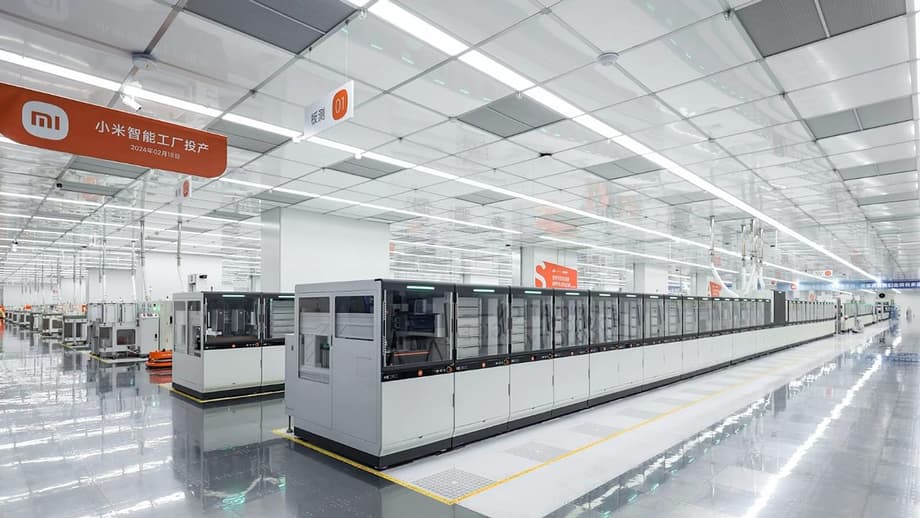
Behind the glass observation windows lies a manufacturing achievement that challenges conventional industrial limits. Xiaomi’s Smart Factory in Beijing’s Changping district produces a new flagship smartphone approximately every six seconds, pushing annual output beyond 10 million units. At sustained operational capacity, this translates to roughly one device every 3.15 seconds averaged across the year, though the actual assembly cycle operates at the six-second benchmark for individual units completing critical production phases.
The facility spans 81,000 square meters, roughly equivalent to eleven football fields, representing a CNY 2.4 billion (USD 330 million) investment that began operations in February 2024. Unlike conventional factories requiring approximately 450 employees to manage 600-meter production lines outputting 300 devices per hour, Xiaomi’s automated line stretches 310 meters with 220 workers producing 600 units hourly. This efficiency stems from an 81% overall automation rate, with several critical processes operating at 100% automation using intelligent robots that perform repetitive tasks with machine precision.
The manufacturing choreography begins with surface-mount technology lines placing microscopic electronic components onto printed circuit boards with micron-level accuracy. Robotic arms transfer up to 40 mainboards simultaneously to drawer-based testing systems, representing a 60% efficiency gain over older technologies that used limited-capacity robotic arms. These systems undergo dozens of simultaneous functional checks to detect defects before structural reinforcement adds foam, steel plates, and cushioning pads to protect fragile components. Company founder Lei Jun has positioned this facility as validation of Xiaomi’s technical credentials, declaring it one of the most advanced mobile phone factories in China while emphasizing that most equipment was developed internally.
Inside the Dark Factory
Industry specialists refer to facilities like Xiaomi’s as “dark factories,” describing fully automated manufacturing environments that operate without lights, heating, or air conditioning for human comfort. These facilities function 24 hours daily, eliminating shift changes, breaks, and the inconsistencies inherent in human labor. The Changping installation represents this concept at scale, utilizing 968 pieces of self-developed equipment and proprietary manufacturing software to create a lights-out operation where automated carts glide along tracks delivering components to larger robotic arms.
The technological core is the Xiaomi Hyper Intelligent Manufacturing Platform, a digital nervous system developed entirely in-house that serves as the brain of the factory. Large displays show live data on daily output, yield rates, and efficiency, while a 3D panoramic view tracks operations from PCB production to final assembly. When deviations occur, the system triggers automatic alarms and technicians intervene immediately. Intelligent early detection identifies potential equipment faults before they occur, saving time and reducing waste through predictive analytics.
This self-reliance extends to the physical machinery, with 96.8% of hardware developed internally alongside 100% self-developed manufacturing software. Advanced filtration and positive-pressure airflow systems maintain autonomous micron-level dust removal, creating pristine conditions for handling microscopic electronic components without human contamination. The modular platform design enables production line conversion for new models in just ten hours, compared to week-long transitions at traditional facilities. If adhesive viscosity changes due to weather conditions, the AI recalculates pump pressure to maintain bonding quality without human intervention.
Removing the Assembly Factory Label
For years, Xiaomi battled perceptions that it was merely an assembly operation, a characterization that Chief Executive Lei Jun describes as a persistent source of grievance. Early devices relied on Qualcomm chips, Samsung displays, and Sony cameras assembled by third-party manufacturers, leading market observers to characterize the company as lacking core technology. Dong Mingzhu, chairperson of rival Gree Electric Appliances, publicly questioned Xiaomi’s technical foundations, creating a rivalry that erupted in recent social media disputes over air conditioner sales rankings and service commitments.
Lei Jun has responded by steering Xiaomi toward vertical integration, establishing what company president Lu Weibing calls a complete industrial closed loop encompassing design, research and development, production, and verification. The Changping smartphone factory joins the Yizhuang automotive facility and the newly operational Wuhan Smart Home Appliance Factory, which covers 500,000 square meters and produces high-end air conditioners every 6.5 seconds with 100% AI visual quality inspection. This CNY 2.5 billion facility began production just 336 days after groundbreaking, representing Xiaomi’s third major manufacturing hub following the smartphone and automobile plants.
“Many people hold biases and stubbornly think Xiaomi lacks technology and is merely an assembly factory,” Lei Jun stated on social media. “These voices once made me fall into severe self-doubt. But after the commissioning of Xiaomi’s smartphone smart factory and automobile smart factory last year, such voices almost disappeared.”
The transformation carries significant financial implications. Technology companies command fundamentally different valuations than contract manufacturers, affecting investor confidence and stock performance. By producing nearly all components in-house, Xiaomi gains control over quality and pricing while positioning itself to compete aggressively against Tesla in electric vehicles and against Apple and Samsung in premium smartphones. The Wuhan facility specifically addresses earlier controversies where consumers noticed Xiaomi air conditioners were manufactured by Sichuan Changhong, leading to jokes that buying Changhong directly would be more cost-effective.
Precision Testing and Human Oversight
Despite automation dominance, human workers remain essential to Xiaomi’s quality assurance process. The 220 employees on the smartphone production line perform inspections, intervene when anomalies arise, and conduct tasks requiring irreplaceable precision, such as cleaning camera lenses under microscopes in specialized clean rooms. This human-machine collaboration achieves a 99% yield rate, exceeding the 98% industry standard while maintaining the flexibility to handle complex final assembly steps.
The testing regime is exhaustive. Following surface-mount technology placement, motherboards undergo multi-channel inspections to verify functionality against specifications. Each back panel is fitted before devices pass water-resistance checks and aesthetic inspections. Final testing occurs across 49 self-developed test stations examining antenna performance, audio quality, camera functionality, display calibration, Bluetooth connectivity, and sensor accuracy.
Devices then enter aging test chambers capable of handling 2,400 smartphones simultaneously, simulating long-term use across varied environments to evaluate battery lifespan and performance stability. This process protects workers from prolonged exposure to harsh testing conditions while shortening testing time. Finished units face comprehensive performance testing for power consumption, antenna performance, audio, camera, display, and sensors before clearing final retest protocols and proceeding to packaging. The seven-stage production process ensures that devices leaving the facility meet premium standards required for flagship models priced around €2,000.
Global Expansion and Market Position
Xiaomi’s manufacturing investments coincide with shifting global market dynamics and aggressive research and development spending. According to technology research group Omdia, the company holds 15% of the Chinese market as of 2025, rising four percentage points year-over-year. While global share dipped slightly to 13%, European markets bucked the trend with a one-point increase to 20%, solidifying Xiaomi’s third-place position behind Apple and Samsung in the premium segment.
The company maintains particularly strong positions in Southeast Asia, holding 21% market share in Malaysia and leading the region according to Canalys data. These markets increasingly view Xiaomi as a premium alternative to established giants, particularly following the Barcelona unveiling of the 17 Series flagship co-engineered with Leica. This imaging partnership leverages the factory’s creative testing spaces, which include staged living rooms, Chinese-style restaurants, and indoor amusement areas where camera systems are tuned for everyday conditions from high-contrast daylight to dim interiors.
This commercial success funds technological advancement, with Xiaomi investing CNY 23.5 billion in the first three quarters of 2025, nearly matching the entire 2024 expenditure. The company operates over 730 laboratories across 11 cities globally covering more than 40,000 square meters, with its Beijing Campus Laboratory serving as the flagship facility. In the third quarter of 2025 alone, spending reached a record CNY 9.1 billion, up 52.1% year-on-year. Revenue rose 22.3% to 113.1 billion yuan with adjusted net profit reaching 11.3 billion yuan, demonstrating that the transition from assembly to manufacturing mastery is yielding financial results.
Key Points
- Xiaomi’s Beijing Changping factory produces one flagship smartphone every six seconds, achieving annual capacity of 10 million units
- The CNY 2.4 billion facility operates with 81% automation using 220 workers compared to 450 workers needed at conventional plants for similar output
- Factory tours have become a tourist phenomenon with month-long waits, lottery systems, and black market tickets selling for up to $300
- The Hyper Intelligent Manufacturing Platform utilizes 96.8% self-developed hardware and 100% proprietary software to enable lights-out manufacturing
- Lei Jun’s vertical integration strategy aims to transform Xiaomi from an assembly operation into a hardcore technology company controlling design through production
- The company has expanded manufacturing to include a Wuhan appliance factory and an automotive facility producing vehicles every 76 seconds
- Xiaomi holds 20% smartphone market share in Europe and 21% in Malaysia, with global R&D investment reaching CNY 23.5 billion in the first three quarters of 2025