
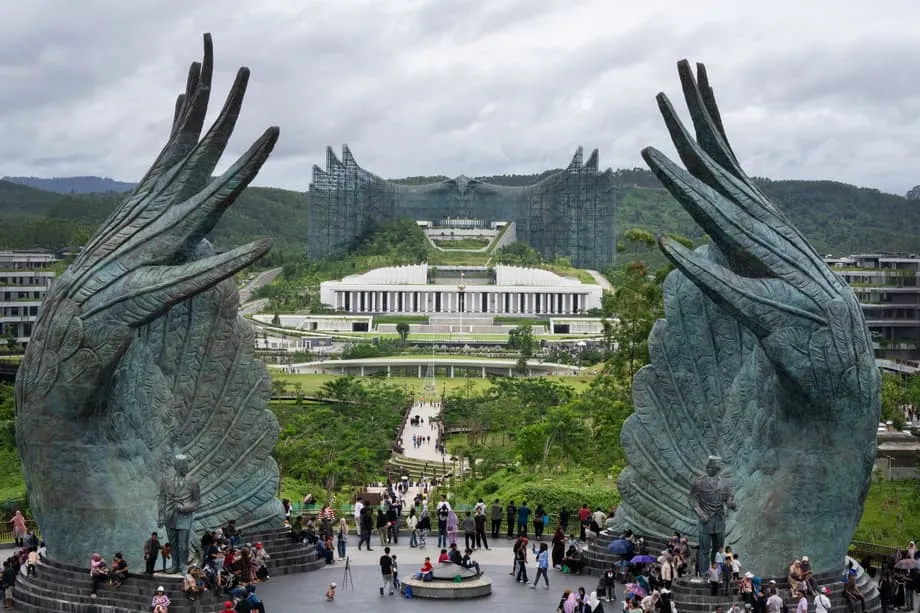
A New Capital With an Unfinished Future
Indonesia's planned capital, Nusantara, has about 10,000 residents in its core, including roughly 1,000 civil servants. Its monumental government buildings are taking shape in East Kalimantan, on Borneo, but the roughly $33 billion project faces reduced state funding, uncertain investment and disputes over the forests and communities in its path.
Contents
- A New Capital With an Unfinished Future
- Why Indonesia Wants to Leave Jakarta
- What Does Political Capital Mean?
- Residents Need More Than Government Offices
- Who Will Pay for Nusantara?
- Can the Forest City Deliver Its Promises?
- Illegal Mining Adds Another Forest Threat
- For Indigenous Families, Land Holds History
- A Court Ruling Changes Investor Land Rights
- Development Rules Face Wider Challenges
- Lessons From Putrajaya, Sejong and Astana
- What to Know
As of April 16, 2026, President Prabowo Subianto is backing a target for Nusantara to become Indonesia's political capital by 2028. State funding for 2026, however, has been cut in half compared with the previous year. Schools, housing for married civil servants, shopping malls and entertainment venues remain largely absent.
The construction area spreads across nearly 1,000 square miles, roughly three times the size of New York City. At its center, a metal structure shaped like Garuda, the mythical bird that is Indonesia's national emblem, rises 250 feet above the presidential palace. Nearby stand white office buildings draped with plants and a futuristic bank resembling a spaceship.
The core government district is nearly complete, yet the broader metropolitan area has only around 150,000 people, mostly construction workers and villagers whose communities were there before the project. The contrast captures Nusantara's immediate challenge: creating a functioning city around its government buildings.
Former President Joko Widodo announced the project in 2019 as a fresh start for a country whose existing capital suffers from congestion, pollution and sinking land. Construction began in 2022, with hopes of inaugurating Nusantara by August 2024. That deadline passed with incomplete buildings and celebrations reduced in scale.
Prabowo's government must now turn those buildings into a place where officials, workers and families can live, while finding investors and addressing the environmental and land disputes accompanying construction.
Why Indonesia Wants to Leave Jakarta
Jakarta has become the world's most populous city, with more than 40 million people in its greater metropolitan area. Chronic traffic congestion causes an estimated $4.5 billion in annual economic losses, while severe air pollution adds to the pressures of daily life.
Parts of Jakarta sink by 3 to 10 centimeters each year. Approximately 40 percent of the city already lies below sea level, leaving it increasingly vulnerable to flooding and rising seas. Nusantara was conceived as a new administrative center away from those problems.
Widodo promised a city powered by renewable energy and managed through advanced technology. Its development was meant to offer a different model from the crowded capital it would replace, combining government offices with forests, modern infrastructure and planned residential areas.
The project's main dates show how its timetable has shifted:
- 2019: Widodo announced plans for a new capital in East Kalimantan.
- 2022: Construction began.
- August 2024: The initial inauguration target passed with buildings unfinished and celebrations scaled back.
- October 2024: Prabowo took office.
- January 2026: Prabowo made his first visit to Nusantara as president and stayed overnight.
- 2028: The government aims for Nusantara to become the political capital and for the president to move there.
What Does Political Capital Mean?
Prabowo's January visit came more than a year after he assumed office. The carefully arranged trip and overnight stay were intended to communicate his commitment to a development also described as costing roughly $32 billion.
Josua Pardede, an economist at Bank Permata, described the significance of the president's stay and its prominent presentation:
a political signal of ownership and irreversibility
Prabowo reaffirmed support and set fresh targets for completing Parliament and court buildings by 2028. A regulation he signed designated Nusantara as Indonesia's political capital by that year, changing the language previously used to describe it as the national capital.
Lawmakers and policy specialists were confused by the wording and concerned that it suggested a reduced role for the project. The change came alongside the halving of annual state funding, giving those concerns a practical financial dimension.
Basuki Hadimuljono, head of the Nusantara Capital City Authority, rejected fears that the development could become a ghost town:
Don't worry. It will be continued.
The construction schedule contains different milestones. Alongside the target of completing Parliament and court buildings by 2028, the relocation plan envisages legislative and judicial buildings being finished in 2027, followed by the president's move in 2028. The immediate task is to make the institutions and their supporting services ready together.
Residents Need More Than Government Offices
Authorities aim to relocate another 4,100 civil servants in 2026. That planned intake is more than four times the roughly 1,000 civil servants already living in the core, but it remains far below the original ambition of moving 1.2 million residents by 2029.
Families need schools, suitable homes and places to shop and spend their free time. Nusantara's shortages in these areas make relocation more complicated than assigning an official a desk in a new ministry building. Housing for married civil servants is a particular gap.
Construction workers also need accommodation. The government has built Hunian Pekerja Konstruksi, known as HPK, to house them. The Nusantara Capital City Authority and Badan Usaha Milik Otorita, or BUMO, manage the accommodation with assistance from the Ministry of Public Works and Housing.
The worker housing is intended to prevent the informal settlements that have developed around other new capitals. Researchers from MIT nevertheless identify possible shortages in the amount of accommodation available, both in the short term and over a longer period.
If workers arrive faster than housing is built, informal settlements could develop before Nusantara officially opens. Providing enough accommodation is therefore part of the city's basic construction task, alongside roads, ministries and public buildings.
Who Will Pay for Nusantara?
The estimated $33 billion cost depends heavily on money from outside the state budget. Public funds are expected to cover only about 19 percent, leaving roughly 81 percent to private and foreign investment. Securing that backing has proved difficult.
Critics have called Nusantara a white elephant, meaning an expensive project whose cost outweighs its usefulness. Their concern centers on the lack of sufficient private investment and the risk of building a capital without enough residents, services or economic activity to sustain it.
China has become a prominent international partner. By May 2025, Chinese companies had invested nearly 70 trillion rupiah, approximately $4.3 billion, in Nusantara. In late 2024, Delonix Group became the first foreign investor to break ground, starting a commercial complex combining several uses.
Chinese companies have also expressed interest in transport, energy, digital systems and industrial development. Huawei has shown interest in supporting the city's information and communications technology ecosystem, the networks and digital systems that would connect its services.
Two major consortia involving Chinese companies are advancing integrated transport projects through partnerships between government and private businesses. The China Harbour Engineering Company-IJM consortium and the China State Construction Engineering Corporation-China Railway Group Limited consortium are each associated with projects valued at roughly 27 trillion rupiah.
These investments align with China's Belt and Road Initiative, which has already shaped Indonesian infrastructure through projects such as the Jakarta-Bandung High-Speed Railway. For Nusantara, foreign capital could help close a large financing gap.
Heavy dependence on Chinese financing also brings concerns about debt sustainability and strategic dependency. Environmental and social safeguards matter because industrial development can bring further forest clearance and displacement. Indonesia faces the task of securing capital while protecting communities and the environment.
Can the Forest City Deliver Its Promises?
Nusantara's master plans require 65 percent of its area to remain forested through reforestation, with another 10 percent set aside for parks and food production. The forest city label depends on restoring trees as well as preserving land within a vast construction area.
The government wants Nusantara to become a net carbon sequestration sink before 2030. In simple terms, that means absorbing more carbon than it releases. It also aims for carbon neutrality by 2045, balancing remaining emissions with the carbon removed or offset, ahead of Indonesia's national goal of net zero by 2060.
Widodo described Nusantara as a manifestation of Indonesia's commitment to tackling climate change. Environmental organizations, however, say construction is already damaging ecosystems that the project promises to protect.
WALHI, the Indonesian Forum for the Environment, reports mangrove deforestation around Balikpapan Bay. Fathur Roziqin Fen, executive director of WALHI East Kalimantan, identified the ecosystems and wildlife most exposed:
The most impacted will be what we call silent victims, including the mangrove ecosystem, the proboscis monkey and owa Kalimantan.
The owa Kalimantan is an endangered primate native to the region. WALHI's concerns extend beyond the immediate construction site: obtaining building materials from Sulawesi has reportedly contributed to increased flooding and dust pollution there.
Nusantara's environmental footprint therefore reaches the places supplying its construction materials as well as the forests around its government district. Its climate targets sit alongside immediate disputes over mangroves, wildlife habitat and damage associated with building the city.
Illegal Mining Adds Another Forest Threat
A special task force reports that more than 13,000 hectares of forest around Nusantara have been damaged by illegal mining and farming operations. Inspector General Edgar Diponegoro gave a breakdown of 8,338 hectares destroyed by unlawful farms and 4,236 hectares by illegal mines.
Those two categories total 12,574 hectares, compared with the task force's broader figure of more than 13,000 hectares. Both figures describe a substantial area of damaged land around a development whose identity rests on its forest plans.
The government has established monitoring stations and promised to rehabilitate degraded land. Critics question whether enforcement will be strong enough when powerful mining interests are involved.
Reforestation, rehabilitation and enforcement are connected responsibilities. The city needs land restored to meet its forest ambitions, while continued illegal clearance would add to the area requiring repair.
For Indigenous Families, Land Holds History
The Alliance of Indigenous People of the Archipelago, known as AMAN, estimates that more than 20,000 Indigenous people could face displacement. Approximately 800 Balik families live on the project site, including in Sepaku Lama village.
Syamsiah, 51, and her husband Pandi, 53, are among them. The Balik couple live in a house built from concrete blocks on their farm in Sepaku Lama, growing cassava, bananas, green beans and fruit trees. Syamsiah's parents and grandparents are buried in the village graveyard.
A nearby rock shaped like a rhino, Batu Badok, is a sacred place for the Balik people in the Sepaku River. It now lies inside a water treatment compound, separated from the community by a concrete wall built to reduce flooding.
The wall also blocks villagers from reaching the river to bathe and wash clothes as they traditionally did. The city supplies free filtered water, but residents must pay to install pipes into their homes. Many collect rainwater or buy water delivered in tanks instead.
Officials have told residents including Syamsiah and Pandi that they will eventually have to sell their land to the project. Pandi remains unwilling, describing the difference between paying for physical property and replacing a family's connection to a place:
Maybe the government can compensate me for the plants or even the house. But my memories, my history, can the government replace that?
The couple's circumstances bring together several disputes surrounding Nusantara: land acquisition, access to water, protection of sacred places and the future of communities that existed long before the capital was planned.
A Court Ruling Changes Investor Land Rights
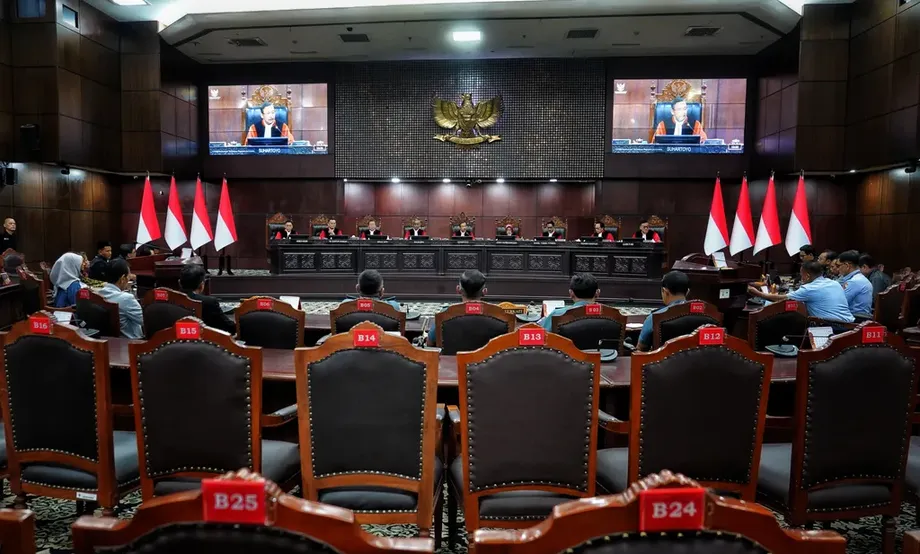
In November 2025, Indonesia's Constitutional Court struck down a 2024 decree granting investors land cultivation rights lasting up to 190 years. The court ruled those privileges unconstitutional and ordered Nusantara to follow national regulations limiting cultivation rights to a maximum of 95 years.
Stepanus Febyan Babaro, a Dayak Indigenous representative, and another resident filed the petition. Indigenous groups welcomed the ruling, while developers viewed the shorter period as a possible deterrent to investment.
The maximum period fell by half, from 190 years to 95 years. For a project seeking substantial private financing, the decision changes how long investors can hold cultivation rights. For Indigenous communities, it addresses one part of the legal framework governing land around the new capital.
Development Rules Face Wider Challenges
Indonesia's Job Creation Law, often called the omnibus law because it changes many rules together, is under judicial review following challenges by civil society groups. They argue that it weakens environmental protection and enables forced evictions.
The law was passed in 2020 and reaffirmed in 2023 despite previously being ruled procedurally unconstitutional. It restricts public participation in environmental impact assessments, which examine how proposed developments could affect people and nature, and replaces environmental permits with approvals based on developers' own declarations.
Nusantara is designated a project of strategic national importance, or PSN. Such projects receive accelerated licenses and weaker safeguards around land rights. Article 173 allows private entities, as well as the government, to acquire land in the name of public interest.
The dispute at Rempang Eco City illustrates the stakes of that framework. Residents there face eviction for a glass factory and an ecotourism resort. Resistance has brought violent crackdowns, including police firing rubber bullets and arresting protesters.
WALHI continues to challenge these development rules, arguing that policy decisions can cause environmental harm as surely as construction machinery. It seeks the restoration of public participation rights and stronger definitions of public interest that protect community welfare and rights.
Lessons From Putrajaya, Sejong and Astana
Nusantara's planners are studying other purpose built capitals through a United Nations supported process called a Voluntary Local Review, or VLR. It is the first such review for a new city and aims to incorporate sustainability measures and human rights principles while development is under way.
Malaysia's Putrajaya, planned as an intelligent garden city south of Kuala Lumpur, incorporated existing Malay villages rather than separating Indigenous residents from their land. South Korea's Sejong offers a model of development in stages and the gradual transfer of administrative functions away from Seoul.
Kazakhstan's Astana illustrates the role of sustained infrastructure investment and planning over many years. It has grown into a city of 1.3 million people.
The VLR process calls for transparency, accountability, decisions based on data and meaningful community involvement. Government departments are expected to work together and document how public feedback affects development. The review can also help attract investors by showing progress and how risks are being managed.
Nusantara's next milestones bring those lessons into immediate focus: relocating 4,100 more civil servants in 2026, completing legislative and judicial facilities under the 2027 and 2028 targets, and preparing for the president's planned move in 2028. Housing, investment and protection of existing communities remain central to making that transition work.
What to Know
- Nusantara is being built in East Kalimantan on Borneo, with a target of becoming Indonesia's political capital by 2028.
- The project is estimated at roughly $32 billion to $33 billion, while state funding for 2026 has been halved compared with 2025.
- The core has about 10,000 residents, including roughly 1,000 civil servants. Authorities aim to relocate another 4,100 civil servants in 2026.
- Schools, family housing and other everyday services remain incomplete as the government district nears completion.
- Forest and climate targets face challenges from mangrove clearance, construction impacts and illegal mining and farming.
- AMAN estimates that more than 20,000 Indigenous people could face displacement.
- The Constitutional Court reduced the maximum cultivation rights available to investors from 190 years to 95 years.
- Chinese companies had invested nearly 70 trillion rupiah, about $4.3 billion, by May 2025.
- A United Nations supported review is drawing lessons from Putrajaya, Sejong and Astana on development, community rights and accountability.