
A two year airport trial puts robots beside ground crews
Japan Airlines is introducing humanoid robots at Tokyo Haneda Airport in an experiment scheduled to begin in May 2026 and continue until 2028. The airline wants machines to share the demanding work of moving luggage and cargo as Japan faces a shrinking workforce and a surge in overseas visitors.
Contents
- A two year airport trial puts robots beside ground crews
- How the experiment will progress
- Which jobs could move to machines?
- Why Japan's workforce and tourism figures matter
- Chinese manufacturers supply the technology
- China's factory scale provides a wider context
- Why human supervision remains central
- What the April demonstration showed
- An airport test within a larger automation push
- Key Points
Haneda, the main gateway to Tokyo, handles more than 60 million passengers a year. Japan welcomed more than 7 million foreign visitors in the first two months of 2026, following a record 42.7 million arrivals in 2025. Those numbers bring pressure to the teams working around aircraft, where loading, unloading and other essential jobs require physical strength, technical knowledge and close attention to safety.
Japan Airlines has partnered with GMO AI & Robotics, a Japanese technology company, to integrate robots manufactured in China into airport operations. The experiment is among the most visible aviation tests of machines designed to work in spaces normally occupied by people.
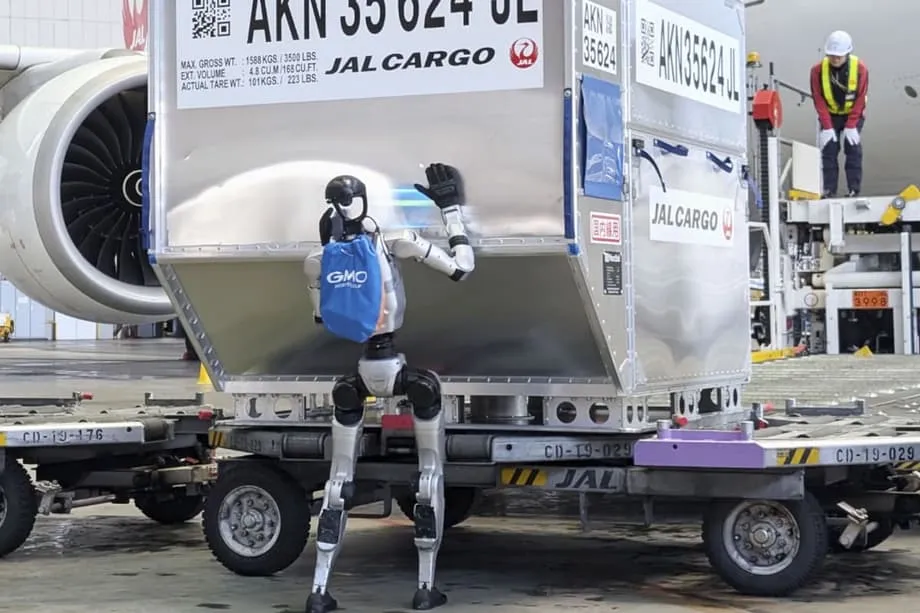
An April demonstration showed a robot about 130 centimeters, or 51 inches, tall wearing shoes and pushing cargo toward a conveyor belt beside a parked aircraft. The scene illustrated the partners' aim: mechanical assistants working within the airport's existing equipment and routines.
Tomohiro Uchida, president of GMO AI & Robotics, described the gap between the airport's automated appearance and the work happening behind the scenes.
While airports appear to be highly automated and standardised, their operations behind the scenes still rely heavily on human labour and face serious labour shortages.
Japan Airlines hopes robots can take on some of the most exhausting assignments, leaving employees with more energy for work requiring judgment and precision. The airline also hopes the venture could eventually reduce personnel needs by roughly half.
How the experiment will progress
Japan Airlines and GMO AI & Robotics plan to develop the trial in stages rather than immediately place robots into regular ground operations. The first stage involves mapping and examining airport conditions to identify places where machines can work safely alongside employees without disrupting established routines.
Simulated airport settings will provide the next testing ground. Robots that perform successfully in those controlled exercises could then move into actual operations on the tarmac, the area around parked aircraft where ground crews carry out much of their work.
Customer baggage will not be assigned to the robots immediately. The early months will concentrate on internal cargo and operational testing. Passengers are already familiar with electronic kiosks, but trusting a new machine with a family suitcase presents a different challenge for the airline.
The timetable allows two years to examine how the machines function in a busy aviation environment. Feasibility studies and risk assessments remain underway, with evaluation and adjustments expected throughout the experiment.
The main dates and stages are:
- April 2026: A demonstration showed a humanoid robot pushing cargo toward a conveyor belt beside an aircraft.
- May 2026: The experiment is scheduled to begin at Haneda Airport.
- During the trial: Site assessments and simulated exercises are intended to precede work in actual airport operations.
- 2028: The experiment is scheduled to conclude.
Haneda's passenger volume makes reliability essential. A problem involving baggage or cargo could delay flights, damage the airline's reputation or create a safety incident. The staged process is intended to assess the machines before expanding their responsibilities.
Which jobs could move to machines?
Baggage transport is only part of the proposed work. The trial's intended tasks extend to cargo loading and unloading, aircraft towing and, eventually, cabin cleaning and operation of ground support equipment. That equipment serves aircraft while they are on the ground.
The robots' height is intended to help them navigate infrastructure already used by people. At approximately 130 centimeters tall, they are being considered for work around existing aircraft, conveyor systems and storage areas without expensive changes to those facilities.
Yoshiteru Suzuki, president of JAL Ground Service, said assigning demanding physical tasks to robots would bring substantial benefits to employees. He also said some responsibilities, including safety management, can only be handled by humans.
Ground handlers routinely lift heavy containers in different weather conditions. Repeating that work takes a physical toll over time. Japan Airlines hopes that transferring the most strenuous assignments to machines will help reduce injuries and improve employee retention.
The airline presents the project as support for human workers rather than a replacement strategy. Its ambition to reduce personnel needs by roughly half also makes the experiment relevant to the debate about how automation changes staffing. Workers and unions have understandable concerns about machines competing for jobs, making the airline's explanation of their intended role important.
Why Japan's workforce and tourism figures matter
Japan's population of working age is projected to decline by 31 percent between 2023 and 2060, according to employment outlook data from the Organisation for Economic Co-operation and Development (OECD). Fewer young people entering employment make recruitment particularly difficult for industries that depend on physical work.
Airport ground handling combines that demographic pressure with growing travel demand. The Japan National Tourism Organisation reported that international arrivals rose by 3.5 percent in March compared with the same month a year earlier.
Ground crews need more than strength. Their responsibilities include aircraft marshalling, baggage sorting and meeting safety requirements. Aircraft marshalling means guiding aircraft during movements on the ground. These tasks require trained employees, so a staffing shortage affects both the amount of work a team can complete and its ability to maintain safe operations.
Japan's record 42.7 million foreign arrivals in 2025 and more than 7 million visitors during the first two months of 2026 show the scale of demand confronting the industry. A rising number of travelers means more luggage and more aircraft needing service, while the domestic labor pool is expected to contract.
Prime Minister Sanae Takaichi has built support around tighter immigration controls, limiting the traditional response of bringing in workers from abroad. Marc Einstein, research director at Counterpoint Research, expects the government to actively encourage humanoid robots as another workforce strategy.
The Ministry of Economy, Trade and Industry published guidelines in March promoting robotics as a response to demographic decline. Barclays analysts also wrote in a January research note that aging populations, labor shortages and changing worker preferences were creating opportunities for humanoids in manufacturing, logistics, agriculture, healthcare and hospitality.
Chinese manufacturers supply the technology
Japan Airlines is evaluating the Unitree G1 humanoid and the UBTech Walker E model. Unitree is based in Hangzhou, while UBTech is headquartered in Shenzhen. Their involvement shows how technology developed by Chinese manufacturers is entering automation projects beyond China.
Unitree has recently attracted attention through both public demonstrations and its financing plans. Its flagship H1 model appeared in a Kung Fu demonstration at China's Spring Festival Gala, drawing substantial public interest.
In March, Unitree became the first major humanoid robotics company to receive approval for an initial public offering on the Shanghai Stock Exchange. An initial public offering allows a company to sell shares to public investors. Unitree aimed to raise approximately 4.2 billion yuan, or about $614 million.
UBTech represents another major participant in China's robotics industry. Together, the two manufacturers reflect the growing role of Asian countries in deploying physical artificial intelligence, with activity advancing faster than among Western competitors.
Physical artificial intelligence refers to AI combined with machines that can perform physical tasks. Rather than producing only information on a screen, these systems act in the world, as automated warehouse pickers and driverless vehicles do.
China's factory scale provides a wider context
China accounted for 54 percent of global industrial robot installations in 2024, according to the International Federation of Robotics. Factories across the country installed 295,000 units, a scale exceeding that of any other nation.
The 54 percent share means China installed more industrial robots than the rest of the world combined that year. Those factory installations provide context for the country's manufacturing strength as its companies develop humanoid machines.
Chinese manufacturers have long pursued automation and lower production costs to keep their operations competitive. The country is also known for dark factories, facilities where robots can operate without lighting because people are not present to carry out the work.
Humanoid robots are being developed for assignments requiring more flexibility and adaptability than many established factory machines provide. Their humanlike form is intended to help them operate in environments built around people, including the equipment and work areas being assessed at Haneda.
Improving AI models are part of that development. For the airport experiment, however, the central task is practical: getting machines to carry out useful work safely and consistently amid aircraft, cargo, equipment and employees.
Why human supervision remains central
Current humanoid robots can perform basic lifting and transportation tasks, but delicate work remains difficult. Fine motor skills are the small, precise movements needed to manipulate objects carefully.
Nvidia chief executive Jensen Huang said earlier in 2026 that developing those skills remained extremely hard because robots currently rely primarily on vision rather than touch. Seeing an object and handling it accurately are different parts of a physical task.
Marc Einstein of Counterpoint Research also described the technology's limitations. He said programming and reasoning capabilities remained largely underdeveloped and assessed the robots as not very smart yet. He expects human supervision to remain central to airport operations for the foreseeable future, even as the machines become more capable.
Airports add challenges beyond those found on established factory production lines. Weather can change, flight schedules leave limited time for work, and machines must interact smoothly with employees and passengers.
Japan Airlines' continuing feasibility studies and risk assessments reflect those demands. Safety management remains a human responsibility, while the trial will examine which physical jobs machines can undertake reliably.
The proposed progression from simulated exercises to actual operations will also give the partners time to adjust their approach. The intended range of tasks is broad, but successful daily use will depend on how the robots perform under airport conditions.
What the April demonstration showed
The April footage offered a concrete view of the experiment's starting point. A Unitree robot pushed a cargo container toward a conveyor belt, while observers noted that the belt itself was doing the actual moving.
The robot also waved to onlookers and shook a colleague's hand. Those gestures displayed social programming, the software that enables recognizable interactions with people, rather than the physical effort needed for demanding cargo work.
The demonstration brought together the appeal of a humanlike machine and the practical issue facing the airline: how much useful work it can perform. Over the trial, Japan Airlines and GMO AI & Robotics will assess reliability, cost effectiveness and safety.
Barclays described physical robotics as the next frontier in artificial intelligence. Its estimate put the sector at $2 billion to $3 billion at present, with the potential to reach as much as $1.4 trillion by 2035. That forecast depends heavily on whether robots can master the details of actual labor.
An airport test within a larger automation push
Aviation industry observers around the world are watching the Haneda experiment because its results could influence other carriers facing labor shortages. No North American airline had announced a similar humanoid ground crew program as of May 29, 2026.
Oxford Economics estimated earlier in 2026 that robots and automation could replace 20 percent of human jobs within two decades. Transportation and logistics were among the sectors most exposed to that change.
China's use of humanoids is also expanding beyond aviation. Battery manufacturer CATL began what it described as the first extensive deployment of robots at its Luoyang factory in December 2025. State Grid Corporation launched a $1 billion plan to deploy humanoids for autonomous grid maintenance, meaning maintenance carried out by machines operating on their own.
Those projects and the Haneda trial place physical AI in different working environments: factories, electricity networks and airport operations. Each involves moving from demonstrations toward machines performing essential tasks.
Japan Airlines' experiment is particularly demanding because airport errors can affect tightly connected international operations. Safety margins are narrow, and a delay or mistake in one part of the ground handling process can spread through flight schedules.
By 2028, the trial is intended to provide practical evidence about whether humanoid robots can reduce the physical burden on workers while meeting aviation requirements. Its results could offer other airports a model to follow or identify problems they would need to address before adopting similar machines.
Key Points
- Japan Airlines' humanoid robot experiment at Tokyo Haneda Airport is scheduled to start in May 2026 and run until 2028.
- The airline is working with GMO AI & Robotics and evaluating China's Unitree G1 and UBTech Walker E models.
- Early work will focus on internal cargo and testing, with customer baggage excluded from the initial stage.
- Proposed tasks include cargo handling, aircraft towing, cabin cleaning and operating ground support equipment.
- Haneda handles more than 60 million passengers annually, while Japan received a record 42.7 million foreign visitors in 2025.
- Japan's population of working age is projected to fall 31 percent between 2023 and 2060.
- The airline hopes to ease demanding physical work and eventually reduce personnel needs by roughly half, while keeping safety management in human hands.
- Limited reasoning and fine motor skills mean human supervision remains central to the experiment.