A Trillion Parameter Model Gets a Speed Boost
Xiaomi says its MiMo-V2.5-Pro-UltraSpeed serving mode can generate more than 1,000 tokens per second using a single computing node containing eight standard GPUs. Live demonstrations peaked near 1,200 tokens per second, putting the company's speed claim at the centre of a contest usually associated with specialist AI chipmakers.
Contents
- A Trillion Parameter Model Gets a Speed Boost
- How Fast Is 1,000 Tokens Per Second?
- Standard GPUs Challenge Specialist Chips
- Smaller Numbers Reduce the Memory Burden
- Drafting Several Tokens in One Step
- Why Software Agents Could Benefit Most
- A Limited Trial Runs Until June 23
- Higher Rates Buy Faster Generation
- Open Releases Put the Claim to a Wider Test
- At a Glance
The announcement on Monday came from a company better known to consumers for affordable smartphones, electric scooters and home air purifiers. Its accelerated system runs MiMo-V2.5-Pro, a flagship AI model with one trillion parameters, rather than a smaller replacement built to produce a more impressive speed figure.
Parameters are the numerical weights that shape how an AI model processes information. A model with a trillion of them can represent complex patterns in text and computer code. Tokens are the pieces of text a model reads and writes, averaging roughly three quarters of a word, although their size varies.
Xiaomi attributes the performance to coordinated changes involving the model and the software that runs it, developed with inference partner TileRT. The three main components are FP4 quantization, DFlash speculative decoding and the TileRT inference engine.
The company describes the approach as extreme model system codesign: designing the model's execution and its serving software together so that each improvement supports the others. Its claim is that software can push an enormous model past a speed threshold previously associated with dedicated hardware.
As of June 9, 2026, independent third party verification has not been widely published. Xiaomi has opened a limited API trial and released a model checkpoint for researchers and developers to examine. Those tests will help establish how the performance holds up across different tasks and operating conditions.
How Fast Is 1,000 Tokens Per Second?
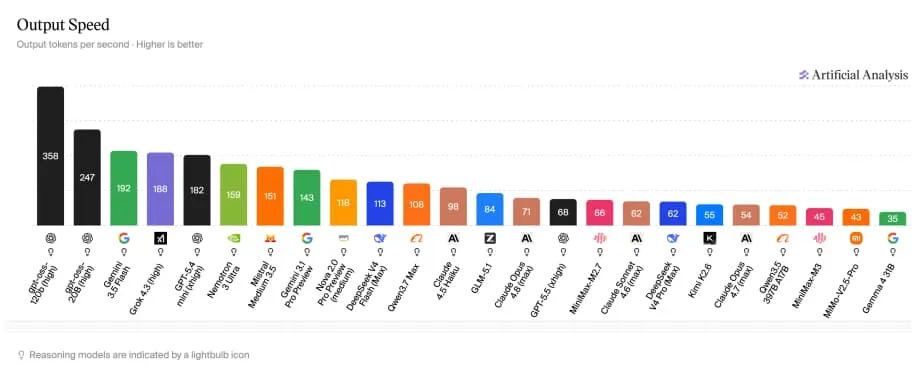
The benchmark figures cited from Artificial Analysis put GPT-5.5, described as the model powering most ChatGPT conversations, at approximately 68 tokens per second. Claude Opus 4.6 runs at around 71, Anthropic's lighter Haiku model reaches 98, and Google's Gemini Flash reaches 192.
Against those figures, Xiaomi's claimed 1,000 tokens per second is about 14.7 times the GPT-5.5 rate and 14.1 times the Claude Opus 4.6 rate. The calculation is straightforward: divide 1,000 by 68 or 71. The comparison illustrates the size of the claimed gap, with independent testing still needed to assess Xiaomi's system.
The earlier MiMo Flash model already produced responses at 150 tokens per second, equivalent to roughly 110 words per second. That was faster than a person could comfortably read or speak. UltraSpeed pushes generation much further beyond the pace of human consumption.
A conventional language model generates its reply by predicting the next token from the text that came before it. The speed of this process helps determine how long someone waits for an answer. At familiar consumer chatbot speeds, a paragraph takes several seconds to appear. At Xiaomi's claimed rate, a page of analysis could appear almost instantly once generation is underway.
For a person reading one answer, the benefit is a shorter wait. For software requesting many answers, speed can determine how much work fits within a deadline. It also affects the number of requests a server can handle, which matters to businesses paying for capacity and trying to expand their services.
Standard GPUs Challenge Specialist Chips
Xiaomi says the UltraSpeed result comes from eight commodity GPUs in one standard node, without custom silicon. A node is a computing unit that can contain several processors working together. The hardware category is available through major cloud providers, making the company's approach relevant to developers who rent computing resources.
Cerebras has pursued faster inference with a chip built at wafer scale, roughly the size of a dinner plate. Its design packs 44GB of memory onto the chip to reduce the constraints created by moving data between processing hardware and memory. That system reached 969 tokens per second on Meta's Llama 3.1 405B.
Llama 3.1 405B has 405 billion parameters, less than half MiMo-V2.5-Pro's one trillion. Groq's custom Language Processing Unit architecture delivers between 300 and 750 tokens per second, depending on the model. Both approaches use specialist hardware rather than the standard cloud GPU equipment developers can rent from providers such as AWS.
Xiaomi's claimed result challenges the idea that exceptionally fast inference must depend on a new chip design. Inference means running a trained model to produce an answer, rather than training it in the first place. Here, the company and TileRT concentrated on how that process is executed.
Specialist chips require substantial capital, long design cycles and specialised manufacturing. Commodity GPUs benefit from large production volumes, broad availability and continuing improvements from manufacturers including NVIDIA. If the performance is independently confirmed, Xiaomi's approach could make very fast inference accessible to more organisations through familiar infrastructure.
The comparison is especially striking because custom AI chip development has attracted hundreds of millions of dollars in investment. Xiaomi is presenting coordinated software engineering as another route to the speed those investments seek.
Smaller Numbers Reduce the Memory Burden
FP4 quantization is the first part of Xiaomi's acceleration strategy. Quantization stores a model's numerical values with fewer bits, reducing the amount of memory needed and the volume of data that must move through the machine.
Many large models use numerical precision of 16 bits or 8 bits. At those levels, a parameter occupies two bytes or one byte respectively. Xiaomi compresses MiMo-V2.5-Pro's expert layers to 4 bits, while leaving the rest of the model at full precision.
The expert layers account for most of the model's one trillion parameters. Compressing that part of the system therefore addresses much of its memory demand. Less data needs to be stored and transferred, easing the bandwidth pressure that can slow generation.
Lower precision carries a risk: when numerical values are represented less precisely, a model's reasoning or answer quality can deteriorate. Xiaomi says its selective treatment of the expert layers produces near zero quality loss. The company presents UltraSpeed as an accelerated version of the full flagship model, retaining its intelligence rather than substituting a less capable model.
The practical idea is simple. A large AI system spends time moving the numbers it needs as well as calculating with them. Making most of those numbers smaller can help the processors receive data faster. Xiaomi combines that saving with changes to token generation and GPU execution, rather than relying on compression alone.
Drafting Several Tokens in One Step
DFlash speculative decoding is the second technique. Conventional speculative decoding uses a smaller draft model to guess several upcoming tokens. The larger model then checks those guesses together, allowing accepted text to advance faster than ordinary generation of one token at a time.
DFlash changes the drafting process. Instead of producing each draft token in sequence, it fills a block of masked positions in a single forward pass. A forward pass is one run of the model's calculations to produce predictions. The larger model then verifies the proposed tokens.
On coding tasks, Xiaomi reports that the large model accepts an average of 6.3 out of eight proposed tokens per verification round. That allows roughly six tokens to advance in a step where ordinary generation would advance one. The reported acceptance rate helps explain why the technique contributes so much to the speed claim.
TileRT supplies the third component. Its inference engine keeps the computing pipeline continuously resident inside the GPU. Standard serving systems can launch individual operators, or computing operations, one after another, leaving small gaps between them.
TileRT removes the launch overhead associated with those individual operations and keeps data flowing through the pipeline. Compression reduces the data burden, DFlash advances more text per verification step, and TileRT reduces interruptions in execution.
Xiaomi says the combined effect takes generation beyond 1,000 tokens per second. None of the three techniques alone accounts for the result. Their coordination is the central engineering claim behind UltraSpeed and the reason the company describes it as model system codesign.
Why Software Agents Could Benefit Most
Developers using AI for difficult coding problems often request one answer, wait for it to finish and then check whether it works. Faster generation could give an automated system time to explore dozens of reasoning paths within the same period, compare candidate solutions and correct errors.
That would change how the available waiting time is used. Instead of spending it on a single attempt, a coding agent could use it for several attempts and verification. The attraction is especially strong for autonomous agent loops, in which software repeatedly observes a situation, decides what to do and acts.
Fraud detection and trading signal generation are other applications identified for the technology. Fraud systems may need to evaluate transactions within milliseconds, while systems handling live market signals cannot afford delays of several seconds. Faster text generation could help reduce one part of those processing times.
Healthcare applications requiring rapid analysis of patient data and investment platforms processing live market feeds are also potential users. These are proposed uses of the greater responsiveness, rather than deployments announced alongside the trial.
The benefit for everyday coding is more immediate to understand. A developer waiting for generated code could spend less time watching text appear and more time checking or using the result. At generation rates approaching or exceeding 1,000 tokens per second, the exchange could feel closer to real time collaboration.
Businesses running many automated tasks have a different reason to care. Faster output can allow more reasoning and checking within strict time limits. Xiaomi's proposition therefore extends beyond making a chatbot feel quicker: it concerns the amount of work that software can attempt before a deadline.
A Limited Trial Runs Until June 23
Xiaomi's API trial runs from June 9 through June 23, 2026. An API allows another piece of software to send requests to the model and receive its responses, making it the route for developers to test UltraSpeed inside their own workflows.
Access requires an application, and approval is not guaranteed. Enterprise users and professional developers with concrete business needs receive priority. Xiaomi is limiting participation because high speed inference resources are constrained.
Each account can join the queue up to 10 times per day. A session lasts no more than 30 minutes, and a session left idle for more than five minutes is automatically released. Those limits govern access during the trial rather than allowing continuous, unrestricted use.
The main dates and access milestones are:
- April 2026: MiMo-V2.5-Pro launched, with performance described as matching Claude Opus on most coding benchmarks.
- Monday, before the June 9 article: Xiaomi announced the UltraSpeed serving mode and its speed claims.
- June 9, 2026: The limited API trial begins.
- June 23, 2026: The announced trial period ends.
The trial gives approved users an opportunity to examine whether faster generation improves the tasks they actually run. Its queue and session rules also show that access to the accelerated service is being rationed during this initial period.
Higher Rates Buy Faster Generation
UltraSpeed is priced at three times the standard MiMo-V2.5-Pro rate, with approximately 10 times the generation speed. That makes it a premium option within Xiaomi's own service, aimed at users who place a high value on reducing waiting time.
The standard MiMo-V2.5-Pro prices cited are roughly $0.43 per million input tokens and $0.87 per million output tokens. Input tokens are the text sent to the model; output tokens are the text it generates in response.
At three times those rates, the corresponding amounts would be approximately $1.29 per million input tokens and $2.61 per million output tokens. Those figures are calculated from the stated standard prices and the UltraSpeed multiplier.
The Claude Opus prices cited for comparison are $5 per million input tokens and $25 per million output tokens. On those figures, even Xiaomi's accelerated option remains substantially cheaper per token. The standard MiMo service already costs far less than Opus.
For a business, the decision combines price and time. Paying three times as much per token may be attractive when generation is approximately 10 times faster and a task must finish quickly. A user who does not need the extra speed may have less reason to pay the premium.
Xiaomi's figures make the pricing proposition concrete: more expensive than its standard service, faster by the company's account, and still below the cited competing frontier model rates. Actual spending will depend on the amount of text each application sends and receives.
Open Releases Put the Claim to a Wider Test
Xiaomi has released the MiMo-V2.5-Pro-FP4-DFlash checkpoint as open source on Hugging Face. A checkpoint contains the model data needed to load and examine a particular version. TileRT has also released selected modules on GitHub.
The releases give researchers and developers a route to inspect, test and adapt the underlying work without buying proprietary hardware or securing enterprise licences. They also allow the wider community to investigate whether the techniques transfer to other models and uses.
Community testing will be central to evaluating the speed claim over the coming weeks. The API trial offers access to Xiaomi's serving system, while the checkpoint and selected software modules open parts of the engineering to examination outside the company.
Xiaomi's consumer identity helps explain why the announcement attracted attention. It has sold millions of smartphones, scooters and air purifiers across global markets, while its AI division has grown more quietly. MiMo-V2.5-Pro's April launch had already placed its coding performance alongside Claude Opus on most benchmarks.
UltraSpeed builds on that model rather than announcing a new, less capable alternative. Xiaomi is seeking to combine the flagship's existing abilities with much faster serving and prices that remain below the cited Opus rates.
If independent testing confirms the result, the achievement would strengthen the case for software optimisation on standard equipment as a route to leading inference performance. It would also place the Beijing consumer electronics company more firmly among AI infrastructure developers, competing through coordinated model and serving design rather than a proprietary chip architecture.
At a Glance
- Xiaomi claims more than 1,000 tokens per second for MiMo-V2.5-Pro-UltraSpeed, with live demonstrations peaking near 1,200.
- The model has one trillion parameters and runs on a single node containing eight standard GPUs.
- FP4 quantization, DFlash speculative decoding and the TileRT inference engine work together to accelerate generation.
- On coding tasks, Xiaomi reports an average acceptance of 6.3 out of eight draft tokens per verification round.
- The API trial runs from June 9 to June 23, 2026, with applications, queues and session limits.
- UltraSpeed costs three times the standard MiMo rate for approximately 10 times the generation speed.
- The FP4-DFlash checkpoint is available on Hugging Face, and selected TileRT modules are available on GitHub.
- Independent third party verification has not been widely published as of June 9.