Thousands of Boats, Hundreds of Miles of Pressure
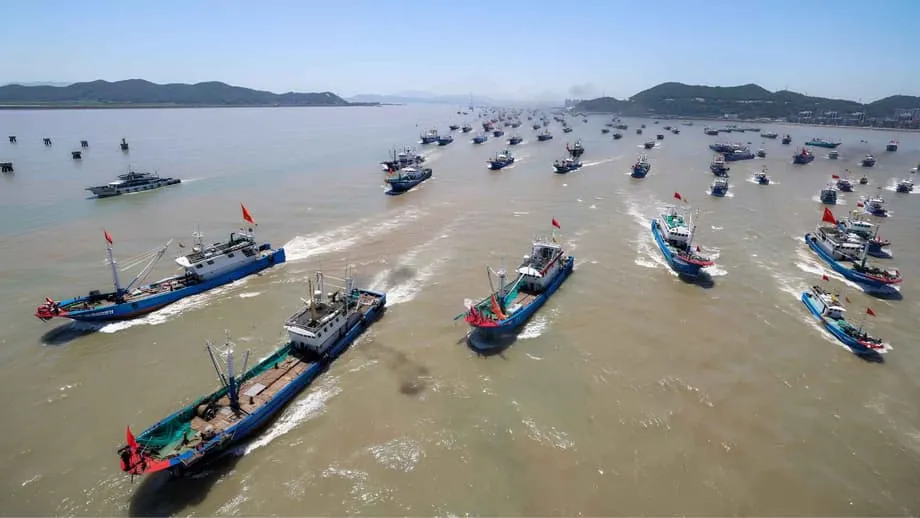
About 1,400 Chinese fishing vessels formed a barrier stretching more than 200 miles across the East China Sea on January 11. Two weeks earlier, on Christmas Day, roughly 2,000 boats had assembled into two parallel lines spanning about 290 miles in an inverted L shape. The formations placed thousands of apparently civilian vessels across one of Asia's most sensitive waterways.
Contents
- Thousands of Boats, Hundreds of Miles of Pressure
- Beijing Points to the Winter Fishing Season
- How the Gray Zone Works
- The Three Forces Behind China's Maritime Presence
- Taiwan Faces Pressure on Patrols and Internet Cables
- Confrontations Across the South China Sea
- A Fishing Presence Far Beyond Asia
- Fish Stocks and Coastal Livelihoods Under Strain
- Subsidies Connect Commercial Activity and State Pressure
- Monitoring, Cable Protection and Regional Cooperation
- Warnings and the Risk of Armed Confrontation
- Key Points
Commercial captains approaching such concentrations faced an uncomfortable choice: sail around them or weave through congested waters. A collision could become an international incident. Detours and slower passage also created practical problems for shipping schedules, turning open water into a sprawling traffic bottleneck.
An American congressional commission subsequently described the mobilizations as a new gray zone threat and suggested that the formations could reveal a tactic for a future blockade or invasion involving Taiwan. A blockade seeks to restrict movement into or out of an area. Large numbers of fishing boats could obstruct routes while complicating decisions about how to respond.
The East China Sea brings together commercial shipping, fishing grounds, disputed borders and marine ecosystems already under strain. Boats holding position in geometric formations can slow traffic, crowd radar displays and make it difficult to distinguish ordinary fishing from coordinated activity undertaken for another purpose.
China rejects the military interpretation. Its explanation is that the gatherings occurred during the busiest part of the winter fishing season. That disagreement sits at the center of the story: vessels that sustain coastal livelihoods can also become instruments of pressure, while neighboring governments must decide how to respond without turning a confrontation with civilian boats into armed conflict.
The January and December gatherings were repeated large formations, rather than an isolated concentration of boats. Their scale, shape and location have drawn attention to how fishing fleets, coast guards and naval forces can operate together, and to the costs for shipping, coastal communities and the environment.
Beijing Points to the Winter Fishing Season
The Chinese Embassy in Washington said the East China Sea remains an important fishing area and that November through February is the peak winter fishing season. Embassy spokesperson Liu Pengyu described the concentration of vessels as consistent with that seasonal activity.
It is therefore normal to see a high concentration of fishing boats operating at sea during this time.
Chinese state media has also cited fishing seasons, technology used to find fish and traditional fishing grounds near Zhoushan as explanations for large gatherings. Those explanations reflect the commercial importance of waters where many vessels pursue the same resources.
Public vessel tracking shows where boats travel and how they gather. The precise orders and role of each vessel in the Christmas Day and January 11 formations remain unknown. Maritime analysts have nevertheless questioned whether seasonal fishing alone explains their geometric precision and density.
The same concentration can therefore prompt different interpretations. Beijing describes fishing activity, while the congressional commission sees a possible method of obstructing maritime routes during a crisis. For captains navigating through the area, the immediate problem is the number of vessels occupying their path.
How the Gray Zone Works
Gray zone activity occupies the space between ordinary civilian conduct and open military conflict. At sea, it can involve obstructing movement, applying pressure or asserting control without firing a shot or displaying the flag of a naval vessel.
Fishing boats are useful for this purpose because their civilian status and protections under international maritime law make responses more complicated. Their numbers can overwhelm coast guard resources, while crowded radar screens make it harder to understand what individual vessels are doing.
The International Regulations for Preventing Collisions at Sea, known as COLREGs, govern how vessels avoid collisions. The rules place constraints on naval vessels interacting with boats actively engaged in fishing. Analysts describe China's use of this legal framework to gain room for its fleets as lawfare, meaning the use of legal rules to advance strategic objectives.
Neighboring states face a difficult operational choice when civilian boats obstruct a route. They may need to protect navigation or enforce maritime rules, yet a forceful response can be portrayed as an attack on fishermen. That uncertainty gives a large fleet influence beyond the size or equipment of any individual boat.
The Three Forces Behind China's Maritime Presence
China has the world's largest navy, coast guard and maritime militia. Researchers describe their integration as a structure of three sea forces, with civilian vessels creating the outer layer of presence and friction and coast guard ships and naval forces available as further stages of escalation.
The militia is officially called the People's Armed Forces Maritime Militia, or PAFMM. Beijing defines it as an armed mass organization composed of civilians who retain their regular jobs. It is a component of China's armed forces and an auxiliary reserve force of the People's Liberation Army, or PLA.
Xi Jinping has personally supported the expansion of maritime militia forces since declaring a maritime power strategy in 2012. His visits to fishing villages in Hainan Province underlined the importance he placed on protecting China's sovereignty claims.
The arrangement allows pressure to begin with vessels that resemble ordinary fishing boats. Coast guard ships can then supply a law enforcement presence, with the PLA Navy available behind them. Countries facing those vessels must judge both the immediate encounter and the possibility that it could escalate.
Victor Cha, president of the Geopolitics and Foreign Policy Department at the Center for Strategic and International Studies, described China's actions as carefully calibrated to strengthen regional control without triggering war. The central objective is to make a presence or a restriction increasingly familiar while keeping individual encounters below the threshold of open conflict.
Taiwan Faces Pressure on Patrols and Internet Cables
Beijing increased its use of civilian and paramilitary vessels around Taiwan throughout 2025, probing the island's defenses without entering formal conflict. Large groups of sand dredgers and fishing boats repeatedly appeared near the Matsu islands, sometimes numbering in the hundreds and stretching the Taiwanese Coast Guard's patrol capacity to its limit.
Near Kinmen, a fatal incident involving a Chinese speedboat in February 2024 was followed by more intensive Chinese coast guard patrols. Beijing presented those patrols as routine law enforcement, gradually making its presence more familiar in waters long administered by Taiwan.
Taiwan's communications infrastructure has also faced disruption. Two undersea internet cables serving the Matsu islands were severed within days of each other in early 2023. Residents experienced degraded connectivity for weeks, showing how damage beneath the sea can affect daily life ashore.
Taiwanese authorities more recently detained the cargo ship Hong Tai 58 and prosecuted its captain for intentionally damaging a cable linking Taiwan to the Penghu Islands. Establishing intent can be difficult in cable incidents, but the damage exposes the vulnerability of maritime digital infrastructure and the potential use of commercial shipping networks for strategic signaling.
The events around Taiwan and elsewhere show how pressure has developed over several years:
- In 2012, Xi Jinping declared a maritime power strategy, while researchers' record of maritime militia harassment and assault incidents begins that year.
- In early 2023, two internet cables serving the Matsu islands were severed within days of each other.
- In February 2024, the fatal Chinese speedboat incident near Kinmen preceded an increase in Chinese coast guard patrols.
- Throughout 2025, Beijing increased its use of civilian and paramilitary vessels around Taiwan.
- On Christmas Day, roughly 2,000 Chinese fishing boats formed two parallel lines spanning about 290 miles in the East China Sea.
- On January 11, approximately 1,400 boats formed a barrier stretching more than 200 miles.
- In February 2026, a Philippine patrol over Scarborough Shoal received 28 radio challenges from a PLA Navy vessel.
Confrontations Across the South China Sea
Researchers have documented 270 specific incidents of harassment and assault by Chinese maritime militia vessels against regional states since 2012. Several encounters show how sustained presence, close physical contact and military messaging can place pressure on neighboring countries.
More than 200 Chinese vessels anchored in a tight formation at Whitsun Reef in March 2021. The reef lies inside the Philippine Exclusive Economic Zone, or EEZ. An EEZ is a maritime area where a coastal country has rights over resources, including fisheries. The vessels remained stationary for weeks without casting nets.
Chinese Coast Guard personnel allegedly used axes and physical violence against Filipino resupply boats near Second Thomas Shoal in 2014, injuring a serviceman. The allegation illustrates the physical danger that can accompany disputes involving vessels carrying supplies.
The Philippine Coast Guard reported more than 50 Chinese maritime militia vessels swarming Rozul Reef in June 2025, also within the Philippine EEZ. Their numbers created another concentration of Chinese vessels in waters where Manila claims resource rights.
A routine Philippine maritime patrol over Scarborough Shoal in February 2026 received 28 separate radio challenges from a PLA Navy vessel. A Chinese military jet subsequently appeared. Philippine Coast Guard spokesperson Jay Tarriela disclosed the encounter, which conveyed deliberate and calibrated messaging through repeated warnings and a military presence.
Indonesia has faced similar pressure in the North Natuna Sea. Chinese research vessels and coast guard ships have repeatedly entered areas claimed by Jakarta, while Beijing has increasingly asserted traditional fishing rights inside Indonesian waters.
Chinese vessels have also carried out prolonged seabed mapping and demanded that Indonesia halt drilling exercises in Natuna waters. Those activities reflect a measured effort to encourage acceptance of the maritime rights Beijing claims.
A survey in March 2024 found that 73 percent of Indonesians viewed Chinese actions in the South China Sea as a threat. That perception existed alongside economic ties worth more than $135 billion, showing the tension between extensive commercial relations and maritime security concerns.
A Fishing Presence Far Beyond Asia
China's distant water fishing fleet, the largest in the world, operates across the Indian Ocean, South Atlantic and Pacific. One estimate puts China's industrial fishing fleet at more than 57,000 vessels and attributes roughly 44 percent of visible global fishing activity across more than 90 countries to China.
Many vessels gather near the boundaries of foreign EEZs. Some switch off their Automatic Identification System, or AIS, transponders, which broadcast vessel information used for tracking. Operating without that signal is commonly called dark shipping and makes movements harder to follow.
Chinese trawlers have increased their activity around India's maritime zones, including the Bay of Bengal, Arabian Sea and waters near the Andaman and Nicobar Islands. Indian naval monitoring has recorded surges in vessels considered high risk, illegal fishing incidents and operations serving both civilian and strategic purposes.
Trawlers have shadowed military exercises and traveled at night through sensitive channels. Such activity draws attention because fishing vessels can gather information or maintain a presence in areas important to military movement as well as commercial fishing.
In the South Atlantic, Argentina has observed roughly 200 Chinese vessels fishing for squid near its waters. The flotilla has grown by nearly 50 percent over the past decade. Argentine and American officials suspect that some vessels carry antennas inconsistent with fishing activity and may undertake unauthorized seabed mapping.
Washington has helped Argentina improve maritime surveillance, including approving purchases of P3C Orion aircraft. The aim is to protect against illegal fishing and monitor the behavior of foreign fleets.
These fleets can remain at sea for months alongside ships that provide fuel, sometimes maneuvering with Chinese Coast Guard or PLA Navy warships trailing behind. That support extends the time fishing vessels can operate far from their home ports.
Ecuador tracked around 510 Chinese fishing boats near the Galapagos EEZ between 2021 and 2023. Many went dark simultaneously, raising concerns about intelligence gathering and ocean mapping as well as fishing activity.
Fish Stocks and Coastal Livelihoods Under Strain
The East China Sea's ecological problems add another layer to its maritime disputes. A 2022 study in Frontiers in Marine Science described depleted fishery stocks and China's efforts to address them through seasonal fishing moratoriums, policies seeking zero growth in fishing and minimum mesh sizes for nets.
The study found signs of slow ecosystem recovery, but warned that fishing pressure after seasonal closures still needed to fall. A closure gives fish a period without harvesting, yet heavy fishing when the season reopens can limit the gains.
A study published in 2023 examined chub mackerel and conger populations in the East China Sea. It concluded that both were overfished and declining and called for more conservative management. For fishing communities, declining stocks mean growing pressure on the resources that support their work.
Concentrations of hundreds or thousands of boats also bring engine noise, fuel consumption and collision risks. Gathering, holding position and dispersing adds activity to waters already crowded by commercial shipping and politically sensitive encounters.
A 2024 study in Marine Policy found that Chinese gray zone actions in the East China Sea, Taiwan Strait and South China Sea can reduce fishing space and lower catch volumes. Coastal communities can lose safe places to work at the same time that fewer fish reach their docks.
In Argentina, squid specialist Marcela Ivanovic described Chinese fleets as fishing savagely in the area and depleting stocks on which local industries depend. Her concern connects the scale of foreign fishing activity to the economic needs of communities ashore.
Subsidies Connect Commercial Activity and State Pressure
The Chinese state provides an estimated $7.2 billion in subsidies to distant water fleets, including support for fishing and oceanographic intelligence gathering. That funding ties commercial activity to operations that can collect information about the sea.
Workers on some vessels are assigned solely to enforcing blockades and using intimidation rather than fishing. Such assignments show how a boat with a civilian appearance can perform a coercive role while operating alongside vessels engaged in harvesting marine resources.
China's claims of responsible conduct contrast with documented deception and evasion of rules. The combination of commercial extraction and state pressure gives fishing fleets a strategic role while adding to the depletion of marine resources worldwide.
The distinction between tasks matters for governments deciding how to respond. Fisheries enforcement addresses harvesting and resource protection, while obstruction, intimidation and intelligence gathering create security problems that can require coordination among coast guards, infrastructure operators and defense authorities.
Monitoring, Cable Protection and Regional Cooperation
Responding to gray zone fleets requires treating coordinated coercive activity as an instrument of state policy as well as a fisheries concern. Better maritime transparency is one proposed starting point: satellite imagery, AIS data and radar monitoring can be combined to identify suspicious behavior and coordinated movements.
Taiwan and its security partners can also focus on protecting undersea cables. Stronger monitoring along cable routes and faster repair capacity would address both the risk of damage and the disruption residents experience afterward.
Better surveillance tools, operational cooperation and legal frameworks for maritime enforcement would help Taiwan and other regional partners respond to large numbers of civilian vessels while limiting the risk of a military confrontation. The challenge is to act effectively at the level of the incident without allowing every encounter to escalate.
The United States and regional allies have diplomatic and operational options. Cooperation on fishing rights and enforcement of international law, including the United Nations Convention on the Law of the Sea, can support responses in territorial waters. Intelligence sharing and diplomatic back channels across the Indo Pacific can help governments address maritime militia activity backed by Beijing.
Identifying the ports and bases where militia vessels assemble, together with their commanders, could supply information for targeted sanctions and restrictions. Strengthening partner coast guards would improve law enforcement and deterrence in places where China seeks to exploit gaps in maritime security.
Joint patrols, including those conducted by Japan, France and the United Kingdom, increase naval deployments around Indo Pacific flashpoints and demonstrate collective resolve. These measures place a visible international presence alongside efforts to improve monitoring and enforcement.
Warnings and the Risk of Armed Confrontation
Some analysts propose a graduated diplomatic warning system. In a wartime scenario, Beijing would receive notice that fishing vessels acting as extensions of the PLA Navy would be treated accordingly after repeated warnings to disperse.
The proposal includes time for vessels to withdraw. Its purpose is to prevent the Chinese Communist Party from using the collision avoidance framework as cover for boats that persist in mock blocking maneuvers while serving a military function.
Analysts advancing this approach argue that China's willingness to disregard international law while selectively using its protections creates a risk of direct confrontation if a Taiwan contingency or a comparable crisis develops. A response designed around repeated warnings would seek to make the consequences explicit before force is used.
The practical stakes reach beyond naval planning. Commercial ships need navigable routes, island communities need reliable communications, and fishing communities need access to waters with sustainable stocks. Large formations of civilian vessels bring all of those concerns into the same contested space.
Key Points
- About 1,400 Chinese fishing boats formed a barrier exceeding 200 miles on January 11, following a Christmas Day formation of roughly 2,000 boats spanning about 290 miles.
- An American congressional commission identified a possible tactic for a Taiwan blockade or invasion; Beijing attributed the concentrations to the winter fishing season.
- China combines the world's largest navy, coast guard and maritime militia in a layered structure that complicates responses to civilian vessels.
- Researchers recorded 270 maritime militia harassment and assault incidents against regional states since 2012, alongside pressure around Taiwan, the Philippines and Indonesia.
- China's fishing activity extends across the Indian Ocean, South Atlantic and Pacific, with some vessels switching off tracking signals.
- Studies found depleted or declining fish stocks and reduced fishing space, while cable damage exposed risks to island communications.
- Proposed responses include integrated surveillance, cable protection, stronger coast guards, international cooperation and repeated warnings before treating vessels as military participants.