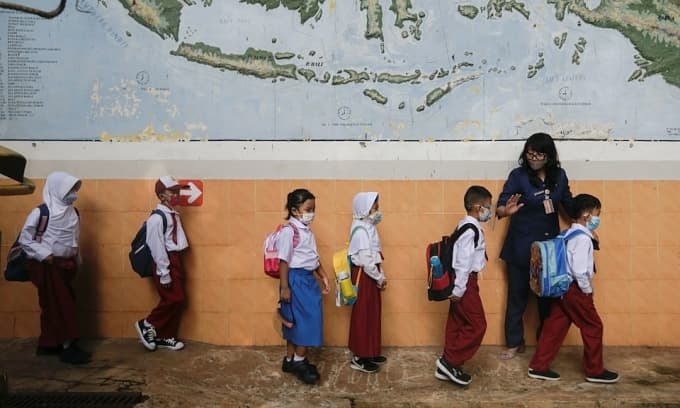
A Generational Bet on Language Skills
Indonesia is preparing to reshape the educational experience of generations to come. Starting with the 2027 academic year, elementary school students across the sprawling archipelago will be required to study English from the third grade, marking one of the most significant shifts in the basic education policy of Indonesia in over a decade. The announcement from Primary and Secondary Education Minister Abdul Muti signals a clear intention: the fourth most populous nation on Earth wants its children to master a global language before they reach adolescence. With an estimated population of nearly 288 million people, Indonesia stands as the most populous country in Southeast Asia, and any change to its national curriculum ripples across a vast and diverse landscape of cultures, economies, and local languages.
Until now, English instruction in Indonesian public schools has largely been an informal offering or an elective during early childhood education. The language only becomes compulsory at the junior high school level, covering grades six through nine. By lowering the mandatory starting point to the third grade, when students are typically around eight years old, the government aims to embed linguistic foundations far earlier than the current system allows. The hope is that earlier exposure will translate into stronger communication skills and sharper international competitiveness by the time students complete their schooling.
From Elective to Essential: The 2027 Timeline
The policy rests on firm regulatory ground. Minister Abdul Muti confirmed that the change is anchored in the Primary and Secondary Education Ministers Regulation Number 13 of 2025, which frames foreign language proficiency as a key instrument for nurturing productive and globally competitive graduates. During a recent visit to East Lombok in West Nusa Tenggara Province, he delivered the message in unmistakable terms.
Starting in 2027, English will become a mandatory subject beginning from the third grade of elementary school.
The minister described the shift as part of the broader National Education Roadmap spanning 2025 to 2045. Within this framework, English sits alongside coding and artificial intelligence as essential pillars of education designed for the future. The roadmap identifies three main transformation goals: equitable access to quality education, improved competency among teachers and staff, and a deep learning approach that prepares students for an interconnected economy. For parents and educators, the practical meaning is straightforward. Where English was once a bonus skill taught unevenly depending on school resources, it will soon be a standardized classroom requirement from the moment children enter the latter half of primary school. Schools will be given a transition window to adapt, with full mandatory implementation targeted for the 2027/28 academic year.
Why the Golden Age Matters
The decision to start English instruction at age eight is not merely administrative. It aligns with findings in modern neuroscience and educational psychology about how young brains acquire language. Dr. Adi Sutrisno, Head of the English Literature Study Program at Universitas Gadjah Mada, described the policy as a strategic and visionary step that could determine the success of the national education system over the long term.
According to Dr. Sutrisno, the primary school years represent what developmental experts call the golden age of learning. During this window, the brain undergoes synaptogenesis, a process where neural connections multiply rapidly. The prefrontal cortex, which supports cognitive skills, memory, and decision making, develops at an accelerated pace. These biological conditions create an optimal environment for absorbing new languages with greater fluency and retention than is typically possible in later adolescence. This neurological advantage means that children exposed to English at eight years old are more likely to develop intuitive grammar recognition and authentic pronunciation patterns, advantages that tend to diminish after puberty.
The policy also connects to a larger pedagogical framework known as Outcome Based Education, or OBE. Many countries use national qualification frameworks to define global competency standards. In Indonesia, this standard operates through the National Standard for Higher Education. Dr. Sutrisno argued that OBE cannot function optimally without a solid foundation at the primary level, making early English instruction a structural necessity rather than a luxury.
We must start preparing now to meet global qualification standards.
English Returns to the Primary Classroom
This upcoming change also represents a formal homecoming for English in Indonesian primary education. The subject has been absent from the national primary curriculum since 2013, leaving a generation of students without standardized early language exposure. The reintroduction occurs within the Emancipated Curriculum, known locally as Kurikulum Merdeka, which the government formally mandated as the national curriculum for all education levels starting in July 2024 under Ministerial Decree No. 12/2024.
Before becoming mandatory, Kurikulum Merdeka had already been adopted voluntarily by more than 300,000 schools since 2022. The approach grants teachers greater agency to structure lesson plans based on local context and student needs, moving away from rigid prescriptions that ignore local realities. Within this flexible structure, English is being phased back in gradually. Schools are expected to conduct internal evaluations to determine their readiness, and authorities have set the 2027/28 academic year as the deadline for universal implementation.
International education observers have welcomed the move. The British Council highlighted that English instruction at the primary level should raise the national language proficiency and produce high school graduates better prepared for university study abroad or transnational education programs. Improved English skills could also help deepen research collaboration between Indonesian institutions and global partners, connections that have historically lagged behind the economic weight of the archipelago. For the United Kingdom specifically, the policy opens potential avenues in teacher training, educational technology, and assessment services.
Training Teachers for the Task Ahead
A curriculum is only as effective as the educators who deliver it. Recognizing this, the Ministry of Primary and Secondary Education has committed to an intensive nationwide training program designed to bring elementary school teachers up to an A2 proficiency level on the Common European Framework of Reference for Languages. This scale, widely used across Europe and increasingly globally, defines A2 as an elementary level where users can communicate in simple routine tasks requiring direct exchange of information. While not advanced, this benchmark represents a functional foundation for teaching young learners.
The training program will incorporate digital learning management systems and emphasize what the ministry calls mindful, joyful, and meaningful learning principles. Technology and artificial intelligence are expected to play central roles, both in how teachers learn and in how they will eventually teach. In a notable alignment with the broader roadmap, coding and AI elective subjects are being designed to integrate with English language learning, creating connections across multiple subjects that build digital literacy.
The scale of this human capital investment is substantial. The government, in collaboration with the British Council, is conducting needs analyses and trialing continuing professional development programs. The goal is to design a national-scale training initiative targeting approximately 180,000 English teachers in basic education. These instructors will need to move beyond traditional lecture methods toward interactive activities centered on students that suit the cognitive stage of pupils who are eight years old. These efforts reflect a sober understanding that without teacher readiness, even the most carefully designed policy risks falling flat in the classroom.
The Geography of Inequality
For all its ambition, the policy faces a familiar adversary in Indonesian education: geography and resource disparity. Dr. Sutrisno acknowledged that while the vision is compelling, implementation will encounter serious challenges in regions where educational facilities and access remain limited. A mandate to teach English in the third grade may be straightforward to execute in Jakarta, Surabaya, or Bali, where private language tutors and internet access are common. In remote provinces such as Papua, where UNICEF has been running targeted rural and remote education initiatives through 2027, the reality is far more complex.
The UNICEF Rural and Remote Education Initiative for Papua provinces, supported by the Australian government, focuses on foundational literacy and numeracy gaps. Its programs address gender equality, disability inclusion, and social barriers that prevent children from accessing quality schooling. Adding a new mandatory foreign language subject in these contexts raises practical questions about whether sufficient trained teachers, teaching materials, and digital infrastructure can reach the areas that need them most. While curriculum improvement and teacher competency development can narrow these gaps, eliminating inequality entirely remains a distant goal.
The risk is that without deliberate intervention, the English mandate could widen the existing divide between affluent urban centers and underserved rural communities. Students in schools with abundant funding may graduate with conversational fluency, while their peers in remote areas struggle with basic vocabulary because of a lack of qualified instructors. Dr. Sutrisno stressed that aligning schools and curricula with current educational needs is necessary, yet he also emphasized that stakeholders must prepare concrete strategies for reaching isolated populations.
Stakes for a Global Economy
Beyond the classroom, the policy carries considerable economic weight. Indonesia has long sought to position itself as a leading destination for foreign investment and a competitive player in global supply chains. Yet language barriers frequently limit workforce mobility and international partnership opportunities. By embedding English into the primary curriculum, the government is betting that children who are eight years old today will become the professionals of tomorrow capable of negotiating contracts, reading technical documentation, and collaborating with multinational teams without the delays of translation.
This vision connects directly to the emphasis of the National Education Roadmap on deep learning. Rather than treating English as a discrete subject filled with memorization drills, the ministry intends to weave it into a broader cognitive framework. The integration of artificial intelligence and coding electives with language instruction suggests a future where students learn English not merely as a literary exercise but as a functional tool for navigating technology and global commerce. If successful, the reform could accelerate the transition from an economy dependent on natural resources to one driven by knowledge industries and digital services.
For international education partners, the shift represents a substantial market and diplomatic opportunity. Needs analyses and pilot programs already underway with the British Council could expand into large-scale teacher certification schemes, assessment partnerships, and educational technology contracts. The success of these collaborations will likely depend on how effectively Indonesia balances standardization with respect for its immense local diversity. Observers note that Indonesia stands at a crossroads where bold investment in human capital today may determine its position in the global economy for decades to come.
What to Know
- Indonesia will make English a mandatory subject from the third grade starting in the 2027 academic year, down from the current junior high school starting point.
- The policy is anchored in Ministerial Regulation Number 13 of 2025 and the National Education Roadmap 2025-2045.
- Elementary teachers will receive intensive nationwide training to reach an A2 English proficiency level under the Common European Framework of Reference for Languages.
- The reintroduction of English at the primary level occurs within the Kurikulum Merdeka, which became the national curriculum in July 2024.
- Approximately 180,000 English teachers in basic education are expected to participate in continuing professional development programs.
- Experts highlight both the neurological advantages of early language acquisition and the serious challenges posed by regional inequality in educational resources.