A Systematic Erasure Decades in the Making
North Korea has completed the piecemeal demolition of two prominent symbols of cooperation between the two Koreas, satellite imagery analysis reveals, removing a $37 million family reunion hotel in the Mount Kumgang tourist zone and razing the remnants of the liaison office inside the shuttered Kaesong Industrial Complex. The work, which stretched across late 2024 and much of 2025, represents the physical culmination of leader Kim Jong Un’s years-long drive to scrub infrastructure built by the South from Northern soil and abandon any pretense of reunification. While Pyongyang has recycled high quality building materials from the sites, the dismantlement carries a stark political message. After decades of intermittent engagement, the Kim regime now treats the South as a primary enemy, and the removal of these facilities transforms former zones of cooperation into empty lots on the terrain of division.
- A Systematic Erasure Decades in the Making
- The Kumgang Hotel: From Reunions to Rubble
- Kaesong Complex: The Final Removal of Southern Infrastructure
- A Broader Purge Across the Mount Kumgang Zone
- Why Pyongyang Is Razing What Seoul Built
- Seoul Condemns Destruction Amid Humanitarian Crisis
- What Comes Next for the Border Zones
- The Bottom Line
The Kumgang Hotel: From Reunions to Rubble
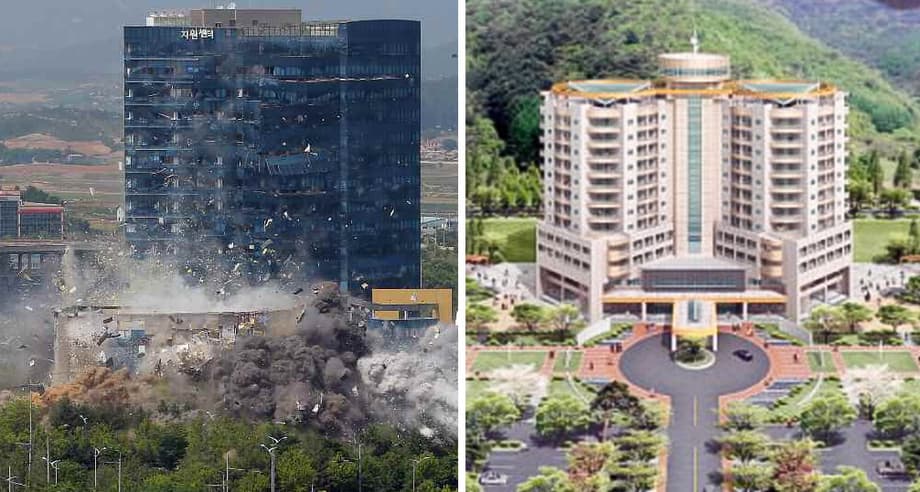
On the east coast, just beyond the Demilitarized Zone (DMZ) that separates the two Koreas, the Inter-Korean Family Reunions Center once stood as a 12 story monument to reconciliation. Built in 2008 by the South Korean government at a cost of roughly 50 billion won, or about $37 million, the facility contained more than 200 guest rooms and an event hall designed to host tearful meetings between relatives separated by the 1950 to 1953 Korean War. Hyundai Asan, the South Korean firm that operated tourism projects in the North, ran the venue, and the last such reunion took place there in August 2018 during a brief thaw in relations.
Demolition began in earnest around May 2025, with commercial satellite imagery showing the structure being carefully taken apart rather than imploded, a method that allows workers to preserve construction materials for reuse. By December, only the central elevator shaft remained, a hollow concrete pillar that itself toppled around February 3 of the following year, according to imagery analysts. In the months since, the ground has been entirely cleared, and no new North Korean construction has begun on the empty lot, leaving a barren spot where families once embraced after lifetimes apart.
North Korean authorities have also removed a fire station of two stories that Seoul funded with 2.2 billion won in 2008 to protect tourists in the zone, and the government has dismantled multiple Hyundai Asan properties across the area since 2022. The methodical clearing of hotels, golf courses, and cultural houses leaves the mountain resort virtually unrecognizable compared with its appearance during the peak of South Korean tourism between 1998 and 2008.
Kaesong Complex: The Final Removal of Southern Infrastructure
At the western end of the border between the two Koreas, inside the city of Kaesong, a parallel dismantlement has played out across the lot that once housed two distinct but intertwined South Korean government projects. The 15 story Kaesong Industrial Complex (KIC) Support Center, built between 2007 and 2009 for approximately 53 billion won ($38 million), served as the administrative heart of an unprecedented economic experiment in which South Korean companies operated factories staffed by North Korean workers. Seoul permanently closed the complex in 2016 amid rising tensions, and the building sat dormant for years, damaged but still standing after North Korea detonated the neighboring Inter-Korean Joint Liaison Office in June 2020. That explosion, carried out in protest over South Korean activists sending propaganda leaflets across the border, left debris scattered across the area and turned the support center into a damaged shell.
Starting in December 2024, North Korean crews began methodically taking apart both the tower and the remains of the liaison office, removing roofing and exterior materials in a process that lasted well into 2025. Satellite views from mid-May show the site now mostly clear, with only a few unidentified objects lingering amid the rubble. The work concludes the physical afterlife of a structure that had already been destroyed once by diplomacy and then again by demolition.
Even as Pyongyang tears down South Korean administrative buildings at Kaesong, it continues to make use of other Southern assets there. North Korean authorities began operating factories owned by South Korea inside the complex without permission in early 2023, repainting roads and roundabouts to signal continued industrial activity. Last year, they severed electrical supplies from the South, blocked the main road across the border, and dismantled a nearby rail bridge, sealing the complex off from its original partner while keeping its production lines active.
A Broader Purge Across the Mount Kumgang Zone
The family reunion hotel was neither the first nor the only South Korean asset to vanish from the scenic Mount Kumgang area. In recent years, North Korea demolished multiple facilities owned by Hyundai Asan, including the floating Haegumgang Hotel, golf resorts, and the Onjong Pavilion. Earlier in 2025, workers turned their attention to the fire station, a move that Seoul confirmed and condemned. The South Korean Unification Ministry warned that the government may pursue legal measures, noting that Pyongyang must take full responsibility for infringing on Southern property rights.
More recently, satellite imagery has revealed activity at the Kumgang Pension Town, a cluster of bungalows that North Korea had previously taken over and rebranded without Hyundai Asan’s consent. Kim Jong Un, during a highly publicized visit to the area in 2019, derided the entire collection of South Korean-built lodgings as unsightly and devoid of national character, ordering officials to replace them with new, modern service facilities built in authentic North Korean style. Since then, Pyongyang has systematically removed virtually every trace of the Southern commercial presence that once defined the zone, from hot springs resorts to caravan camping sites.
North Korean state media claimed that a forest fire caused damage to some resort properties, but satellite images have shown consistent worker activity at the sites in the months since, suggesting deliberate demolition rather than accidental destruction. South Korean tourism to the area ran for a decade until 2008, when Seoul terminated tours after a North Korean soldier fatally shot an ROK tourist near the resort. Pyongyang claimed the tourist had entered a restricted military area, but the incident froze what had been a rare reliable source of hard currency for the North.
Why Pyongyang Is Razing What Seoul Built
The demolitions are not merely about urban renewal or recycling concrete and steel. They form the physical expression of a profound ideological shift that Kim Jong Un formalized in late 2023, when he declared an end to North Korea’s nearly eight decade policy of seeking reunification with the South and redefined bilateral relations as those between two hostile states. Since that declaration, the regime has worked to physically sever the peninsula at the DMZ, blowing up sections of roads and rail lines on the Northern side in 2024 and significantly refortifying the buffer zone inside the demilitarized area.
State media has portrayed the South Korean facilities as architectural symbols of a failed engagement policy that Pyongyang now considers incompatible with its revised constitutional posture toward Seoul. Kim personally criticized them during his 2019 tour of Kumgang, calling the buildings unsightly and promising to rebuild the area according to North Korean aesthetic standards. The regime has set ambitious targets to replace the demolished structures with world class hotels, golf courses, and skiing grounds, aiming to complete new coastal and mountaineering tourist areas in stages through the end of 2025. Yet despite these plans, progress on the ground has been slow, with cleared lots remaining empty and no major construction evident at the sites of the demolished hotel or liaison office.
The contrast between rhetoric and reality suggests that symbolism remains the primary motive. By removing physical evidence of past cooperation, Pyongyang seeks to erase the very idea that the two Koreas once pursued shared economic and humanitarian goals, replacing the narrative of potential unity with one of permanent confrontation.
Seoul Condemns Destruction Amid Humanitarian Crisis
South Korea’s Unification Ministry, which manages affairs between the two nations, has strongly condemned the demolitions, characterizing the destruction of the family reunion venue as an act devoid of humanity that tramples on the wishes of separated families. More than 130,000 South Koreans had registered to meet long lost relatives in the North as of December 2024, but only about 36,941 remained alive, making each lost facility a lost chance for final goodbyes. The ministry has urged Pyongyang to immediately halt such unilateral actions and has threatened legal measures, including potential compensation suits. Seoul has already filed a 44.7 billion won ($32.7 million) claim in domestic courts over the North’s 2020 destruction of the Kaesong liaison office.
South Korean spokesperson Koo Byoung-sam stated the government position clearly during a regular press briefing.
North Korea’s unilateral dismantling cannot be justified, and the North Korean regime should take all responsibility for this case, including the property infringement of our government.
The ministry also called the demolition of the reunion facility an act that disregards the dwindling number of elderly separated family members still hoping to meet their relatives across the border.
Diplomatically, the demolitions come as North Korea has scrapped a 2018 accord designed to reduce the risk of accidental clashes along the border, ending years of confidence building efforts and prompting Seoul to follow suit. The two Koreas remain technically at war, having never signed a peace treaty to replace the 1953 armistice that halted combat. Against this militarized reality, the removal of civilian meeting spaces and economic cooperation offices shows how thoroughly the relationship has deteriorated in the span of just a few years.
What Comes Next for the Border Zones
Despite the destruction, there are faint signals that North Korea may be preparing to welcome foreign visitors again for the first time since closing its borders to tourism at the start of the COVID-19 pandemic in 2020. Koryo Tours, based in Beijing, announced recently that tours are officially back, with staff allowed to enter the Rason special economic zone in the northeast. Additionally, state media reported this year that pandemic related restrictions on domestic tourism have been removed, and television segments have encouraged citizens to visit Mount Kumgang, suggesting that Pyongyang may restart local tours to existing facilities or finally begin building the grand resorts Kim envisioned years ago.
Yet for engagement projects with the South specifically, the outlook remains bleak. Hyundai Asan has publicly expressed interest in resuming tourism ventures, but Pyongyang has shown no interest in engaging with Seoul. The continued unauthorized use of Kaesong factory buildings, combined with the dismantling of South Korean administrative structures and the physical severing of transportation links, suggests a strategy of absorbing what is useful while destroying what is symbolic. The cleared ground at Kumgang and Kaesong now stands as a blank canvas, but also as a reminder that an entire era of cooperation between the two Koreas has been reduced to rubble.
Observers note that the piecemeal nature of the demolition, carefully salvaging materials rather than dynamiting the structures, reveals a pragmatic streak beneath the political theater. North Korea appears intent on squeezing practical value from South Korean construction even as it denies the diplomatic history those buildings represent.
The Bottom Line
- North Korea has fully dismantled the $37 million Inter-Korean Family Reunions Center in Mount Kumgang and the $38 million KIC Support Center and former liaison office in Kaesong, completing work that began in late 2024 and May 2025 respectively.
- The demolitions represent the physical fulfillment of Kim Jong Un’s 2019 orders to remove South Korean-built facilities and his late 2023 policy declaration ending reunification efforts and labeling the South a hostile state.
- South Korea’s Unification Ministry has condemned the actions as inhumane violations and illegal infringements on property rights, warning of legal measures including compensation suits totaling tens of billions of won.
- The demolition campaign extends far beyond the two headline facilities, encompassing Hyundai Asan hotels, golf courses, pavilions, and even a government-funded fire station at Mount Kumgang.
- While North Korea continues to use factories owned by South Korea inside the Kaesong Industrial Complex without permission, it has simultaneously destroyed roads, rails, bridges, and electrical links that once connected the two Koreas.
- More than 130,000 South Koreans remain registered to reunite with separated family members in the North, but with reunion venues gone and only about 36,000 elderly registrants still alive, hopes for such meetings have dimmed drastically.
- Pyongyang has set a target to rebuild Mount Kumgang with resorts in North Korean style by the end of 2025, though no major new construction has yet begun at the cleared sites.
- Some signs point to a possible reopening of North Korea to foreign tourism through third-party operators, though no engagement between Seoul and Pyongyang appears imminent.