When Fiction Becomes a Lifeline
An idea that first appeared in a short online comic nearly a decade ago is now offering real comfort to mothers across Japan. In 2017, a cartoonist and mother shared a simple concept on social media. She imagined a place called Yonakigoya, or Night Crying House, where overwhelmed mothers could escape the isolation of midnight childcare. The post attracted widespread attention and eventually evolved into a serialized manga published online in 2023.
Readers responded with extraordinary force. Many said the fictional refuge would have changed their lives during their hardest nights. The author later admitted she had once doubted such a place could exist outside the pages of a story. Yet across Japan, small community groups are now turning that vision into brick, mortar, and warm cups of tea.
These late night crying cafes are not commercial ventures. They are volunteer run spaces that welcome mothers whose babies refuse to sleep, offering shelter during the hours when exhaustion feels endless and help feels impossible to find.
Inside Hokkaido’s Parent and Child’s House
Past 9 p.m. on a Sunday in Memuro, a northern town in Hokkaido, a faint glow appears in a French toast specialty shop near the train station. The business is usually closed at this hour, but on Sunday nights it transforms into something far more important. Since October last year, 28-year-old owner Madoka Nozawa has opened the space free of charge from 9 p.m. until 6 a.m. Monday, naming it Oyako no Koya, or Parent and Child’s House.
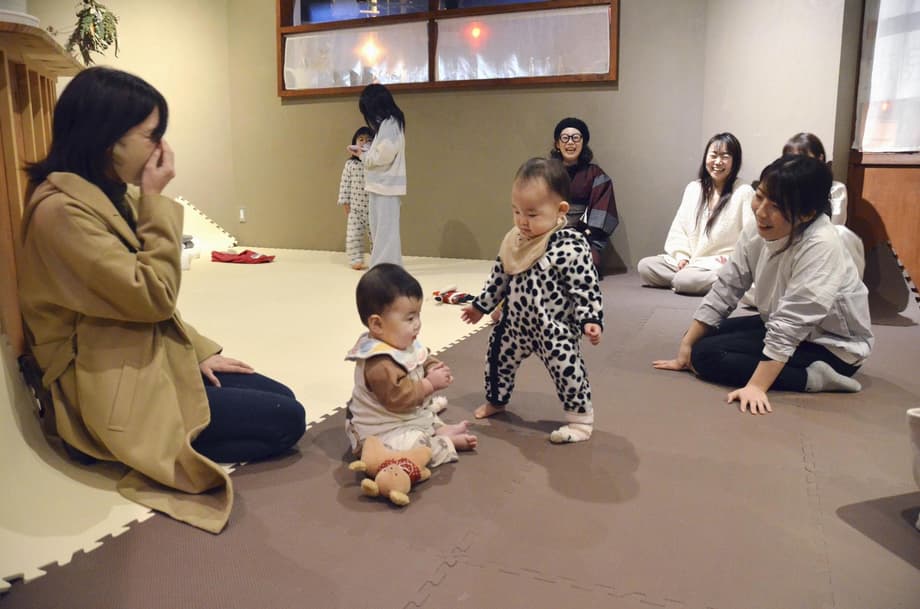
Inside, volunteers watch over children while mothers rest. Mats cover the floor so babies can crawl and sleep safely. Designated corners allow for breastfeeding and diaper changes. Female staff members sit with visitors, offering conversation and a listening ear.
Nozawa created this refuge from personal memory. When her eldest daughter was an infant, she spent countless nights alone while her husband slept in preparation for work the following morning. At times, she held her crying child until dawn without relief or company. Her experience shaped a simple mission.
I want this to be a place of refuge where people can feel like they are not alone in their struggles.
A 34-year-old visitor on maternity leave recently brought her 1-year-old and 6-year-old daughters to the Memuro shop. She told reporters that the visit gave her something she rarely finds at home during sleepless nights.
Coming here offers me the chance to talk to someone and gives me a mental break.
The Weight of Silent Nights
The hours between midnight and dawn can feel crushing for parents of newborns. In Japan, where apartments are often compact and walls are thin, a crying baby can create tension that extends beyond the nursery. Many mothers feel unable to wake their partners because early commutes and demanding jobs leave little room for shared nighttime duty. The result is a private, isolating struggle that unfolds while the rest of the world sleeps.
Postpartum mental health experts recognize this pattern as a serious stressor. When a mother sits alone with a screaming infant for hours on end, the psychological toll compounds quickly. Without another adult to confirm that the baby is healthy and that the mother is doing nothing wrong, ordinary exhaustion can spiral into something more dangerous.
Local health clinics and municipal family support centers rarely open their doors past sunset. Hotlines can provide a voice, but they cannot hold a baby or make tea while a mother cries. The physical absence of another human being in the room turns a difficult night into an ordeal that feels endless.
The isolation has grown deeper as Japan records fewer births each year. Neighborhoods that once held clusters of young families now contain scattered households where new parents may not know anyone facing the same challenges. A mother struggling at 2 a.m. cannot call a friend who no longer exists in her community.
A Nation’s Shrinking Future
These volunteer cafes are emerging at a moment of national demographic crisis. Preliminary data released by the Health Ministry showed that 705,809 babies were born in 2025, a drop of 2.1 percent from the previous year. This figure represents the lowest number of births since record keeping began in 1899, marking the tenth consecutive annual decline.
The speed of the collapse has alarmed researchers. Japan crossed below 700,000 births roughly 15 years earlier than the National Institute of Population and Social Security Research had projected in 2023. Policymakers who once measured the problem in decades are now confronting it in terms of months and single percentage point shifts.
Some rural towns now see only a handful of new children enrolled in nursery schools each spring. Young parents who remain in these areas find themselves surrounded by an aging population with little recent memory of newborn routines. The crying cafes, though small, restore a sense of normalcy by bringing parents together in the same physical space.
Without intervention, the National Institute of Population and Social Security Research warns that the working age population will shrink to unsustainable levels within a generation. Schools will close, hospitals will strain, and the social safety net will face pressure from both ends. Each birth becomes statistically more precious, yet the conditions supporting parents have not kept pace with the demographic alarm bells.
Researchers have long identified overnight childcare strain as one factor influencing a woman’s decision about whether to have a second or third child. When nights feel unmanageable, many women reconsider expanding their families. The shrinking population of young children then deepens the isolation of those who do choose to parent, creating a feedback loop where fewer peers mean less community support, which in turn makes the experience feel harder.
Grassroots Lights Across the Country
Memuro is not the only town where these refuges have appeared. In Tokushima Prefecture, a childcare support group now operates two crying cafes during monthly sessions. Professional childcare workers temporarily look after children so mothers can sit quietly, nap, or speak with other adults who understand their situation.
In Niigata, a women’s group focused on regional revitalization has run a similar cafe once a week since July last year. The organizers see the space as part of a larger effort to rebuild local social fabric while addressing an immediate practical need.
The movement has also reached larger cities. In Seto, Aichi Prefecture, a bookshop hosts monthly babies’ nights from 8:30 p.m. until midnight. Volunteers include a former nursery school teacher, a midwife, and a children’s art class director. One mother who attended with a three-year-old and an 11-month-old told local media that the gathering gave her rare breathing room.
While putting my children to sleep, I could not move and felt completely overwhelmed. There are not many people I can talk to casually about parenting yet, so a place like this is a real source of support.
In Tokyo, Yonakiba Setagaya opened in March under the direct influence of the original manga. A manager there expressed surprise at how quickly strangers gathered around a shared purpose.
The Tokyo location has already drawn steady attendance from caregivers who travel from neighboring wards. Some visitors bring infants who have resisted sleep for hours, while others arrive simply to sit in a room where tears, whether from babies or adults, are accepted without awkwardness.
I am deeply moved by the fact that so many people have been touched by Yonakigoya and have gathered together because they do not want to leave mothers in need alone.
The rapid growth of these gatherings across multiple prefectures suggests that demand far exceeds what existing social services currently address.
Volunteers and Donations Keep the Doors Open
For all the emotional rewards, sustaining these spaces presents real practical difficulties. Most crying cafes charge nothing. They rely on donations from private individuals and local companies, as well as the unpaid labor of volunteers who sacrifice their own sleep to staff overnight shifts. The financial costs of utilities, supplies, and insurance for after hours operations add up quickly.
Madoka Nozawa’s cafe in Memuro faces exactly these pressures. The fact that her French toast shop becomes a social service one night each week speaks to her commitment, but it also highlights the fragile nature of a system built on personal generosity rather than institutional funding.
In smaller cities, organizers sometimes pay for supplies out of their own pockets. Refrigerators must stay cold, lights must remain on, and emergency diapers must sit ready on shelves. When a volunteer falls ill, the entire session may be canceled. Unlike government run childcare centers, these cafes cannot draw on stable budgets or trained civil servants on rotating night shifts.
The challenge grows when demand increases. Word of mouth spreads quickly among mothers who feel invisible, yet each new visitor stretches the same limited pool of resources. A model based entirely on charity risks collapse precisely when it becomes most necessary.
Corporate sponsors have stepped in at some locations, offering modest grants or product donations. Local restaurants might contribute baby food. Medical supply shops occasionally share diapers and wipes. These contributions help, but they arrive unpredictably and rarely cover the full cost of rent, electricity, and liability coverage for overnight guests.
Kaori Ichikawa, a professor at Tokyo University of Information Sciences who specializes in postpartum care, argues that the current model cannot survive on goodwill alone.
Government support is often limited at night and on weekends or public holidays, so the public and private sectors need to work together to create places like nighttime crying cafes where people can seek help whenever they are in need of it.
Her observation points to a structural mismatch. Traditional childcare centers, municipal health services, and family support programs generally operate within standard business hours. The darkest hours of the night remain a service desert for parents in crisis.
Why These Spaces Matter More Than Ever
Beyond the immediate relief of a few hours of rest, these cafes carry a broader social significance. They represent neighbors recognizing a gap that official channels have not filled, and they create visibility for a struggle that often remains hidden behind closed doors. A mother who arrives in loungewear, carrying a crying infant, finds not judgment but company.
The original manga author continues to receive messages from readers who say the story validated years of silent suffering. She has noted that despite all the attention her concept received, the fundamental loneliness of early parenting remains largely unchanged. Actual cafes offer one answer to that problem, but they cannot replace the larger networks of support that many Japanese families still lack.
Child psychologists say that an exhausted parent cannot provide optimal care. A mother operating on three hours of sleep is more likely to make mistakes, feel resentment, or experience symptoms of depression. By offering a place to recover, even temporarily, these cafes protect the wellbeing of both the caregiver and the child. The benefits ripple outward into the home long after the sun rises.
Fathers also benefit indirectly. When a mother returns home calmer, the entire household experiences less tension. Partners who were previously caught between work obligations and nighttime duty may find that these community resources reduce the pressure on them as well, creating space for healthier family dynamics.
When a woman decides whether to expand her family, financial incentives matter, yet so does the memory of whether anyone held her hand during the longest night she ever faced.
What to Know
- Late night crying cafes across Japan offer free refuge to mothers struggling with sleepless infants during overnight hours when traditional services are closed.
- The movement was inspired by a 2017 social media comic concept called Yonakigoya, or Night Crying House, which became a serialized manga in 2023.
- Madoka Nozawa, a 28-year-old shop owner in Memuro, Hokkaido, operates one of the most prominent spaces, opening her French toast cafe from 9 p.m. Sunday to 6 a.m. Monday with volunteer help.
- Japan recorded 705,809 births in 2025, the lowest figure since records began in 1899 and the tenth consecutive yearly decline.
- Similar initiatives have launched in Tokushima, Niigata, Aichi, and Tokyo, all relying on volunteer labor and private donations rather than government funding.
- Experts say public and private sector cooperation is needed to expand nighttime and weekend support for parents and newborns.