New Bicycle Rules Meet Uneven Roads
Japan's new bicycle blue ticket system produced approximately 2,147 citations in its first month, with failing to stop at stop signs and using smartphones while riding accounting for most cases. Introduced on April 1, 2026, the system covers 113 types of traffic violations by cyclists aged 16 and older, with penalties ranging from 3,000 yen to 12,000 yen, approximately $19 to $76.
Contents
- New Bicycle Rules Meet Uneven Roads
- What the First Enforcement Figures Show
- The Dates Behind the Change
- Most Support the Rules, but Students Push Back
- Families and Low Income Riders Face Practical Pressures
- Why Sidewalk Rules Have Become a Flashpoint
- Drivers Also Want Changes to the Streets
- Fake Officers Turn Confusion Into Cash
- Recognition of the System Exceeds Understanding
- Rain on Launch Day Exposed Everyday Habits
- Safety Evidence and the Need for Usable Roads
- Key Points
By May 15, the debate extended beyond whether dangerous riding should be punished. Students questioned the financial burden, parents described difficulties following the rules during essential journeys, and riders complained that narrow streets and blocked road shoulders left them without a safe route. Criminals also began exploiting confusion by pretending to be police officers and demanding cash.
The National Police Agency intends the reform to prevent dangerous behavior before it causes serious injury or death. Bicycle enforcement now more closely resembles the system long used for automobiles, replacing an approach under which many infractions brought little more than verbal warnings.
National figures recorded more than 72,000 traffic incidents involving bicycles in 2023, roughly 20 percent of all collisions in Japan. Total collisions decreased slightly in 2024, but bicycle incidents remained a persistent safety problem.
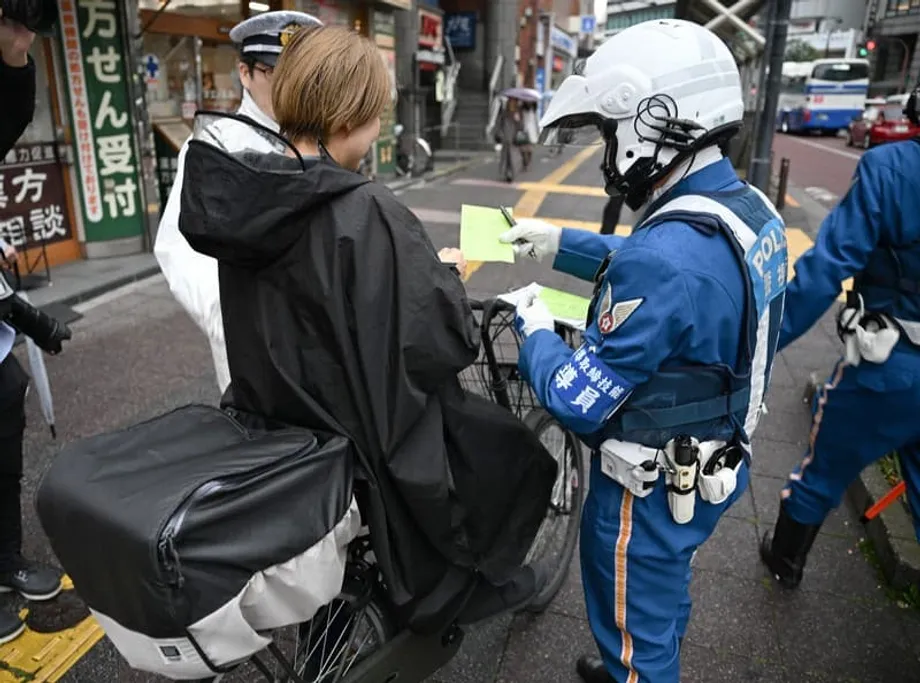
Police can issue a blue ticket at the scene for violations including smartphone use, riding without lights after dark, ignoring traffic signals and riding on sidewalks not marked for bicycle use. Payment happens later at a bank or post office. That difference has become essential as impersonators use the new penalties to pressure riders into handing over money immediately.
What the First Enforcement Figures Show
The National Police Agency's first month figures show 846 tickets for failing to halt at stop signs, an offense carrying a 5,000 yen fine. Smartphone use while riding accounted for 713 tickets, each carrying the maximum 12,000 yen penalty. Running red lights generated another 298 cases, with fines of 6,000 yen.
Stop sign and smartphone violations together accounted for 1,559 of the approximately 2,147 tickets, about 73 percent. The figures place basic intersection safety and distraction at the center of the initial enforcement effort.
During the first two weeks, police issued at least 842 fines and approximately 21,900 warnings. Warnings therefore remained much more common than tickets, even as the new financial penalties attracted attention.
Aichi Prefecture recorded 136 tickets during that early period, followed by Osaka with 125, Saitama with 104 and Kyoto with 99. Nine prefectures, including Aomori, Kochi and Okinawa, recorded none. The contrast shows how uneven the initial enforcement was across the country.
Officials said blue tickets are generally issued after cyclists ignore guidance or warnings. Dangerous violations, including smartphone use while riding, can bring a ticket without that earlier step.
Police departments have described early changes in behavior. Niigata officers said more cyclists were stopping completely at stop signs, while Tochigi police observed fewer riders holding phones. Miyagi authorities also sensed a general decline in bicycle accidents following the launch.
The Dates Behind the Change
The April rollout followed years of concern about bicycle crashes, distraction and more serious offenses. The sequence helps explain why riders are encountering both ordinary traffic fines and tougher penalties under a separate system.
- Between 2018 and 2022, collisions caused by cyclists using smartphones rose by more than 50 percent, reaching 454 incidents.
- In 2023, Japan recorded more than 72,000 traffic incidents involving bicycles, roughly one fifth of all collisions.
- Total collisions decreased slightly in 2024.
- In 2025, Japan tightened penalties for drunk cycling under the separate red ticket system. License suspensions reached 1,507, compared with 23 in 2024.
- An early March 2026 survey found that 82.4 percent had heard of the forthcoming blue ticket system, but only 7.6 percent said they knew every violation it covered.
- On April 1, 2026, blue tickets began applying to cyclists aged 16 and older.
- On April 4, a teenage boy in Hiroshima lost 2,000 yen in a scam involving a supposed bicycle penalty.
- The first two weeks brought at least 842 fines, and the first month brought approximately 2,147 tickets.
The blue ticket system addresses a broad range of everyday traffic violations. Drunk cycling is handled through the more serious red ticket regime, a distinction many riders still struggle to understand.
Most Support the Rules, but Students Push Back
A nationwide poll found that 62 percent considered the new rules appropriate, while 20 percent thought they were too strict and 8 percent said they were not strict enough. Those headline figures conceal large differences by age and occupation.
A male respondent in his 60s supported tougher enforcement because of the danger posed by serious bicycle accidents. He said:
Fatal accidents are happening, so stricter rules are better.
Women in their 50s and 60s expressed similar frustration. One described bicycles as a moving weapon. Another said cyclists should recognize that bicycles are light vehicles and therefore subject to traffic law.
Among respondents aged 70 and older, 75 percent considered the rules appropriate. Support exceeded 60 percent among people in their 50s and 60s and remained above 50 percent among those in their 30s and 40s.
Respondents aged 18 to 29 were much more divided: 36 percent called the rules appropriate, while 33 percent considered them too strict. The gap between those positions was just three percentage points.
Occupation exposed an even sharper split. Approval stood at 57 percent among employees working full time and 69 percent among homemakers, but only 20 percent among students. A majority of students, 60 percent, considered the system too strict.
Teenagers often depend on bicycles to reach school and lack an independent income. An observer said that even when accident prevention is the aim, the penalties are harsh for students. A respondent in their 20s supported action against smartphone use and riding without lights, while opposing other restrictions. Opposition to parts of the system therefore exists alongside support for addressing particular dangers.
Families and Low Income Riders Face Practical Pressures
Parents raised concerns even within the group that broadly approved of the rules. A woman in her 30s said that taking a child in the first grade to hospital could make following every rule nearly impossible for mothers.
Another woman, in her 50s, complained that the wide variety of violations effectively told people to walk instead of cycle. A respondent in their 40s warned that the system restricted freedom of movement for people with low incomes.
Parents using mamachari, bicycles commonly used to carry children and handle everyday errands, are directly affected by restrictions on sidewalk riding. For a household managing school trips, shopping and medical visits, cycling is often a practical necessity.
Japan has more than 70 million bicycles in daily use. In Tokyo, roughly 20 percent of residents commute to work or school by bicycle, while the figure in Osaka approaches 28 percent. Those shares help explain why changes to bicycle enforcement reach far beyond recreational riders.
Families and students who rely on affordable transport may have few convenient substitutes. Their objections center on how to comply during ordinary journeys, particularly where road conditions make riding beside motor traffic feel unsafe.
Why Sidewalk Rules Have Become a Flashpoint
The Road Traffic Act classifies bicycles as light vehicles and requires them to travel on the left side of roadways. A light vehicle is still a vehicle under traffic law, so cyclists have road responsibilities rather than the freedom of pedestrians.
Riders describe streets where that legal requirement is difficult to put into practice. Narrow lanes, parked cars and delivery trucks blocking shoulders can leave little space between bicycles and moving motor vehicles. Dedicated bicycle lanes remain scarce.
Tokyo riders often cite Minato City as a rare example of a more protective arrangement, with poles separating bicycles from motor traffic. Beyond such isolated examples, many urban roads offer little physical protection.
Sidewalks become an alternative when the roadway feels dangerous, but the new system heavily restricts their use. Riding on a sidewalk not marked for bicycle use carries a 6,000 yen fine. Parents carrying children are among those caught between the road requirement and concerns about safety.
Open responses to surveys repeatedly focused on this mismatch. A man in his 20s said there was no way to ride on a narrow road full of parked cars. A man in his 40s called it strange to impose harsh penalties before building infrastructure such as bicycle lanes.
A woman in her 50s argued that authorities should tighten restrictions on cars parking in the street if bicycles must use the roadway. Other respondents made the same demand, saying bicycle enforcement should be accompanied by action against vehicles blocking the space riders need.
Drivers Also Want Changes to the Streets
A female respondent in her 20s warned that bicycles traveling along the edge of narrow lanes could block cars and create severe congestion. Her complaint illustrates how a roadway with too little usable space can produce friction between people trying to follow different transport rules.
Some respondents viewed the crackdown as an effort to raise revenue rather than improve safety. A man in his 30s dismissed it as an attempt to pad police numbers. Such comments reflect distrust among riders who feel they are being punished for behavior encouraged by the road layout.
A Tokyo resident described how even a simple line of poles separating bicycles from cars on Minato City roads made a large difference to the feeling of safety. Other social media users demanded fines for drivers who blocked existing bicycle lanes.
The common complaint is concrete: cyclists are being directed onto roads where parked vehicles, narrow lanes and missing infrastructure make space hard to find. Pedestrians, meanwhile, need sidewalks where bicycles do not put them at risk. The argument therefore concerns how streets allocate space as much as how police issue tickets.
Fake Officers Turn Confusion Into Cash
Scammers have used the publicity surrounding blue tickets to impersonate police officers and demand immediate payment for supposed violations. The cases span several parts of Japan and involve both threats and convincing paperwork.
In Fukuoka, an 18 year old university student handed over 8,000 yen to a fake officer wearing plain clothes. The man accused the student of failing to signal a turn, an offense not included in the revised violation list.
In Oyama City, north of Tokyo, a cyclist paid 15,000 yen to a man who claimed to be a traffic division officer named Yamanishi. The impersonator produced a convincing replica ticket and threatened arrest unless the cyclist paid immediately.
A teenage boy in Hiroshima lost 2,000 yen to a similar scheme on April 4. The three cases show criminals using the appearance of official enforcement to obtain money from riders who may not understand the payment process.
The National Police Agency has warned that genuine officers never collect fines at the scene. A cyclist receiving a legitimate blue ticket must pay within seven days at a bank or post office. The agency said any demand for immediate payment at the scene is fraudulent and urged victims and witnesses to report such encounters to police without delay.
Fear of large fines and possible license suspensions can make threats sound believable. The separate crackdown on drunk cycling resulted in 1,507 license suspensions in 2025, compared with just 23 the previous year. Riders aware of those severe consequences may be more vulnerable when an impersonator threatens immediate arrest.
Recognition of the System Exceeds Understanding
The early March survey found a wide gap between awareness and detailed knowledge. Although 82.4 percent had heard of the blue ticket system, just 7.6 percent claimed to know all the violations covered.
Roughly half said they knew some infractions but not all. About one in five respondents in their 20s through 40s had never heard of the system at all. Authorities therefore face the task of explaining specific rules to people who recognize the name, as well as reaching people unfamiliar with the reform.
Respondents commonly identified smartphone use, earphone use and running red lights as acts that could attract fines. More complicated distinctions were less widely understood.
Some mistakenly believed drunk cycling and riding without a helmet were covered by blue tickets. Drunk cycling falls under the more serious red ticket regime, while helmet use remains a voluntary guideline rather than a mandatory rule.
Police departments reported a continuing flow of questions about what counts as a bicycle traffic violation. Headquarters responded by strengthening awareness campaigns, holding traffic safety classes and distributing information through social media.
Rain on Launch Day Exposed Everyday Habits
Heavy rain in Tokyo on April 1 brought an immediate example of the knowledge gap. Tickets for riding while carrying an umbrella accounted for roughly 70 percent of infractions that day.
Many riders protested that they had not known it was illegal to pedal while carrying an umbrella. An ordinary response to bad weather had become a reason for a financial penalty, exposing the distance between familiar habits and traffic rules.
Confusion has two practical consequences. Cyclists can commit violations without understanding the rule, and they can struggle to recognize invented accusations made by scammers. Clear explanations of both prohibited behavior and the legitimate payment process are therefore part of the same public education task.
Safety Evidence and the Need for Usable Roads
Kochi Prefectural Police reported that traffic violations were involved in 85 percent of the 152 injury accidents involving bicycles in the prefecture during 2025. The most common causes were failures to watch the road ahead and failures to check other road users, followed by unsafe behavior at intersections and signal violations.
Smartphone distraction adds another concern. Collisions caused by cyclists using smartphones increased by more than 50 percent between 2018 and 2022, reaching 454 incidents. An agency official attributed the increase to both widespread smartphone ownership and a growing variety of video and gaming content that distracts riders.
Supporters of stricter enforcement point to these figures as reasons to address dangerous behavior before a crash occurs. Expert views also described enforcement as necessary while warning that confusion would persist until road environments improved and guidance became clearer.
Surveys showing around 70 percent support for the underlying safety goal suggest that many residents accept the purpose of the reform. A substantial share of that same group nevertheless says the policy does not match conditions on the ground.
The early observations from Niigata, Tochigi and Miyagi offer encouraging signs, but no measured national change in bicycle accidents following the rollout was given by May 15. The figures reported so far describe enforcement activity alongside local observations of behavior.
Japan's task combines education, infrastructure investment and consistent enforcement. Older pedestrians need safe sidewalks, younger commuters need understandable rules they can follow without an overwhelming financial burden, and drivers need roads where everyone's role is clear. Bicycle lanes, tighter control of roadside parking and measured use of warnings where safe alternatives are lacking are central to the balance described by riders and supporters alike.
Key Points
- Japan introduced blue tickets on April 1, 2026, covering 113 bicycle violations for riders aged 16 and older, with fines from 3,000 yen to 12,000 yen.
- Police issued approximately 2,147 tickets in the first month, including 846 for stop sign violations and 713 for smartphone use.
- A nationwide poll found 62 percent considered the rules appropriate, but 60 percent of students considered them too strict.
- Narrow roads, parked vehicles and a shortage of bicycle lanes are central complaints about compliance.
- Impersonators obtained money from cyclists in Fukuoka, Oyama City and Hiroshima. Real officers never collect fines at the scene.
- Legitimate blue ticket payments must be made within seven days at a bank or post office.
- An early March survey found 82.4 percent had heard of the system, while only 7.6 percent said they knew every violation covered.
- Police described early improvements in rider behavior, while the debate continued over education, safe road space and proportionate enforcement.