241 mothers left work as children struggled to attend school
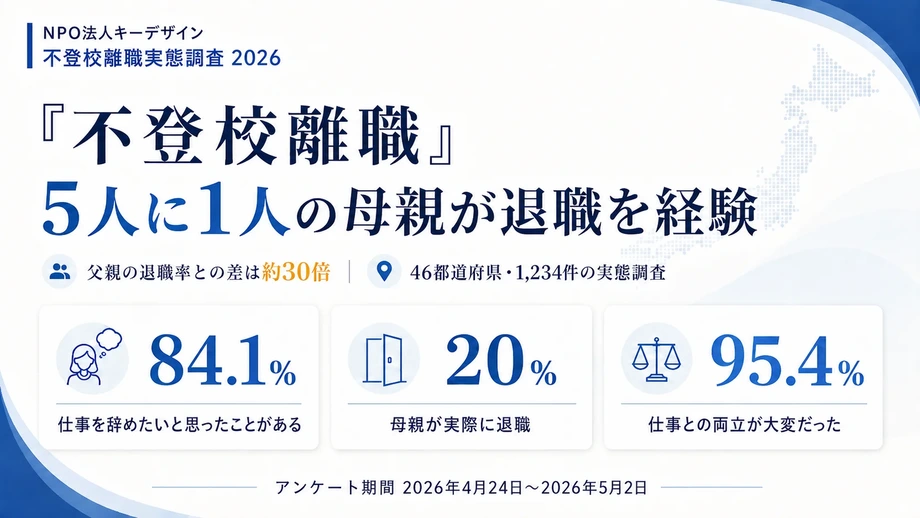
A survey of 1,234 parents across 46 Japanese prefectures has put a number on a difficult family decision: 241 mothers left their jobs while supporting children who could not attend school or struggled to go. Among 1,053 mothers who were working when their child's difficulties began, that amounted to 22.9%.
Contents
- 241 mothers left work as children struggled to attend school
- Who answered the survey?
- Resignation often follows smaller changes at work
- What one employer changed instead of accepting a resignation
- Less income arrives alongside higher costs
- Parents are managing health concerns as well as attendance
- Could care leave help parents stay employed?
- Companies are becoming part of the support network
- How the response has developed
- Key Points
Key Design, a nonprofit organisation based in Utsunomiya, Tochigi Prefecture, published its 2026 survey findings on July 9. Its official release gives the same 241 departures as 19.93%, alongside eight fathers leaving work, or 0.67%. The percentage base behind the release's maternal figure is not explained in its text. The organisation describes its published maternal and paternal rates as roughly 30 times apart.
The practical pressures extend far beyond resignation. Among 1,032 parents answering a question about combining work with support for their child, 985, or 95.4%, said it had been difficult. Among 1,066 respondents who had previously been working, 84.1% had considered quitting.
For families, the problem can begin with an unpredictable morning: whether a child can get out of bed, leave home, attend part of the school day or safely stay alone. Each decision can affect a parent's arrival at work, working hours and income.
The findings have helped bring attention to what Japanese support organisations call "futoko rishoku", leaving employment because of a child's school attendance difficulties. Employers, parent support groups and organisations developing leave application tools are now treating the parent's ability to keep working as part of the support a family needs.
Who answered the survey?
Key Design collected responses through an online questionnaire from April 24 to May 2, 2026. Parents were recruited through social media, its LINE consultation service and other channels. The questionnaire covered children experiencing school nonattendance as well as reluctance or difficulty going to school.
The original respondent breakdown was 1,193 women and 41 men. Key Design states that recruitment was voluntary rather than random, and that the survey represents the experiences of participating families rather than all Japanese households dealing with school absence.
The heavy participation by women is also important to understanding whose experiences are most visible in the results. Mothers provided nearly all the responses, while the organisation's findings describe substantial differences in how maternal and paternal employment changed.
Japan's education ministry recorded more than 350,000 elementary and junior high school students experiencing school nonattendance in the 2024 academic year, the highest total recorded. That scale helps explain why workplaces are being drawn into an issue often discussed mainly between families and schools.
Resignation often follows smaller changes at work
Key Design's official release records 434 responses saying mothers had become late, left early or missed work more often. Another 332 described difficulty concentrating at work because they were worried about their child.
Paid leave use increased in 219 responses. Reduced shifts or working days and shorter working hours each appeared in 173 responses, while 107 recorded a temporary leave of absence. Parents could select more than one answer, so the categories overlap.
Those figures show why counting resignations alone gives an incomplete picture of the workplace burden. A mother may remain employed while using up leave, working fewer hours or stepping away temporarily. The effects reach colleagues who cover shifts and managers trying to plan staffing around changes that may arise that morning.
The concentration figure captures another cost: being physically at work while attention remains focused on a child at home. Key Design describes this as presenteeism, a term for being present at work but having reduced capacity to carry out normal duties.
What one employer changed instead of accepting a resignation
A 35 year old woman in Tochigi Prefecture illustrates how quickly school attendance difficulties can disrupt employment. Her eldest son entered elementary school in spring 2025. When he later struggled to attend in the morning, she accompanied him to school, sometimes arriving during the third or fourth lesson.
That schedule conflicted with her job at a company publishing a local information paper, where her working day ended shortly after 1 p.m. She normally worked about 16 days a month. In January she missed four of those days; in February she missed 10.
Her husband's job included weekend shifts, which also limited the jobs she could take while ensuring their son had someone at home. Feeling that her absences were burdening the company, she offered to resign in March.
The company president chose a different response. The business, which had fewer than 10 employees, kept her position open and placed no fixed end date on her leave. The president also explained the arrangement directly to colleagues who would cover her work.
For this family, the immediate change was concrete: the mother could concentrate on her son's needs while retaining a place to return to. The arrangement also shows that support can depend on a manager's decisions about staffing and communication, as well as formal leave rules.
Less income arrives alongside higher costs
Half the families in Key Design's 2026 survey faced a loss of income. The proportion reporting either a reduction or a temporary reduction was 50.3%. At the same time, 79.7% said their spending had increased, either temporarily or for a longer period.
Key Design identifies fees for alternative learning settings, medical care, counselling and higher utility bills among the pressures families face. A child spending more time at home may need support during hours when a parent would normally be earning money.
The organisation's earlier survey, conducted from February 16 to 20, 2024 among users of its LINE consultation service, had already identified financial strain. It found that 14.8% had resigned and 6.0% had taken leave. Together, those categories amounted to 20.8%, or about one in five respondents stepping away from work.
In that earlier survey, 37.8% reported lower income and another 1.9% said income had fallen to zero or almost zero. Among households reporting either kind of loss, 35.8% had lost at least 80,001 yen a month. Respondents were overwhelmingly women, at 98.1%.
The two surveys used different questions and participant groups. Read together, they trace a recurring problem: families need to pay for support at the same time that providing care can reduce their capacity to earn.
Parents are managing health concerns as well as attendance
Key Design's 2026 release says 93.9% of mothers reported an effect on their mental or physical health ranging from continuing stress and anxiety to symptoms or difficulties requiring medical attention. The categories included disruption to daily life, sleeplessness and physical illness.
Parents also described serious concerns about their children. The survey recorded 481 responses saying a child had expressed a wish to die or disappear, and 190 reporting self harm. These accounts help explain why some parents felt unable to leave a child alone while they worked.
Yuhei Dobashi, Key Design's representative director, said parents were having to manage home life, employment, finances and their own emotional wellbeing together. In his statement accompanying the survey, translated from Japanese, he described the kind of society the organisation wanted to avoid:
What we want to aim for is not a society where, when a child is struggling, the parent beside them must also give up work.
Support within the home can be difficult too. In the 2024 survey, only 22.6% said they could discuss their child's nonattendance satisfactorily with their spouse. Another 45.5% talked but felt those conversations were insufficient, while 12.5% identified themselves as single parents.
Nao Okitsu, an assistant professor specialising in school health at Chiba University and a former school health teacher, has called for support for parents alongside their children. In a November 16, 2026 interview, she identified parent groups as a source of help and discussed arrangements through which schools could give families information about them.
Could care leave help parents stay employed?
Japan's family care leave system is one possible route for some working parents. Although commonly associated with looking after older relatives, it can also apply to a child whose physical or mental condition meets the requirement for constant care for at least two weeks.
Eligibility depends on the child's condition and the applicable employment rules. Family care leave provides up to 93 days in total for each eligible family member. For a family facing prolonged school attendance difficulties, that makes it one part of a plan that may also involve shorter hours, other leave and changes to work schedules.
Amendments to Japan's Child Care and Family Care Leave Act that took effect in 2025 also introduced duties for employers to hear individual employees' preferences about combining work and childrearing and give consideration to their circumstances, within the law's scope.
Awareness remains limited. A 2026 Cybozu survey of 1,000 working parents found that more than 60% did not know family care leave could sometimes be used when supporting a child experiencing school nonattendance or reluctance to attend.
School nonattendance journalist Shiko Ishii, together with Kizuki and Branch, developed a free tool available through LINE to help families assess eligibility and prepare application paperwork. It can create a leave application as a PDF and help prepare a statement from a third party describing the child's needs.
Ishii has highlighted requests for medical certificates as a practical obstacle. The tool offers a way to prepare a supporting statement from someone such as a colleague, a support centre worker or an alternative school staff member. Parents and employers still need to discuss the relevant conditions and documentation for the individual application.
Companies are becoming part of the support network
Cybozu launched its Tsuzukeru Project on August 26 with support from seven companies, aiming to prevent parents from leaving work and to support places where children can spend time. The initiative also seeks cooperation with local government leaders and education officials.
A survey released by the Insource Research Institute on August 19 suggests the issue is already familiar to many employers. Among 698 human resources employees, executives and business leaders, 47.3% said they had received a consultation during the previous year from an employee raising a child experiencing school nonattendance.
The survey reported that 4.8% of cases involving such consultations ended in resignation. Changes including shorter hours and different responsibilities helped some employees continue working.
Satoshi Tsukada, a senior researcher at the institute, has proposed support that considers both the child's needs and the parent's working life. His comparison is with care planning for older relatives: knowing what an employer can provide allows those organising support to build a more workable plan.
Key Design is also developing guidance and working with local companies on preventing resignations. Its recommendations include flexible working arrangements, a workplace where parents can speak safely about difficulties, and managers who understand that a child's attendance may be unpredictable.
Dobashi's organisation began operating the Mizutamari alternative school in 2019 and opened its free LINE consultation service in May 2020. By 2026, the service had more than 5,800 registered users, giving it a continuing channel for hearing how children's difficulties affect parents at home and at work.
How the response has developed
The growing focus on employment has followed several years of consultations, surveys and workplace initiatives. Key dates show how support has expanded from providing children with a place to learn toward helping parents retain their jobs.
- 2019: Dobashi opened the Mizutamari alternative school in Utsunomiya.
- May 2020: Key Design launched its free LINE consultation service for parents.
- February 16 to 20, 2024: An earlier survey documented resignations, leave and household income losses.
- April 24 to May 2, 2026: Key Design collected 1,234 responses for its latest employment survey.
- July 9, 2026: The organisation published the findings and called for action by employers, schools, public authorities and support organisations.
- November 2026: Discussions of parent support and access to care leave brought further attention to ways of keeping families connected to work and community help.
The practical goal running through these efforts is to give families time and options before employment ends. A parent may need emergency flexibility today, reliable advice about leave next week and a sustainable work arrangement over the following months.
Key Points
- 241 mothers left work in Key Design's survey, equivalent to 22.9% of the 1,053 mothers identified as working when their child's difficulties began.
- The official release reports the same departures as 19.93%, alongside eight paternal departures, or 0.67%.
- 95.4% of parents answering the relevant question found combining work and support for their child difficult.
- Income fell for 50.3% of participating households, while spending rose for 79.7%.
- Some parents may qualify for family care leave, depending on their child's condition and the relevant rules.
- Employers are being asked to provide flexible arrangements, informed advice and a place to discuss difficulties before parents resign.
- The survey recruited volunteers through support channels and social media rather than drawing a random national sample.