A Pond Discovery Reveals a Giant
A forelimb bone measuring 1.78 meters helped researchers identify Nagatitan chaiyaphumensis, a dinosaur about 27 meters long that weighed an estimated 25 to 28 metric tons. The animal, which lived roughly 113 million years ago in what is now northeastern Thailand, is the largest dinosaur ever found in Southeast Asia and the fourteenth dinosaur species formally named in Thailand.
Contents
The discovery began in 2016 beside a public pond in Chaiyaphum province. During the dry season, falling water levels exposed unusual shapes in the mud. Local resident Thanom Luangnan noticed what looked like strange rocks and alerted Thailand's Department of Mineral Resources. The objects were fossilized bones.
Paleontologist Sita Manitkoon, a National Geographic Explorer based at Mahasarakham University, led the team investigating the site. Excavations from 2016 to 2019 recovered ten bones, including a forelimb fossil nearly six feet long. Funding ran out in 2020, stopping the work. A National Geographic Society grant enabled researchers to resume their efforts in 2024.
The resulting study in Scientific Reports introduced Nagatitan chaiyaphumensis and gave scientists a new benchmark for the size of dinosaurs in Southeast Asia. Its remains also provide the most complete sauropod specimen recovered from the Khok Kruat Formation, a rock layer previously known for rare, fragmentary finds of these animals.
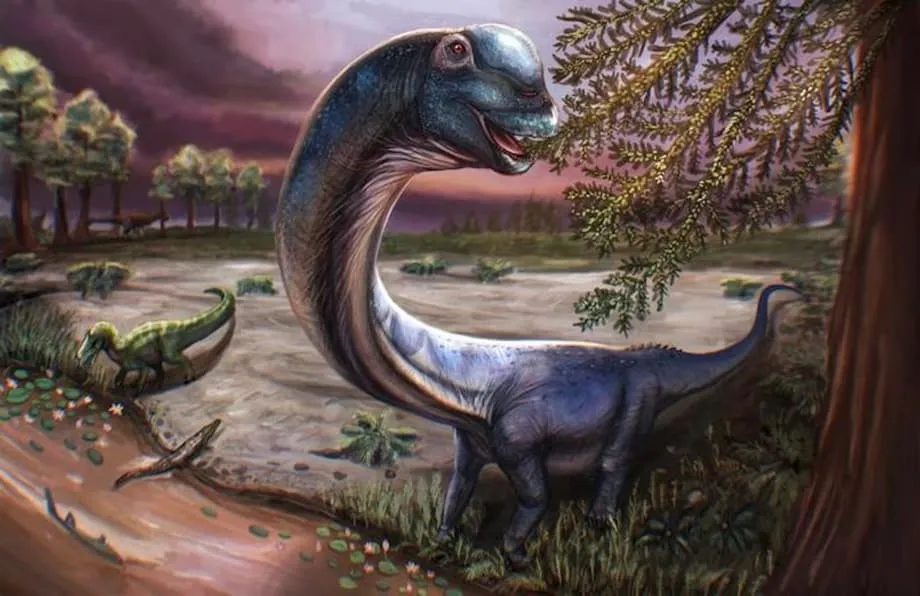
Sauropods were dinosaurs with long necks, long tails and large bodies supported by legs resembling pillars. Nagatitan adds a particularly large example to Thailand's record, while its bones offer details about the variety of these animals across Asia and their ability to live in a hot climate.
How Large Was Nagatitan?
Nagatitan measured approximately 27 meters from snout to tail, roughly 89 feet. Its estimated mass of 25 to 28 metric tons, with some estimates approaching 30 metric tons, was comparable to the weight of about nine adult Asian elephants. It also exceeded the mass of more than three Tyrannosaurus rex individuals.
The 1.78 meter front leg bone was taller than many adult humans. Thitiwoot Sethapanichsakul, the study's lead author and a doctoral candidate at University College London, described his reaction to seeing the humerus, the bone in the upper part of the forelimb.
When I first laid eyes on the humerus, it was taller than me, and that was quite surprising.
Nagatitan was a regional record setter, although other sauropods elsewhere reached greater sizes. It probably weighed at least 10 tonnes more than Diplodocus carnegii, the dinosaur represented by the famous specimen known as Dippy. South America's Patagotitan reached 60 tonnes, while the Asian giant Ruyangosaurus has been estimated at 50 tonnes.
Those comparisons place Nagatitan between familiar large sauropods and the most enormous examples. Its position in that size range gives researchers clues about when and how dinosaurs on different continents developed exceptionally large bodies.
What the Bones Reveal
The recovered skeleton includes four dorsal vertebrae from the back, four sacral vertebrae associated with the pelvis, five dorsal ribs, a right humerus, a right ilium, left and right pubis bones, and a largely complete right femur. The ilium and pubis are parts of the pelvis; the femur is the thigh bone.
Researchers concluded that the remains belonged to one individual. No skeletal elements were duplicated, the bones were consistent in size, and they lay close together. This combination allowed the team to study them as the remains of a single animal.
Nagatitan's middle and posterior dorsal vertebrae have two distinct types of joint structures. These specialized features helped lock the spinal column together, providing stability beneath an immense body. Differences in the spine are among the anatomical traits that separate the dinosaur from its relatives.
The right forelimb was also proportionally longer than those of recently discovered giants such as Patagotitan and Dreadnoughtus. Researchers examined the material using three dimensional scanning and printing, allowing specialists at University College London and in Thailand to study the fossils without transporting the fragile originals across continents.
All the specimens are housed at the Sirindhorn Museum in Kalasin Province and remain available for future research. For the Khok Kruat Formation, where sauropod finds have usually been incomplete, this relatively extensive skeleton provides an unusually detailed basis for comparing species.
A Name Rooted in Thailand
Nagatitan combines two mythological references. Naga refers to the serpentine beings of Southeast Asian folklore and Buddhist tradition, often associated with water and guardianship. That association suited an animal whose bones emerged beside a communal pond.
Titan refers to the primordial giants of Greek mythology. The species name, chaiyaphumensis, honors Chaiyaphum province, preserving the connection between the dinosaur and the place where its remains were discovered.
Nagatitan chaiyaphumensis became Thailand's fourteenth formally named dinosaur species. The country's list began in 1986 with Siamosaurus suteethorni, placing the new discovery within a scientific record that has developed over only four decades.
For Sethapanichsakul, a Thai doctoral student at University College London, naming the animal fulfilled an ambition he had held since childhood. He had dreamed of naming a dinosaur and had specifically hoped that it would come from Thailand.
The name brings the animal's scale, its discovery site and regional cultural traditions together. Its scientific description also gives researchers a distinct species to compare with other sauropods from Thailand, neighboring Laos and the wider Asian fossil record.
Where It Fits on the Dinosaur Family Tree
Researchers placed Nagatitan within Somphospondyli, a widespread group of titanosauriform sauropods that flourished during the Cretaceous. Within that group, the analysis assigned it to Euhelopodidae, a subgroup previously known only from Asia.
Other members include Phuwiangosaurus sirindhornae from Thailand and Tangvayosaurus hoffeti from Laos. Both lived during roughly the same period as Nagatitan and shared the broad sauropod body plan of long necks and legs resembling pillars.
Nagatitan nevertheless differs from both animals in its spine, pelvis and leg bones. In the researchers' evolutionary tree, it did not fall into an exclusive Southeast Asian subgroup with those neighbors. Asian euhelopodids instead emerged as a diverse, geographically widespread group.
The analysis used a data matrix containing 153 taxa and 570 characters. Taxa are the groups of organisms being compared, while characters are the anatomical features used to compare them. Researchers analyzed those features under maximum parsimony, a method that seeks an evolutionary tree requiring the fewest changes.
The resulting tree had well resolved relationships. It expands the known diversity of titanosauriform dinosaurs and gives researchers a more detailed picture of how their relatives were distributed across the region. Nagatitan therefore contributes information about both enormous body size and the different branches of Asian sauropod evolution.
A Hot Landscape of Rivers and Shrublands
Nagatitan lived approximately 113 million years ago, during the Aptian to Albian ages of the Early Cretaceous. Northeastern Thailand was then closer to the equator than it is today.
Palynomorph data and sedimentological evidence point to a warm climate with limited rainfall, open shrublands, vegetation resembling savanna and meandering rivers. Palynomorphs are microscopic remains such as pollen and spores; sedimentological evidence comes from the characteristics of deposited material that later became rock.
The rivers supported fish, freshwater sharks, crocodiles and turtles. Smaller plant eating dinosaurs, including iguanodontians and early ceratopsians, browsed lower vegetation. Ceratopsians were relatives of the later Triceratops.
Large predators, including carcharodontosaurians and spinosaurids, lived in the same landscape. An adult Nagatitan would have faced few threats because of its size. Pterosaurs, the flying reptiles, probably fished along the river corridors.
Nagatitan likely fed on conifers and seed ferns. As a bulk browser, it would have taken in large amounts of vegetation with little chewing, using its enormous body volume to process the food. Its constant feeding and movement could reshape the landscape around it.
The combination of rivers, open vegetation and varied animals describes an ecosystem supporting creatures of very different sizes. Nagatitan occupied its largest plant eating role, with a body that required vast amounts of food in an already warm environment.
How Could a Giant Keep Cool?
Nagatitan's tropical setting connects the discovery to a longstanding scientific puzzle. Large bodies retain heat more readily than small bodies. An animal of this size would also have generated substantial internal warmth while digesting huge quantities of plants each day.
Paul Upchurch, a paleontologist at University College London and a coauthor of the study, described the apparent difficulty of sauropods living in such conditions.
It seems a little odd that sauropods were able to cope with higher temperature conditions.
The sauropod body plan offers possible explanations. A long neck and tail increased the surface area through which heat could escape. The extensive skin surface allowed heat loss through radiation and convection, meaning heat could move away from the animal into its surroundings and the passing air.
A complex system of air sacs connected to the lungs may also have acted as a natural cooling system, allowing thermal energy to leave with each exhalation. Together, these adaptations likely helped sauropods thrive in warm conditions and gave them an advantage over other herbivores sharing their ecosystems.
During the middle Cretaceous, global temperatures rose and habitats shifted toward open, warm woodlands. Sauropods were already equipped to use those conditions, and their bodies grew larger. The trend continued for millions of years after Nagatitan lived, eventually producing the enormous titanosaurs of the Late Cretaceous in Asia, South America and possibly Africa.
Nagatitan preserves an earlier stage in that development. Its great size in a warm setting helps researchers examine how sauropods managed the physical demands of living as giants before the appearance of even larger species.
Why It Is Called Thailand's Last Titan
The Khok Kruat Formation is the youngest rock layer in Thailand known to contain dinosaur fossils. That position in the country's geological record explains the nickname given to Nagatitan: the last titan of Thailand.
Palynomorph studies date the formation to the upper Aptian, with the possibility that its upper portion extends into the Albian. Shortly after Nagatitan lived, much of the region sank beneath a shallow sea. Marine deposits replaced the deposits that had preserved animals from forests and floodplains.
Researchers consequently do not expect to find larger or more recent sauropods in Thai rock formations. Younger rocks laid down toward the end of the dinosaur age are unlikely to contain dinosaur remains because the area had become ocean.
The nickname refers to that geological record. Nagatitan's bones preserve a view of the landscape before rising seas transformed the region and interrupted the preservation of terrestrial remains in younger sediments.
The discovery site now has a research center dedicated to further study and public education. The place where a resident noticed unusual objects in the mud has become somewhere researchers can continue investigating the past and share the animal's story with visitors.
From a Local Find to Future Research
Thailand entered formal dinosaur science only four decades ago, yet it now ranks among Asia's richest countries for dinosaur fossils. Manitkoon said the country possibly has the continent's third highest abundance of dinosaur remains, behind China and Mongolia.
Collaboration between Thai institutions and international partners such as University College London is accelerating discoveries and helping train a new generation of scientists. Three dimensional scanning makes specimens accessible to specialists around the world while reducing the need for repeated travel and its associated carbon cost.
The Nagatitan project also shows how research can depend on continued funding. Its progress stretched across several years, with excavation, a halt in work and renewed support before the scientific description emerged.
- 2016: Thanom Luangnan noticed exposed fossils beside a public pond in Chaiyaphum province and alerted the Department of Mineral Resources.
- 2016 to 2019: Initial excavations recovered ten bones, including a forelimb fossil nearly six feet long.
- 2020: Work stopped when funding ran out.
- 2024: A National Geographic Society grant allowed researchers to resume their efforts.
The team believes museum collections already contain numerous undescribed sauropod fossils that may represent additional new species. Some have remained in storage for years, awaiting formal study because resources were limited.
Public outreach is another priority. Researchers hope that a giant dinosaur from Thailand will encourage rural communities to recognize the value of paleontology and report unusual discoveries before erosion or construction destroys them.
A reconstruction of Nagatitan chaiyaphumensis at its full size is already on display at the Thainosaur Museum at Asiatique in Bangkok. Visitors can see the scale of the animal, while the original bones at the Sirindhorn Museum remain a resource for scientific work. Together with the research center at the discovery site, these institutions connect the find to both public education and continued investigation.
What to Know
- Nagatitan chaiyaphumensis is the largest dinosaur found in Southeast Asia, measuring about 27 meters and weighing an estimated 25 to 28 metric tons, with some estimates approaching 30.
- Thanom Luangnan discovered the fossils beside a pond in Chaiyaphum province in 2016.
- The animal lived roughly 113 million years ago and belongs to Euhelopodidae, an Asian subgroup of sauropods.
- Its vertebrae, pelvis and limb bones distinguish it from relatives in Thailand and Laos.
- The skeleton is the most complete sauropod specimen recovered from the Khok Kruat Formation, Thailand's youngest rock layer known to contain dinosaur fossils.
- Nagatitan is Thailand's fourteenth formally named dinosaur species. Its fossils are housed at the Sirindhorn Museum in Kalasin Province.
- A reconstruction at the animal's full size is on display at the Thainosaur Museum at Asiatique in Bangkok.