Warm April Weather Brought an Early Scarlet Peak
Approximately 1.8 million red Shirley poppies filled Flower Hill at Showa Kinen Park in western Tokyo during the 2026 spring season, reaching full bloom about a week earlier than usual after unusually warm days in April. The flowers covered roughly one hectare, sharing the hillside with billowing white kasumiso blossoms.
Contents
- Warm April Weather Brought an Early Scarlet Peak
- Small Flowers, a Millionfold Effect
- A Former Airfield With Room to Spread Out
- How the Spring Flower Relay Unfolded
- Why the Poppies Gave Late Visitors Another Chance
- Bubbles and Photo Spots Changed the View
- Food and Music Beyond Flower Hill
- Families and Photographers Returned for Their Own Reasons
- Admission and the Journey to Western Tokyo
- Timing a Visit Around the Flowers
- The Bottom Line
Park officials expected the poppies to remain at their best through mid May. As of May 29, that expected peak window and the Spring Flower Festival, which ran from March 26 through May 24, had passed. No updated assessment of the flowers' condition on May 29 was given.
The early bloom brought forward a display that usually marks the change from spring to early summer. April's warmth pushed the flowers toward their peak sooner than gardeners and regular visitors anticipated, making timing particularly relevant for people hoping to see the hillside at its brightest.
Flower Hill combined vivid red petals, soft white blossoms and clear blue skies during the peak. A light floral scent mixed with freshly cut grass from the surrounding lawns. Families, photographers and nature enthusiasts visited in large numbers after the flowers opened, while regular visitors returned for an annual outing that turns the hillside into a broad red tapestry.
Showa Kinen Park's display offered a change of scene from the crowded streets and concrete surroundings of central Tokyo. At full bloom, petals opened to the sun across the gently sloping ground, giving visitors both close views of individual flowers and a wider panorama of nearly two million blossoms.
Small Flowers, a Millionfold Effect
Shirley poppies belong to the poppy family and are a cultivated variety of Papaver rhoeas, a species closely related to the common corn poppy. In Japan, they are known as hinageshi or gubijinso, names connected with their long history in East Asian gardening and cultural memory.
The variety planted at Showa Kinen Park produces vivid red petals that catch sunlight, creating a shimmering appearance across the hill. Each flower is relatively small. Their collective effect comes from the dense planting, with paths allowing visitors to walk through the display and see the blossoms from different angles.
White kasumiso provided a lighter contrast to the red flowers. Its billowing blossoms added texture and visual relief, giving photographers a combination of red, white and blue when the sky was clear. The white planting also broke up the solid color of the poppy field.
Japan's cherry blossoms tend to frame spring through flowering branches and brief stretches of pink canopy. The poppies created a different kind of scene: bold color spread across the ground, with the abundance of a meadow rather than the shape of individual trees.
Park gardeners prepare Flower Hill each year for a dense, uniform bloom during the first half of May. The 2026 planting followed that tradition, although the warm April weather advanced the timetable. Both staff and visitors had to adjust to an earlier opportunity to see the flowers at their best.
A Former Airfield With Room to Spread Out
Showa Kinen Park spans the western Tokyo cities of Tachikawa and Akishima. It occupies a former military airfield, a history that left it with unusually flat, expansive ground for an urban park in Japan.
The broad lawns and garden beds give the park a different feel from the dense, vertical surroundings of Shinjuku or Shibuya. Visitors can spread out across open areas rather than spending an entire outing on narrow paths between trees.
Ueno Park and the Meguro River attract large crowds during cherry blossom season. Showa Kinen Park appeals to visitors seeking more breathing room, with wide lawns and spacious flower beds that can accommodate substantial numbers of guests. That space is especially useful for parents with young children and photographers carrying tripods.
Flower Hill, called Hana no oka in Japanese, lies on the northern side of the grounds. Its roughly one hectare of planting is large enough to surround visitors with flowers while still allowing families and photographers to find their own places along the paths and between the rows.
The gentle slope gives casual walkers panoramic views without strenuous hiking. Children have space to move around, while photographers can look for different angles without disturbing other guests. The broad setting is part of the attraction, allowing a visit to include both flower viewing and time on the surrounding lawns.
How the Spring Flower Relay Unfolded
The 2026 Spring Flower Festival ran from March 26 through May 24, arranging successive displays so that different flowers reached their peak at different points in the season. The poppies formed its final major floral display.
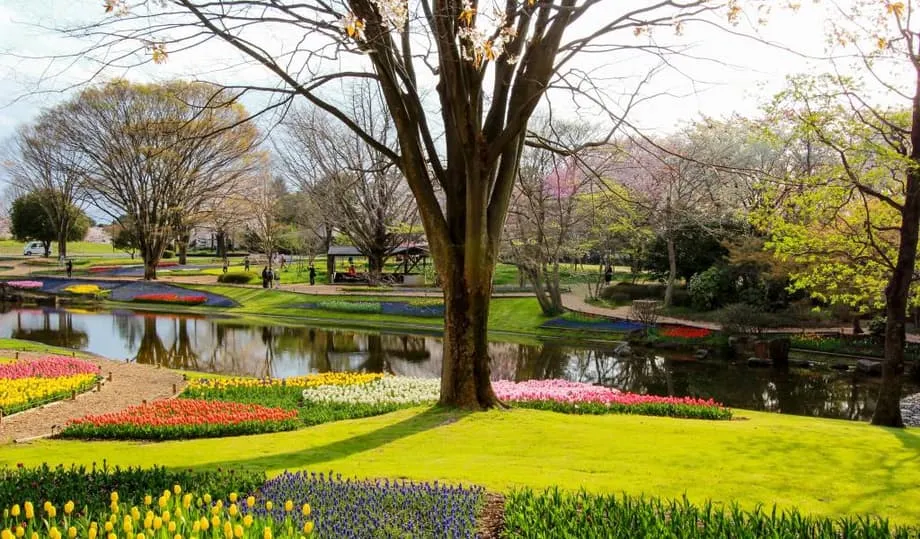
Rapeseed blossoms and tulips began the sequence in late March. Nemophila and cherry trees followed, before red Shirley poppies became the main attraction on Flower Hill. Visitors arriving in late March encountered rapeseed and early tulips, while those coming in mid April found blue nemophila fields that appeared to stretch toward the horizon.
Approximately 250,000 tulip bulbs across 260 varieties filled designated garden beds with structured, geometric patches of color. As the tulips faded, nemophila supplied a blue counterpart to the warmer weather. Around 1,500 cherry trees also contributed their brief pink canopy.
The season's main dates and stages were:
- March 26: The 2026 Spring Flower Festival began, with rapeseed blossoms and early tulips among the first displays.
- Mid April: Nemophila fields became a major attraction, while unusually warm April days advanced the poppies' development.
- Early May: The usual period for Flower Hill's dense poppy display, although the 2026 peak arrived about a week early.
- Through mid May: The viewing window park officials expected for poppies at their best.
- May 16: One of the selected dates for a scheduled soap bubble event.
- May 24: The Spring Flower Festival ended.
Variable weather during 2026 compressed or extended individual flowering periods. The sequence of different species gave visitors several opportunities to find a colorful display, even when the timing of a particular flower changed.
Why the Poppies Gave Late Visitors Another Chance
Cherry blossoms offer a short and sometimes unpredictable viewing period, making precise timing valuable. The poppies' flowering window extended over several weeks, giving travelers more room to plan and another seasonal display after the earlier blossoms had faded.
Visitors who missed the tulips, nemophila or cherry trees could still find a major attraction when Flower Hill turned red. In past years, people arriving later in spring had been surprised by the vivid and relatively reliable flower viewing available in May.
The festival's sequence meant the park changed throughout the season. Structured tulip beds, a blue nemophila field, pink cherry canopies and the red poppy hillside each provided a different visual experience, with one display yielding to the next.
The early poppy peak in 2026 also meant that the festival's closing date was later than the expected period of best poppy viewing. People planning specifically around the red hillside needed to consider the flowers' timetable as well as the dates of the wider event.
Bubbles and Photo Spots Changed the View
Park staff scheduled releases of thousands of soap bubbles over the flower fields on selected dates in April and May, including May 16. The bubbles added moving, iridescent spheres above the petals, giving children another attraction and photographers a different scene to capture.
The scheduled releases made the flower fields more than a static display. Bubbles drifting over the red planting introduced movement and changing reflections, especially appealing to young children seeing the combination for the first time.
Photo spots were another part of the park's seasonal arrangements. Installations changed with the blooming schedule so that visitors could frame themselves against the flowers then at their best.
Past installations included train tracks, doors, swings, benches and a miniature house. These objects offered different ways to compose a photograph, placing a recognizable shape or seat among the blossoms rather than relying only on a distant view of the field.
The park also occasionally opened certain areas early or restricted morning entry for photography sessions with fewer people present. Some of these sessions required advance reservations and modest fees. The opportunities to photograph empty gardens had become particularly popular with social media content creators.
Food and Music Beyond Flower Hill
Spring menus offered visitors donuts, specialty coffees, ground pork cutlets, and shrimp and avocado bagels. Food provided a reason to pause between garden areas and helped turn flower viewing into a longer outing.
Local food trucks often parked near the main entrance, serving grilled meats and chilled drinks that were popular as the May sun grew stronger. These choices complemented the seasonal menus elsewhere in the park.
The Japan Air Self Defense Force Central Band had also performed outdoor concerts on the grounds. Its appearances connected the site's military aviation history with the park's present role as a place for recreation and cultural gatherings.
Food and performances gave visitors who were less interested in flowers other ways to spend their time. Families could combine the hillside display with a meal, music or a break on the lawns rather than making the entire day depend on photographing blossoms.
Families and Photographers Returned for Their Own Reasons
A company employee from Suginami Ward visited Flower Hill with his family during the opening days of the 2026 peak. He described the outing as a regular family ritual, giving his two children space to play while he and his spouse enjoyed the seasonal colors.
We always come here to play with our two children. Today we came to the flower field after hearing the blossoms were at their best.
His young son gave a brief reaction to the flowers:
It was so pretty!
A woman from Shinjuku Ward who returns each season came with her camera and a particular photographic goal. After setting up near the paths, she described both the flowers and the light she wanted to use.
The poppies this year are wonderful, and I want to enjoy photographing them in the backlight.
Backlight means photographing a subject with the light coming from behind it. For this visitor, the direction of the light was part of the attraction, alongside the quality of the year's poppies.
The hillside served different purposes for different guests. Some pursued carefully arranged photographs, while others lay on blankets near the edge of the field, read books or shared picnics with red blossoms moving in the breeze behind them.
Family traditions and individual creative interests helped make the display a shared gathering place. Amateur photographers and casual visitors had access to the same views, while the surrounding open ground offered room to stay without making every moment about the flowers.
Admission and the Journey to Western Tokyo
Admission was 450 yen for high school students and older, with a reduced rate of 210 yen for visitors aged 65 and over. The fees covered access to the entire park, including Flower Hill and the surrounding gardens, making it an inexpensive excursion within the Tokyo metropolitan area.
The JR Chuo, Nambu and Ome Lines provide access to the Tachikawa area. From there, visitors can reach a park entrance by a short walk or bus ride. The journey from central Tokyo was described as roughly 30 to 45 minutes.
Multiple rail connections make the park practical for residents across the metropolitan area. Public transportation is also a useful choice during busy bloom weekends, when parking lots can fill quickly.
Parking is available for visitors arriving by car. Within the grounds, paved paths pass through most major garden areas, providing access for wheelchair users and people pushing strollers.
The park's size means that reaching different gardens and viewpoints involves walking. Comfortable shoes help with the extensive grounds and grassy areas, while water and sun protection are useful on the open flower hills, where shade is limited.
Timing a Visit Around the Flowers
Park officials' expected viewing window for the 2026 Shirley poppies extended through mid May, with the exact timing dependent on weather. Because the flowers arrived early, delaying a visit during that period risked missing the hillside at full color.
Morning light generally offered flattering conditions for photographs. Weekday afternoons tended to attract smaller crowds than weekends, giving visitors another way to choose between preferred lighting and a quieter outing.
Special morning photography access was separate from an ordinary visit and could require a reservation and an additional modest fee. Visitors interested in such sessions needed to account for those arrangements rather than relying only on the general admission price.
May 29 came after both the expected poppy peak and the May 24 festival closing date. The season's central story was the scale of the planting and its early arrival: 1.8 million red flowers, a hillside shared with white kasumiso, and warm April weather that moved a familiar May spectacle forward by about a week.
Showa Kinen Park's wider spring program gave that display a place in a longer sequence. Tulips, nemophila, cherry trees and poppies brought successive changes in color, while open lawns, photography events, food and music offered visitors reasons to spend time beyond a single garden bed.
The Bottom Line
- Approximately 1.8 million red Shirley poppies bloomed on roughly one hectare of Flower Hill at Showa Kinen Park in 2026.
- Unusually warm April days brought the peak about one week earlier than usual, with officials expecting the best viewing to last through mid May.
- White kasumiso shared the hillside, adding contrast to the red flowers.
- The Spring Flower Festival ran from March 26 through May 24 and included approximately 250,000 tulip bulbs across 260 varieties, nemophila and around 1,500 cherry trees.
- Selected April and May dates featured soap bubble releases, including a scheduled event on May 16, alongside seasonal photo spots and special photography sessions.
- The park occupies a former military airfield across Tachikawa and Akishima and is accessible through the JR Chuo, Nambu and Ome Lines.
- Admission was 450 yen for high school students and older and 210 yen for visitors aged 65 and over.
- As of May 29, the expected peak window and the festival had passed; no updated flower condition was given.