Paper tickets will stay, but the way passengers use them will change
Seven Japanese railway operators will begin replacing magnetic paper tickets with QR code tickets in spring 2027, changing a familiar station routine from inserting a ticket into a gate to holding it over a reader. The joint announcement, dated October 13, 2026, sets out a system intended for every line and station operated by the participating companies, although individual launch dates and station procedures will vary.
Contents
- Paper tickets will stay, but the way passengers use them will change
- How passengers will enter and leave stations
- Larger tickets, with some exceptions
- Why the railways are retiring magnetic equipment
- JR East, Keikyu and Tobu have different ticket plans
- From the 2024 proposal to the 2027 rollout
- Transfers depend on coordination beyond the seven companies
- IC cards will remain, while key dates are still pending
- At a Glance
The companies are Keisei Electric Railway, Keikyu Corporation, Sendai Airport Transit, Tokyo Monorail, Tobu Railway, East Japan Railway Company (JR East), and Hokuso Railway. Their plans cover a mix of commuter routes and airport connections, including Tokyo Monorail services to Haneda Airport and Keisei services linking Narita Airport with central Tokyo.
The joint railway announcement establishes spring 2027 as the start of the transition, rather than a single confirmed conversion date for every operator. It also says companies beginning service in fiscal 2027 or later will announce their schedules once decided.
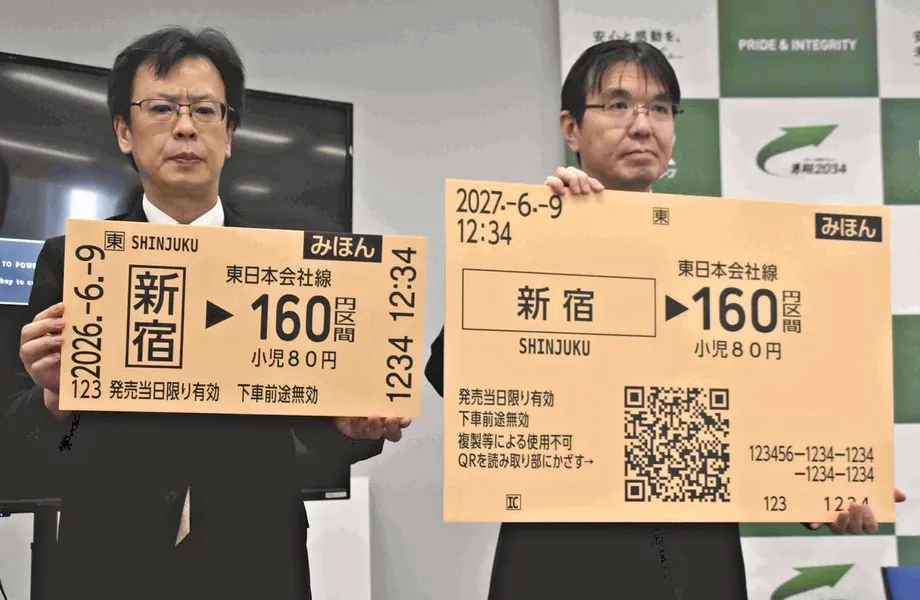
For passengers buying tickets from vending machines, the main change is the ticket and how it passes through the gate. Paper tickets are not disappearing under this plan. Instead, printed QR codes will replace magnetic encoding, while Suica, PASMO and their mobile versions remain part of the operators' wider efforts to expand travel without paper tickets.
How passengers will enter and leave stations
Passengers will hold the QR code on their ticket over a compatible automatic gate reader when entering a station, then keep the ticket for the journey. At the destination, they will scan it again and place the paper ticket in a collection box installed at the gate.
This separates two actions that magnetic gates currently handle together: checking the ticket and taking it back at the end of a trip. Passengers should therefore expect to retain their QR ticket until they have completed the exit procedure, rather than leave it behind after the first scan.
Stations without automatic gates capable of handling the seven companies' QR tickets will use staffed windows. The joint announcement explicitly says procedures will differ according to the equipment installed at each station. Coverage across all stations therefore does not mean every station will have the same automatic reader arrangement at launch.
The operators will publish more detailed instructions once those arrangements are settled. The confirmed distinction is straightforward: compatible gates will read the code, while stations without suitable gates will handle the ticket through staff. The announcement does not provide a station by station equipment schedule.
Larger tickets, with some exceptions
QR tickets issued by vending machines will generally measure 57.5 by 85 millimeters, compared with the current small magnetic format of 30 by 57.5 millimeters. The joint announcement allows exceptions to the new dimensions, so passengers should not assume every participating railway will issue every ticket in an identical format.
The size change is substantial. Using the stated dimensions, the current format has an area of 1,725 square millimeters, while the new format covers 4,887.5 square millimeters. That makes the larger ticket about 2.83 times the area of the smaller one. This comparison describes the ticket's footprint, not its weight or the environmental impact of producing it.
Tobu has given a more specific commitment: all QR tickets sold through its automatic vending machines will use the larger format. Its position fits within the joint plan, which sets a general size while leaving room for differences elsewhere.
A printed QR ticket should also be distinguished from a ticket displayed on a phone. The shared transition concerns paper tickets carrying a code, although Tobu is separately moving many special ticket products to digital formats. A smartphone is therefore not a general requirement for buying and using the replacement paper tickets.
Why the railways are retiring magnetic equipment
The operators describe the transition as a way to sustain railway services over the long term. Magnetic ticket gates and vending machines depend on specialized equipment, and maintaining those systems has become a concern as railways also encourage greater use of IC cards and mobile services.
A magnetic gate must physically draw in a ticket, read it, and either return it or retain it. QR scanning removes the need to carry the paper through that internal mechanism. JR East says the change will eliminate ticket jams inside automatic gates, while the broader project aims to reduce maintenance costs associated with magnetic ticket equipment.
The environmental case concerns the magnetic material as well as machinery. JR East says removing the nonrecyclable magnetic layer on the back of conventional tickets will reduce environmental impact. Magnetic components also make recycling more labor intensive, and the companies seek to reduce the burden of producing and disposing of these tickets.
No quantified maintenance savings, waste reduction estimate or full environmental comparison has been announced in the information accompanying the transition. The larger ticket size means the environmental claim should not be simplified into a promise to use less paper. The stated benefits concern removing magnetic material and changing the equipment needed to process tickets.
JR East, Keikyu and Tobu have different ticket plans
The shared gate system does not mean every operator is replacing exactly the same range of products. JR East's announced change covers magnetic tickets for journeys of up to 100 kilometers on its conventional lines. Shinkansen tickets will continue to be issued on magnetic paper for the time being, so the plan should not be read as an immediate end to every magnetic ticket sold by JR East.
Keikyu's magnetic ticket notice, also dated October 13, 2026, says sales will end in spring 2027 at its stations except Sengakuji. The precise date has not yet been announced. The notice places the change within the company's 20th comprehensive management plan and its plans for the next generation of railway operations.
Keikyu lists ordinary tickets, discounted multiple journey tickets for passengers with physical, intellectual or mental disabilities, discounted multiple journey tickets for students, and special ticket products among the magnetic tickets whose sales will end. It says QR tickets will be sold afterward, with further details to follow. The Sengakuji exception concerns the announced end of magnetic ticket sales, not a statement that the station is excluded from the shared QR service.
Tobu plans to make its transition in March 2027. Its changes cover ordinary tickets, station admission tickets, discounted multiple journey tickets and special ticket products. Most special products will move to digital tickets used on smartphones or similar devices, with sales through automatic vending machines and other outlets ending. Exceptions include certain special products using IC cards.
Tobu also says shareholder travel passes will continue to be issued in both pass and multiple journey formats. Further changes to individual ticket services will be announced in stages. These details show why passengers using discounts, special passes or admission tickets will need to check their operator's product rules, rather than rely only on the general QR gate instructions.
From the 2024 proposal to the 2027 rollout
The project began with a joint announcement on May 29, 2024, proposing a move from magnetic tickets to QR tickets from the end of fiscal 2026 onward. The October 2026 announcement turns that broad proposal into a spring 2027 service plan, while retaining flexibility for operators that start later.
- May 29, 2024: Eight railway companies announced plans to work together on replacing magnetic tickets with QR tickets.
- 2025: Keisei Electric Railway and Shin-Keisei Electric Railway merged, changing the number of separate operators involved.
- October 13, 2026: Seven companies announced the spring 2027 service plan. Sendai Airport Transit joined the current group.
- March 2027: Tobu plans to switch its magnetic tickets to QR tickets.
- Spring 2027 and afterward: The shared rollout begins, with individual schedules to be announced for companies starting in fiscal 2027 or later.
Accounts referring to eight companies and those naming seven describe different stages of the project. The change is not explained by the Keisei merger alone. Sendai Airport Transit has joined the current group, while Seibu Railway, which participated in the earlier proposal, is preparing its QR introduction separately and has not decided its launch timing.
The reference to the end of fiscal 2026 is consistent with a spring 2027 start: Japan's fiscal 2026 ends in March 2027. However, the joint announcement does not establish a common completion deadline for all seven operators.
Transfers depend on coordination beyond the seven companies
The planned shared system and servers are intended to allow participating companies to issue and accept QR tickets across their networks. That common infrastructure matters because a ticket can involve more than one operator, particularly where trains continue directly onto another company's tracks.
The seven companies say they are coordinating with other railways involved in through services and related arrangements. JR East is also working with operators running direct services on its network, and the wider project includes coordination with railways that are not making the same transition.
These discussions are intended to preserve convenient journeys and transfers, but the announcement does not set out a complete list of supported routes, ticket combinations or procedures at every boundary between companies. Acceptance across the participating networks should not be treated as confirmation that every other railway will immediately accept the same QR ticket.
For journeys involving several operators, the remaining detail is practical: which ticket will be issued, where it can be scanned, and when staff assistance may be necessary. The companies have committed to publishing further information, but have not yet supplied all those answers.
IC cards will remain, while key dates are still pending
The move to QR paper tickets runs alongside efforts to expand Suica, PASMO, Mobile Suica and Mobile PASMO. The operators are changing how paper tickets are processed, rather than announcing the withdrawal of those established travel options.
Keikyu specifically confirms that passengers will still be able to use transport IC cards accepted through nationwide reciprocal arrangements and its credit card contactless travel service after magnetic ticket sales end. That assurance is specific to Keikyu's notice and should not be read as an identical payment commitment from every participating railway.
The most concrete dates are Tobu's planned March 2027 switch and the shared spring 2027 starting period. Exact dates for other companies, detailed changes to magnetic ticket services and station instructions will be announced individually. Seibu's separate launch remains undecided.
The central change is already settled: vending machine paper tickets will increasingly be scanned rather than inserted. The outstanding decisions concern the timing and product rules needed to make that change work across different stations, ticket types and connected railways.
At a Glance
- Seven operators plan to begin replacing magnetic tickets with QR tickets in spring 2027, with some launches potentially later.
- The service is intended for all participating lines and stations, but gate procedures will depend on installed equipment.
- Passengers will scan paper tickets at entry and exit, then put them in a collection box when leaving.
- Most vending machine QR tickets will measure 57.5 by 85 millimeters, with some exceptions.
- Tobu plans a March 2027 transition. Keikyu will end magnetic ticket sales in spring 2027 except at Sengakuji.
- JR East's change covers conventional line tickets for trips up to 100 kilometers. Shinkansen magnetic tickets will continue for now.
- IC card services will remain, while transfer arrangements, individual launch dates and some ticket rules await further announcements.