
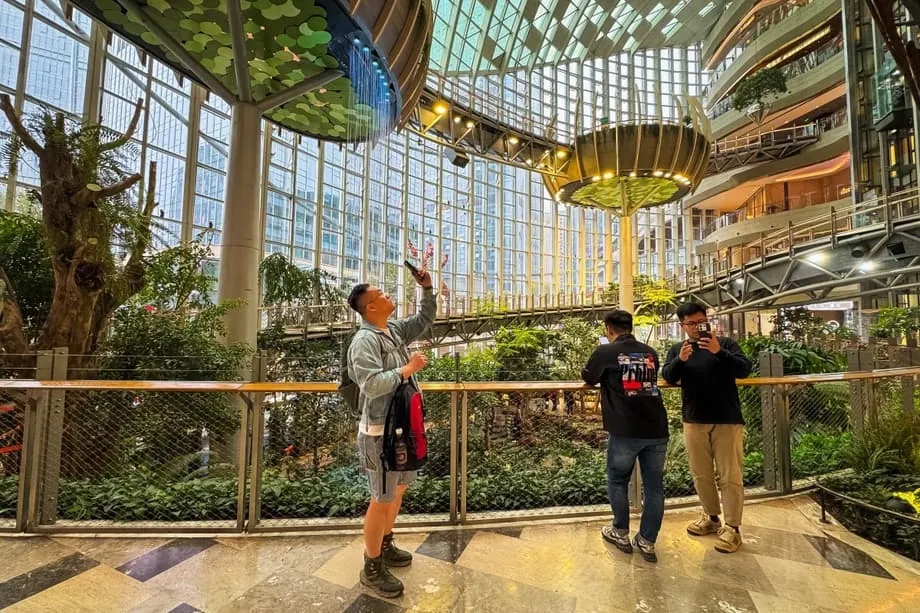
Parks Become Part of the Shopping Trip
A 23 billion yuan development beside a river in northeastern Beijing and a Chengdu complex combining a 400,000 square meter park with nearly 500,000 square meters of commercial space show how Chinese developers are rethinking the shopping mall. Greenery, gardens, water features and places to gather are becoming central to projects designed to give people a reason to leave their phones and visit in person.
Contents
- Parks Become Part of the Shopping Trip
- Why Visitors Want More Than Shops
- Beijing's Biggest Swire Investment
- Chengdu Combines a Park and a Retail District
- Bamboo, Poetry and an Indoor Garden
- Asia's Shift Toward Experiences
- How Transport and Planning Fit Together
- Why Greenery Matters to the Business
- Keeping the Gardens Worth Visiting
- Key Points
Hong Kong developer Swire Properties is investing US$3.4 billion in Taikoo Place Beijing, its largest single investment and the first Taikoo Place on the Chinese mainland. In southwestern China, China Merchants Shekou's Chengdu Tianfu China Merchants Garden City Mall brings together shops, landscaped surroundings and a direct connection to Metro Line 6.
Both developments reflect a move away from the enclosed mall as a building mainly for buying goods. Their designers are creating districts where visitors can eat, meet friends, work, enjoy leisure activities and spend time outdoors. Retail remains part of the business, but the setting itself becomes a reason to visit.
The pressure comes from online shopping. A smartphone can make buying a product faster and more convenient than going to a store. Physical destinations therefore need to provide experiences that a delivery service cannot bring to someone's door: a pleasant atmosphere, sensory experiences and opportunities to spend time with other people.
As of June 7, 2026, the projects also point to a wider change in how commercial property fits into Chinese cities. Parks, riverside spaces, offices, hotels and transport connections are being combined with retail, turning shopping destinations into places used for several parts of daily life.
Why Visitors Want More Than Shops
James Macdonald, head of research for China at the global real estate firm Savills, says consumers are increasingly choosing retail destinations according to how they want to spend their time. Dining, leisure, wellness and social activities have become a larger part of the visit.
Macdonald explained how those priorities affect the spaces developers build:
Consumers increasingly view retail destinations as places to spend time rather than simply places to buy products. They are spending more time on dining, leisure, wellness and social activities, which naturally benefit from more open and human scale environments.
Open spaces can support a wider range of events and activities than a conventional shopping corridor. They also help keep a development active beyond traditional shopping hours, contributing to the nighttime economy, the business generated by people going out to eat, relax and socialize in the evening.
Major Chinese cities add another reason for the change. Many residents live in tall apartment towers, while accessible public outdoor space is scarce. A retail destination with a garden, a park or a riverside route can offer a temporary escape from dense surroundings.
Developers are responding by putting shops within landscapes that people may want to visit even without a shopping list. The commercial idea is straightforward: someone who comes to meet a friend or walk through a garden may also stay for a meal, attend an event or browse a store.
Conventional malls face pressure from both online convenience and changing lifestyle preferences. A larger selection of products alone is less persuasive when those products can be ordered from home. The newer formats make time spent at the destination part of what visitors value.
Beijing's Biggest Swire Investment
Taikoo Place Beijing is designed as a mixed use urban district rather than a standalone shopping center. Mixed use means bringing several functions, such as workplaces, shops and accommodation, into the same development.
The project combines eight connected office buildings, an expanded retail component linked to the existing Indigo mall, a new hotel, outdoor retail streets, riverside leisure features and extensive green space. Swire Properties has described this particular combination as currently unavailable in Beijing.
Han Zhi, director of retail at Swire Properties, said the park concept responds to the shortage of open public spaces in large cities:
We developed the project around a park centered concept, and it functions as an urban oasis. Such open public spaces are scarce in major cities, and I think the Beijing site is well positioned for such a development.
The riverside location is central to that proposition. Offices and shops are being placed alongside areas for outdoor leisure, allowing the development to serve people working there as well as those arriving to dine, shop or relax.
The complex is expected to begin opening in phases by the end of 2026. Its planned sequence starts with handing over the office towers so tenants can fit out their spaces, meaning prepare the interiors for use. Retail and hospitality tenants are then expected to arrive gradually.
- Office towers are scheduled to be handed over first for tenant fit out.
- The development is expected to begin opening in phases by the end of 2026.
- Retail and hospitality tenants are expected to be introduced gradually as the complex develops.
Swire has given an opening window rather than a specific day. The staggered approach is intended to build a workforce and regular daily foot traffic before the full retail experience is operating. Office workers can provide a recurring customer base for food, services and shops, alongside visitors drawn by the park and river.
Chengdu Combines a Park and a Retail District
Chengdu Tianfu China Merchants Garden City Mall takes the same broad idea into a much larger landscape. Developed by China Merchants Shekou and designed by Benoy, it has been billed as China's first retail development of exceptionally large scale fully integrated with a park.
The project sits in the Central Business District of Chengdu's Tianfu New Area. It joins a 400,000 square meter park with nearly 500,000 square meters of commercial space, making the park's area roughly four fifths of the commercial area. The two figures describe the scale of the landscape and the commercial development, rather than just the size of the mall building.
The development's concept, called an "Urban Wild Living Hub," combines enclosed malls, retail streets open to the air, podiums and standalone buildings. A podium is a lower building base that can accommodate shops or other activities beneath or beside taller structures.
Within the wider development, the combined Mall and Retail Street zone covers 300,000 square meters. The newly opened Tianfu Garden City Mall, at 120,000 square meters, serves as its core. That mall accounts for 40 percent of the combined zone, showing how much of the retail setting extends beyond the central mall itself.
Transport is built into the arrangement. The mall sits directly above Metro Line 6, with underground access connecting it to the wider city. This makes the project a benchmark example of transit oriented development, a model that places homes, workplaces, services or shops around public transport.
Chengdu's project consequently offers several ways to spend a visit. Enclosed shopping areas sit alongside outdoor streets and landscaped spaces, while the metro connection makes the destination part of the city's daily movement rather than an isolated commercial site.
Bamboo, Poetry and an Indoor Garden
Benoy's design team used the principles of "Park Life 3.0," placing experience, scenic composition and openness at the center of the Chengdu project. Bamboo provides the main architectural metaphor, helping shape a fluid connection between buildings and landscape.
A layout with two ground levels connects the first and third floors. By using the site's natural topography, the design aims to make more of the development feel open and accessible, while giving retail spaces connections at different heights.
The interior takes inspiration from Tang dynasty poet Li Bai's vision of Chengdu as a heavenly city where trees, clouds and mountains intertwine. Benoy translated that image into five themes: brocade, rivers, blossoms, mountains and greenery. Brocade, a richly patterned fabric, becomes one element in a set of designs intended to give different spaces their own identity.
The mall includes a sunlit atrium covering 1,000 square meters and an indoor garden covering 1,500 square meters. The garden is therefore half again as large as the atrium. Both features bring the landscape concept into the enclosed parts of the building.
A transparent dome covers the indoor garden and filters natural light throughout the year. The result is intended to offer an escape resembling a greenhouse during Chengdu's colder months, extending the garden experience beyond the outdoor season.
Chengdu's design shows that integrating nature into retail can involve the layout of floors, routes, lighting and interiors as well as planting outside. The park, streets and indoor garden are different parts of one destination, with enclosed areas retaining a role alongside the open landscape.
Asia's Shift Toward Experiences
China's developments are part of a wider Asian move toward retail environments that combine commerce, culture and experiences. The purchase itself is increasingly a secondary design consideration, with more attention going to the reasons people might gather at a destination.
Lukasz Wawrzenczyk, Design Principal at international architecture practice 10 Design, described Asian markets as particularly progressive in this approach:
Asia is coming out on top in terms of innovative retail development. The market is galvanized by new developments that break away from the conventional big box mall and integrate immersive, experiential spaces, with commercial and cultural elements combined.
Experiential retail means designing a visit around things people can do and feel, rather than concentrating only on the transaction. In dense Asian cities, where private living spaces are often compact, malls can function as public living rooms: places for dining, cultural events and community connection.
The idea of "Slow Shopping" follows the same logic. Online ordering rewards speed, while a physical destination can encourage people to take their time. More time on site creates more opportunities to encounter shops, restaurants and activities, including ones that were not part of the visitor's original plan.
Food has become a particularly strong draw. Modern food halls and restaurants led by chefs can attract people who have no intention of browsing traditional retail. A meal gives them an independent reason to visit, while the surrounding shops and activities become part of the outing.
The Asian trend therefore changes what acts as the main attraction. A destination may draw visitors through its dining, cultural program or shared spaces, with shopping becoming one choice among several rather than the sole purpose of the trip.
How Transport and Planning Fit Together
China's investment in transit oriented development helps explain why these retail projects are being designed as larger pieces of urban life. The model creates dense, mixed use developments around public transport hubs, bringing residential, commercial, cultural and public service functions together.
China's 14th Five Year Plan places emphasis on creating living circles around regional mega cities that can be traveled within an hour. Railway links between cities and within urban centers support that goal.
At the city level, planners favor compact, multifunctional development connected to public transport. That approach makes use of space below and above ground while including greenery and open areas shared by different users.
Architects at LWK + PARTNERS, which has a pipeline of green transit oriented projects across the Greater Bay Area and other Chinese cities, describe future developments in terms of compactness, smart mixed use, care for the environment, design suited to pedestrians and wellbeing.
Retail woven into that structure becomes a lifestyle destination rather than a separate building devoted to shopping. A person can arrive by public transport and find several daily needs and leisure activities within the same area.
Chengdu's direct connection to Metro Line 6 provides a concrete example of that transport relationship. Beijing's riverside Taikoo Place illustrates how green space and several commercial functions can be assembled into one district. Both connect the demand for pleasant places to spend time with broader urban planning priorities.
The planning model and the retail strategy meet in the same physical spaces. Compact development brings people and activities together, while parks and shared areas give them room to linger outside the shops and offices.
Why Greenery Matters to the Business
Biophilic design is the term for bringing natural elements into built environments. In a shopping development, that can mean gardens, daylight, water features and closer connections between indoor space and the surrounding landscape.
Research associates exposure to greenery with lower stress, better cognitive function, meaning the ability to think and concentrate, and improved wellbeing. Applied to retail, the argument is that a more relaxing setting encourages people to stay longer and explore more of a destination.
Longer visits can create more opportunities for spending on food, entertainment and purchases made without advance planning. The commercial strategy depends on connecting a pleasant experience to activities that generate revenue, rather than expecting greenery alone to sell products.
Developers beyond China are pursuing similar ideas. In Dubai, Majid Al Futtaim is constructing Ghaf Woods Mall, billed as the region's first retail destination integrated with a forest. In Kuala Lumpur, the Exchange TRX is woven into a public park covering 10 acres.
China's approach stands out for the scale and speed of construction, supported by national urban planning frameworks and substantial private investment. Beijing's 23 billion yuan Taikoo Place and Chengdu's extensive park and commercial district show how large that commitment can be.
Keeping the Gardens Worth Visiting
Developers face a practical challenge once these destinations open: the gardens, public areas and activities must remain appealing after the initial novelty fades. Landscaping needs ongoing care, and the relationship between buildings and nature must work as part of everyday use.
A few potted trees provide decoration. A destination organized around a park requires durable landscaping, meaningful integration of natural spaces and routes that connect people to them. Maintenance becomes part of delivering the experience that brought visitors there.
Events and activities also matter. Art, performance, wellness and community gathering spaces can give people reasons to return, allowing retail to operate as one component of a broader place rather than carrying the entire attraction.
Beijing and Chengdu bring different elements to that task. Taikoo Place combines an office population, hospitality, retail and riverside leisure. Garden City combines a substantial park, several retail formats, a metro connection and an indoor garden that extends the nature experience into colder months.
The shared commercial aim is to make the destination useful and enjoyable beyond the act of buying something. Online shopping continues to compete on convenience; these physical projects are competing through the quality of the time people spend there.
Key Points
- Chinese developers are replacing conventional enclosed mall formats with destinations that combine retail, parks, gardens, water features and social activities.
- Swire Properties' Taikoo Place Beijing represents an investment of 23 billion yuan, or US$3.4 billion, and is expected to begin opening in phases by the end of 2026.
- The Beijing project includes eight connected office buildings, retail linked to Indigo, a hotel, outdoor shopping streets and riverside green space.
- Chengdu's Garden City development combines a 400,000 square meter park with nearly 500,000 square meters of commercial space.
- The newly opened Tianfu Garden City Mall covers 120,000 square meters, sits above Metro Line 6 and includes a 1,500 square meter indoor garden.
- Dining, leisure, wellness and cultural experiences give visitors reasons to spend time at retail destinations beyond buying goods.
- China's transit oriented planning supports compact developments that combine transport, commercial uses and shared green spaces.
- Maintaining landscaping and providing activities that encourage repeat visits are central challenges for the new format.