
Four chemistry golds and four biology silvers
Vietnam's eight contestants at the 2026 International Chemistry Olympiad and International Biology Olympiad all won medals, delivering four chemistry golds and four biology silvers. The chemistry team shared first place with China and India by the number of gold medals, while the biology team's combined score put Vietnam among the top eight delegations.
Contents
- Four chemistry golds and four biology silvers
- Who won Vietnam's chemistry gold medals?
- Ten hours of chemistry examinations
- Four biology medallists from three schools
- Biology tested knowledge and laboratory skills
- Two competitions on an overlapping schedule
- Selection and training behind the medals
- How Vietnam compares with China and India
- Scientific talent beyond the competition
- Key Points
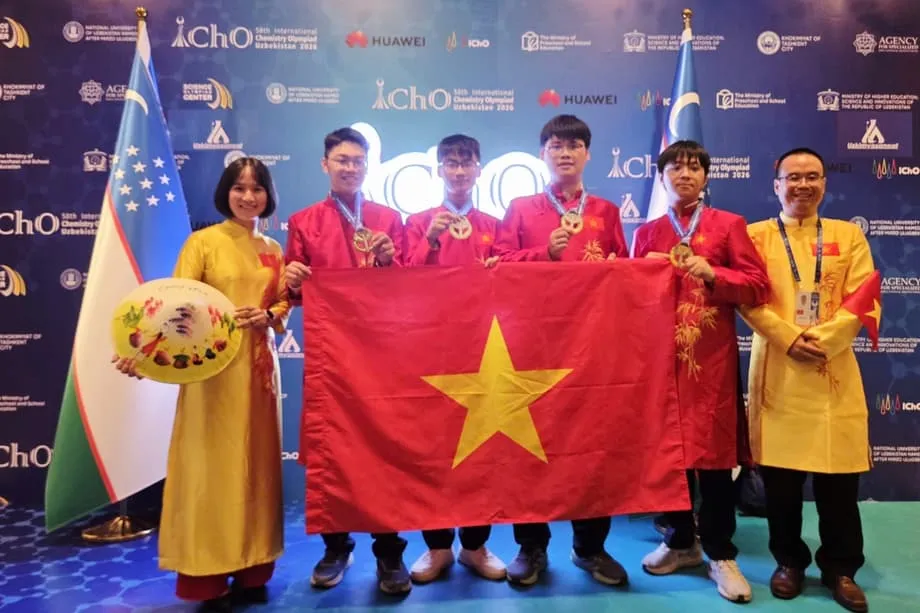
The Authority of Quality Management under the Ministry of Education and Training announced the chemistry result on Sunday. All four Vietnamese contestants reached the highest medal category at the 58th International Chemistry Olympiad, known as the IChO, in Tashkent, Uzbekistan.
Vietnam's chemistry performance extended a strong record stretching from 2020 through 2026. Across those seven years, the country sent 28 students to the competition, and they returned with 25 gold medals and three silver medals. The latest result places Vietnam among the leading countries in the contest and contributes to one of its strongest combined performances in international science competitions.
The biology team also achieved a complete medal result at the 37th International Biology Olympiad, or IBO, in Vilnius, Lithuania. Three of Vietnam's four silver medallists ranked among the seven highest scoring students in the silver category, adding individual strength to the team's position among the leading delegations.
Who won Vietnam's chemistry gold medals?
Nguyen Manh Tuan, Nguyen The Minh and Tran Hoang Nam, all students in grade 12 at Hanoi Amsterdam High School for the Gifted, won three of Vietnam's chemistry gold medals. Dinh Xuan Phuc, a student in grade 12 at Vinh Phuc High School for the Gifted in Phu Tho Province, won the fourth.
Hanoi Amsterdam therefore supplied three quarters of the chemistry team. With every member winning gold, the result showed consistency across the entire Vietnamese delegation rather than success concentrated in one contestant.
Vietnam's longer chemistry record shows the same consistency over several teams. The 25 gold medals out of 28 participants from 2020 through 2026 represent about 89% of its competitors during that period. The other three students won silver, meaning every Vietnamese contestant in those years received one of the two highest medal categories.
The 2026 team added four more gold medals to that record while matching the gold medal totals of China and India, two major science education powers in Asia. Its achievement reflects a sustained stream of students able to perform at the highest level of the competition.
Ten hours of chemistry examinations
The chemistry Olympiad ran from July 10 to 19 in Tashkent and brought together 368 secondary school students from 93 countries and territories. Each contestant completed a theory examination lasting five hours and a practical examination lasting another five hours.
The written tasks demanded more than remembering formulas or memorising reactions. Students had to interpret information, construct scientific arguments, explain processes found in nature and industry, and apply chemical principles to unfamiliar problems.
The practical examination required careful measurement and accurate laboratory work. An error early in an experiment can affect several later stages, making precision important throughout the task, not just when recording a final answer.
The 2026 questions covered ammonia production, nuclear chemistry and the reuse of carbon dioxide. Ammonia is widely used in fertiliser and chemical manufacturing. Research into converting carbon dioxide into other substances is connected with efforts to reduce emissions from industry.
Nuclear chemistry studies changes in atomic nuclei, the central parts of atoms. Its applications include energy, medicine and materials research. These topics asked students to connect chemical knowledge with technologies and decisions beyond the classroom.
The examination format reflects a wider change in science education competitions. Strong contestants are expected to connect lessons with production systems, environmental challenges and technical choices. They need to understand why a reaction works, judge evidence and select a suitable method when faced with a new situation.
Four biology medallists from three schools
Than Duc Chinh and Phung Quang Hung, both from Bac Giang High School for the Gifted in Bac Ninh Province, won silver medals at the biology Olympiad. Nguyen Thanh An, from the High School for Gifted Students under Vietnam National University, Hanoi, and Nguyen Luong Thai Duy, from Hanoi Amsterdam High School for the Gifted, also received silver.
All four biology contestants were students in grade 12. Their medals, alongside the four chemistry golds, meant that every member of Vietnam's two national teams finished with an award.
Three Vietnamese students placed among the seven highest scoring silver medallists, indicating that much of the team was close to the highest scoring group. Vietnam's combined biology score placed it among the top eight delegations, even though all four of its medals were silver.
Hanoi Amsterdam contributed one biology medallist as well as three chemistry medallists. Across the two competitions, the eight Vietnamese students came from specialised schools in Hanoi, Phu Tho and Bac Ninh Province, including the school under Vietnam National University in Hanoi.
Biology tested knowledge and laboratory skills
The biology Olympiad took place from July 12 to 19 in Vilnius. Nearly 300 candidates from 86 countries and territories participated, and the event included six observer delegations.
Contestants faced two theory papers, each lasting 180 minutes, and four laboratory stations, each lasting 90 minutes. Together, those examinations amounted to six hours of theory and six hours of practical work.
The theory papers contained 100 questions tied to practical global concerns. Subjects included environmental pollution, green growth, carbon neutrality, efforts to limit climate change, public health and the diagnosis of difficult human diseases.
Those subjects connected biology lessons with problems faced by communities, hospitals, researchers and governments. Questions about carbon neutrality or disease diagnosis required students to apply their knowledge, rather than simply reproduce definitions.
The four laboratory areas were biochemistry and molecular biology, human and animal physiology, animal anatomy and systematics, and plant bioinformatics. Moving between those subjects required students to work at different scales, from molecules and cells to organs, whole organisms and ecosystems.
Biochemistry examines the chemical reactions that keep living systems functioning. Molecular biology studies genetic material and how cells use biological information. Physiology examines how organs and living bodies work, while anatomy concerns their structures.
Systematics classifies organisms by studying their features and evolutionary relationships. Plant bioinformatics uses computing and data analysis to investigate plant genes, traits and biological processes.
The breadth of these tasks helps explain why the IBO is widely viewed as one of the most demanding international science competitions for secondary school students. Competitors need a strong foundation in biology, supporting knowledge of chemistry, physics, mathematics and environmental science, and practical laboratory skills. Strong theoretical answers alone cannot compensate for poor experimental technique.
Two competitions on an overlapping schedule
Vietnam's chemistry and biology teams competed during much of the same period in July, in two different host cities. Both contests ended on July 19, bringing their results together within the same week.
The key dates and the longer chemistry record are:
- 2020 through 2026: Vietnam sent 28 chemistry contestants to the IChO, winning 25 gold medals and three silver medals.
- July 10 to 19, 2026: The 58th IChO took place in Tashkent, Uzbekistan.
- July 12 to 19, 2026: The 37th IBO took place in Vilnius, Lithuania.
- Sunday: The Authority of Quality Management announced Vietnam's four chemistry gold medals.
The schedules placed both teams under sustained examination pressure. Chemistry contestants completed ten hours of examinations, while biology contestants completed twelve hours across written papers and laboratory stations.
Both formats combined reasoning with experimental work. Students had to use scientific knowledge accurately under time limits and then demonstrate that they could carry out practical tasks, not just describe them.
Selection and training behind the medals
The Ministry of Education and Training said the two medal hauls reflected the education sector's work in identifying, selecting and training students with strong scientific ability. National teams are formed through a demanding process that examines subject knowledge, reasoning, laboratory performance and the ability to handle difficult material under time pressure.
Specialised schools play a major role in that process. They provide advanced classes, experienced teachers and access to preparation beyond the standard secondary school curriculum. Hanoi Amsterdam's four medallists across the two teams made its contribution especially visible in the 2026 results.
Students preparing for international Olympiads often spend months studying concepts taught at university, practising experiments and solving problems from previous competitions. The preparation also requires persistence because many tasks test unfamiliar applications rather than routine classroom exercises.
The examinations reward the ability to transfer knowledge from one setting to another. A student may understand a chemical reaction in a textbook but still need to work out how it behaves in an industrial process. A biology contestant may know how cells function but have to apply that knowledge to a question about disease diagnosis.
Vietnam's chemistry results from 2020 through 2026 show that this preparation has supported several successive teams. The latest sweep of gold medals adds to a record built over seven years, while the biology team's four silvers show strength in another branch of natural science.
How Vietnam compares with China and India
China, India and Vietnam each won four chemistry gold medals in 2026, sharing the highest total. India described its four gold medals as its best chemistry Olympiad result since it began participating in the competition.
An all gold result for a national team of four students is a strong measure of consistency. Individual scores and their distribution also matter when comparing performances, alongside the number of medals awarded and the results of particular contestants.
India also reported one gold medal and three silver medals in biology. Vietnam won four silvers in that contest. Across chemistry and biology together, India's result was five golds and three silvers, while Vietnam's was four golds and four silvers.
Vietnam's biology standing adds another measure of performance: its combined score placed it among the top eight delegations, and three students finished near the top of the silver category. The chemistry medal count and biology team score describe different parts of the country's success.
The results highlight the strength of Asian participation in international science competitions. They also show how national education systems are investing in intensive science training and seeking stronger connections between secondary schools, universities and research institutions.
Scientific talent beyond the competition
Chemistry and biology support medicine, agriculture, clean energy, environmental protection, food production, materials research and industrial manufacturing. Students who train intensively in those subjects develop skills relevant to work beyond an Olympiad examination.
Contestants learn to assess evidence, test assumptions and explain conclusions. Those abilities are useful in laboratories, engineering teams and other fields where decisions depend on accurate interpretation of complex data.
A student studying ammonia catalysts, carbon dioxide conversion or molecular diagnostics is also encountering problems found in energy, health and climate research. The competition topics connect advanced school study with practical scientific needs.
The Vietnamese government has linked the results with national policies on education, science, technology and innovation under Politburo Resolutions 71 NQ TW and 57 NQ TW. The stated goal is to develop a larger pool of highly skilled workers in chemistry and related scientific fields.
Reaching that goal requires continued opportunities after competition success. Keeping strong students engaged in research, expanding laboratory access, supporting teachers and creating routes into universities, industry and public research are part of that effort.
Olympiad teams can provide an early source of scientific talent. Their training can also help raise standards in specialised education, where advanced teaching and practical preparation support students before they enter higher education.
The 2026 results bring together two complementary achievements: a chemistry sweep of gold medals and a biology team among the top eight by combined score. Both depended on using knowledge in written examinations and laboratory tasks.
For the eight students, the medals mark the end of years of study and training during their final year of secondary school. For Vietnam, they provide a public measure of its ability to identify young scientific talent and prepare students for competition at the highest international level.
Key Points
- Vietnam won four chemistry gold medals and four biology silver medals in 2026.
- All four chemistry contestants won gold, matching China and India for the highest gold medal total.
- Vietnam's 28 chemistry contestants from 2020 through 2026 won 25 gold medals and three silvers.
- The chemistry Olympiad took place in Tashkent from July 10 to 19, with 368 students from 93 countries and territories.
- The biology Olympiad took place in Vilnius from July 12 to 19, attracting nearly 300 candidates from 86 countries and territories.
- Vietnam's biology team placed among the top eight delegations by combined score.
- Three Vietnamese biology contestants ranked among the seven highest scoring silver medallists.
- All eight Vietnamese medallists were students in grade 12.