
A Cake Making Robot Takes on a Skills Shortage
Juchheim Co. is lending its baumkuchen robot, Theo, to about 20 businesses across Japan and aims to reach 100 by the end of the fiscal year. The Kobe based confectionery company opened a training facility and showroom for the machine at its headquarters on March 25, following its display at the 2025 Osaka Kansai Expo.
Contents
- A Cake Making Robot Takes on a Skills Shortage
- Why Baumkuchen Demands Years of Practice
- Turning a Confectioner's Judgment Into Data
- Food Businesses Face a Tight Labor Market
- Cooking, Tuna Grading and Recipe Searches
- How the Projects Have Developed
- Physical AI Needs Machinery, Computing and Training
- Why Kitchens Are Difficult Places to Automate
- Where Human Work Still Matters
- Key Points
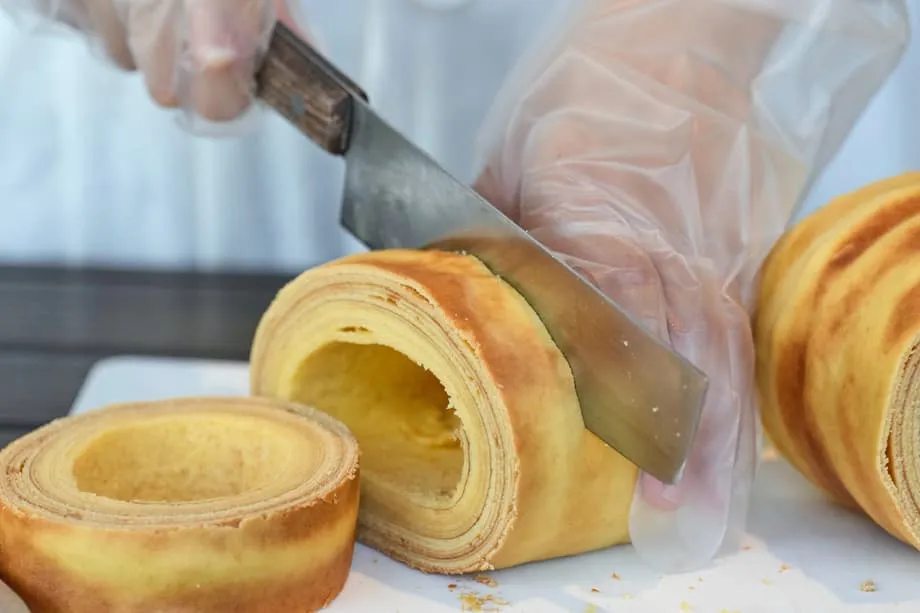
Theo is being trained to copy experienced confectioners as they make baumkuchen, a German cake whose thin layers form a pattern resembling tree rings. Its task involves more than turning equipment on and off. The robot must judge how long each layer of batter should cook before the next is added, adjusting to conditions that can change the finished cake.
Japan's food industry has a pressing reason to test such machines. Health, Labor and Welfare Ministry data showed 2.31 job openings for every job seeker in food service in February, compared with 1.13 across all industries. Food businesses are competing for workers while also trying to find successors to experienced staff.
Juchheim President Hideo Kawamoto said the robot could support an industry struggling to find those successors. Theo represents an attempt to keep production running and preserve skills that have traditionally taken years of observation and practice to acquire.
Artificial intelligence is moving beyond office software and factory assembly lines into kitchens, where cameras, image sensors, cooking equipment and production records can capture parts of a craft. The wider question for businesses is whether that recorded knowledge can deliver reliable results in different workplaces, with enough savings to justify the cost.
Why Baumkuchen Demands Years of Practice
Karl Juchheim, the German pastry chef who founded the company, introduced baumkuchen to Japan in 1919. The cake has since been part of Japanese confectionery culture for more than a century. Its familiar appearance depends on a demanding process repeated many times.
A confectioner spreads batter over a rotating spit, cooks it in an oven and adds another layer. Repeating those steps builds the cake's distinctive rings. Each layer affects the next, so the worker must keep checking the surface and deciding when to continue.
Small changes in temperature, humidity and cooking time can alter the result. Skilled workers respond to the feel of the batter, the appearance of its surface and conditions in the kitchen. Learning to make those judgments reliably can take several years.
Theo uses cameras and image sensors to observe experienced Juchheim employees. It records the color, thickness and texture of each layer, then connects those visible features with conditions inside the oven and the movement of the spit. Those connections help the machine estimate when a layer is ready.
Juchheim says Theo can learn a new technique in a few days, much faster than a person would normally gain the same experience. The company describes a system that adjusts when temperature, humidity or ingredients vary, giving it a role beyond repeating a fixed movement.
Turning a Confectioner's Judgment Into Data
Theo relies on deep learning, a method of training AI that is modeled loosely on networks in the human brain. A system studies many examples and finds patterns, rather than receiving a complete set of instructions for every situation it might encounter.
New images and sensor readings can then be compared with the patterns learned during training. In Theo's case, the useful response is a physical decision in the baking process, such as judging whether the current layer has cooked enough for another to be added.
Experienced cooks often hold what is called tacit knowledge: skills they can use correctly without being able to explain every decision in a written manual. A cook may know to turn a pan faster when ingredients release extra moisture, or recognize a finished cake layer from a slight change in color.
Traditional apprenticeships transfer that knowledge through watching and repeated practice. Learning by observing an expert has remained a strong part of Japan's culinary culture. The approach can produce excellent work, but fewer apprentices and fewer senior workers available to teach make that transfer harder to sustain.
Hitoshi Matsubara, a professor at Kyoto Tachibana University who specializes in AI development, said advances in the technology have made it possible to record movements that earlier systems struggled to handle. He described how this changes the treatment of knowledge held by skilled workers:
In the pre deep learning era, AI could not teach tacit knowledge, but as technology has advanced, it has become possible to digitize skilled workers' movements, which involve tacit knowledge.
Capturing craftsmanship depends on the quality of the training examples, the range of conditions recorded and the accuracy of the sensors. A robot trained in one kitchen may need further instruction to work reliably with different ovens, ingredients or production targets elsewhere.
Food Businesses Face a Tight Labor Market
The ministry's February figures place the food service job opening ratio at just over twice the average for all industries: 2.31 openings per job seeker against 1.13. A high ratio means employers have more vacancies than the pool of people seeking work can readily fill.
Restaurants, bakeries and food manufacturers also face an aging workforce and fewer young people entering skilled occupations. Filling today's shifts is one problem. Finding someone who can take over when a veteran worker retires is another, especially when a job requires years of training.
Kawamoto's comments about successors put Theo's development in that context. Automation can help maintain production when there are too few trained people to fill every role, while recording techniques that would otherwise depend on a small number of workers.
Japan's population decline gives the experiments a wider national purpose. The government has discussed deploying about 10 million robots equipped with AI across 18 sectors by 2040. Its plans for physical AI concern machines that interpret their surroundings and act in the real world, rather than systems limited to generating text or images.
The same practical response to a smaller workforce extends to logistics, agriculture, retail, healthcare and manufacturing. The goal is to keep essential services operating without waiting for population trends to reverse.
Cooking, Tuna Grading and Recipe Searches
Tokyo based TechMagic is applying AI to robots that prepare dishes such as fried rice and yakisoba. In 2025, the company introduced an app that calculates pan rotation speeds and other settings from the recipe a user selects.
The robots use that system to learn cooking times and heat levels for individual ingredients. TechMagic says it has improved their consistency. The work focuses on controlling physical actions that are difficult to repeat with the same accuracy throughout every shift, rather than taking over every responsibility of a chef.
Dentsu developed Tuna Scope in 2019 to assess tuna quality from smartphone photographs of tail sections. Its aim is to reproduce mekiki, the expert eye used to judge tuna. Human specialists may spend a decade developing that ability.
Kura Sushi later served tuna assessed through the system as AI Tuna at its conveyor belt sushi restaurants. The example extends the use of AI from cooking to an earlier decision in food production: deciding the quality of an ingredient.
In Hiroshima, Otafuku Sauce created an AI search tool in 2023 for its archive of sauce formulas. Trained on more than 15,000 products and prototypes, the tool can complete a formula search in about five minutes that previously took up to two hours. For a search that used the full two hours, that is a reduction from 120 minutes to five, or one twenty fourth of the time.
These projects address different parts of the food business. Theo records baking judgments, TechMagic controls cooking actions, Tuna Scope assesses quality and Otafuku's tool retrieves accumulated recipe knowledge.
How the Projects Have Developed
Japan's food AI experiments span several years and several types of work. The sequence connects the preservation of an old confectionery technique with newer tools for assessing ingredients, retrieving formulas and operating cooking equipment.
- 1919: Karl Juchheim introduced baumkuchen to Japan.
- 2019: Dentsu developed Tuna Scope to assess tuna quality using smartphone photographs.
- 2023: Otafuku Sauce created its AI search tool for an archive of more than 15,000 products and prototypes.
- 2025: TechMagic introduced its recipe based cooking settings app, and Juchheim displayed Theo at the Osaka Kansai Expo.
- March 25: Juchheim opened Theo's training facility and showroom at its Kobe headquarters.
- By the end of the fiscal year: Juchheim aims to increase the businesses borrowing Theo from about 20 to 100.
- 2040: The government's discussed deployment target is about 10 million robots equipped with AI across 18 sectors.
Juchheim's expansion target would bring the number of businesses borrowing Theo to roughly five times its current level. That growth would provide a practical test of whether the skills learned by the machine can travel beyond the company's own showroom and work in different kitchens.
Physical AI Needs Machinery, Computing and Training
Conventional industrial robots generally perform carefully defined movements in controlled settings. Physical AI connects cameras, sensors and AI models to machinery so it can respond to changes in objects, heat, timing and space.
Japanese robotics companies are working on this area through partnerships involving Nvidia, Fujitsu, Fanuc, Yaskawa Electric and Kawasaki Heavy Industries. The work combines Japan's experience in precision machinery with advanced computing and AI models. Nvidia has presented tools intended to help robots understand physical environments and adapt to changing tasks.
Local computing capacity may let businesses train systems on sensitive production data without sending all that information overseas. Food manufacturers have reasons to protect recipes, process records and customer information. Secure networks, dependable sensors and trained technicians are also needed for wider use.
Nikko supplies automation systems for seafood, meat and agricultural processing. It also operates the Hokkaido Robot Laboratory, where students and workers can receive robot training and companies can test whether automation suits a particular production site.
Such facilities address a staffing problem within automation itself. A business may have a machine but lack people who can install, supervise, repair and update it. Robots can reduce the workers required for a particular task while creating demand for engineers, operators and maintenance specialists.
Japan's precision machinery experience and manufacturers' accumulated operational knowledge provide a base for physical AI. Connecting that hardware and experience with systems that learn from images and sensor data still requires the people and infrastructure to keep it working.
Why Kitchens Are Difficult Places to Automate
Restaurants and confectionery kitchens are less predictable than many industrial plants. Ingredients change between batches, menus vary and workspaces can be crowded. Customers also expect food to look carefully prepared, while temperature and humidity affect dough, sauces and cooking times.
A robot's cost extends beyond the machine itself. Businesses must account for sensors, software, installation, maintenance and staff training. Small restaurants may lack space for large equipment or enough daily production to make the expense worthwhile. Older machinery can be difficult to connect to modern AI systems.
Japan's service culture adds another challenge. Hospitality often depends on personal attention, presentation and fast responses to unusual requests. Robots can handle repetitive cooking or delivery tasks, but they have yet to reach the full standard expected of human service workers.
A machine that performs one narrow task effectively may struggle in a busy kitchen where many demands arise at once. That difference helps explain why businesses are testing specific jobs rather than handing an entire workplace to a robot.
At Narita airport, a robot resembling a cat has been used in an unattended souvenir shop in a demonstration aimed at reducing staffing needs. Restaurants and cafes have also tested robots for delivering food, preparing pancakes, rolling sushi and cooking okonomiyaki. These trials show a gradual spread into defined service tasks.
Where Human Work Still Matters
Theo's immediate role is more likely to be supporting skilled confectioners than replacing them completely. Human workers remain responsible for preparing ingredients, inspecting results, managing unusual situations and developing new products, while a robot can repeat a process, monitor conditions and preserve a recipe.
Experienced confectioners could spend more time teaching, testing recipes and supervising several machines instead of carrying out every repetitive step themselves. That division of work could make traditional production less dependent on a small group of individuals while retaining human judgment.
Recording a craft also creates concerns about control of the resulting data. A company's production system may gain value from a worker's personal experience once movements and decisions become training information. Workers and employers may need clear agreements about consent, credit, pay and how the data can be used.
Customers have their own expectations. Consistency is useful when a product should look and taste the same across many locations, while some people value the human story behind a traditional confection. Businesses will need to explain where AI is used and where people remain involved.
Juchheim's planned expansion will test whether Theo can preserve skilled baking across different workplaces. The wider adoption of food robots depends on measurable results: easing labor pressure, maintaining quality, working safely alongside people and earning back their costs. Education, reliable data infrastructure and workers able to manage the technology are part of that test.
Key Points
- Juchheim is lending Theo to about 20 businesses and aims to reach 100 by the end of the fiscal year.
- The robot uses cameras, image sensors and deep learning to copy skilled baumkuchen makers and adjust to changing conditions.
- Japan's February food service job opening ratio was 2.31 per job seeker, compared with 1.13 across all industries.
- TechMagic, Dentsu and Otafuku Sauce are applying AI to cooking, tuna grading and formula searches.
- The government has discussed deploying about 10 million robots equipped with AI across 18 sectors by 2040.
- Costs, variable kitchen conditions and technical staffing needs affect adoption, while people remain needed for supervision, creativity and service.