A vast stadium takes shape in southern Hanoi
About 16,000 workers are building Hanoi's VinFast - Trong Dong Stadium and its supporting facilities as the project targets completion in July 2027. Designed for 135,000 spectators, the venue would exceed India's Narendra Modi Stadium, which holds about 132,000 people, by 3,000 seats if completed at its planned capacity.
Contents
- A vast stadium takes shape in southern Hanoi
- How much bigger would it be?
- A construction calendar compressed into 19 months
- Lifting a roof weighing about 40,000 tonnes
- A bronze drum translated into architecture
- From football pitch to concert floor
- Managing 135,000 people beyond their seats
- The stadium sits inside a much larger development
- The commercial task starts after construction
- Key Points
The stadium broke ground on December 19, 2025, and occupies approximately 73.3 hectares within Vingroup's Hung Vuong International Sports Complex in southern Hanoi. Its construction schedule puts the reinforced concrete structure on course for completion in December 2026, followed by the retractable roof in May 2027 and the completed stadium in July.
Nguyen Chi Khanh, a representative of the project's construction management board, has put the workforce across the wider sports complex at nearly 20,000. Contractors are working through three daily shifts with four rotating crews, while all four main stands, designated A, B, C and D, advance together.
The scale has attracted attention in China and South Korea, where coverage has focused on the planned capacity, rapid construction and golden roof inspired by Vietnam's Dong Son bronze drums. For Hanoi, the project combines an attempt at a world capacity record with a more practical ambition: creating a venue for international football, major concerts and large cultural celebrations.
How much bigger would it be?
VinFast - Trong Dong's planned 135,000 seats would exceed Narendra Modi Stadium's approximately 132,000 by about 2.3%. The Indian venue primarily serves cricket, while the Hanoi stadium is designed around football, with a movable playing surface and facilities for other events.
The domestic comparison is more dramatic. Hanoi's My Dinh National Stadium has about 40,000 seats. VinFast - Trong Dong would provide 95,000 more, making its planned seating capacity roughly 3.4 times as large. Compared with Wembley's approximately 90,000 seats, it would offer another 45,000, or 50% more.
Other major projects also shape the comparison. Morocco's Hassan II Stadium is planned for 115,000 spectators for the 2030 World Cup, putting Hanoi's design 20,000 seats ahead. Barcelona's Camp Nou is expected to hold around 105,000 after redevelopment, about 30,000 fewer than the Vietnamese project.
A completed VinFast - Trong Dong would also surpass Pyongyang's Rungrado 1st of May Stadium, commonly listed at approximately 114,000 seats. The final ranking will depend on the completed venue's approved capacity, while the number of tickets available for individual events will vary with stage layouts, security areas and other operating requirements.
A construction calendar compressed into 19 months
July 2027 is approximately 19 months after the groundbreaking and 13 months earlier than the previously reported August 2028 target. The revised schedule requires structural work, roof installation and technical systems to progress in closely coordinated stages.
The main dates show how much work is concentrated into the final months:
- December 19, 2025: Construction officially began.
- April to May 2026: Work advanced on an access road serving the development.
- June 2026: The stands began taking a more visible shape.
- Mid October 2026: The hydraulic lifting tower works had reached approximately 60% completion.
- November 2026: The roof lifting support system is scheduled for completion and trial operation.
- December 2026: Contractors plan to finish the reinforced concrete structure and begin lifting the first section of steel roofing.
- May 2027: The retractable roof and the main construction programme are targeted for completion.
- July 2027: The stadium is scheduled to be completed.
Finishing work is already progressing wherever structural conditions allow. Contractors are installing electrical and water systems, fire protection equipment and other building services alongside painting and surface finishing, rather than waiting for every stand to be structurally complete.
Lifting a roof weighing about 40,000 tonnes
The stadium roof is one of the project's most demanding engineering tasks. Construction plans call for approximately 40,000 tonnes of steel for the stadium roof, within a broader roof programme expected to use around 73,000 tonnes.
Main supports are designed to rise nearly 80 metres, roughly the height of a building with 20 storeys. Steel bearings at their tops will position the roof and transfer its weight through the supports into the foundations. Hydraulic lifting equipment will raise large steel sections assembled closer to ground level into their final positions.
Contractors have mobilised cranes rated at 1,800, 1,250 and 800 tonnes to help assemble and install the steel structures. The plan is to test the lifting system in November 2026 before working with an overseas partner to lift the first roof section in December.
The lifting sequence connects several parts of the timetable. Supports must be ready to receive the load, steel sections must be assembled accurately, and roof installation must leave time for the mechanisms and equipment that allow it to open and close. The May 2027 roof target is therefore a major step toward the July completion goal.
A bronze drum translated into architecture
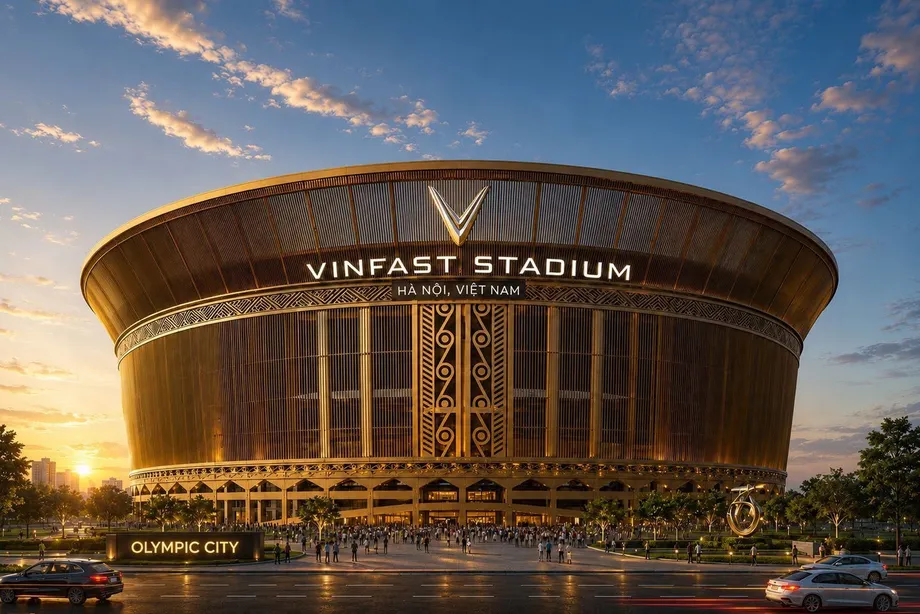
VinFast - Trong Dong's circular design draws on Dong Son bronze drums, a familiar symbol of ancient Vietnamese culture. Trong dong means bronze drum. The planned golden exterior, concentric roof patterns and decorative details give the immense structure a recognisably Vietnamese identity.
Design descriptions place the circular dome at approximately 408 metres in diameter. From above, its rings and central pattern are intended to recall the decorated face of a bronze drum. Exterior motifs also draw on the stylised Lac birds associated with Dong Son designs.
The retractable roof adds a practical purpose to that appearance. Closing it would give organisers more control over exposure to rain and strong sunshine, supporting a wider range of events throughout the year. Its automatic movement will require a large structural system to work together with mechanical and electrical equipment.
From football pitch to concert floor
The stadium is planned around international football, with a movable pitch and a modular system intended to change the playing area into a surface suitable for concerts or other events within six to 10 hours. Modular construction means using sections that can be moved or rearranged instead of rebuilding the entire surface each time.
For an operator, that flexibility could make the difference between a venue used mainly for occasional matches and one able to accommodate a broader programme. Football, opening ceremonies, music performances and festivals each require different arrangements for the field, backstage areas and audience access.
The six to 10 hour conversion target concerns the playing surface. A complete concert setup also involves staging, sound, lighting and safety preparations, with the work depending on the event's size and design.
The stadium is being designed to meet FIFA requirements, while the surrounding complex is intended to support major international competitions. Formal sporting certification will follow completion and assessment. No opening fixture, concert programme or confirmed award of a World Cup, Olympic Games or Asian Games has been announced.
Managing 135,000 people beyond their seats
Plans include artificial intelligence systems to monitor crowds and security conditions as events happen. Such systems are intended to help operators identify congestion around entrances, corridors and stands, allowing staff to respond to problems more quickly.
High speed 5G connectivity and connected seating features are also part of the proposed technology package. For spectators, the intended benefit is reliable communication in a place where tens of thousands of people may be trying to use their phones at once.
Road access will be just as consequential. A route through the Tam Hung area is described as approximately 1.5 kilometres long and about 120 metres wide. The stadium's southern location is intended to make it accessible from surrounding provinces without requiring every visitor to cross central Hanoi.
Connections with Ngoc Hoi station, urban rail and shuttle buses feature in descriptions of the area's longer term transport possibilities. Moving a crowd of 135,000 requires coordinated ticket checks, pedestrian routes, emergency access and transport services, extending the operating challenge far beyond the edge of the stands.
The stadium sits inside a much larger development
The Hung Vuong International Sports Complex covers more than 400 hectares within Vingroup's broader Hanoi International Sports Urban Area, also described as Olympic Sports City and Vinhomes Global Sportia. The main stadium occupies the development's sports core in Zone B.
Nearby plans include an Olympic stadium with 40,000 seats, an indoor arena for 12,000 spectators, an aquatic complex for 10,000 and a cycling velodrome holding approximately 4,000 to 5,000. The Olympic stadium is intended for international athletics competitions as well as major sporting and cultural programmes.
The much larger urban development has been described as covering about 22,200 acres, with housing planned for approximately 750,000 residents and completion extending to 2035. Those figures refer to the wider district, rather than the 73.3 hectare stadium site or the sports complex alone.
A reported investment estimate of around $38 billion also covers the wider development. The stadium's own final construction budget, full parking provision and complete technical specifications have not been publicly detailed. Vingroup is the developer; project descriptions identify private investment as the funding model.
The commercial task starts after construction
Hanoi would gain a venue capable of admitting far more spectators than its existing national stadium. A major football match could accommodate a much larger audience, while concert organisers would have another option for performances requiring extensive seating and event space.
The capacity also creates a substantial operating task. A crowd of 40,000, enough to fill My Dinh's stated seating capacity, would occupy less than 30% of the new stadium's planned seats. Organisers would need to match event layouts, staffing and services to audiences of different sizes.
The retractable roof, movable pitch and surrounding sports facilities form a connected commercial proposition: attracting different types of events rather than relying on football alone. Nearby housing, retail, hotels and public spaces are intended to make the development a destination beyond match days.
July 2027 is the immediate construction goal. After opening, the venue's practical value will rest on the events it attracts, the frequency of use and whether spectators can arrive, enjoy the programme and leave safely. The engineering race is already visible; a sustained event calendar will be the next major test.
Key Points
- VinFast - Trong Dong Stadium is designed for 135,000 spectators on a 73.3 hectare site in southern Hanoi.
- Its planned capacity exceeds Narendra Modi Stadium's approximately 132,000 seats by 3,000.
- About 16,000 workers are building the stadium and supporting facilities, within a wider workforce approaching 20,000.
- The concrete structure is targeted for December 2026, the retractable roof for May 2027 and stadium completion for July 2027.
- The stadium roof is expected to use approximately 40,000 tonnes of steel.
- The broader sports complex includes facilities for athletics, indoor sports, swimming and cycling.
- The wider urban development extends to 2035, while the stadium's final budget and opening event programme remain unannounced.