Cheaper loans come with tighter banking controls
Vietnam's central bank has ordered credit institutions and foreign bank branches to cut listed deposit rates by at least 0.5 percentage points a year for terms of six months or longer, while targeting lending rate reductions of 1.5 to 2 percentage points for production, business and priority sectors.
Contents
- Cheaper loans come with tighter banking controls
- What the rate reductions mean
- Major banks announce targeted programs
- How the October measures developed
- Funding costs explain the pressure on banks
- More credit, but unchanged lending standards
- Small businesses need access as well as lower rates
- Connected borrowers face closer scrutiny
- Collateral and trade finance receive detailed checks
- Bad debts and profits must reflect actual risks
- Key Points
The State Bank of Vietnam set out the instructions in Document 9608/NHNN-CSTT, dated October 18, 2026. Banks that disregard interest rate directives or engage in competition that destabilizes the market could have their remaining lending growth allowances for 2026 reviewed and receive lower allowances in 2027.
The package reaches well beyond interest rates. It directs banks to examine large groups of connected borrowers, value collateral close to market prices, recognize troubled loans promptly and control dividend payments. Bank leaders and internal oversight departments are responsible for carrying out the instructions and maintaining safe operations.
For businesses, the intended benefit is lower financing costs as they fund orders, wages and investment. For savers, lower advertised rates would reduce the return available on affected deposits. Banks must manage both changes while keeping enough funding available and checking that borrowers can repay.
Several large banks have already announced lending programs. BIDV began offering qualifying loans from October 15, Vietcombank has committed to cuts through the end of December, and Agribank is introducing reductions from October 19. Eligibility rules and credit assessments remain central to who receives the cheaper money.
What the rate reductions mean
The deposit instruction applies specifically to listed annual rates for terms of at least six months. The lending instruction calls for reductions for customers, with particular attention to production, business and priority sectors. The document gives an immediate direction to act but no single calendar deadline for every bank to complete the adjustments.
A percentage point measures the difference between two interest rates. A reduction from 8% to 6% is a cut of 2 percentage points. That helps explain why the lending reductions being sought are larger than the minimum adjustment to deposit rates.
Banks are being told to make room for cheaper loans by reducing operating expenses, accepting a smaller share of profit and lowering funding costs. They must also avoid a race to attract deposits through higher rates or other unfair competition that threatens monetary and financial stability.
Lower deposit costs can help banks charge borrowers less, but the lending reductions sought are 1 to 1.5 percentage points larger than the minimum deposit reduction. The central bank is therefore asking lenders to contribute through their own costs and earnings, alongside changes to what they pay savers.
Major banks announce targeted programs
BIDV's program, available across its system from October 15, offers interest rates starting at 6% a year on loans in Vietnamese dong with short terms. Rates are up to 2 percentage points below ordinary levels, depending on the loan term and business sector. Customers must satisfy the program's conditions and BIDV's lending rules.
Vietcombank chairman Nguyen Thanh Tung told an October 17 discussion on the draft Law on Small and Medium-Sized Enterprise Development that the bank would reduce lending rates by at least 2 percentage points through the end of 2026 to support businesses.
Agribank's reductions of up to 2 percentage points begin on October 19, focusing on priority sectors and customers engaged in production and business. The bank expects to devote about VND2 trillion of its financial resources to sharing financing costs with households and companies.
Agribank is also continuing a preferential credit program worth VND70 trillion, running from August 2026 through 2028. It serves small and medium enterprises, priority sectors and new sources of economic growth, with rates 1 to 2 percentage points below the bank's average for comparable loan terms.
Agribank reported about VND275 trillion in preferential loans at an average annual rate of 6.6%, approximately 2 to 2.5 percentage points below ordinary rates. Its reduction in interest income had reached VND6 trillion. Total outstanding loans exceeded VND2.1 quadrillion, up 8.8% from the beginning of the year, including an increase of about VND36 trillion during September.
How the October measures developed
The central bank's order follows a series of political instructions and bank announcements during October. Document 9608 also tells lenders to implement the governor's Directive 01/CT-NHNN of January 9, 2026, covering the banking sector's main tasks for the year.
- October 15: Central Committee Conclusion 106-KL/TW called for lower lending rates and credit directed toward production, business and priority sectors. BIDV's preferential lending program began the same day.
- October 16: Deputy Prime Minister Nguyen Van Thang called for effective and timely lending rate reductions of 1.5 to 2 percentage points at a meeting on monetary policy for the remaining months of 2026.
- October 17: Prime Minister Le Minh Hung outlined the government's lending rate direction to the National Assembly. Vietcombank's chairman announced the bank's commitment during a legislative discussion that afternoon.
- October 18: The State Bank issued Document 9608/NHNN-CSTT, combining rate reductions with detailed controls on lending and bank finances.
- October 19: Agribank's latest lending rate reduction program begins.
Conclusion 106-KL/TW also sets a GDP growth target of at least 10% for 2027, alongside economic stability and inflation control. The October banking measures connect that growth ambition with instructions to direct financing toward viable projects and manage risky lending more closely.
Funding costs explain the pressure on banks
The rate order follows a period of rising deposit costs. According to central bank figures, the average annual deposit rate on new transactions stood at 6.38% on September 20, up 1.15 percentage points from the end of 2025.
A September survey by securities company MBS covering 16 banks found that six raised deposit rates and four lowered them. Increases ranged from 0.2 to 0.4 percentage points for terms of six to 24 months, while reductions ranged from 0.1 to 0.6 percentage points for terms of 12 to 24 months. The cited average rate for deposits lasting 12 months was 8.45%, up 2.63 percentage points since the beginning of the year.
Agribank's own figures put its average deposit rate for the first nine months at about 5.45%. The bank also reported that its average lending rate had risen by 1.49 percentage points since the start of the year. Its new concessions arrive after that upward movement.
Money borrowed between banks has followed a different daily pattern. Figures published by the Vietnam Interbank Market Research Association put the overnight dong rate at 3.5% on October 14, with rates of 4.7% for one week, 5.5% for two weeks and 5.3% for one month. Most of those terms fell from the previous session, while dollar rates rose by 0.01 percentage points.
The State Bank withdrew a net VND764.91 billion through open market operations that day, with about VND110.92 trillion outstanding in collateralized lending operations. Those operations help manage cash available to banks. Retail deposits, by comparison, provide funding over agreed terms, so their costs can move differently from rates on money borrowed overnight.
More credit, but unchanged lending standards
Vietnam's outstanding bank credit reached VND20.75 quadrillion on September 30, according to central bank figures. That was 11.59% above the end of 2025 and 16.69% above September 2025.
The central bank wants further lending directed toward production, business, priority sectors and viable major projects. Its list includes science, technology, innovation, digital development, greener production, education and cultural industries. It also encourages banks to join together to finance large projects, spreading the funding requirement across several lenders.
Banks must keep their credit standards intact. They are instructed to verify genuine financing needs, improve loan assessments and detect false customer information or money used for purposes different from those approved.
Funding must also match lending more closely by currency and maturity. A bank that lends money for many years while relying heavily on deposits repayable soon can face pressure when depositors want their money back. The order calls for tighter controls on that mismatch and a greater share of funding available for medium and longer terms.
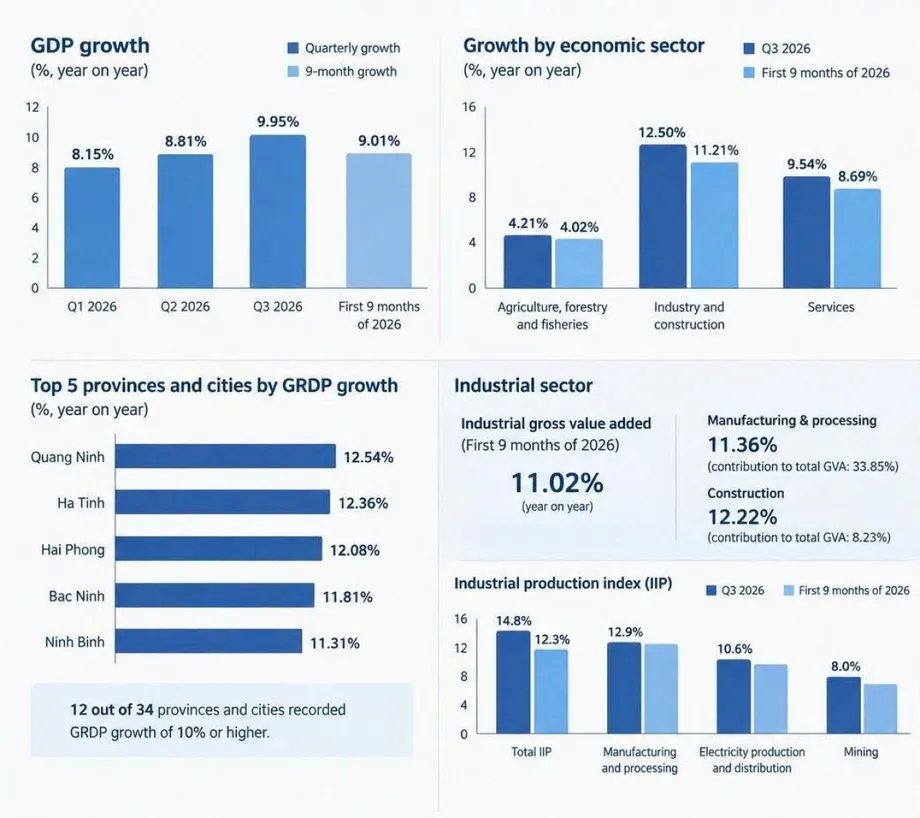
Growth and inflation make the task demanding. Third quarter GDP growth was reported at 9.95%, while average consumer prices increased 4.52% during the first nine months. Pham Chi Quang, director of the central bank's Monetary Policy Department, described pressure from changing international interest rates and the need to balance domestic growth, inflation and the exchange rate.
Small businesses need access as well as lower rates
Small and medium enterprises account for about 98% of Vietnamese businesses but around 20% of outstanding credit, according to Vietcombank chairman Nguyen Thanh Tung. He called for support focused on businesses with development potential and the ability to join production and supply chains.
Central bank figures put loans to these enterprises above VND4.1 quadrillion at the end of August, up 12.4% from the end of 2025. Nineteen commercial banks had introduced preferential packages totaling VND407 trillion, with rates at least 1 percentage point below their averages for comparable terms.
Production and business received about 77.44% of total outstanding credit at the end of August. Credit serving agriculture and rural areas accounted for about 22%. A program for agriculture, forestry and fisheries had cumulatively disbursed nearly VND238.12 trillion against a stated program size of VND185 trillion, reaching 88,434 customer instances.
Dang Quang Vinh, an associate professor at British University Vietnam, said successful rate reductions also depend on bank funding costs, business access to loans, market demand and expectations of future profit. A company needs customers and a credible opportunity to earn money before taking on more debt.
Mac Quoc Anh, director of the Institute for Enterprise Economics and Development, recommended assessing borrowers through cash flow, contracts, electronic invoices and tax histories. He also proposed stronger credit guarantee funds and wider use of financing against orders and unpaid invoices. Those approaches would give banks more information about repayment capacity when a business has limited property to pledge.
Connected borrowers face closer scrutiny
Banks must review large borrowers and groups whose finances may be tied together. Warning signs include shared managers or legal representatives, an owner holding more than 5% of a customer's charter capital, common collateral, the same collateral owner, financing concentrated in one project or a shared source of repayment.
Several companies can have different names while depending on the same project or stream of income. If that project struggles, repayment problems can reach several loans at once. The central bank wants lenders to examine those connections and spread lending across a broader range of customers.
The order directs banks to track property prices, market liquidity, project inventories and corporate bond issuance alongside customer relationships. Banks must also establish criteria for identifying potentially risky connections under Point g, Clause 24, Article 4 of the Law on Credit Institutions, and closely control transactions with shareholders and people related to them.
Certain uses of borrowed money receive special scrutiny: purchases of stakes in limited liability companies and partnerships; purchases of shares that are unlisted or unregistered for trading on UPCoM; and capital contributions to investment projects that are not legally eligible to enter business when the loan is approved.
Loans reimbursing money customers have already spent are also subject to close controls, with an exception requiring both specified conditions. The costs must have arisen less than 12 months before the lending decision, and they must form part of the financing plan submitted for consideration of a loan with a medium or long term. Banks are prohibited from creating loan files to divert funds, evade lending limits or avoid regulatory monitoring of cash flows.
Collateral and trade finance receive detailed checks
Collateral, the property or other assets pledged to support a loan, must be valued close to market prices. Banks are told to pay particular attention to reassessments that raise its value and to update valuations regularly.
The amount lent against an asset must reflect its risks and how readily it can be sold. If its value falls, banks must consider additional security, adjustments or other action to protect repayment and limit losses.
The order also covers outright purchases without recourse of documents under letters of credit issued by the purchasing bank itself. These trade finance transactions involve buying payment claims represented by documents; without recourse means the bank generally cannot require the seller to repay if the relevant payment fails.
Banks must assess the transaction, counterparties, payment sources and cash flows with controls comparable to other lending. For 2026, the order requires banks to keep relevant credit outstanding within their notified maximum after subtracting the outstanding balance of these document purchases arising during the year.
Bad debts and profits must reflect actual risks
Banks must closely monitor Group 2 loans, an early warning category requiring attention, as well as bad debts, restructured loans and other potentially troubled exposures. They must reassess customers' recovery prospects and pursue repayments as they fall due.
The central bank prohibits hiding bad debts or delaying recognition of risk. Banks must classify loans accurately and set aside loss provisions fully and promptly. It also calls for stronger financial resources and higher coverage of bad debts, meaning more provisions available relative to the amount of troubled lending.
Interest recorded as income before it is collected receives particular attention when amounts are large, longstanding or difficult to recover. Banks must account for and reverse that accrued interest under the applicable rules, while controlling dividends and profit distributions so reported earnings reflect their actual condition.
Noncompliant institutions may face lower lending growth allowances or requirements to maintain one or more safety ratios above normal regulatory levels, depending on the nature and severity of the risk. A lower credit allowance would leave a bank less room to expand lending. Board chairs, chief executives, supervisory leaders and compliance teams are responsible for implementation through the remaining months of 2026.
Key Points
- Document 9608/NHNN-CSTT orders listed deposit rate cuts of at least 0.5 percentage points for terms of six months or longer.
- Lending reductions of 1.5 to 2 percentage points target production, business and priority sectors.
- BIDV, Vietcombank and Agribank have announced lending concessions with eligibility conditions.
- Banks must retain credit standards and strengthen checks on connected borrowers, collateral, bad debts and reported income.
- Noncompliance could bring reviews of remaining 2026 lending allowances, lower allowances in 2027 and stricter safety ratios.