Record capital brings a tougher test for Vietnam
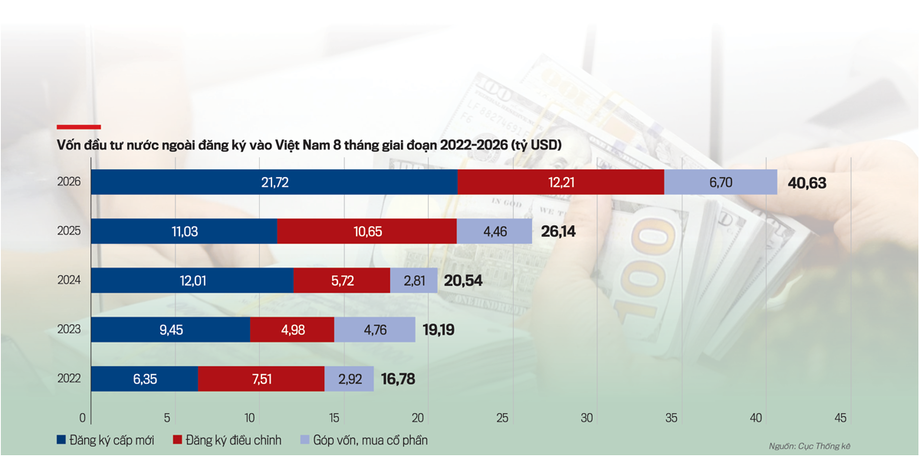
Vietnam registered $50.36 billion in foreign investment in the first nine months of 2026, up 76.4 percent from a year earlier. Its new investment strategy sets a different test of success: whether those commitments help build roughly 10,000 Vietnamese businesses into suppliers and partners of foreign investors by 2030.
Contents
- Record capital brings a tougher test for Vietnam
- What the investment surge actually contains
- Large projects reshape the investment map
- A policy timetable with measurable targets
- Incentives would reward delivery, not promises alone
- Samsung shows what supplier development involves
- A logistics partnership offers another measure of progress
- Land, credit and production scale constrain local firms
- Skills and reliable infrastructure must grow together
- Trust and access to finance will shape the next stage
- Key Points
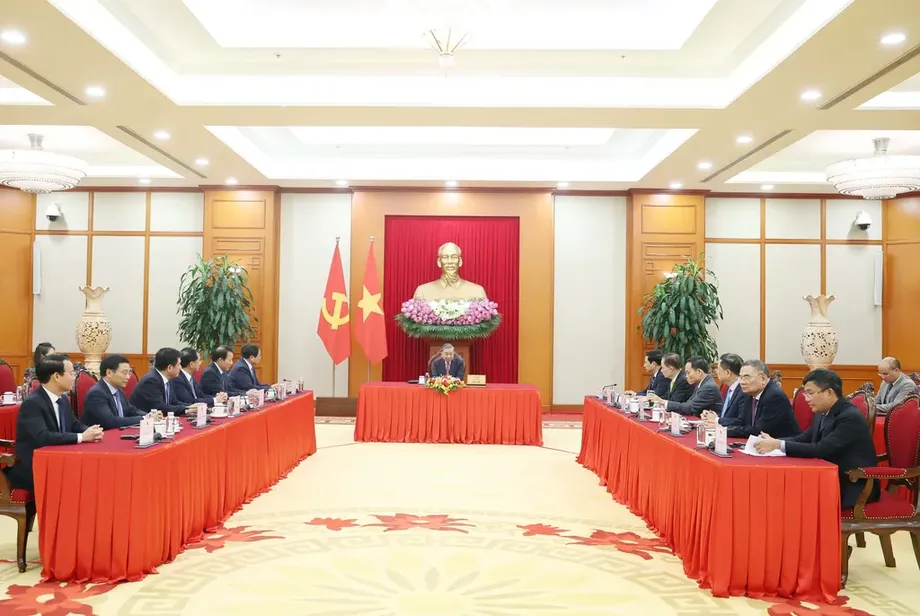
The Politburo's Resolution No.10-NQ/TW, issued on June 8, 2026, and signed by General Secretary and President To Lam, targets average localization of 45 to 50 percent in key industries. It also seeks 500 to 1,000 Vietnamese suppliers that sell directly to foreign enterprises, rather than through intermediaries.
Those goals put domestic industrial development at the center of foreign investment policy. Vietnam still wants substantial international capital, but the resolution makes technology transfer, workforce training, local procurement and actual economic contributions central criteria for attracting and supporting it.
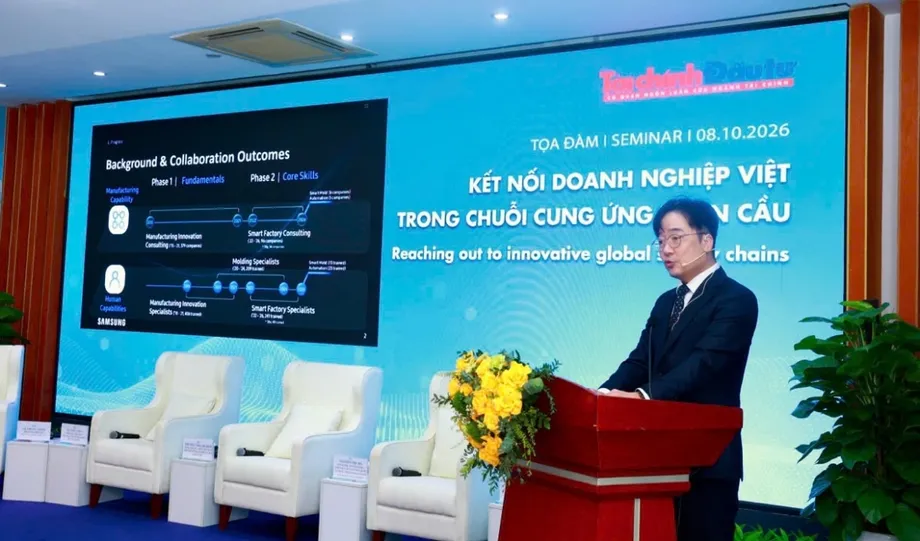
The challenge was discussed at the October 8 seminar in Hanoi, Reaching out to innovative global supply chains, held under the auspices of the Ministry of Finance. Government representatives, businesses and industry associations described a country attracting larger projects while many local manufacturers still struggle with expensive land, financing costs, skills shortages and access to established international supplier networks.
Deputy Minister of Finance Tran Quoc Phuong said connections between foreign investors and domestic firms remain limited. Technology transfer and research and development have fallen short of expectations, and relatively few Vietnamese businesses participate in global supply chains. Strong investment totals, in other words, have not yet translated into equally strong domestic industrial capabilities.
What the investment surge actually contains
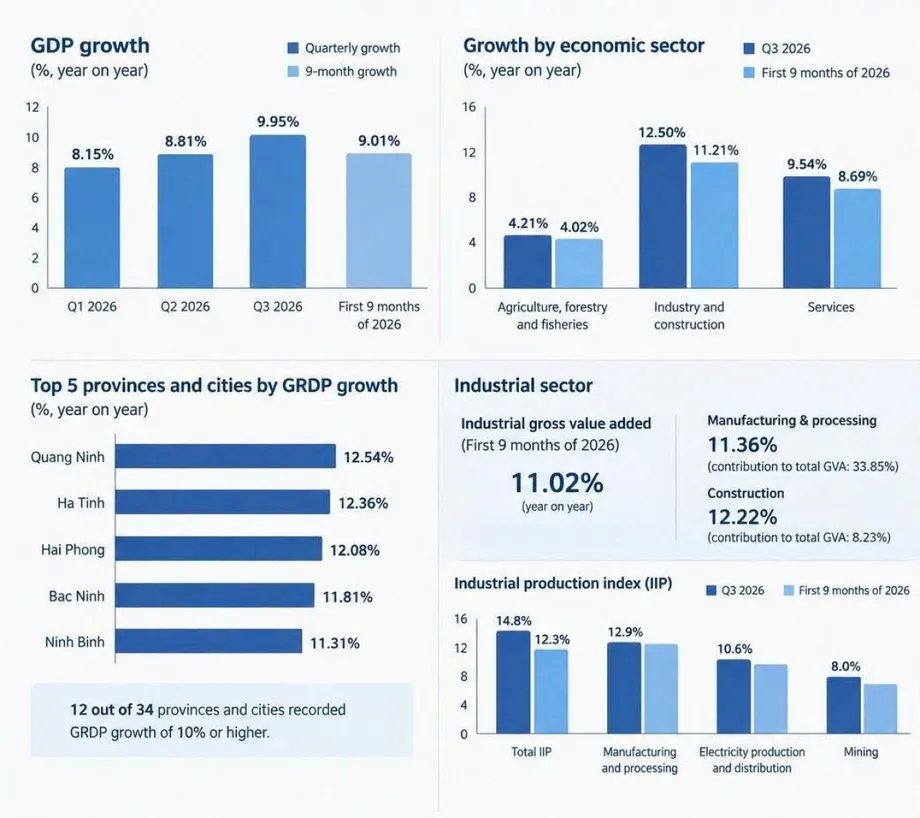
The National Statistics Office, under the Ministry of Finance, estimates that foreign investment disbursement reached $21.07 billion through September 30, up 12.1 percent. That was the highest amount for the first nine months of a year in five years. The agency also estimated economic growth at 9.95 percent in the third quarter and 9.01 percent across the first nine months.
The $50.36 billion registered investment total combines three different categories: $29.24 billion committed through 3,108 newly licensed projects, $14.15 billion in additional capital for 948 existing projects, and $6.97 billion through 2,335 capital contribution and share purchase transactions.
This distinction matters because registered investment is not money already spent building factories or operating businesses. It includes commitments and ownership transactions. Disbursement measures investment actually implemented during the period, including spending associated with projects registered in earlier years. The two totals therefore should not be treated as a simple measure of how many new commitments have been completed.
New project numbers increased 6.2 percent, while their registered capital reached 2.4 times the previous year's level. Using those figures, average capital per newly licensed project rose approximately 126 percent. The surge reflects much larger commitments, rather than a comparable increase in the number of investors establishing projects.
Manufacturing and processing received $17.40 billion, or 82.6 percent, of disbursed investment. Its share of newly registered capital was much lower, at 45.8 percent, down from 58.7 percent a year earlier. Transportation and storage attracted $5.14 billion in new registrations, equivalent to 17.6 percent. The difference shows a pipeline broadening beyond manufacturing while actual investment spending remains heavily concentrated there.
Large projects reshape the investment map
Ho Chi Minh City attracted more than $18 billion in registered foreign investment during the nine months. Its Department of Finance identified the $4.9 billion Can Gio International Transshipment Port and a $2.1 billion AI Factory data center among major projects attracted during 2026. Thai Nguyen recorded $8 billion with just 24 new projects.
Nghe An ranked sixth nationally in registered capital despite having only 12 new projects. A major proposed investment is the Quynh Lap liquefied natural gas power plant, valued at more than $2.2 billion and being developed by a consortium involving PV Power, South Korea's SK Innovation and Nghe An Sugar Co.
Large commitments also make monthly totals uneven. Cumulative newly registered capital increased from $3.5 billion to $10.2 billion in March, then from $21.7 billion to $29.2 billion in September. These jumps mean a few approvals can substantially change the national investment picture without showing how broadly smaller suppliers are benefiting.
Singapore and South Korea led total registered investment with $12.85 billion and $9.75 billion respectively. For newly licensed projects alone, their figures were $9.26 billion and $5.70 billion, followed by Luxembourg at $4.99 billion. These are different statistical categories, not conflicting estimates of the same investment flows.
A policy timetable with measurable targets
The government's June implementation conference placed the new strategy against almost four decades of investment opening. Standing Deputy Prime Minister Pham Gia Tuc said Vietnam had attracted nearly $550 billion in registered foreign capital and had more than 46,000 projects still in effect.
The policy has advanced through several stages:
- June 8, 2026: The Politburo issued Resolution No.10-NQ/TW on developing the economic sector with foreign investment.
- June 30: A national implementation conference connected nearly 35,000 locations and almost 2.1 million participants.
- September 22: Deputy Prime Minister Nguyen Van Thang signed Government Resolution No.280/NQ-CP, establishing the implementation action plan.
- September 30: National Assembly Vice Chairwoman Nguyen Thi Hong called for investment incentives tied to commitments and actual performance, with evaluation and recovery mechanisms.
- October 8: The Hanoi seminar examined supplier development, technology transfer, workforce training and the role of financial institutions.
Resolution 280 directs ministries, sectors and localities to prepare action plans and organize implementation, inspection, monitoring and evaluation. The Ministry of Finance is assigned work on institutions, incentives and stronger links between domestic and foreign enterprises.
For 2026 to 2030, Resolution 10 sets targets of $200 billion to $300 billion in registered foreign investment and $150 billion to $200 billion in implemented capital. It seeks 75 percent of foreign investment from developed economies, a 30 percent increase in Fortune 500 corporations investing in Vietnam, and at least three leading global technology groups establishing headquarters, offices or research and development centers.
One official detail differs between documents. The published resolution gives the localization target as 45 to 50 percent, while the government account of the June conference gives 40 to 50 percent. Both refer to key industries and approximately 10,000 domestic businesses joining foreign investment supply chains. The resolution itself provides the higher lower bound.
Incentives would reward delivery, not promises alone
The resolution calls for a gradual shift from incentives based on project inputs toward support tied to results. Priority commitments include advanced technology, research, training Vietnamese workers, developing domestic suppliers, environmental performance and efficient use of land, resources and energy.
It also provides for checks after support is granted and recovery of incentives when investors fail to deliver their commitments. This would change the relationship between approval and accountability: the announcement of a large project would start an assessment process, rather than serve as sufficient evidence of economic value.
Bui Thu Thuy, deputy director general of the Foreign Investment Agency, explained that the intended measure is the effect on domestic businesses and the wider economy:
Incentives in the new period, for example, need to be linked to measurable outcomes and the actual contribution of investment projects to the economy.
One mechanism under consideration would reimburse 30 to 50 percent of costs incurred by foreign enterprises training Vietnamese suppliers, or recognize those expenses through tax incentives or other support. That percentage is a proposal, not an established entitlement.
Reports differ on the legislative stage. Phuong said the National Assembly passed an amended and supplemented Law on Investment in August. Other accounts describe amendments still being prepared or discussed in September. It is not established whether these references concern separate legislative measures or different stages of the same reform. The supplier training reimbursement proposal should therefore not be presented as enacted law.
Samsung shows what supplier development involves
Samsung Vietnam's programs provide a concrete example of the capabilities the policy seeks to build. Between 2015 and 2021, the company provided production innovation consulting to 379 businesses. It trained 406 production innovation specialists between 2018 and 2021 and 209 specialists in making moulds between 2020 and 2024.
In 2026, Samsung added 14 companies to its smart factory support program, bringing the total to 96. Another 40 smart manufacturing specialists were trained, taking the cumulative number to 241. Separate programs supported six companies in smart mould production and five in automation, while training 13 and 23 practitioners respectively.
These figures count consulting, training and support activities. They do not establish that every participating company has become a Samsung supplier, and the different program totals should not be added together as though they represent distinct businesses.
Cha Ji Ho, vice president of Samsung Vietnam's Vietnam Procurement Center, said the company wants improvements to continue after consulting ends:
"The reason we place such strong emphasis on human resource training is to ensure that, even after Samsung's support comes to an end, local enterprises can continue improvement and innovation using their own internal human resources," he said.
Samsung plans to expand programs concentrated in Bac Ninh and Ho Chi Minh City into Phu Tho, Haiphong and Thai Nguyen. Its approach identifies key factory personnel, builds their practical skills and develops them into internal leaders. The next step is to connect training with genuine purchasing opportunities through cooperation among government, Samsung and local enterprises.
A logistics partnership offers another measure of progress
Supplier development extends beyond electronic components. Nestlé Vietnam CEO Binu Jacob described cooperation with Tuan Manh Logistics, a Vietnamese company established in 2005 by former transport university students. It grew alongside Nestlé's operations, including the Bong Sen factory in Hung Yen.
Between 2013 and 2025, Tuan Manh's truck fleet increased tenfold. Jacob said the relationship helped improve safety standards and compliance practices, while automated pallet loading supported a shift from transport between northern and southern Vietnam toward specialized distribution. The company now serves around 60 percent of Nestlé's customers in northern Vietnam and has expanded its customer base to other foreign enterprises.
The example points to a broader definition of technology transfer. Domestic value can grow through safer operations, better management, equipment adoption and access to additional customers, even outside advanced manufacturing. The fleet growth alone does not establish how much resulted from Nestlé's partnership, but it illustrates the scale of the company's expansion during that relationship.
Phan Duc Hieu, a standing member of the National Assembly's Economic and Financial Committee, said such gains depend on the ability of Vietnamese businesses to use what foreign investors bring:
"Good FDI will not automatically generate spillovers if the economy lacks the capacity to absorb them," he said.
Land, credit and production scale constrain local firms
Truong Thi Chi Binh, vice chairwoman and secretary general of the Vietnam Association for Supporting Industries, described a difficult investment calculation for domestic manufacturers. They need substantial capital and technical expertise, yet their margins may be lower than returns available from less demanding investments.
Reports give different accounts of her land cost figures. One quotes industrial rents near Hanoi at $90 to $100 per square meter annually. Another gives about $170 per square meter near major hubs and $90 farther away, without specifying the rental period. Those numbers cannot reliably be compared as equivalent annual costs.
Binh also cited interest rates of 12 percent on loans lasting seven to ten years and possible bank deposit returns of 10 percent. These are her examples of business financing conditions, not established nationwide rates. They explain why a firm might hesitate to finance machinery, premises and training before securing dependable orders.
Production volume is another constraint. Local component manufacturing becomes commercially viable only when demand is sufficient to spread equipment, tooling and quality control costs across enough units. Binh said Vietnam has more than 500 capable supporting industry suppliers, while the association aims to develop 10 to 20 leading companies able to bring smaller businesses into their networks.
Dr. Phan Huu Thang, chairman of the Vietnam Industrial Park Finance Association, proposed verifiable technology transfer roadmaps, joint ventures or joint investment with Vietnamese firms, and connections to domestic innovation institutions for major technology projects. These are his recommendations, not automatic requirements for every investor under current law.
Skills and reliable infrastructure must grow together
The workforce challenge predates the new strategy. January's skilled labor shortage included a battery manufacturer's effort to recruit 150 technical workers, which had attracted only 60 applicants after more than a month. Technical, management and language skills were especially difficult to find.
Nguyen Thu Ha, a director at Talentnet, identified continuing gaps in vocational education, graduate readiness, English proficiency and senior leadership. Resolution 10 targets trained workers at approximately 80 percent of employment in the foreign investment sector and seeks more Vietnamese professionals in technical, management, research, design and supply chain roles.
Infrastructure requirements are also changing. Phung Thi Thanh Loan, senior leasing manager for industrial and logistics services at CBRE Vietnam, said advanced investors need electricity that is reliable as well as sufficient, together with utilities and environmental standards. Thomas Rooney, director of Pacific Land Vietnam, described industrial parks increasingly connecting factories with research, nearby universities, services and places for workers to live.
Björn Koslowski, deputy chief representative of AHK Vietnam, said productivity, technology adoption and domestic supply chains are becoming more important than labor costs alone. Marcel Klingemann, general director of LPKF Vietnam, recommended stronger technical education and concentration on selected industries, rather than spreading resources too thinly. He also identified Resolution No.57-NQ/TW as part of the technology policy direction.
Electricity infrastructure is a specific risk for data centers, artificial intelligence and semiconductor manufacturing. Delayed generation and grid projects could leave industrial hubs unable to meet concentrated demand, even without a nationwide shortage. A project approval therefore needs to be matched by power, skills and supplier capacity at its actual location.
Trust and access to finance will shape the next stage
Jackson Woo, managing director of SGS Vietnam, said global buyers need confidence that suppliers can meet international quality, regulatory and environmental requirements. Existing multinational supplier relationships are difficult to displace simply because a Vietnamese alternative is available. Local firms must demonstrate dependable standards and delivery.
Professor Nguyen Trong Hoai of the University of Economics Ho Chi Minh City called for stronger links between global companies and domestic suppliers, better business conditions and supply chain finance, citing World Bank recommendations. Such finance can help suppliers pay for materials and production while waiting for customers to settle invoices.
Kamudo Hiroki, deputy general director at VPBank, said investors increasingly view Vietnam as a lasting platform for resilient supply chains, talent and innovation. Resolution 10 supports that broader approach through supplier databases, national development programs, industrial clusters and coordination across localities, rather than competition mainly over project numbers.
The immediate test is implementation. Detailed supplier training reimbursement rules, verification methods and the legislative status of some incentives are not settled in the reporting. The major dated benchmarks are 2030, including supplier and localization targets, and 2045, when the foreign investment sector is intended to account for about 25 percent of total investment and 30 percent of GDP.
Key Points
- Registered foreign investment reached $50.36 billion through September 2026, while disbursement reached $21.07 billion.
- Resolution 10 targets roughly 10,000 domestic businesses in foreign investment supply chains by 2030, including 500 to 1,000 direct suppliers.
- The published resolution sets localization at 45 to 50 percent in key industries; the official conference account gives 40 to 50 percent.
- Investment support is intended to depend increasingly on delivered technology, training, supplier development and environmental commitments.
- Samsung's manufacturing programs and Nestlé's logistics partnership illustrate practical routes for developing Vietnamese business capabilities.
- Land costs, financing, production scale, workforce readiness and reliable electricity remain central constraints.
- Reimbursement of 30 to 50 percent of supplier training costs is under consideration, not confirmed as an enacted benefit.