A 2.2 quadrillion dong gap puts project financing under scrutiny
Ho Chi Minh City expects to need more than 3.17 quadrillion dong for infrastructure between 2026 and 2030, while its budget can provide about 975 trillion dong. That leaves more than 2.195 quadrillion dong to secure elsewhere, roughly 69% of the total. A proposed municipal bond framework, open for consultation from October 6 to 16, 2026, would create another financing channel through the Vietnam International Financial Centre in Ho Chi Minh City.
Contents
- A 2.2 quadrillion dong gap puts project financing under scrutiny
- Different estimates reveal the scale of the shortfall
- Bank lending is growing faster than durable funding
- Public investment brings work, costs and competing credit demand
- More investment interest does not guarantee financeable projects
- Project bonds must show exactly how investors get repaid
- Ho Chi Minh City proposes borrowing in stages
- Readiness and liquidity will determine whether cities can sell bonds
- Energy finance exposes the importance of the buyer and the contract
- Domestic savings need credible investment channels
- The Essentials
The city's challenge captures Vietnam's wider financing problem. Transport, energy, logistics, digital infrastructure and climate adaptation require money that can remain invested for 15 to 20 years or longer. Banks, however, largely fund themselves with deposits lasting less than a year. Investors with longer investment horizons need dependable revenues, enforceable contracts and a clear division of responsibility before committing capital.
The National Assembly has approved 8.22 quadrillion dong in public investment for 2026 to 2030. Yet public allocations alone do not determine whether a railway, power plant or flood prevention scheme can attract the rest of its financing. The decisive questions concern repayment: where the money will come from, how reliable it will be and who absorbs losses when construction, demand or policy changes upset the plan.
Vietnam therefore faces two connected tasks. It must develop investors and instruments capable of providing funding for decades, while preparing projects those investors can assess. Issuing more bonds will do little to relieve pressure on banks if the bonds mature quickly, depend on uncertain revenues or are mostly purchased by banks themselves.
Different estimates reveal the scale of the shortfall
The World Bank's capital markets report estimates Vietnam's annual infrastructure financing requirement at about $25 billion, equivalent to 7% of GDP at the time of its assessment. It says government could provide at most two thirds, leaving roughly $8.3 billion annually for other financing sources. Private infrastructure projects alone were estimated to require financing equal to 2% to 4% of GDP each year.
A separate estimate for key infrastructure projects during 2025 to 2030 puts demand at $245 billion, including about $176 billion in public investment. Those figures imply approximately $69 billion outside public investment and a public share of about 72%. Another account gives public coverage as 70%, implying a $73.5 billion remainder.
These estimates differ in scope, reference periods and assumptions. The World Bank's annual assessment should not be treated as directly interchangeable with the later total for selected projects through 2030. Both point to a substantial requirement beyond government resources, rather than a single agreed national financing gap.
The distinction also matters for broader economic funding. Can Van Luc, a member of the national financial and monetary policy advisory council, estimates total investment needs over five years at 38.5 quadrillion dong, with 22% from the state and 78% from private and foreign investment. That covers the wider economy, not infrastructure alone.
Bank lending is growing faster than durable funding
The dependence on banks is visible across several measures. BIDV's Institute for Economic Research estimates that credit supplies about 50% to 51% of economic funding, compared with 6.4% from equity markets and 7% from corporate bonds. Can Van Luc gives a somewhat different breakdown: about 48% from bank credit and approximately 15% from shares and corporate bonds together. These are separate estimates, but both put banks close to half of the financing system.
At the end of July 2026, outstanding credit was reported at 20.26 quadrillion dong, up 8.98% from the end of 2025. Medium and long duration funding accounted for about 16% of total funding, while loans of those durations represented 48.5% of outstanding credit. The difference illustrates how much lending depends on renewing shorter deposits.
Reports differ on August credit totals. One gives 20.4 quadrillion dong as of August 22, with growth of 9.71% since the end of 2025. Another gives 20.1 quadrillion dong during August, against deposits of 19.2 quadrillion dong. The reporting dates and coverage do not establish a directly comparable series, so the figures should not be presented as evidence that lending fell.
Banks routinely lend for longer than their deposits last, a practice known as maturity transformation. The risk increases when too much money is committed to assets that produce little cash in their early years. Retired economist Cuong Nguyen, formerly a senior economist at the Asian Development Bank, argues that regulatory relief can ease immediate funding constraints without removing that underlying mismatch.
Public investment brings work, costs and competing credit demand
Public investment disbursement reached nearly 643 trillion dong in the first nine months of 2026, about 63% of a plan exceeding 1,000 trillion dong. The National Statistics Office put GDP growth over the same period at 9.01%. Achieving double digit growth for the full year would require fourth quarter growth above 12.5%.
Nguyen The Minh, director of the investment banking division and deputy director of the securities business division at An Binh Securities, said accelerating public investment was one of the few remaining ways to support that target.
"Therefore, there is no other way to achieve 10% growth for the full year than to step up public investment. It will be a driver in the remaining three months and make a significant contribution," Minh said.
Contractors face a less comfortable picture. Hoa Binh Construction Group chairman Le Viet Hai said the company's workload had doubled from a year earlier and could rise another 50% in 2027, while higher costs were squeezing profits. Vietnam Association of Construction Contractors chairman Nguyen Quoc Hiep put skilled worker pay at 700,000 to 1 million dong a day, compared with cost norms around 350,000 dong. Actual pay was therefore roughly two to 2.9 times those norms.
These pressures affect financing as well as construction. Higher costs can increase borrowing needs before a project generates revenue. Infrastructure investment also competes with manufacturing and property for bank funding. Minh estimates capital recovery at about one year in manufacturing, two to three years in property and five to 10 years in infrastructure. Those recovery periods are distinct from the longer financing terms and operating lives that major assets may require.
More investment interest does not guarantee financeable projects
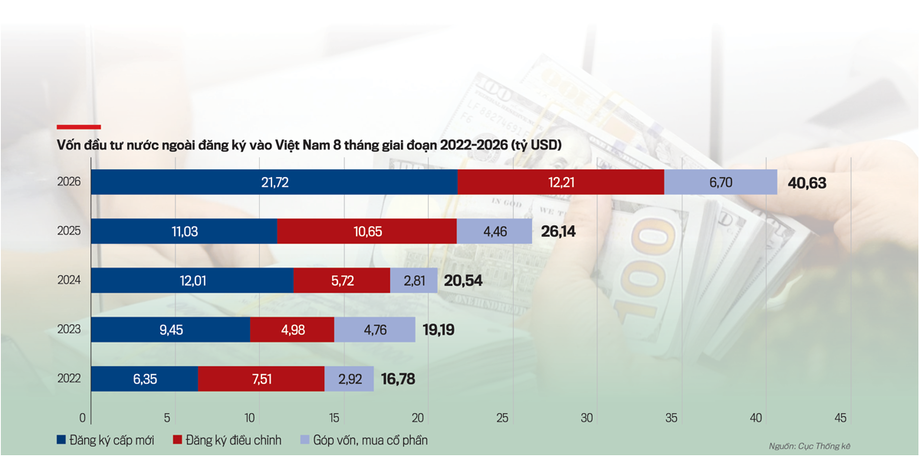
Registered foreign direct investment reached $40.63 billion by the end of August 2026, up 55.4% from a year earlier. Newly registered capital was $21.72 billion across 2,771 projects. Capital rose 96.8%, while project numbers increased 9.4%, implying an approximately 80% increase in average newly registered capital per project.
That points to larger investment commitments, but registered investment is not the same as disbursed money or committed infrastructure debt. Lenders still need to examine contracts, costs, expected revenues and repayment arrangements before providing finance.
A FiinRatings survey of 19 listed infrastructure and energy companies shows the gap between expansion and financing instruments. Combined assets grew from 120 trillion dong in 2017 to 364 trillion dong in 2024, just over three times the earlier total. Bank credit remained at 33% to 36% of assets, while bonds increased from about 1% to 7%. Between 2022 and 2024, assets rose by about 50 trillion dong, but bond financing barely increased in absolute terms.
Abhishek Dangra of S&P Global Ratings says the first priority is to reduce a project's total risk, then assign remaining risks to the parties best able to bear them. Tran Tuan Phong, senior partner at VILAF, says international financing is feasible when contracts allocate risks clearly and receive the necessary official approvals. Both arguments connect financing access to project preparation, rather than simply the availability of money.
Project bonds must show exactly how investors get repaid
A conventional corporate bond depends on the issuing company's ability to repay. A project bond instead relies on the cash generated by a specific asset, usually held in a separate legal entity. That separation can protect investors from problems elsewhere in the sponsor's business, provided the contracts and legal arrangements work as intended.
The World Bank describes infrastructure project bonds as instruments whose principal and interest are paid from project cash flows. Its report records Vietnam's first such issuance in 2019 as a $679 million bond with a maturity of 10 years for a major private power project. It also suggests that refinancing operating assets may offer more opportunities than financing entirely new construction, where completion and revenue risks are greater.
For that model to work, revenues must be identifiable, assets and contractual rights secured, and payment priorities explicit. Investors need to know which obligations get paid first and whether cash can be diverted to other businesses. Independent credit ratings and guarantees can help investors assess or absorb specific risks, but cannot substitute for a credible repayment plan.
Many bonds associated with Vietnamese infrastructure are still issued by parent companies, lack ratings and mature in two or three years. The World Bank puts average corporate bond maturity in 2021 and 2022 at 4.2 years, compared with 12.7 years for government bonds. These figures describe different groups of instruments, but show the same problem: corporate funding often expires well before infrastructure assets finish earning revenue.
Pricing compounds the mismatch. Corporate bonds frequently use floating rates linked to bank deposits, including deposits lasting 12 months. Investors and issuers therefore remain exposed to changing bank funding conditions. India's experience offers a comparison: some established renewable energy projects can now issue bonds lasting up to 25 years, supported by stable contracts and respect for agreed prices.
Ho Chi Minh City proposes borrowing in stages
Ho Chi Minh City's draft would classify municipal and project bonds issued through the financial centre as local government bonds. That is a crucial distinction from a private project bond relying only on an asset's revenues: the city would be responsible for timely payment of principal, interest and related expenses.
The proposal cites Point a, Clause 1, Article 24 of the Law on Urban Development and is linked to National Assembly Resolution 222/2025/QH15 of June 27, 2025. It would permit issues in dong or freely convertible foreign currencies, with proceeds restricted to approved projects that have completed investment and environmental procedures.
Nguyen Huu Huan, deputy head of the financial centre's executive body, proposes several issues under a medium term programme. Common documents would be prepared initially, while each issue would reflect disbursement needs, debt repayment capacity and market conditions. The city could adjust timing, size, currency, maturity and target market within limits approved by the municipal People's Council.
The draft also allows annual programme updates, additional issues of existing bonds, and debt management operations such as buybacks and exchanges. Borrowing must remain within debt, deficit and repayment limits. Foreign currency issues could use hedging instruments, which help manage exchange rate and interest rate changes but do not make borrowing risk disappear.
Key dates and procedural steps include:
- June 27, 2025: adoption of Resolution 222/2025/QH15, cited as part of the proposed framework's legal basis.
- October 6 to 16, 2026: consultation period for Ho Chi Minh City's draft resolution.
- October 7, 2026: consultation organised by the financial centre and the International Finance Corporation.
- After approval: individual issuance plans would still require preparation, appraisal and approval under the proposed process.
Readiness and liquidity will determine whether cities can sell bonds
At the October 7 consultation, International Finance Corporation senior municipal finance specialist Pavel Kochanov recommended financial modelling across the full borrowing term, including adverse scenarios. Investors need information on city revenues, spending, liquidity, existing debt and possible future obligations, alongside a safety margin for repayment.
IFC principal investment officer Neeraj Gupta recommended prioritising projects with completed feasibility studies, secured land, permits and necessary contracts. Borrowing before a project can spend the proceeds incurs financing costs without delivering immediate construction progress. For metro projects, ridership, site clearance and payment obligations need explicit allocation among the parties.
Hanoi is exploring a different municipal bond programme. Vietcombank deputy chief executive Bach Thanh Long estimates potential funding needs of 150 trillion to 200 trillion dong during 2027 to 2030. The city's railway plan envisages 18 lines extending 979 kilometres, while five lines reported to have started construction in June carry investment above 1.3 quadrillion dong.
Vietcombank proposes varied maturities and denominations, possible early redemption and interest rates linked to market conditions and government bond yields. It also wants municipal bonds considered for Level 1 high liquidity asset treatment and transactions with the State Bank. Those are proposals, not confirmed regulatory changes. Their purpose is to make the bonds easier to hold and trade, which matters even to investors intending to keep them for years.
Energy finance exposes the importance of the buyer and the contract
The Asian Development Bank Institute's green finance study identifies electricity pricing, the creditworthiness of Vietnam Electricity and weak bank capacity to assess green projects as financing barriers. Its findings are historical, including EVN's BB credit rating in 2018, and should not be read as a current rating assessment.
The mechanism remains relevant to project design. A renewable energy asset may generate electricity reliably, yet struggle to repay debt if its buyer cannot pay or if contract prices do not support costs. The study also records an asset and debt mismatch at EVN, with assets lasting up to 25 years and about half its debt consisting of loans with maturities below five years.
The study describes an early green bond pilot in which Ho Chi Minh City issued 523.5 billion dong in bonds lasting 15 years for 11 projects. Ba Ria Vung Tau planned 80 billion dong in bonds lasting five years. It also reported that formal green bond development faced gaps in legal rules, reporting standards and independent assessment capacity. A green label alone does not establish credit quality.
Domestic savings need credible investment channels
Vietnam's savings rate is estimated by BIDV at about 37% of GDP, yet much of that money remains in bank deposits. Investment and pension fund assets exceeded 835 trillion dong in the first quarter of 2026, while voluntary supplementary pension funds held only about 2.21 trillion dong across seven funds managed by four licensed companies.
HSBC financial institutions banking director Ta Thi Tue Anh estimates that life insurers manage more than $30 billion but lack suitable investments of long duration. She explicitly cautions that the figure is not official. HSC chairman Johan Nyvene says domestic individuals account for 85% to 90% of daily trading value, illustrating the limited depth of the domestic institutional investor base.
The World Bank estimates that capital market reforms could attract more than $78 billion in new funding and investment by 2030, primarily for companies. That is conditional potential, not committed infrastructure money. Its proposals address both investors and instruments, including pension, insurance and investment fund development.
Legal changes also need careful separation from promises. Amended public private partnership rules reportedly allow project companies to make private bond placements without historical financial statements. An August 2025 account described a further decree permitting public issues and immediate listings as forthcoming; its subsequent status is not established here. Deputy Finance Minister Nguyen Duc Chi said Securities Law amendments were planned for submission to the National Assembly in October 2026.
Bank liquidity changes offer a separate route. Circular 50/2026 reportedly raises the loan to deposit ceiling from 85% to 95% on a roadmap beginning October 1, 2028, with possible earlier adoption subject to liquidity requirements. Easier bank lending limits do not create investors willing to hold infrastructure risk for decades. Genuine diversification requires buyers outside banks, dependable project revenues and transparent responsibility for guarantees and budget support.
The Essentials
- Ho Chi Minh City's infrastructure needs exceed 3.17 quadrillion dong for 2026 to 2030, with its budget covering about 31%.
- Its municipal bond framework remains a proposal, with consultation scheduled for October 6 to 16, 2026.
- Vietnam's infrastructure financing estimates differ in scope, but consistently identify substantial needs beyond public funding.
- Banks remain the dominant funding channel, despite a large mismatch between deposit durations and infrastructure financing needs.
- Project bonds require identifiable revenues, enforceable contracts, clear payment priorities and defined risk allocation.
- Pensions, insurers and investment funds could supply longer funding, provided suitable assets and investor protections develop alongside them.