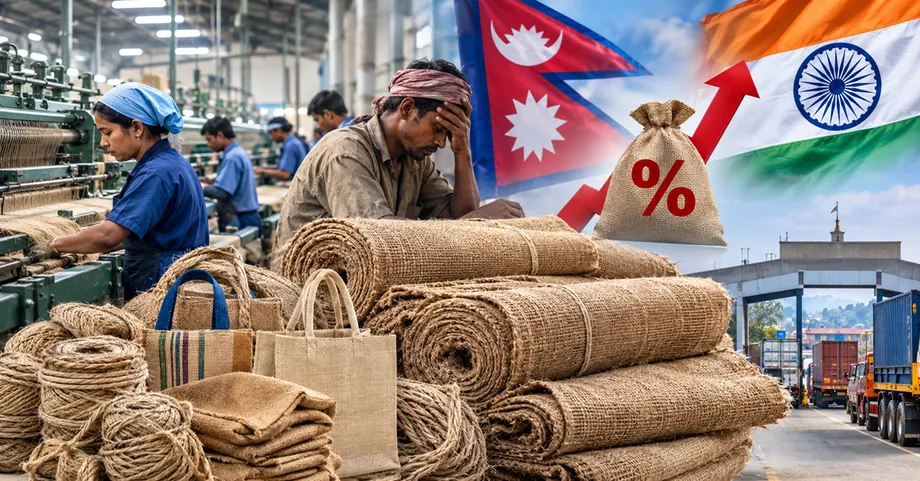
A shrinking market threatens an industrial mainstay
Nepal’s jute manufacturers are warning that most remaining mills could close as Indian import duties squeeze an industry exporting roughly Rs 11 billion in goods annually and employing an estimated 12,000 to 15,000 people. At a Friday discussion in Biratnagar, Jute Association president Raj Kumar Golchha said producers had lost about 95 percent of their market share following increases in India’s anti dumping duties.
Contents
- A shrinking market threatens an industrial mainstay
- What manufacturers say the higher duties mean
- India’s official record shows a long dispute
- Why the tariff accounts cannot be combined
- Export earnings show the scale of exposure
- Workers face a threat, not a confirmed shutdown
- Falling domestic cultivation adds another pressure
- Support at home has also become uncertain
- Diplomatic appeals have yet to deliver reported relief
- Key Points
That figure is an industry claim, not a verified measure of export losses. No reference period, sales dataset or definition of market share accompanied it. Nevertheless, the concentration of Nepal’s jute business in India makes the warning consequential: industry representatives say the Indian market consumes more than 90 percent of their production.
The discussion was organized by South Asian Watch on Trade, Economics and Environment (SAWTEE), with support from the International Labour Organization and assistance from the Federation of Nepalese Chambers of Commerce and Industry’s Koshi Province chapter. Around 30 business representatives attended. Rajendra Raut, president of the provincial chapter, chaired the meeting and called for immediate government action.
Golchha said mills had invested heavily in modern machinery and a wider range of products, leaving those investments exposed if access to their principal market deteriorated further. The concern reaches beyond factory owners: closures would affect workers, technicians, farmers and businesses serving the Sunsari and Morang industrial corridor.
The central problem is well established, but several details require caution. Reports give different tariff increases, different counts of operating mills and different employment estimates. India’s official investigation record also complicates claims that competing products from Bangladesh face no comparable trade measures.
What manufacturers say the higher duties mean
One account describes an increase in India’s anti dumping duty from about 4 percent to 16 percent, enforced by the Indian Ministry of Finance on September 25 following a recommendation from the Directorate General of Trade Remedies (DGTR). It says the increase covers four categories of finished jute products. The year of that September date is not specified.
Golchha, identified as president of the Nepal Jute Industry Association, described the commercial effect in stark terms:
India’s latest tariff hike leaves us with no option but to close down our mills,” Golchha said. “Exporting Nepali finished jute products to India while paying a 16 per cent anti-dumping duty is completely unfeasible.
An increase from 4 percent to 16 percent means the rate is four times as high, or 12 percentage points higher. As a simple illustration, a shipment valued at Rs 100 would attract Rs 16 rather than Rs 4 in this duty alone, assuming that value is the applicable assessment base. That does not mean total production costs rise fourfold.
Earlier accounts describe rates of 2 to 4 percent, while another gives a range of 2 to 4.5 percent. These differences could reflect products, producers or reporting periods, but the precise explanation is not established. Exporters previously estimated their annual payments under the lower duties at Rs 300 million.
India’s official record shows a long dispute
The DGTR’s jute investigation record, file 14/19/2015-DGAD, covers products originating in or exported from both Bangladesh and Nepal. It documents a proceeding stretching from an investigation opened in October 2015 to final findings listed in June 2026.
An anti dumping duty addresses imports that authorities determine are sold below their normal value and injure domestic producers. A sunset review examines whether a measure should continue as it approaches expiry. A review during the measure’s term can reconsider aspects of the existing arrangement.
The official chronology records these principal steps:
- October 21, 2015: India initiated the investigation into jute products from Bangladesh and Nepal.
- October 20, 2016: The DGTR published its initial final findings.
- June 28, 2021: A sunset review began.
- February 24, 2022: An extension of existing duties was listed.
- September 30, 2022: Final findings in the sunset review were published.
- June 30, 2025: A further review was initiated.
- February 20, 2026: An oral hearing was listed.
- June 17 and June 25, 2026: The record lists a disclosure statement followed by final findings.
The listing establishes the investigation’s history, but does not itself display the operative rates for each Nepali producer or product. Findings and recommendations must also be distinguished from the customs notification that puts a duty into effect. The chronology alone cannot verify the reported 16 percent rate across all shipments.
Why the tariff accounts cannot be combined
A separate account says some anti dumping duties increased by as much as 56 times and that higher countervailing duties took effect on the 13th. It does not identify the month, year, starting rates or product schedule needed to compare those changes with the reported increase to 16 percent.
Countervailing duties address subsidies that benefit imported goods, rather than the pricing issue addressed by anti dumping duties. Both measures can affect the cost of an import, but they are different instruments. Without the relevant notifications, the reported increases should not be added together or treated as one uniform tariff.
There is also a conflict concerning Bangladesh. Golchha has said India does not impose anti dumping charges on Bangladeshi jute products, and another account describes their access as unrestricted. Yet the DGTR file expressly covers Bangladesh alongside Nepal and lists several proceedings involving Bangladeshi producers. That official scope does not prove every Bangladeshi shipment currently pays a duty, but it prevents a blanket exemption from being treated as established fact.
Export earnings show the scale of exposure
The most detailed annual breakdown puts Nepal’s jute exports to India at Rs 10.66 billion in the previous fiscal year. Hessian cloth, a woven jute fabric commonly used for sacks and packaging, accounted for Rs 7.14 billion. Jute bags contributed Rs 2.74 billion, twine and rope Rs 771.7 million, and handcrafted bags Rs 5.6 million.
Hessian and ordinary jute bags together accounted for about Rs 9.88 billion, or approximately 92.7 percent of the stated total. The sector’s exposure is therefore concentrated in a few major product groups. The listed components add up to roughly Rs 10.657 billion, consistent with the rounded Rs 10.66 billion total.
Earlier figures for shipments through the Jogbani border point were Rs 7.67 billion in fiscal year 2022/23 and Rs 6.72 billion in 2023/24, a fall of about 12.4 percent. Another account gives national jute exports of Rs 7.64 billion for 2022/23. The figures are close, but their stated coverage differs, so they should not be treated as an identical series.
An earlier account also describes an eight month export decline as 7 percent, while giving values of Rs 5.86 billion and Rs 4.97 billion. Those values imply a decline of about 15.2 percent. The inconsistency cannot be resolved without the underlying trade table. Nor can these historical export totals establish the timing or extent of Golchha’s claimed 95 percent market loss.
Workers face a threat, not a confirmed shutdown
Reports count either five or six operating jute mills in the Sunsari and Morang corridor. Employment estimates range from 12,000 to 15,000 workers. Earlier descriptions say roughly half of about 12 factories had already closed, while another recalls more than a dozen mills operating in the belt.
These accounts agree that the sector has contracted, although they do not establish a single current factory count. The latest warnings also should not be read as confirmation that all remaining mills have stopped. Manufacturers describe possible closures once finished stocks are cleared; one account says factories have already halted raw jute imports.
At the Biratnagar discussion, jute specialist Dr. Mohan Chandra Ghimire argued that the industry deserved special government attention because it depends heavily on workers. He said its problems should not be handled as routine industrial concerns. His argument places livelihoods alongside export earnings in the case for intervention.
Anil Shah, president of the Morang Industry and Trade Association, linked the sector’s survival to Nepal’s industrial identity. Biratnagar Jute Mills was founded in 1936 and is associated with the beginning of modern industry in Nepal. That history explains the strength of local concern, though it does not by itself resolve the present commercial problem.
Falling domestic cultivation adds another pressure
Nepali mills depend heavily on imported fibre, with accounts putting reliance on India and Bangladesh at up to 70 percent of raw jute requirements. One account reports around Rs 6 billion in raw fibre imports from those countries in the previous fiscal year, against finished exports of approximately Rs 11 billion.
The gap between those two values is not a profit figure. Mills must also pay wages, energy bills, transport costs, financing charges and other expenses. Their production chain nevertheless shows a particular vulnerability: they buy much of their material abroad, process it in Nepal and sell most of the finished output back into India.
Figures attributed to the Directorate of Agricultural Development in Koshi Province show how far domestic cultivation has receded over about two decades. Morang’s jute area fell from 40,000 hectares to 5,070 hectares. Sunsari declined from 20,000 to 1,300 hectares, and Jhapa from 10,000 to 550 hectares.
Across those three districts, the stated area fell from 70,000 hectares to 6,920 hectares, a reduction of about 90.1 percent. National annual production reportedly dropped from 80,000 tonnes to 10,000 tonnes, or 87.5 percent. These long declines show that the industry’s dependence on imported fibre predates the latest duty warnings.
Support at home has also become uncertain
Manufacturers say Nepal removed a 70 percent electricity subsidy and replaced it with export cash incentives set at 5 percent of export value, up from an earlier 3 percent. An earlier account describes promised incentive payments that had not arrived. A later account says the incentive was discontinued under the interim government headed by Sushila Karki, with election expenses cited as the reason.
Delayed payments and withdrawal of a scheme are separate problems, potentially occurring at different times. Both accounts describe lost financial support, but they do not establish which claims remain unpaid, the date of withdrawal or the status of every mill’s entitlement.
At the Biratnagar meeting, entrepreneur Champalal Rathi proposed stronger domestic demand through greater use of jute packaging for food and other goods. He said a previous policy promoting such packaging had not been effectively implemented and that imported goods arriving already packaged reduced opportunities for Nepali producers.
Rathi also argued that Nepal should support its mills as India and Bangladesh support theirs. No detailed spending comparison was presented. Greater domestic packaging demand could provide another outlet, but the accounts give no estimate showing how much of a market dominated by India it could replace.
Diplomatic appeals have yet to deliver reported relief
Former prime minister Pushpa Kamal Dahal raised the duties with Indian Prime Minister Narendra Modi during a visit to New Delhi. Exporters say India indicated that the issue would be studied and discussed at a meeting between senior trade officials, but that a year passed without resolution. Another account describes unsuccessful appeals by manufacturers and government representatives before the reported tariff increase.
Nepal’s Trade Integrated Strategy 2023 included jute among promising export products as the strategy expanded its list from 12 products and services to 32. An earlier account put jute’s contribution at 4.94 percent of national exports. That policy recognition contrasts with manufacturers’ complaints about uncertain support and unresolved market access.
At the Biratnagar event, SAWTEE researcher Rupesh Thapa presented a paper on the industry’s problems, while vice president Ravishankar Sainju explained the discussion’s purpose and addressed questions. The meeting produced calls for protection and diplomatic action, not an announced settlement.
No next bilateral meeting, relief deadline or agreed tariff reduction is identified. The immediate unresolved issues are the duties applicable to individual products and producers, the extent of actual lost orders, the number of mills still operating and the availability of domestic assistance. Closure remains a warning from manufacturers, rather than a confirmed outcome for the entire sector.
Key Points
- Jute manufacturers warn that Indian duties could force most remaining Nepali mills to close.
- Golchha’s claim of a 95 percent market loss has no stated reference period or supporting sales table.
- Reports estimate 12,000 to 15,000 workers and either five or six operating mills.
- Annual exports to India are reported at Rs 10.66 billion, dominated by hessian cloth and jute bags.
- Reports differ on tariff increases, while India’s official investigation covers both Nepal and Bangladesh.
- Manufacturers seek diplomatic action, reliable financial support and greater domestic use of jute packaging.