One in three police warrant requests stopped before court
Prosecutors rejected 9,186 of the 26,961 arrest warrant requests submitted by South Korean police from January through August 2026, a rejection rate of 34.1%, according to Public Prosecution Service data. The figure crossed 30% for the first time, just as the country prepared to dismantle a prosecution system that had combined investigative and charging powers for 78 years.
Contents
- One in three police warrant requests stopped before court
- A rising trend, with competing explanations
- What changed on Oct. 2
- The dates shaping the transition
- A backlog grows before transfers begin
- Missing systems and investigation leaders
- Real cases expose disputed boundaries
- Victims face repeated investigative handoffs
- Police oversight remains unfinished
- Key Points
The increase is substantial: the rejection rate was 26.8% in 2025, making the latest figure 7.3 percentage points higher. Requests for search and seizure warrants followed the same pattern. Prosecutors rejected 19.1% during the first eight months of 2026, compared with annual rates of 10.7% to 13.7% between 2021 and 2025.
These are prosecutorial rejections, not court refusals. Police ask prosecutors to seek a warrant, and prosecutors decide whether to submit that request to a court. A rejected application therefore stops before a judge considers whether detention or a search is justified.
The figures describe the months before the Oct. 2 institutional change. They cannot establish how the replacement agencies have performed since opening. They do, however, identify a pressure point that survives the reform: police have greater investigative responsibility, while prosecutors retain the authority to request warrants and assess whether evidence can support a prosecution.
That relationship is now being tested alongside a backlog of 186,307 unresolved prosecution cases, vacant leadership positions and incomplete electronic systems. The immediate challenge is larger than institutional rivalry. It is whether agencies with newly divided responsibilities can move cases forward without losing evidence, repeating work or leaving victims uncertain about who is responsible.
A rising trend, with competing explanations
The arrest warrant rejection rate was roughly 18% during 2018 through 2020. After the 2021 redistribution of investigative authority, it moved above 20%. Most accounts give the 2021 figure as 22.8%, although one gives 22.9%. The subsequent figures are consistent: 23.2% in 2022, 25.0% in 2023, 24.7% in 2024 and 26.8% in 2025.
The trend was therefore upward, but not uninterrupted. The small decline in 2024 contrasts with the much larger increase in 2026. The latest 34.1% rate is about 27% higher than the 2025 rate in relative terms. For search and seizure warrants, 19.1% is 5.4 percentage points above even the highest annual rate recorded between 2021 and 2025.
Police investigators say prosecutors have increasingly returned applications for further work, including requests to add supporting court precedents. Some describe repeated returns even in straightforward cases. A police officer at superintendent level attributed reluctance to seek detention warrants partly to prosecutors' workload: once police transfer a detained suspect, prosecutors must indict within 10 days.
Prosecutors give a different explanation. They point to inadequate evidence of suspected offenses, insufficient justification for compulsory investigation, concerns about unlawfully obtained evidence and stricter judicial scrutiny. They also argue that, without their former ability to fill investigative gaps themselves, they must assess police work more carefully before seeking detention.
Neither explanation is proved by the rejection totals. There is no breakdown here of rejection grounds, offense types, repeat applications or changes in application quality. The comparison also places eight months of 2026 against complete earlier years. It demonstrates a sharp increase, but does not isolate its cause.
What changed on Oct. 2
The overhaul separates investigation from prosecution. The former prosecution office was replaced by a prosecution body responsible for indictments and maintaining cases in court, and a separate agency assigned to investigate designated serious crimes. Police carry greater responsibility for ordinary criminal investigations.
The legal framework came from amendments to the Government Organization Act passed by the National Assembly in September 2025. Changes to criminal procedure and investigative rules govern how the institutions now cooperate. The ruling Democratic Party presents the separation as a response to longstanding criticism that prosecutors held excessive power by investigating cases and deciding whether to prosecute them.
Democratic Party floor leader Han Byung-do described the intended public benefit on Oct. 1, the day before the new institutions opened:
Above all, what matters is strengthening investigative capabilities and protecting the public interest.
The opposition People Power Party has questioned whether adequate checks on police investigations and sufficient operational preparation were in place. Those concerns are distinct from opposition to separating powers: an institution can have a narrower legal mandate while still lacking the staff or systems needed to carry it out.
English accounts use different names for the new bodies, including Serious Crimes Investigation Agency and Major Crimes Investigation Agency for the investigative institution. Reports also differ on its seven crime categories. One lists corruption, finance, economy, defense, national security, cybercrime and distortion of law. Another lists corruption, economic crimes, defense procurement, drugs, insurrection and foreign aggression, cybercrime and distortion of law. Those descriptions should not be treated as an identical jurisdictional list, particularly while responsibility for actual cases is being disputed.
The dates shaping the transition
The reform's opening weeks brought several overlapping deadlines and decisions. The warrant statistics became public after the new system opened, but cover only the period through August. Later developments reveal a separate problem: the institutions were legally operating before all their practical arrangements were ready.
- Sept. 29, 2026: Revised investigative rules were promulgated, allowing police and prosecutors to request consultations over disagreements or cooperation needs, with participation expected absent special circumstances.
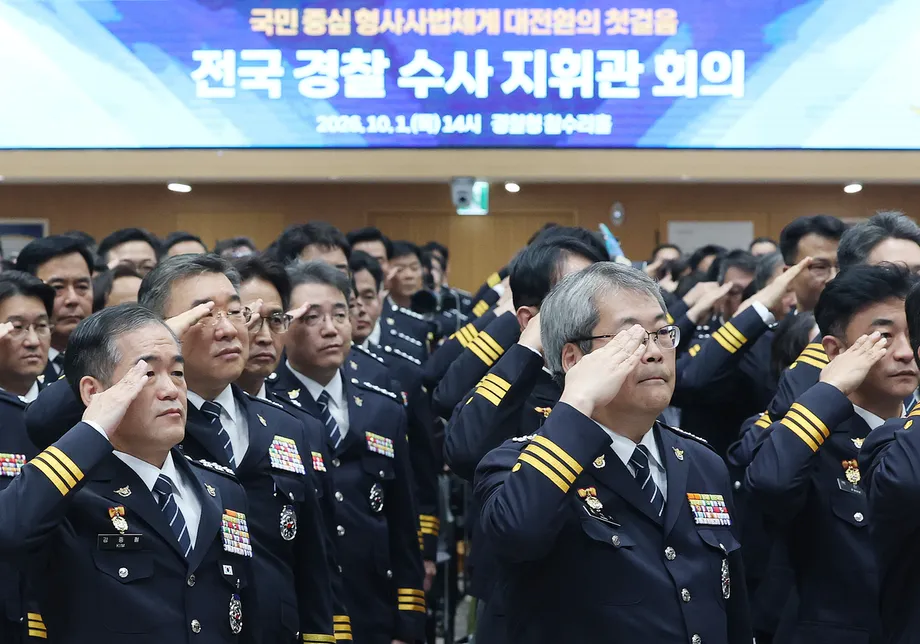
- Oct. 1: Acting police chief Kim Jong-cheol convened about 650 investigative commanders and declared an emergency response posture.
- Oct. 2: The replacement prosecution and serious crimes investigation agencies opened.
- Oct. 4: Figures showing the 34.1% arrest warrant rejection rate were made public.
- Oct. 6: Police opened a financial institution hacking investigation, and a police reform committee announced 12 recommendations.
- Oct. 14: A confirmation hearing was scheduled for investigative agency chief nominee Kim Ji-yong.
- Dec. 30: The transitional permission for prosecutors to investigate existing cases directly expires.
- February 2027: The investigative jurisdiction coordination council is expected to begin operating.
The sequence leaves a gap between the December deadline for legacy investigations and the expected February launch of the body meant to resolve jurisdictional disputes. Until that council operates, police and the new investigative agency must negotiate responsibility case by case.
A backlog grows before transfers begin
Unresolved cases at prosecutors' offices reached 186,307 at the end of September, up from 140,513 at the end of June, according to prosecution figures. That is an increase of 45,794 cases, or approximately 32.6%, in three months.
Classification criteria and a list of cases for transfer had been prepared, but reports from Oct. 9 said the actual handover had not begun. Cases must be allocated according to jurisdiction and whether prosecutors can finish them before the Dec. 30 grace period ends. Observers expect at least 100,000 cases to move to police or the new agency, although that is an estimate rather than a confirmed transfer total.
The difficulty is both administrative and investigative. The receiving agency lacks a completed electronic transfer system. It plans to use limited functions of the police Korea Information System of Criminal Justice Services, known as KICS, alongside paper records. Documents already digitized may need to be printed again if electronic transfer cannot be arranged.
Delayed transfers do not automatically mean cases have been lost. They do create a need to track the case file, responsible investigator, warrant status and any wanted notice together. Kim Beom-jun, head of the Public Policy Research Institute, has proposed a separate tracking process for sensitive transfers and checks to verify that each handover is complete.
He also proposed public reporting at three and six months on processing times, delayed transfers, staffing, warrant handling and victim protection. These are recommendations, not announced reporting commitments. Their value would be to show whether the transition is functioning beyond the replacement of office signs and institutional names.
Missing systems and investigation leaders
The new investigative agency opened without its own functioning electronic case system. People filing complaints on Oct. 2 received stamped copies rather than electronic receipts. Reports in the following week said paper handling of records and warrants could continue for several months or longer.
Physical preparation was unfinished too. Renovations at the Seoul office were expected to continue through the end of 2026, and some regional offices had not issued staff computers. Officials said full investigations might take another month to begin, rather than starting immediately after the agency opened.
Leadership vacancies add another constraint. At the Seoul office, 11 of 25 division chief positions were vacant, equivalent to 44%. The antitrust investigation bureau, with an authorized staff of 122, also lacked a bureau chief. The cyber investigation leadership vacancy was especially relevant to the disputed hacking case.
Kim Beom-jun put staffing across the new agencies at 68% of authorized levels. That figure is his assessment and does not provide a detailed breakdown by institution or investigative specialty. A separate account said the investigative agency had no police officers and had not yet begun recruiting experienced officers as of its first week.
Chief nominee Kim Ji-yong faced criticism from ruling party prosecution reform advocates and Gwangju office head Lim Eun-jung over his suitability. He pledged to organize a team addressing staffing, facilities and systems, and to recruit former prosecutors, police officers, lawyers, accountants and other specialists. His confirmation hearing was scheduled for Oct. 14; the reports do not establish its outcome.
Real cases expose disputed boundaries
A hacking investigation opened by the police National Office of Investigation on Oct. 6 became an early test of the new jurisdictional rules. The case involved financial institutions, but responsibility depended on how the affected systems were legally classified.
Accounts describe the relevant question differently: whether the systems constitute electronic financial infrastructure, or whether they fall within national critical infrastructure covered by the new agency's mandate. Police tentatively concluded that they could retain the case and sought a legal interpretation from the Financial Services Commission. That review had not produced a stated outcome in the reports.
Even if referral were required, the new agency's vacant cyber leadership post raised a practical question about who would direct the investigation. The dispute illustrates how legal responsibility and operational capacity can pull in different directions.
A second overlap concerns Won Hospital in Incheon's Michuhol District, where four patients died during the first half of 2026. On Oct. 6, the National Human Rights Commission of Korea filed a criminal complaint with the new agency against the hospital director, alleging offenses including death by occupational negligence, unlawful confinement and ordering unlicensed medical procedures.
Incheon police were already investigating following a complaint from bereaved families and searched the hospital that same day. These are allegations under investigation, not findings of guilt. With complaints before two institutions, authorities must decide how to coordinate the work and avoid unnecessary duplicate questioning.
Victims face repeated investigative handoffs
The consequences of the reform extend beyond warrants. When police decide not to refer a case for prosecution, prosecutors can review the records and request reinvestigation. Police may investigate again and retain their initial decision, prompting another request or a transfer to a different investigative body.
Such review has changed outcomes before. National Police Agency data submitted to People Power Party Rep. Kang Myoung-gu show that police reversed initial decisions in 8,808 of 40,001 cases after reinvestigation requests during 2023 through 2025, or 22%. The figure establishes that review sometimes corrected an earlier decision, not that every remaining decision was wrong.
Further investigation was also requested in 110,623 of 752,560 cases referred by police in 2025, or 14.7%, compared with a reported 11.9% rate in 2021. These requests concern referred cases and should not be combined with the separate figures for reviewing decisions against referral.
Under the new arrangements, prosecutors can request reinvestigation and conduct fact checking, but cannot ordinarily carry out their own supplementary investigations. Statements and materials obtained through that fact checking cannot be admitted as trial evidence. The narrow transitional permission for existing cases lasts only through Dec. 30.
Koo Bon-jin, an attorney and former criminal division prosecutor, explained the evidentiary change:
Victims sometimes change their statements after reaching a settlement,
Previously, statements made to a prosecutor could be used as evidence if the person who gave them confirmed they were accurate. Under the new system, they cannot be used as evidence even if the person confirms them.
If admissible evidence is still needed, an investigative agency must obtain it. That requirement makes the quality of communication between institutions central to both the speed and strength of a case.
Investigators generally have three months to complete a requested reinvestigation, while victims have three months after notice to object to a police decision against referral. One account calculates an 11 month route through successive review and investigation stages. That is a possible sequence, not a universal minimum or measured average. Its cited 2025 average of 6.9 months runs from investigation to an initial court ruling, so the two measures are not directly comparable.
Police oversight remains unfinished
Acting police chief Kim Jong-cheol responded to the transition by gathering about 650 commanders at police headquarters in Seoul on Oct. 1. He said the public was watching whether police had sufficient capacity and exercised authority fairly and with restraint, then announced:
I declare a shift to an emergency response posture until the new system has fully taken root in the field.
Police said station chiefs would check major cases and cases flagged by prosecutors daily, with further reviews by provincial and metropolitan agencies and the National Office of Investigation. Serious misconduct, including case manipulation or bribery, would normally result in dismissal or removal. Dedicated units established in September would track prosecutors' requests for additional investigation.
The Police Investigation Reform Committee for Restoring Public Trust added 12 recommendations on Oct. 6. It proposed hiring at least 100 officers with lawyer qualifications annually for five years and placing two to four additional legal experts at each station. It also sought mandatory reporting of unauthorized inquiries into cases, disciplinary consequences for failing to report them, and electronic documentation of supervisors' investigative instructions.
Other recommendations included transferring cases involving officers' relatives to another agency, online case status access and a statutory investigation review panel composed entirely of external members. The National Police Agency said it would accept the recommendations actively and submit implementation plans and timelines. That response does not establish that the measures are already operating.
External oversight is also unresolved. Proposed National Police Commission changes would allow it to demand reports, request disciplinary action and maintain its own administrative secretariat. Personnel rotation plans have met resistance over the possible loss of expertise and local knowledge, and talks with the police workplace council have broken down.
The force is attempting these changes under a third acting chief since former commissioner general Cho Ji-ho was removed from duty in December 2024 over his role in the Dec. 3 martial law declaration. The combined test is concrete: stronger review must catch weak investigations without creating avoidable delay, while wider police powers require controls that operate in practice.
Key Points
- Prosecutors rejected 34.1% of police arrest warrant requests during January through August 2026, up from 26.8% in 2025.
- The figures concern applications stopped by prosecutors before court review and predate the Oct. 2 institutional overhaul.
- The unresolved prosecution caseload reached 186,307 at the end of September, approximately 32.6% above June.
- The new investigative agency opened with incomplete systems, staffing gaps and vacant leadership posts.
- Legacy investigative authority expires Dec. 30, while the jurisdiction coordination council is expected in February 2027.
- Police oversight reforms and legal staffing recommendations remain at different stages of planning and implementation.