Six wins, no games lost and a historic title in Cairo
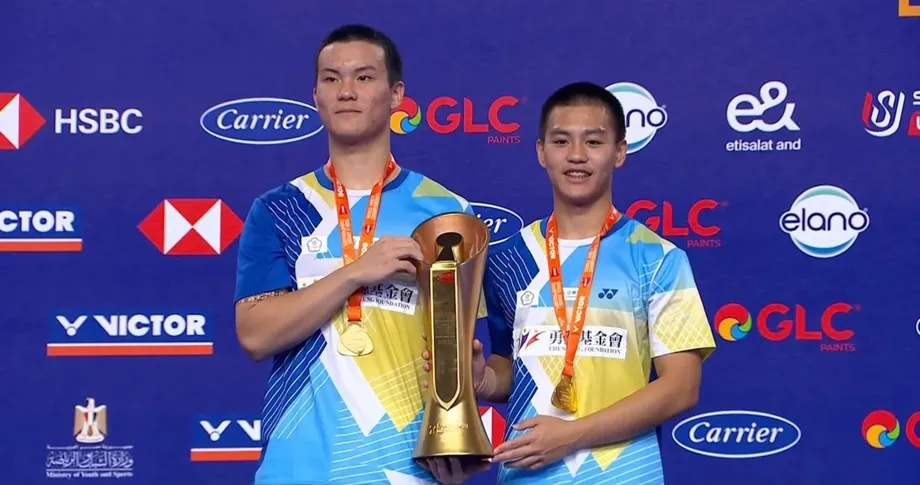
Chen Ping-hsuan and Lee Wei-ting won Taiwan's first men's doubles gold at the 2026 World Junior Badminton Championships in Cairo, defeating Japan's Mahiro Oku and Masato Yamashiro 15-10, 15-9 in the final on October 17. The top seeds completed six victories without dropping a game, turning their fourth appearance in a world junior men's doubles final into Taiwan's first title.
Contents
- Six wins, no games lost and a historic title in Cairo
- How the final swung Taiwan's way
- A perfect run through six rounds
- The semifinal showed the same control
- Three earlier finals had ended in silver
- A partnership built at Tatung
- Why the shorter games suited them
- Specific training and earlier senior experience
- Where the gold fits in Cairo's results
- Key Points
The Badminton World Federation (BWF), in its championship finals review published on October 18, confirmed the score and described the result as Chinese Taipei's first gold in any paired event at the championships. Chinese Taipei is the name under which Taiwan competes in the tournament.
That wider milestone matters. Taiwan's previous three world junior titles had all come in singles, where one player competes against another. Chen and Lee became the first Taiwanese partnership to win a world junior title in an event played by two players on each side.
The pair, who represent the Chung Chou Tatung badminton team and attend Taipei Municipal Tatung High School, had been regular partners for only a little more than a year. Their coach, Lin Chun-yung, had set them a target of winning a medal. They returned with gold after controlling the final's two decisive stretches: a late surge in the opening game and five consecutive points from 6-6 in the second.
How the final swung Taiwan's way
Chen and Lee started aggressively against the Japanese sixth seeds, building a 7-2 lead in the first game. Their attacks and placement forced difficult returns, with several Japanese shots going out of bounds.
Oku and Yamashiro reduced the gap to two points. At 11-9, Chen and Lee responded with three consecutive points, taking advantage of a Japanese service error during the closing stages. They went on to secure the game 15-10.
The second game began more evenly. Neither pair pulled clear before 6-6, when Chen and Lee put together a run of five points to move ahead 11-6. Another Japanese service error helped open the opportunity, and the Taiwanese pair kept control to finish 15-9.
Across the final, Chen and Lee scored 30 points to their opponents' 19. Their winning margins of five and six points show how decisively they finished each game, even though both contained moments when the Japanese pair were close enough to threaten.
A perfect run through six rounds
Chen and Lee entered Cairo as the world's top ranked junior men's doubles pair. A ranking reflects results across tournaments, while a seeding determines a pair's placement in a particular draw. In their case, the ranking and the number one seeding both pointed to a strong title challenge.
The men's doubles draw had 128 places. Chen and Lee received a bye in the opening round, meaning they advanced without playing, and began competing in the round of 64. They then defeated pairs from the United States, South Korea, Turkey, Japan and Hong Kong before facing another Japanese partnership in the final.
Six victories in straight games meant they won all 12 games they played. The result was also a step beyond their previous world junior campaign, which had ended in the quarterfinals.
- 2025: Chen and Lee reached the world junior quarterfinals.
- October 16, 2026: They defeated Hong Kong's Yu Chi-rui and Yeung Shun-on 15-4, 15-8 in the Cairo semifinals.
- October 17, 2026: They beat Oku and Yamashiro 15-10, 15-9 for the men's doubles title.
- October 18, 2026: The BWF published its finals review confirming Taiwan's first gold in a paired event.
The semifinal showed the same control
Hong Kong's badminton association, in its semifinal report, recorded Chen and Lee's 15-4, 15-8 victory on October 16. Their opponents, Yu and Yeung, were ranked 25th in the junior world standings and had eliminated pairs from Brazil, India, Malaysia and China.
Chen and Lee allowed the Hong Kong pair only four points in the opening game. The second was initially more balanced, before the Taiwanese pair again used a sequence of five consecutive points to take control.
The semifinal and final followed a similar pattern: opponents stayed competitive early in the second game, then Chen and Lee created a gap with a concentrated scoring run. Those passages fit Lin's assessment that their strengths lay in controlling the opening and middle stages of play.
Hong Kong still finished with men's doubles bronze, its first medal in that event since Lee Chun Hei and Ng Ka Long won gold in 2012. Its team also earned a women's singles bronze through 16-year-old Yip Sum-yau, bringing its total in Cairo to two medals.
Three earlier finals had ended in silver
Taiwan's wait for a men's doubles title stretched back to 1996, when Huang Shih-chung and Chien Yu-hsun reached the final. Huang Po-jui and Lin Chia-yu followed in 2011, and Lai Po-yu and Tsai Fu-cheng reached the title match in 2023. All three partnerships finished with silver.
Chen and Lee became the fourth Taiwanese pair to reach that final and the first to win it. Their success came 30 years after the first of those appearances, ending a sequence in which Taiwan had repeatedly reached the last match without securing the title.
The gold brought Taiwan's cumulative world junior medal tally to four golds, seven silvers and 15 bronzes, a total of 26 medals. Its earlier champions were Cheng Shao-chieh in women's singles in 2004, Lu Chia-hung in men's singles in 2015 and Kuo Kuan-lin in men's singles in 2022.
The title also supplied a major individual success after Taiwan failed to reach the quarterfinals of the team competition in Cairo. Chen and Lee delivered the breakthrough in an event where Taiwanese players had come close across several generations.
A partnership built at Tatung
Lin brought both players into Tatung's school programme after observing their potential. In their first year of high school, they played alongside older teammates, gaining experience in domestic competition before becoming a regular partnership in their second year.
Lee moved north from Taichung and initially worried about adapting to the Tatung system. The team paired him with an older player to help him settle in. Chen, meanwhile, won a high school cup men's doubles title alongside a senior teammate.
Lin described the eventual partnership as mentally mature, technically rounded and easy to communicate with. He also pointed to their clear division of responsibilities and quick playing rhythm.
The pair had already won Asian junior silver before Cairo. The Hong Kong association identifies that result as coming in 2026, and accounts of their season place it in July; Lin also referred to the silver as a result from the previous year. Taiwan's Lin Sheng-ming and Huang Tzu-yuan won the Asian title, but their world junior campaign ended in the round of 16.
Why the shorter games suited them
The 2026 championship was the first world junior edition to use games based on 15 points rather than the traditional 21, according to Lin. Tatung adjusted its training after the summer break to prepare for that format.
A lower scoring target gives players fewer points in which to recover from a poor start. Chen and Lee's ability to seize the initiative early therefore carried particular value. Lin identified their pressure in the middle and front of the court, their reactions during the first five shots of a rally, and their awareness of when to attack or defend as key strengths.
The front court is the area near the net. Controlling it can force opponents to lift the shuttle, creating opportunities to attack. Quick reactions there also help a pair keep the initiative before a rally develops into a longer exchange.
Lin said their forceful approach used considerable energy and that the shorter games allowed them to apply it more fully. He also acknowledged that the outcome might have been different under the former 21 point format. Their preparation addressed the competition they faced: taking control early, protecting a lead and finishing before opponents could rebuild momentum.
Specific training and earlier senior experience
Tatung's preparation included individual changes after the Asian junior championships. Coaches worked on Chen's precision near the net and Lee's movement around the court, aiming to make the partnership's existing strengths more effective.
Lin also arranged an earlier introduction to international senior competition, entering the pair in two events during the first half of the year. Support through level six of Taiwan's Golden Plan funding programme helped them gain experience against adult players.
Those appearances exposed the teenagers to a different level of competition before their world junior title attempt. Lin credited the experience with improving their confidence and making their play more complete. The team's corporate partner also arranged further international competition during the second half of the year.
Both players remain eligible for another world junior appearance in 2027. Lin hopes the Cairo title will attract more resources so they can continue gaining experience in senior tournaments. No specific future tournament schedule or new funding commitment was announced.
Where the gold fits in Cairo's results
Taiwan was one of four teams to win titles across the five individual events. Indonesia took two golds, while Taiwan, Malaysia and China won one each, according to the BWF's finals review.
Indonesia won mixed doubles through Muhammad Luthfi Habibi and Dian Ramadhani Mukti, who recovered from 11-14 in the deciding game against China's Feng Yi Lang and Li Meng Han. Radithya Bayu Wardhana then won an all Indonesian men's singles final against Fardhan Rainanda Joe.
Malaysia's Low Zi Yu and Genevie Lim secured their country's first women's doubles world junior gold, defeating Japan's Nijika Kamata and Shizuku Kashio in three games. China's Zhang Yi Xin won women's singles by coming from a game behind against Japan's Saki Matsumoto.
Japan consequently finished with silver in men's doubles, women's doubles and women's singles. Chen and Lee's victory was the only final settled in two games, completing a tournament in which no opponent took a game from them.
Key Points
- Chen Ping-hsuan and Lee Wei-ting defeated Japan's Mahiro Oku and Masato Yamashiro 15-10, 15-9 in Cairo.
- The title was Taiwan's first world junior men's doubles gold and its first gold in any paired event.
- The top seeds won six matches and all 12 games after receiving an opening round bye.
- Taiwan's three previous men's doubles finals, in 1996, 2011 and 2023, had ended in silver.
- Coach Lin Chun-yung credited their maturity, skills, targeted training and experience in senior competition.
- Both players remain eligible to compete at the world junior championships in 2027.