
A profitable robot maker moves toward the public market
Unitree Robotics has secured approval to raise about 4.2 billion yuan, roughly $619 million, through a listing on Shanghai's STAR Market. The China Securities Regulatory Commission (CSRC) approved the Hangzhou company's registration on July 3, 2026, bringing a manufacturer of humanoid robots, robots with four legs and robot components closer to one of China's most closely watched technology offerings this year.
Contents
- A profitable robot maker moves toward the public market
- How the approval process unfolded
- Where the 4.2 billion yuan would go
- Why making its own joints matters
- A giant machine draws attention before the IPO
- China's IPO recovery gives the offering momentum
- Embodied AI funding reaches 93.5 billion yuan
- Security concerns reach Washington
- Investors weigh margins against practical limits
- Key Points
As of July 17, Unitree had not announced a final launch date or price range. A listing could come as early as late July, and its registration approval is valid for 12 months. That gives the company time to complete pricing, arrange underwriting and issue shares without restarting the approval process.
Unitree plans to sell at least 40.45 million shares, representing a minimum 10% stake. The proposed fundraising implies a valuation of roughly 42 billion yuan, equivalent to about $5.9 billion to $6.2 billion. Investors would therefore be buying into a business valued at about ten times the money it seeks to raise.
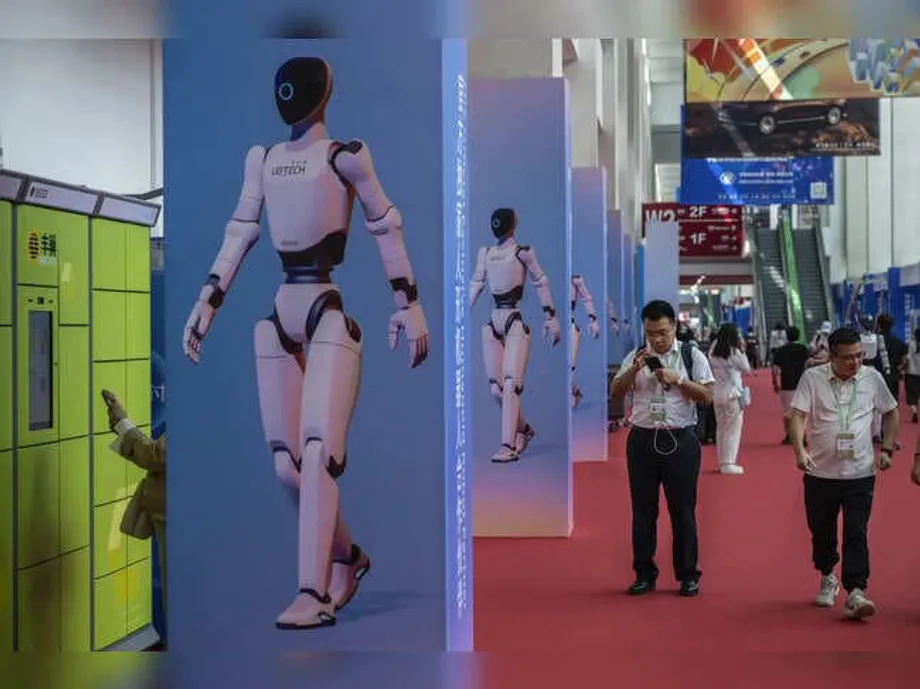
The offering has been described as potentially making Unitree the world's first publicly listed humanoid robotics company. Hong Kong already has a listed robotics peer, UBTech, so investors also have an existing public company against which to compare its performance. Unitree's flotation would provide another direct route into a sector Beijing has placed near the center of its industrial ambitions, from factory automation to home services and applications in public spaces.
Unitree brings something unusual to that market: a profit. In 2025, it reported revenue of about 1.7 billion yuan, roughly $250 million, and net profit of 278 million yuan. Its ability to earn money while many robot developers spend heavily on research makes the proposed listing a test of both investor enthusiasm and the economics of building humanoid machines.
How the approval process unfolded
Unitree filed its IPO application on March 20, 2026, passed the Shanghai Stock Exchange listing committee review on June 1 and received CSRC registration approval on July 3. Its review was described as taking roughly 73 days from acceptance to final approval, placing it among the fastest under the STAR Market's pre-review mechanism. The filing and final approval dates themselves span more than three months.
The main steps were:
- June 2025: The STAR Market introduced its pre-review mechanism as part of reforms for high quality technology companies.
- March 20, 2026: Unitree filed its IPO application.
- June 1, 2026: The Shanghai Stock Exchange listing committee approved the application.
- July 3, 2026: The CSRC approved registration, valid for 12 months.
- July 17, 2026: A final launch date and price range had not been announced, with a possible debut as early as late July.
The pre-review system is intended to shorten the route from exchange assessment to regulatory registration for companies meeting specific criteria. Registration approval clears the final regulatory stage, while the practical work of selling and issuing the shares still follows.
The STAR Market opened in 2019 as China's answer to Nasdaq. It accommodates science and technology businesses that may fall short of the profit requirements of traditional exchanges. Unitree is already profitable, giving it more financial cushion than many earlier candidates.
Other technology businesses are moving through the same market. Shanghai Enflame Technology, one of China's four GPU unicorns, received listing committee approval in June. GPUs are processors used for demanding computing tasks, including artificial intelligence. The exchange also accepted an IPO filing from XPHOR, a silicon photonics company working with technology that uses light in silicon devices.
At the 2026 Lujiazui Forum, CSRC chairman Wu Qing said the commission would expand STAR Market listing standards to include artificial intelligence and support enterprises in quantum technology, bio-manufacturing and embodied intelligence. Those priorities place Unitree's approval within a wider effort to bring advanced technology businesses into public markets.
Where the 4.2 billion yuan would go
Unitree's prospectus assigns the proceeds to four projects, with research receiving the largest share. About 48.1% would fund intelligent robot model research, 26.4% robot body development, 10.6% new intelligent robot products and 14.9% an intelligent robot manufacturing base.
The allocation puts 85.1% into the first three development projects and 14.9% into the manufacturing base. It reflects the two sides of a robot business: improving how machines understand and perform tasks, and building the bodies and production capacity needed to deliver them.
Unitree's product range includes the G1 humanoid, priced at roughly $27,300, alongside its more expensive H1 and H2 platforms used in research and industrial pilots. These pilots allow organizations to try robots in working environments before deciding how widely to deploy them.
The company shipped more than 5,500 humanoid robots in 2025, accounting for about 32.4% of the global market, according to its prospectus. That is close to one in three humanoid robots shipped worldwide under that measure.
Humanoid machines are also becoming a larger part of Unitree's business. They generated 51.5% of revenue in the first nine months of 2025, compared with 27.6% for the whole of 2024. The increase is 23.9 percentage points, although the figures cover different reporting periods.
Unitree's 2025 financial results included adjusted profit of about 591 million yuan alongside net profit of 278 million yuan. Adjusted profit changes the accounting measure by removing selected items. Core business gross margins were around 60.3%, exceeding those of most robotics peers. Gross margin measures the share of sales left after the direct cost of producing the goods, before other business expenses.
Why making its own joints matters
Unitree's central engineering choice is to design and manufacture its own joint actuators instead of purchasing them from specialist suppliers. Actuators are the motorized joints that move a robot's limbs, and they typically represent 35% to 40% of a humanoid robot's component cost.
Many Western companies buy strainwave gearboxes with high reduction ratios from suppliers such as HarmonicDrive. These gearboxes convert motor movement into slower, stronger motion. External purchasing can involve long delivery times and restrict how much a robot developer can customize the equipment.
Unitree uses a quasi direct drive approach, combining lower gear ratios with motors it builds itself that deliver high torque for their size. Torque is the turning force that lets a joint move or support a load. Independent examinations of dismantled G1 robots found no external supplier logos on their actuator assemblies.
Analyst estimates put the G1's component cost at roughly $9,000 against a selling price of about $27,300. That calculation produces a margin of approximately 67% before costs beyond the components are considered. Unitree's reported core business gross margin of 60.3% covers a broader accounting measure.
UBTech provides a useful comparison. The Hong Kong listed company generated 2 billion yuan in revenue in 2025, more than Unitree's 1.7 billion yuan, yet recorded a net loss of roughly 700 million yuan. Unitree earned 278 million yuan. Sales volume alone therefore tells only part of the story; the expense of building and developing the robots matters too.
Unitree can also design and prototype a new actuator in weeks. Competitors dependent on outside supply chains often need three months or more for each cycle. Faster development lets the company test changes and move to the next design sooner.
The approach follows earlier Chinese hardware examples. DJI built its consumer drone position by controlling flight controllers and electronic speed controllers, while BYD developed its electric vehicle advantage by making battery cells internally. Unitree is applying the same principle to a costly and central part of the robot.
A giant machine draws attention before the IPO
In May 2026, Unitree unveiled the GD01, a machine that a person can pilot, weighing 500 kilograms and standing about 2.8 meters tall. It can switch between walking on two legs and crawling on four.
Chief Executive Wang Xingxing piloted the GD01 during its launch demonstration. With prices starting at about $650,000, the machine is unlikely to become a major revenue driver, but its appearance displayed Unitree's engineering capabilities as the IPO review approached its final stage.
The GD01 also shows how Unitree attracts attention beyond the laboratories and industrial pilots buying its smaller robots. For investors, the more immediate commercial measures remain shipments, production costs, margins and the ability to turn demonstrations into products customers purchase.
China's IPO recovery gives the offering momentum
China's domestic IPO market is recovering after a prolonged slowdown. Listings on the Shanghai, Shenzhen and Beijing exchanges raised $7.7 billion in the first half of 2026, up 64.4% from the same period a year earlier, according to LSEG data.
These domestic listings are commonly called A-share IPOs. Their stronger fundraising suggests regulators are allowing larger offerings to proceed after a quiet period marked by tighter review standards and constrained capital market activity.
Just days before Unitree received approval, China Resources New Energy raised 24.5 billion yuan in Shenzhen. The wind and solar company's shares more than doubled on their debut, following the largest IPO in Asia so far this year.
China Resources New Energy's fundraising was about 5.8 times Unitree's planned 4.2 billion yuan. Its size and strong opening performance provide a measure of renewed investor appetite for major Chinese listings, even though energy generation and humanoid robotics are very different businesses.
Unitree's eventual market valuation could become a public benchmark for Chinese humanoid robot competitors. At roughly 42 billion yuan, its implied value is in the range of some midsized automotive suppliers, while its business is growing much faster than traditional hardware companies.
Embodied AI funding reaches 93.5 billion yuan
Chinese embodied AI companies raised 93.5 billion yuan, about $13.8 billion, in the first half of 2026, according to ITJuzi data. That was five times the amount raised a year earlier. The period recorded 322 financing deals, more than double the previous year's count.
Embodied intelligence means AI that can perceive, reason and act in the physical world. For a robot, this involves connecting software decisions to movement: recognizing an object, deciding what to do and controlling the limbs needed to perform the task.
Funding has concentrated on three areas: large language models for embodied AI, collecting robot training data at scale, and the ability to deliver finished products. Unitree, AgiBot and Galbot reached valuations above 10 billion yuan last year, becoming early unicorns in the sector. This year's financing account identifies another 19 firms joining the group and names Galbot, X Square Robot and Galaxea AI among the companies involved, with several exceeding 20 billion yuan.
Beijing has made the sector a policy priority. Embodied intelligence appeared in China's 2025 Government Work Report and the proposal for the 15th Five-Year Plan. More than half of China's provinces and cities included embodied intelligence and robotics development in their government work reports in 2026.
The Ministry of Industry and Information Technology said Chinese manufacturers had launched more than 330 humanoid robot product models by 2025. China has also established 27 data collection sites to support embodied AI training, while the National Artificial Intelligence Industry Investment Fund has backed companies including Galbot and Deep Robotics.
Wei Kai, head of the AI research institute at the China Academy of Information and Communications Technology, described progress in both robot movement and the systems that guide it:
China's humanoid robots have made significant strides in motor control capabilities, which can be seen in recent events. The evolution of the brain is also very fast.
His reference to the brain concerns the software and cognitive architecture used to interpret information and direct actions. The investment push is therefore about improving both physical control and the decisions behind it.
Security concerns reach Washington
Unitree's low prices and rapid growth have brought international attention alongside scrutiny in the United States and elsewhere. A central legal concern is Article 7 of China's 2017 National Intelligence Law, which requires organizations and citizens to support, assist and cooperate with state intelligence work.
Unitree remains subject to Chinese law regardless of server locations, privacy policies or the presence of a foreign subsidiary. That creates the possibility that robot data, including video, audio, GPS information and joint telemetry, could be accessible to Chinese authorities on demand. Joint telemetry records information about how a robot's joints are moving and operating.
Independent security researchers reported in 2025 that the G1 transmitted audio, video, GPS and sensor data to servers in China at regular intervals during normal operation. They also identified hardcoded encryption keys and a Bluetooth exploit called UniPwn.
Hardcoded keys are built into software rather than separately configured. UniPwn was described as wormable, meaning it could spread between vulnerable devices, and capable of granting attackers within wireless range root level access, the highest level of control over a device.
Unitree said it addressed most of the issues. No independent audit has publicly confirmed that all fixes are complete.
US lawmakers have proposed restrictions. The American Security Robotics Act would bar federal agencies from buying unmanned ground systems from companies associated with foreign adversaries. Senator Rick Scott's Blocking CCP Spy Tech Act of 2026 specifically names Unitree and would require a national security review before it could continue selling in the United States. A House subcommittee held a dedicated hearing on Unitree's national security risks in March 2026.
Security experts recommend placing Unitree robots on isolated network segments and disabling Bluetooth in favor of connections using WiFi alone. Those measures reduce the routes available for technical attacks. The company's obligations under Chinese law continue to apply.
Investors weigh margins against practical limits
South Korean researchers have highlighted Unitree's low prices and strong margins. Yoojin Park, a researcher at Hanwha Investment & Securities, cited an expected gross margin of 60.4%, compared with a competitor average of 44.4%. That is a gap of 16 percentage points.
Yeji Song, a researcher at Hana Securities, pointed to growing use of Unitree's platform by software developers and argued that its longer term potential lies in software and service ecosystems as well as hardware:
Based on this, an ecosystem of algorithms, development tools, and applications utilizing the Unitree platform is expanding.
NVIDIA's decision to use Unitree's H2 Plus body for its Isaac GR00T reference humanoid robot system, announced in June 2026, gives the company credibility in the research community while heightening competition. A reference system provides a common hardware and software foundation for further development.
Tesla's Optimus project is Unitree's closest global competitor and is designed for heavier payloads and longer operating times than the G1. Unitree's G1 can carry roughly 3 to 5 kilograms, far below the 20 to 25 kilograms Tesla aims for. That limits the G1 to lighter tasks and makes the intended job an essential part of any purchasing decision.
Unitree's patent portfolio presents another investment risk. It held 262 registered patents worldwide as of early 2026, compared with nearly 3,000 at UBTech. Unitree has historically relied on trade secrecy, keeping engineering knowledge confidential rather than relying as heavily on patents. That strategy faces greater pressure as competitors dismantle products and study their designs.
The IPO brings these strengths and risks into one public valuation: profitable manufacturing, rapid development and growing shipments on one side; task limitations, intellectual property exposure and possible restrictions on overseas sales on the other. The final offering price will show how investors balance them.
Key Points
- The CSRC approved Unitree's Shanghai STAR Market IPO registration on July 3, 2026. The company seeks about 4.2 billion yuan, roughly $619 million.
- At least 40.45 million shares would be sold, representing a minimum 10% stake and implying a valuation of roughly 42 billion yuan.
- As of July 17, no final launch date or price range had been announced. A debut could come as early as late July.
- Unitree reported 2025 revenue of about 1.7 billion yuan, net profit of 278 million yuan and adjusted profit of about 591 million yuan.
- More than 5,500 humanoid robots shipped in 2025, representing about 32.4% of the global market according to the prospectus.
- Making its own actuators helps Unitree control costs and develop new designs faster.
- Chinese embodied AI firms raised 93.5 billion yuan in the first half of 2026, while domestic IPO fundraising rose 64.4% to $7.7 billion.
- Reported security vulnerabilities, Chinese intelligence law obligations and proposed US restrictions remain central concerns for customers and investors.