A New Income Status, With Bigger Tests Still Ahead
Vietnam entered the World Bank's upper middle income category on July 1, 2026, after gross national income per person rose to $4,970 from $4,490 in 2024. Its economy grew 8 percent in 2025, nearly twice the Southeast Asian average, and expanded 7.83 percent compared with a year earlier in the first quarter of 2026. Hanoi now wants annual growth of 10 percent by 2030 and high income status by 2045.
Contents
- A New Income Status, With Bigger Tests Still Ahead
- The 2045 Goal Requires More Than Fast Growth
- How Reform Opened Vietnam to the World
- Foreign Factories Power Exports, While Local Firms Stay Small
- Trade Diplomacy Faces Pressure From Washington and Beijing
- The Infrastructure Bill Exceeds What Banks Can Fund
- Workers, Electricity and Management Limit Expansion
- Consumers Are Spending More, but Looking for Value
- Faster Growth Brings a Familiar Stability Test
- Key Points
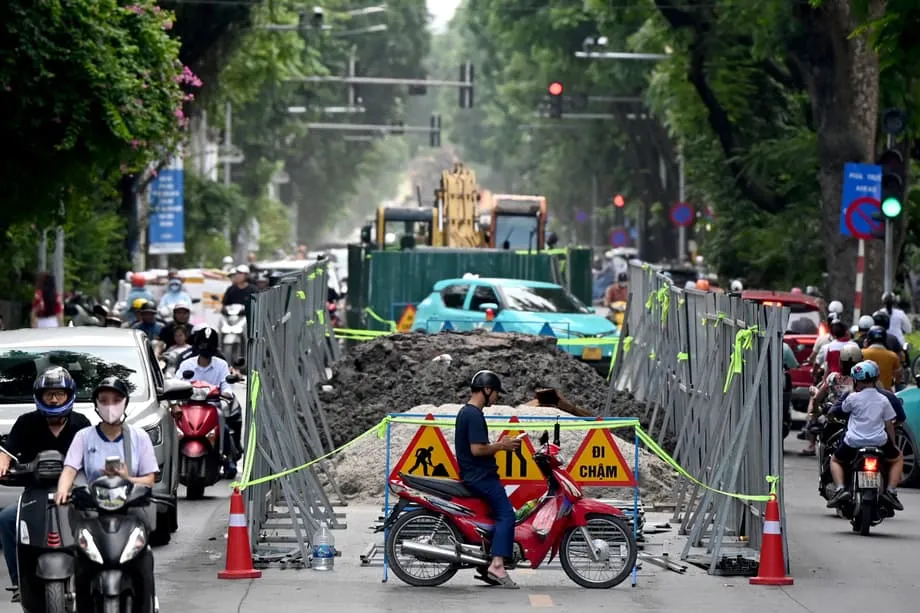
Ho Chi Minh City's streets show how quickly the economy is changing. Cyan electric taxis pass coffee shops with glass fronts, luxury hotels and flagship stores, while workers still eat meals costing a few dollars at eateries furnished with plastic stools. Motorcycles remain part of the city, but the newer businesses and vehicles reflect an economy that is expanding and diversifying.
Industry, construction and services drove growth in the first quarter. Total exports reached $122.93 billion, including $33.9 billion shipped to the United States, an increase of 24.2 percent. Vietnam's appeal to investors rests partly on how quickly projects can move from approval to operation.
Michael Piro, co-CEO of Indochina Capital and an investor in industrial real estate, described the opportunity:
You license a project in six months, you build it in 12. It is so easy. I have never seen, in my 20-year career, an opportunity like this.
Financial markets also reflect that optimism. The VN-Index has risen sharply, and FTSE Russell is scheduled to upgrade Vietnam to secondary emerging market status in September 2026, potentially bringing billions of dollars from passive funds. Such funds follow market indexes rather than choosing each investment individually. Yet on the day of the World Bank's income upgrade, MSCI left Vietnam off its upgrade watch list. Rising national income and easier access for international investors are advancing at different speeds.
The 2045 Goal Requires More Than Fast Growth
Vietnam's ambition would require gross national income per person to rise from around $4,500 to $14,000, nearly tripling. According to the World Bank, only 27 economies have made that transition since 1990. Gross national income measures income earned by a country's residents, while gross domestic product measures production within its borders.
Resolution 68 places private enterprise at the center of the government's strategy. It raises the private sector's standing from "important" to the "most important driving force" of the economy and describes entrepreneurs as "new warriors on the economic front." The resolution calls for 2 million private enterprises by 2030, twice the current number, and 20 large private companies capable of competing globally, modeled on South Korea's chaebol business groups.
Infrastructure plans match the scale of those ambitions. A railway costing $67 billion would reduce the Hanoi to Ho Chi Minh City journey from 30 hours to five. Airports are scheduled to receive $25 billion by 2030, including a long delayed replacement for overcrowded Tan Son Nhat International Airport.
Viettel, the telecommunications conglomerate owned by the military, broke ground in January on Vietnam's first semiconductor fabrication plant. It plans to produce 32 nanometer chips by 2027. Semiconductor fabrication means making the chips themselves, rather than simply assembling products that contain them. An international financial center proposed for Ho Chi Minh City and Da Nang would create a distinct regulatory area through which banks and investors could access global capital.
General Secretary To Lam, who also became president in April 2025, holds Vietnam's two most powerful posts. Yap Kwong Weng, CEO of Vietnam SuperPort, a logistics hub in the north, said leadership continuity matters to investors:
We are seeing a transition where leaders are being given more permanent positions, which helps make policy formulation and execution more secure. For a business like ours, especially from an investor perspective, political stability and consistent policy implementation are extremely important.
How Reform Opened Vietnam to the World
Vietnam's current ambitions follow decades of economic change. After reunification in 1976, the Communist Party established a centrally planned economy with nationalized companies and collective farms. By the middle of the 1980s, hyperinflation and collapsing Soviet aid forced the leadership to reconsider that model.
General Secretary Nguyen Van Linh launched Doi Moi, meaning renovation, in 1986. The reforms opened the way for private ownership, foreign investment and a stock market. The United States lifted its trade embargo in 1994, and Vietnam joined the World Trade Organization in 2007.
Chris Freund, founder of Mekong Capital, recalled the difficulty of investing in private businesses during the early period:
The private sector was not really investable at that point," he says. "The people you partnered with had no personal stake in the long term success of the business.
Piro recalled a different atmosphere by the middle of the 2000s, as entry into the World Trade Organization approached:
There was a pervasive sense of optimism around the WTO," recalls Piro. "Back then, the whole market was in its infancy.
The country's economic opening and its latest ambitions span several milestones:
- 1976: Reunification was followed by a centrally planned economy.
- 1986: Nguyen Van Linh launched Doi Moi.
- 1994: The United States lifted its trade embargo.
- 2007: Vietnam joined the World Trade Organization.
- 2025: GDP grew 8 percent.
- July 1, 2026: The World Bank reclassified Vietnam as an upper middle income country.
- September 2026: FTSE Russell's upgrade to secondary emerging market status is scheduled.
- 2030 and 2045: Hanoi targets annual growth of 10 percent by 2030 and high income status by 2045.
Foreign Factories Power Exports, While Local Firms Stay Small
Vietnam has become the biggest beneficiary of the "China plus one" strategy, under which multinational companies shift part of their supply chains outside China to reduce tariff exposure or make production more resilient. Samsung, Apple, Nintendo and other foreign businesses have invested billions of dollars in factories producing laptops, televisions, headphones and game consoles.
Roughly 80 percent of Vietnam's exports now come from foreign direct investment, meaning investment by overseas businesses in operations inside the country. Foreign companies own much of the manufacturing sector, and many suppliers have Chinese financial backing.
Alberto Vettoretti, a senior ASEAN executive at Ascentium, said investors from mainland China, Hong Kong and Taiwan lead in the number of projects. At Indochina Capital's industrial parks, about 70 percent of tenants are manufacturers from mainland China and another 20 percent are Taiwanese.
Piro argued that foreign manufacturing and the creation of wealth within Vietnamese businesses are different parts of the growth story:
Much of it is not creating wealth for Vietnamese people. It is foreign owned businesses conducting foreign business, so it is not the core engine of what is driving wealth for ordinary Vietnamese.
About 97 percent of registered Vietnamese companies are micro or small enterprises. Medium sized businesses are rare, leaving a gap described as the "missing middle." Vietnam needs more domestic companies capable of growing beyond small operations and supplying larger businesses if it is to move from assembling products toward creating goods with greater value.
Resolution 68's push for more private enterprises therefore addresses a weakness beneath the export totals. The challenge is to build companies that can retain more income, skills and business activity within Vietnam while continuing to attract foreign manufacturers.
Trade Diplomacy Faces Pressure From Washington and Beijing
Vietnam calls its approach to international relations "bamboo diplomacy," a phrase coined by former General Secretary Nguyen Phu Trong. Strong roots, a sturdy trunk and flexible branches describe Hanoi's effort to maintain warm relations with Washington, Beijing and Moscow at the same time.
In March 2026, then Prime Minister Pham Minh Chinh traveled to Moscow to seek support for nuclear power plants and railways. A month later, To Lam made China his first foreign destination after becoming president and returned with railway and aircraft agreements.
The United States remains Vietnam's most important customer, purchasing more than $190 billion in Vietnamese goods each year. In October 2025, Washington agreed to impose a 20 percent tariff on Vietnamese goods, below the 46 percent threatened on "Liberation Day" in April 2025 and roughly in line with tariffs on other ASEAN economies.
The agreement also includes a 40 percent tariff on goods deemed to have been transshipped from China. Transshipment involves moving goods through another country before they reach their destination. The provision could affect products assembled in Vietnam using Chinese components.
The Office of the United States Trade Representative has also launched Section 301 investigations into Vietnam, accusing it of industrial overcapacity and weak intellectual property protection. Overcapacity means producing more than markets can absorb; intellectual property protection concerns rights over inventions, brands and other creations.
Vettoretti, the Ascentium executive, described the pressure on Vietnam's balancing strategy:
Vietnam has done quite a lot of things right, no matter how you look at it," says Alberto Vettoretti. "The question is whether it can keep all sides happy when the geopolitical temperature rises.
A deeper separation between the American and Chinese economies would make that balancing act harder. Vietnam depends on the United States as a major buyer while Chinese investment and components support much of its manufacturing activity.
The Infrastructure Bill Exceeds What Banks Can Fund
Most outside analysts estimate that Vietnam needs $160 billion in infrastructure investment by 2030. Jens Lottner, CEO of Techcombank, one of the country's largest private banks, puts the financing gap at $200 billion, alongside total investment needs of $1.1 trillion. Infrastructure requirements, total investment and the amount still needing finance describe different parts of the funding challenge.
Lottner said domestic banks cannot provide all the money required:
There is no way all these infrastructure investments can be financed by the local banking systems," Lottner says. "Vietnam's capacity to generate deposits just is not big enough.
Bank deposits are the savings that banks use to support lending. Vietnam will need foreign capital as well, but institutional investors remain cautious about capital controls, limited ways to exit investments and financial infrastructure that is still developing.
MSCI continues to classify Vietnam as a frontier market rather than an emerging market. Its June 2026 review identified unresolved issues involving foreign ownership limits, unequal rights for overseas investors, foreign exchange rules, settlement and clearing procedures, disclosure, securities lending and short selling. Settlement and clearing are the processes that complete a trade and transfer money and securities. Short selling involves selling borrowed securities in the expectation of buying them back at a lower price.
The VN-Index has gained more than 35 percent over the past 12 months, but a small group of large companies, including names linked to Vingroup, has driven the rally. Without four Vingroup related stocks, the index would be below its level at the end of 2025.
The proposed financial center in Ho Chi Minh City and Da Nang is intended to address some investment constraints. It remains at an early stage, and few executives fully understand how it will work. Piro described a central concern for investors:
It is not difficult to get money into Vietnam," Piro says. "It is getting money out.
The government's plan for 2026 to 2030 calls for public investment to nearly triple compared with the previous five years. Stronger public private partnerships, in which government and businesses share responsibility for projects, are intended to bring in additional money.
The World Bank warns that public resources alone will be insufficient. It calls for attention to shift from simply spending allocated money faster toward projects with greater impact, supported by better selection, stronger preparation and efficient procurement.
Workers, Electricity and Management Limit Expansion
Vietnam's construction and manufacturing boom is already creating labor shortages and pushing wages higher. Some manufacturing with lower value, including garments, is moving to cheaper locations such as Cambodia and Bangladesh. Electronics suppliers seeking sites near Samsung sometimes struggle to afford wages or recruit enough workers.
Vietnam became an aging society in 2015. United Nations projections indicate that more than a quarter of its population will be older than 60 by 2050, a share similar to Germany or Hong Kong today. The country has a limited window to build greater wealth before its workforce shrinks.
Lottner, the Techcombank chief executive, described the urgency:
"Time really is our scarcest resource," Lottner says.
Sustaining rapid growth becomes harder as a population ages. Vietnam's targets depend on both the number of people working and how much each worker can produce.
Electricity is another constraint. The grid experiences rolling outages, particularly in the north. Domestic fuel prices rose after hostilities broke out in the Middle East, and inflation reached 5.8 percent, exceeding the central bank's ceiling. Higher interest rates to contain inflation could slow economic growth.
Most electricity still comes from fossil fuels, and reaching renewable energy targets will take years. Chipmakers, data center operators and manufacturers producing goods with greater value need reliable electricity at competitive prices.
Freund, the Mekong Capital founder, identified management as the leading business problem:
There is still a shortage of really great management talent," he says. "Good companies are able to attract and retain people. For an average company, however, it is a real struggle.
Vietnamese factories often trail Chinese or Korean counterparts in efficiency. Vettoretti described the training challenge:
When we ask clients what level of efficiency they can get out of Vietnamese factories versus Chinese or Korean factories, Vietnam, with some exceptions, is still lower," Vettoretti says. "So the question becomes: How do you drive more efficiency? How do you provide the training needed to reach that level?
Consumers Are Spending More, but Looking for Value
Vietnam's middle class is projected to reach 26 percent of the population in 2026, up from 13 percent in 2023, adding more than 25 million consumers with rising disposable incomes. The projected population share is twice the 2023 level.
Retail sales grew 12.1 percent compared with a year earlier between January and April 2026. Urban incomes are increasing faster than rural incomes, and consumers spend heavily on education, healthcare and housing. Travel and premium brands are also attracting more spending.
Inflation, household debt and uncertainty about the world economy are making shoppers cautious. Consumers are cutting purchases they consider unnecessary, saving more and seeking value online. NielsenIQ data shows that 72 percent prefer online shopping, while 26 percent are reducing unnecessary expenses.
Melissa Cyrill, a consumer research analyst, described changing expectations:
Vietnam's pursuit of developed economy status by 2050 is reshaping its consumer landscape. A fast-expanding middle class is redefining spending priorities and expectations, creating vast opportunities for companies that deliver high quality products and services aligned with their evolving needs.
Online commerce is reshaping retail while also giving households more ways to search for lower prices. Vietnam's challenge is to turn rising consumer confidence into lasting domestic demand without depending on spending financed by credit that could destabilize the economy.
Faster Growth Brings a Familiar Stability Test
Independent forecasts remain below Hanoi's ambitions. The World Bank expects growth of 6.8 percent in 2026, the OECD forecasts 6.2 percent and HSBC predicts 6.5 percent. The Asian Development Bank, International Monetary Fund and ASEAN+3 Macroeconomic Research Office are more optimistic, with forecasts around 7 percent.
Domestic institutions such as Dragon Capital project growth of 10 percent. Even those more optimistic models require credit growth of 16 to 20 percent, fiscal deficits of 4 to 5 percent of GDP and annual export growth above 12 percent. A fiscal deficit occurs when government spending exceeds revenue.
Rapid lending, spending and investment can also overheat an economy, push asset prices upward and create loans that borrowers cannot repay. Between 2007 and 2010, bank lending increased by more than 30 percent a year, reaching over 50 percent in 2007. Inflation exceeded 18 percent in 2008 and 2011, and banks accumulated large amounts of nonperforming loans.
The State Bank of Vietnam is targeting credit growth of 15 percent in 2026, down from 19 percent in 2025, as it seeks to avoid repeating that experience while the government presses for faster expansion.
Mariam J. Sherman, the World Bank's division director for Vietnam, Cambodia and Laos, said the next stage depends on the quality of growth:
While the drivers that helped Vietnam reach upper middle income status remain important, sustaining future growth will increasingly depend on productivity, innovation, stronger domestic enterprises, and the ability to generate greater value across the economy.
Sherman points to the widening gap between foreign invested and domestic companies, a financial sector still dominated by banks and infrastructure needs that exceed public budgets. She argues that the 2045 vision is possible, but requires coordinated reforms across every level of government and a steady willingness to adapt.
Vietnam's new income category marks progress. Its next task is to connect export success with stronger domestic businesses, finance infrastructure without excessive borrowing, and improve skills and productivity before population aging makes rapid expansion harder.
Key Points
- Vietnam grew 8 percent in 2025 and 7.83 percent in the first quarter of 2026. The World Bank granted it upper middle income status on July 1, 2026.
- Hanoi targets annual growth of 10 percent by 2030 and high income status by 2045, with Resolution 68 placing private enterprise at the center of the strategy.
- Foreign investment accounts for roughly 80 percent of exports, while about 97 percent of registered domestic firms are micro or small enterprises.
- United States tariffs of 20 percent, a 40 percent transshipment tariff and Section 301 investigations create uncertainty for manufacturers.
- Infrastructure investment needs and financing gaps run into hundreds of billions of dollars, exceeding what domestic banks can fund alone.
- FTSE Russell's market upgrade is scheduled for September 2026, while MSCI continues to classify Vietnam as a frontier market.
- Labor shortages, population aging, electricity constraints and limited management talent threaten continued expansion.
- Consumer spending is growing, but inflation and debt are encouraging greater caution.
- Independent growth forecasts for 2026 range from 6.2 percent to around 7 percent, below the government's ambition.