A Trillion Parameter Model Crosses a Speed Threshold
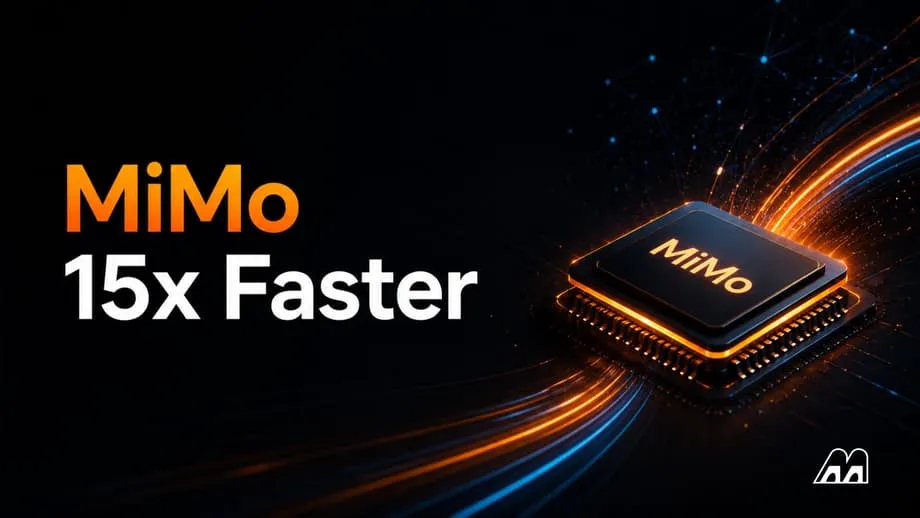
Xiaomi released MiMo V2.5 Pro UltraSpeed on June 8, 2026, claiming that its artificial intelligence model can generate more than 1,000 tokens per second on standard cloud graphics processing units. Internal demonstrations showed peak throughput approaching 1,200 tokens per second, sustained on a single computing node equipped with eight GPUs.
Contents
- A Trillion Parameter Model Crosses a Speed Threshold
- How Xiaomi Built Its MiMo Lineup
- How the Speed Compares With Other Systems
- Why Generation Speed Changes What AI Can Do
- FP4 Compression Reduces the Memory Traffic
- DFlash Lets the Model Check Several Tokens Together
- TileRT Removes Tiny Gaps Between GPU Operations
- Trial Access, Prices and the June Timeline
- Product Expansion Has Not Lifted Xiaomi Shares
- Open Releases Put the Claim to a Replication Test
- Key Points
The company describes the achievement as the first time a language model at this scale has crossed the 1,000 token threshold without custom silicon or specialized hardware. Tokens are the units of text a model processes and generates. The faster it produces them, the sooner an answer, a piece of code or a sequence of reasoning steps can be completed.
MiMo V2.5 Pro has 1.02 trillion parameters, the numerical values that shape its responses, and a context window of one million tokens. The context window determines how much material the model can consider at once. Its Mixture of Experts architecture uses specialized groups of parameters within the model, and it processes text, images, audio and video natively in a single system.
UltraSpeed is a serving mode layered on top of that existing model. Xiaomi attributes the acceleration to inference optimization, meaning changes to how the trained model runs, rather than a redesign of its underlying weights or architecture. Three coordinated techniques drive the result: selective FP4 compression, DFlash speculative decoding and the TileRT GPU runtime.
As of June 17, the speed figures come entirely from Xiaomi's internal benchmarks. No independent third party verification has been published. The central test now is whether other developers can reproduce the performance on common cloud GPU instances and maintain the model's quality across different tasks.
How Xiaomi Built Its MiMo Lineup
Xiaomi is better known for affordable smartphones, electric scooters and, increasingly, electric vehicles. It shipped 33.8 million handsets in the first quarter of 2026 and delivered more than 30,000 electric vehicles in May alone. Behind those consumer businesses, a dedicated artificial intelligence division has been developing large language models.
The MiMo family began in April 2025 with a compact reasoning model containing 7 billion parameters. Over the following fourteen months, it grew into a competitive lineup of models with openly available weights. The current flagship, MiMo V2.5 Pro, debuted on April 22, 2026.
MiMo V2.5 Pro performs close to Claude Opus 4.6 on software engineering evaluations, while its standard price per token is roughly one eighth as much. That combination places the model in competition with frontier systems, the leading models used for demanding reasoning and coding work.
Xiaomi's standard pricing is 0.025 yuan per million input tokens on cache hits, 3 yuan per million input tokens on cache misses and 6 yuan per million output tokens. A cache hit means previously processed input can be reused, which explains why that category is much cheaper than processing input afresh.
The underlying checkpoint was released under the MIT open source license. Developers can host it themselves, fine tune it and deploy it commercially without licensing fees. UltraSpeed adds a faster way to serve the same flagship model, putting the emphasis on software performance rather than another increase in model size.
How the Speed Compares With Other Systems
Public benchmark figures cited in the comparison put OpenAI's GPT 5.5 at roughly 68 tokens per second, Claude Opus 4.6 at approximately 71 and Google Gemini Flash at 192. Xiaomi's claimed rate of more than 1,000 tokens per second is roughly fifteen times the output speed of the standard ChatGPT experience.
Specialized chip companies have pursued similar speeds through different hardware. Cerebras built a chip at wafer scale, roughly the size of a dinner plate, with 44 gigabytes of memory on the chip. Its design aims to remove the memory bandwidth constraints that slow conventional GPU inference. That system achieved approximately 969 tokens per second on Meta's Llama 3.1 405B, which has fewer than half as many parameters as MiMo V2.5 Pro.
Groq developed its own Language Processing Unit architecture, delivering between 300 and 750 tokens per second depending on the model. Neither that platform nor the Cerebras system runs on hardware available through standard cloud rental services.
Xiaomi's result instead uses rentable commodity GPUs. A developer with access to a standard node containing eight GPUs could theoretically replicate it. Whether that happens in practice is part of the independent testing still to come.
The business stakes extend beyond producing a chat answer faster. Specialized chipmakers have invested hundreds of millions of dollars in pursuing this kind of performance. Confirmation of Xiaomi's claims would give software and algorithm design a stronger role in a contest often framed around new hardware.
Why Generation Speed Changes What AI Can Do
A model producing 68 tokens per second can work well in a chat interface, where people read at their own pace. Applications that need decisions almost immediately have a different requirement: waiting for a long sequence of generated tokens can hold up the entire process.
Fraud detection in real time, trading signals at high frequency and autonomous coding agents are examples of tasks where that delay becomes a serious constraint. A coding agent may need to generate a plan, write code and work through several further reasoning steps. Faster output reduces the wait between those steps.
Xiaomi's claimed performance also makes parallel reasoning more practical. In Best of N reasoning, a system generates several candidate solutions and selects among them. Tree search explores branching routes toward an answer. At higher speeds, dozens of these reasoning paths can run within the time a slower model would need for one.
Trading signal generation, fraud interception and live dialogue systems could benefit when delays fall below what a person can readily perceive. The practical value depends on how quickly the complete decision loop runs, with token generation one of its constraints.
Xiaomi's public demonstrations focused on tasks limited by output speed. A fully functional Snake game was generated in approximately ten seconds, while a prototype of a macOS interface appeared in about one minute. In both examples, producing the necessary code quickly was central to the demonstration.
FP4 Compression Reduces the Memory Traffic
The first component of UltraSpeed is FP4 quantization, a method of representing numerical values with fewer bits. Standard inference typically stores model weights at 16 bit or 8 bit precision. At the scale of a trillion parameters, moving those values from memory to processing cores creates a traffic jam that limits generation speed.
Xiaomi applies 4 bit precision selectively to the expert layers in its Mixture of Experts architecture. Those layers contain the vast majority of the model's parameters and are more tolerant of reduced numerical precision. They are compressed into the MXFP4 format, while other modules remain at higher precision, reported as FP8.
Quantization Aware Training integrates the compression into the model's learning process. This allows the model to learn while accounting for the lower precision it will use when running. Xiaomi's benchmarks show the quantized version performing essentially on par with the original version at full precision.
The selective approach reduces the model's memory footprint while preserving higher precision where it is needed. Because the expert layers hold most of the parameters, compressing them sharply reduces the amount of data that must move through memory during each generation step.
Less memory traffic means the GPU can spend less time waiting for values to arrive and more time processing them. Those bandwidth savings form one part of the claimed increase in throughput, the amount of output generated in a given period.
DFlash Lets the Model Check Several Tokens Together
The second component tackles the sequential nature of language generation. A model normally produces one token at a time, with each new token depending on the tokens already generated. Speculative decoding speeds this up by using a smaller draft model to guess several upcoming tokens, then asking the larger target model to verify those guesses in parallel.
Traditional speculative decoding still requires the draft model to generate its guesses one after another. DFlash, a method from the research community that Xiaomi refined, removes that sequential constraint from drafting. It fills a whole block of masked positions in a single forward pass, producing several guesses through one run of the draft model.
Xiaomi tuned the process using the Muon second order optimizer and model self distillation. These are training techniques used to improve the draft model. The draft model uses Sliding Window Attention exclusively, keeping the computational cost of each prediction constant regardless of how long the conversation becomes.
In coding scenarios, the system achieves an average acceptance length of 6.3 tokens per verification round, with the block size capped at 8. That means the larger model confirms around six or seven tokens in one step rather than generating each individually.
Rejection sampling controls which guesses pass through. Xiaomi describes the resulting output as mathematically identical to standard decoding, so this acceleration comes without quality loss from the speculative decoding process. Acceptance rates are lower in open ended conversation than in structured coding tasks, making performance across different uses an important part of replication testing.
TileRT Removes Tiny Gaps Between GPU Operations
The third component addresses delays measured in microseconds. Once inference exceeds 1,000 tokens per second, individual mathematical operators run so quickly that the gaps between launching them become a primary bottleneck. Traditional serving systems launch operators one after another, leaving small pauses that matter much less at ordinary speeds.
The TileRT runtime, developed jointly with inference partner TileRT, uses a Persistent Engine Kernel that remains resident inside the GPU continuously. Rather than repeatedly starting and stopping operations, it keeps execution active.
Warp Specialization assigns different hardware threads coordinated roles in moving data, performing calculations and communicating. Tiny operations such as RMSNorm, rotary position embeddings and KV cache writes can then execute without interruption. Those operations help normalize numerical values, represent token positions and store information reused during generation.
Xiaomi designed the runtime alongside its FP4 compression and DFlash choices. The model and serving system were developed together so that the three components work in coordination. The company explicitly says that none of them alone reaches 1,000 tokens per second.
The claimed record therefore rests on the combined execution of all three techniques. Compression reduces the data that must move, speculative decoding reduces the number of sequential generation steps, and the persistent runtime removes gaps between the remaining operations.
Trial Access, Prices and the June Timeline
UltraSpeed access is available through a limited API trial requiring an application, running from June 9 to June 23, 2026. An API lets developers connect their own software to the model. The Token Plan subscription service does not apply to UltraSpeed.
The service costs three times the standard MiMo V2.5 Pro rate, in exchange for approximately ten times the generation speed promised by Xiaomi. Exchange calculations put the price at roughly $1.29 per million input tokens and $2.61 per million output tokens.
Approved users receive two weeks of free Chat access, subject to daily and session limits. Each account can enter the queue ten times per day, sessions are capped at thirty minutes, and resources are automatically released after five minutes of inactivity.
The key dates trace the move from a small reasoning model to the current trial:
- April 2025: Xiaomi launched a reasoning model with 7 billion parameters.
- April 22, 2026: MiMo V2.5 Pro debuted as the flagship model.
- June 8, 2026: Xiaomi released the UltraSpeed inference mode.
- June 9, 2026: The limited API trial began.
- June 11, 2026: Xiaomi shares closed at €2.91.
- June 23, 2026: The announced API trial ends.
June 23 is the next stated deadline for developers seeking access through the trial. The pricing and access rules make UltraSpeed a distinct service option rather than a feature included in the existing Token Plan.
Product Expansion Has Not Lifted Xiaomi Shares
Xiaomi's financial market performance has remained weak despite the technical milestone. Its shares closed at €2.91 on June 11, just 1.75% above their low over the preceding 52 weeks. The stock was down 35% since the start of the year.
The company continues to diversify across consumer electronics, software and vehicles. It launched the premium 17T smartphone in India on the same day as the MiMo Code assistant release, and it is pursuing electric vehicle expansion with the city of Changchun.
The 33.8 million handsets shipped in the first quarter and more than 30,000 electric vehicles delivered in May show the scale of the businesses alongside its AI division. The MiMo speed announcement adds another development to that expansion, while upcoming earnings data will help show whether operational momentum can reverse the stock's performance.
Open Releases Put the Claim to a Replication Test
Xiaomi has released the MiMo V2.5 Pro FP4 DFlash checkpoint on Hugging Face, including the quantized weights and DFlash parameters. TileRT has published selected modules on GitHub. Those releases invite community testing of the software behind the claimed speed.
Independent developers will need to test whether generation above 1,000 tokens per second holds on common GPU instances outside Xiaomi's controlled trial environment. The internal demonstrations establish the company's reported result; replication will show how broadly developers can achieve it.
Open ended conversational tasks are another focus because speculative decoding acceptance rates are lower there than in structured coding. Testing can measure whether quality regressions appear and how the different acceptance rates affect speed.
Production use also depends on whether TileRT's persistent kernel approach can integrate with standard serving stacks already deployed by developers. Publishing selected modules gives the community something to examine, while integration remains a practical question for existing services.
Independent confirmation would mean Xiaomi had achieved through software a performance level competitors pursued through expensive custom silicon. That would strengthen the case for developing models and serving systems together, and could redirect investment across the artificial intelligence industry toward algorithmic innovation alongside hardware design.
Key Points
- Xiaomi released MiMo V2.5 Pro UltraSpeed on June 8, claiming more than 1,000 tokens per second on a standard node with eight GPUs and internal peaks approaching 1,200.
- The underlying model has 1.02 trillion parameters, a context window of one million tokens and native support for text, images, audio and video.
- Selective FP4 compression, DFlash speculative decoding and the TileRT persistent GPU runtime work together to deliver the claimed speed.
- The base model performs close to Claude Opus 4.6 on software engineering evaluations at roughly one eighth the price per token.
- The limited API trial runs from June 9 to June 23, with pricing at three times the standard rate for approximately ten times the promised generation speed.
- The model checkpoint is available under the MIT license, and the FP4 DFlash release includes quantized weights and drafting parameters. TileRT has released selected runtime modules.
- No independent third party verification had been published as of June 17, 2026.
- Xiaomi shares closed at €2.91 on June 11, near their low over 52 weeks and down 35% since the start of the year.