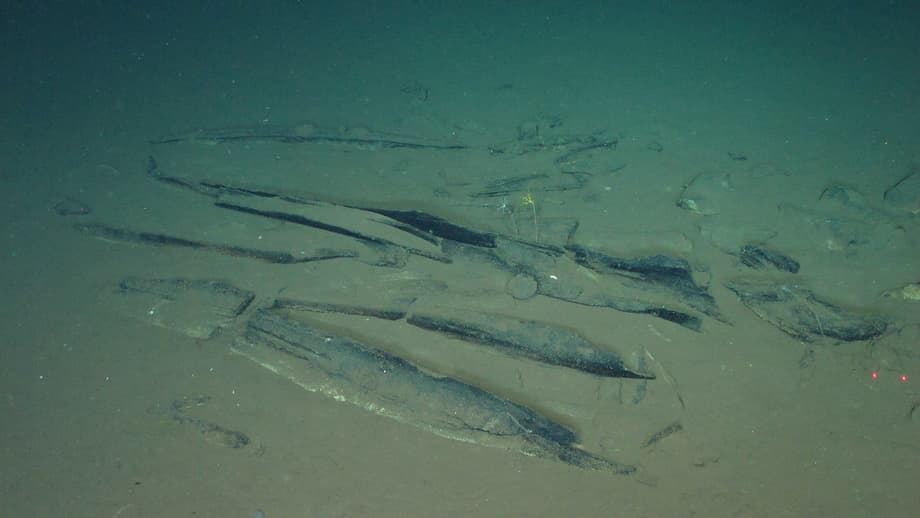
An Unprecedented Underwater Discovery
In the pitch-black depths of the southeastern Indian Ocean, a Chinese-led research team has uncovered a marvel that has astonished marine scientists around the world. Using the crewed submersible Fendouzhe, capable of descending to 11,000 meters, researchers mapped a vast underwater graveyard containing the remains of hundreds of whales, some of which have rested on the seabed for more than five million years. The discovery, published in the journal Nature, represents the deepest, oldest, and most extensive whale necropolis ever documented on Earth.
The expedition took place between February and March 2023, when the research vessel Tan Suo Yi Hao explored the Diamantina Zone, a remote fracture zone of underwater ridges and trenches located approximately 1,600 kilometers west of Australia. During an initial dive into the Dordrecht Deep, scientists first encountered whale fossils at a depth of 7,002 meters. What began as a puzzling observation quickly transformed into a month-long investigation involving 32 additional dives. The team eventually catalogued 485 whale-fossil sites and active whale falls stretching across an extraordinary distance along the seafloor.
Xiaotong Peng, deputy director of the Chinese Academy of Sciences Institute of Deep-sea Science and Engineering and lead author of the study, expressed profound surprise at the scale of the find. The researchers had set out to investigate biodiversity, ecosystems, pollution, and geological processes in the hadal zone, the deepest parts of the ocean between 6,000 and 11,000 meters. Instead, they encountered a fossil archive of unprecedented magnitude.
“Discovering a necropolis of this scale was completely unexpected. The size of distribution, the depth and the age range were far beyond anything we had imagined.”
The revelation has prompted excitement across the scientific community, with researchers comparing the significance of the site to previous landmark discoveries such as the first hydrothermal vents in 1977. The sheer number of remains promises to reshape understanding of deep-sea ecology and cetacean evolution over geological time scales.
A Graveyard Stretching Across the Abyss
The newly discovered necropolis extends approximately 1,200 kilometers along the seafloor, making it not merely a localized anomaly but a sprawling paleontological supercorridor. Located at depths ranging from 4,200 to 7,002 meters, the site pushes far past the hadal zone boundary, which begins at 6,000 meters below the surface. Previous whale-fall records were largely limited to depths of less than 4,000 meters, with the deepest known example prior to this discovery sitting at 4,204 meters. The Diamantina Zone findings extend the known depth range for these ecosystems by more than 2,500 meters, establishing one of the deepest known whale-fall habitats in the ocean.
Researchers identified 476 fossilized whale remains alongside five recently deceased carcasses in advanced stages of decomposition. Based on systematic extrapolation from survey data, the team estimates that the area could harbor between seven and eight modern carcasses and roughly 750 fossils per square kilometer. Some projections suggest that more than 10 million whale carcasses may lie scattered across the broader region, representing approximately 6.7 million tonnes of sequestered carbon that continues to fuel deep-sea life.
Nick Pyenson, curator of fossil marine mammals at the Smithsonian National Museum of Natural History, commented on the extraordinary scope of the site.
“It covers over 1,200 kilometers, which just defies belief.”
Jon Copley, professor of ocean exploration at the University of Southampton, noted that finding nearly 800 skeletons per square kilometer was a genuine surprise. He explained that whale falls typically function as isolated habitats for deep-sea animals, yet this concentration suggested something unique about the geography and oceanography of the region. Stephen J Godfrey of the Calvert Marine Museum described the graveyard as a truly unique discovery, writing that the research reminded him of a trailer for the first in a series of epic movies.
Life After Death in the Deep
When a whale dies and sinks to the ocean floor, its body initiates one of the most remarkable ecological phenomena in marine biology. Known as a whale fall, the carcass becomes an oasis of life in an environment where food is otherwise scarce. The Diamantina Zone discovery includes five active whale falls currently teeming with organisms that depend entirely on these decaying remains. These active sites are in the sulfophilic stage, where bacteria break down lipids inside the bones and release sulfur compounds that sustain specialized communities of invertebrates.
The research team observed dense, whitish microbial mats covering the bones, along with bone-boring Osedax worms, brittle stars, jellyfish, bivalve mollusks, crustaceans, and cnidarians. Many of these creatures may represent species previously unknown to science. Densities of some organisms reached up to 2,800 individuals per square meter, creating vibrant ecosystems on an otherwise dark and cold ocean floor. Peng Zhou, a deep-sea geologist at the Chinese Academy of Sciences, described the experience of witnessing these communities firsthand.
“The vibrant ecosystems we saw offered a completely different perspective on this otherwise dark and cold ocean floor.”
Whale falls progress through four recognized stages. First, large scavengers such as hagfish and sleeper sharks consume the soft tissues over a period of months. Second, smaller organisms colonize the bones and surrounding sediment during an enrichment phase that can last years. Third, the sulfophilic phase begins as bacteria decompose fats within the bones, generating chemicals that support mussels, worms, and other chemosynthetic organisms for decades. Finally, once all organic material is exhausted, the bare bones become a reef structure for filter feeders such as sponges and sea anemones.
Giovanni Bianucci, a paleontologist at the University of Pisa and co-author of the study, stressed the biological significance of these extreme communities.
“This discovery demonstrates that these extreme and unexplored environments are home to species and ecosystems still unknown to science, and that we are therefore still far from understanding the true biodiversity of our planet.”
Fossils That Rewrite Evolutionary History
Among the 43 fossil specimens collected by the Fendouzhe submersible using robotic arms, researchers identified remains from five beaked whale species and one baleen whale species. The fossils ranged in age from approximately 120,000 years to 5.26 million years old, with isotopic dating of strontium in the bones confirming that whale falls have occurred in this region since at least the Early Pliocene epoch. This timeline offers a continuous window into cetacean history spanning millions of years.
The oldest fossil belonged to an extinct beaked whale in the Pterocetus genus, dated to about 5.3 million years ago. Another significant find represented an entirely new species, which the researchers formally named Pterocetus diamantinae in honor of the discovery site. Giovanni Bianucci noted that the skull fragments displayed sufficient anatomical differences from known species to justify the new classification. The discovery improves our understanding of the evolutionary history of beaked whales and helps clarify how this highly specialized group evolved over millions of years.
Beyond extinct species, the fossil record included remains from extant beaked whales such as Andrews beaked whale and the strap-toothed whale, demonstrating that certain lineages have occupied these deep waters for millions of years. A single fossil from a baleen whale, identified as belonging to the sei whale species, was also recovered among an assemblage dominated by beaked whales.
The largest active carcass discovered was an Antarctic minke whale measuring five meters in length, found at a depth of 5,610 meters. This finding was particularly notable because minke whales are filter feeding species that typically feed at shallower depths, while beaked whales are deep-diving hunters. The mixture of shallow-diving and deep-diving species among the remains presents a puzzle that scientists are still working to solve. Craig Smith, a whale fall expert at the University of Hawaii who was not involved in the study, called the vast number of fossil whale falls documented truly amazing and of major importance to understanding whale evolution and distributions over geologic time.
Why Did So Many Whales Gather Here?
The extraordinary concentration of whale remains in the Diamantina Zone raises a compelling question about how this graveyard formed. Researchers believe a combination of geographical, oceanographic, and biological factors created conditions perfect for accumulating carcasses over millions of years. The Diamantina Fracture Zone itself formed between 60 and 50 million years ago as the Australian and Antarctic continents separated, creating a complex landscape of ridges and trenches that would later influence ocean currents and migration paths.
The V-shaped topography of the zone appears to act like a natural funnel, channeling dead whales that sink through the water column toward the trench floor. This geological feature likely prevents carcasses from drifting away and instead concentrates them in specific areas where they can be buried and preserved. However, topography alone does not explain the sheer number of remains.
The area likely serves as both a migratory corridor and a prime foraging habitat. Filter-feeding whales such as Antarctic minkes may pass through the region during seasonal migrations, while deep-diving beaked whales hunt for squid in the surrounding waters. Some researchers hypothesize that beaked whales diving to extreme depths in this region may reach physiological limits, increasing their risk of fatal exhaustion or decompression sickness. Xikun Song, a marine biodiversity researcher at the Chinese Academy of Sciences, explained that deep-diving beaked whales exceeding 3,000 meters may encounter physical stresses that prove fatal.
Jon Copley suggested that the necropolis probably results from the area sitting on a migration route for filter-feeding species while also providing a hunting ground for beaked whales. These hunters may push extremely close to their physical limits as they dive into the fracture zone in pursuit of prey, occasionally failing to return to the surface. This combination of regular traffic and treacherous hunting conditions may have created the perfect conditions for mass accumulation over geological time.
The Secret to Five Million Years of Preservation
Finding bones on the seafloor is not unusual, but discovering fossils that have remained intact for more than five million years requires exceptional conditions. The Diamantina Zone provides a rare combination of factors that have protected these remains from the usual processes of decay and destruction. The most significant factor involves the unusual anatomy of beaked whales themselves. These animals possess extremely dense rostra, or snouts, that are rich in minerals and physically resistant to degradation. Xiaotong Peng compared this bone density to armor, noting that the dense structure makes the bones less palatable to bone-boring organisms and more durable under extreme pressure.
Environmental conditions in the Diamantina Zone also play a critical role. Sedimentation rates in the region are extraordinarily low, with only 0.05 to 0.55 millimeters of material deposited per thousand years over the past five million years. This slow burial means the fossils were not quickly smothered by sediment that might crush or obscure them. Instead, they remained exposed long enough to develop protective coatings of ferromanganese oxides, which seal the bones from the surrounding environment and create natural sarcophagi.
The deep-sea environment itself contributes to preservation. Cold temperatures and stable chemical conditions minimize physical and chemical weathering. Without the fluctuations in temperature and chemistry found in shallower waters, the bones undergo very little erosion. As a result, the fossils have escaped being eaten or dissolved for over five million years, creating a continuous record of whale life and death that stretches back to the Pliocene.
What This Discovery Means for Science and Conservation
Beyond its value as a paleontological treasure, the Diamantina necropolis carries profound weight for how scientists understand deep-sea biodiversity and evolution. The study authors wrote that their findings reshape the understanding of the limits and biogeography of whale-fall ecosystems. By establishing that these communities can thrive at depths exceeding 6,700 meters, the research extends the known environmental boundaries for chemosynthetic life and suggests that comparable hidden archives may be widespread in the global deep oceans.
Whale falls appear to function as evolutionary hotspots and biogeographic stepping stones for sulfide-dependent fauna, potentially connecting distant deep-sea communities that would otherwise remain isolated. Some of the animals observed at the site also inhabit hydrothermal vents and cold seeps, suggesting that whale carcasses may help bridge these disparate ecosystems across vast distances. The carbon locked within the estimated millions of carcasses, roughly 6.7 million tonnes, highlights the role of whale falls in deep-sea carbon cycling.
The discovery also raises important conservation questions. Xikun Song noted that sea trenches face increasing threats from pollution and human activity, even at extreme depths. He argued that establishing marine protected areas in trench ecosystems should be considered to preserve the last frontiers of our planet and their unique evolutionary heritage. Professor Peng suggested that similar whale necropolises probably exist in other habitats central to beaked whales, meaning future expeditions could uncover additional sites of comparable importance.
With so many new species likely awaiting description and the potential for further fossils hidden beneath the sediment, the Diamantina Zone has cemented its place as one of the most significant marine discoveries in recent decades. Researchers expect that continued exploration of this underwater archive will yield insights into ancient climates, shifting ocean currents, and the extended evolution of marine mammals across vast time scales.
Key Points
- Chinese researchers discovered a massive whale graveyard in the Diamantina Zone of the Indian Ocean, extending 1,200 kilometers at depths up to 7,002 meters.
- The site contains 485 whale-fossil sites and active whale falls, with remains dating back at least 5.3 million years to the Early Pliocene epoch.
- Five active whale falls host diverse deep-sea communities, including bone-eating worms, brittle stars, and mollusks, many potentially representing new species.
- Researchers identified a new extinct beaked whale species, Pterocetus diamantinae, alongside fossils from both extinct and living whale lineages.
- The concentration of remains likely results from the V-shaped topography funneling carcasses and the area serving as both a migration corridor and deep-foraging habitat.
- Exceptional preservation stems from extremely dense whale bones, minimal sedimentation, ferromanganese oxide coatings, and stable deep-sea conditions.
- The findings extend the known depth range for whale-fall ecosystems by over 2,500 meters and establish deep-sea floors as major archives for tracing cetacean evolution.