A shoreline covered in living pink
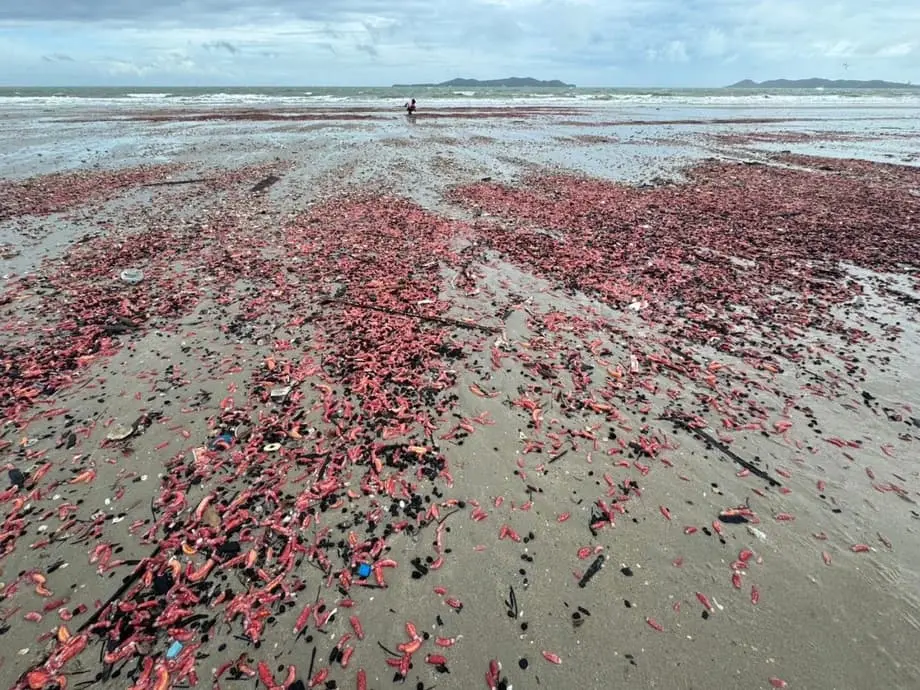
Millions of pink sea cucumbers washed ashore at Suan Son Beach in Thailand's Rayong province on June 6, 2026, covering hundreds of meters of coastline after powerful overnight storms. Marine officials identified the animals as Cercodemas anceps and attributed the extraordinary scene to strong monsoon winds, rough seas and waves that swept them from the seabed.
Contents
- A shoreline covered in living pink
- What happened on June 6?
- The animals behind the color
- How waves reached the seabed
- An urgent government investigation
- What officials said about pollution
- Why sea cucumbers matter beneath the waves
- Visitors urged to leave the animals alone
- A local event draws international attention
- Monitoring the beach and the seabed
- Key Points
Tourists reported the unusual sight at about 10:00 AM in Phe subdistrict, within Mueang Rayong district on Thailand's eastern seaboard. The normally golden sand appeared to have changed color beneath a dense layer of small, cylindrical creatures ranging from pink to reddish orange.
The animals were reportedly still alive. Officials expected many to return to the sea as high tides rose over the following days, while authorities began investigating whether the mass stranding posed an environmental threat.
Local residents initially expressed concern, and the vivid shoreline quickly attracted curious visitors. Close inspection revealed that the color came from marine animals rather than paint or pollution. Photographs and videos circulated on social media within hours, bringing scientific interest and public attention to a species that usually lives out of sight beneath the waves.
Thailand's Department of Marine and Coastal Resources said its preliminary assessment found no evidence of pollution, chemical contamination or harmful algal blooms contributing to the event. Authorities nevertheless advised people to avoid touching the stranded animals because some sea cucumbers release defensive substances that can irritate skin.
The scale made this stranding exceptional. Individual sea cucumbers sometimes wash ashore during severe weather, but officials said they had never documented this species appearing in such large numbers along this stretch of Rayong's coast.
What happened on June 6?
Suan Son Beach became a temporary natural attraction as visitors discovered that the pink covering consisted of countless small marine animals. The dense accumulation gave the impression that the sand itself had turned pink, drawing tourists who wanted to see and photograph the unusual scene.
Marine biologists and coastal resource officers were sent to examine the beach and identify the creatures. Their immediate task was to determine what had brought the animals ashore and whether conditions in the surrounding sea were abnormal.
The sequence described by officials and beachgoers was:
- In the days before June 6, strong winds, heavy swells and unsettled weather affected the eastern Gulf of Thailand.
- Overnight storms before the morning discovery generated powerful waves that disturbed the seabed and carried marine animals toward shore.
- At about 10:00 AM on June 6, tourists reported the dense pink and reddish orange covering at Suan Son Beach.
- Within hours, photographs and videos spread across social media as authorities arranged a scientific assessment.
- After the preliminary survey, officials announced continued monitoring and expected rising tides over subsequent days to return many living animals to the sea.
Visitors largely responded with curiosity and wonder rather than panic. The sight also prompted a government response, with the Ministry of Natural Resources and Environment ordering an urgent investigation into the unusual beachfront phenomenon.
The animals behind the color
Cercodemas anceps is commonly called the pink sea cucumber, pink warty sea cucumber or pink spiny sea cucumber. It belongs to Holothuroidea, a class of marine invertebrates containing approximately 1,700 species worldwide. An invertebrate is an animal without a backbone.
Sea cucumbers are animals despite their vegetable name. Their soft, elongated bodies resemble cucumbers or sausages, and the pink species generally measures several centimeters in length. Small bumps or spines give its skin a textured surface, while its color ranges from bright bubblegum pink to dark reddish orange.
Cercodemas anceps occurs in coastal waters across the Indo-Pacific region, including the Gulf of Thailand. It favors relatively shallow water, where organic material collects on the seafloor and provides food.
Marine officials described these animals as benthic organisms, meaning they live on or just beneath the seabed. They burrow through sand or mud in search of food and move slowly using tiny tube feet. Their usual habitat and limited movement leave them particularly vulnerable when strong currents disturb the ocean floor.
Millions appearing together made familiar biological features suddenly visible on a striking scale. Officials stressed that a simultaneous stranding of this size was exceptionally unusual for Rayong, even though smaller numbers of sea cucumbers can be carried onto beaches during severe weather.
How waves reached the seabed
Thanet Mannoi, director of the Marine and Coastal Resources Regional Office 1, explained that severe winds generated powerful waves whose effects reached down to the seabed. Those movements stirred sediment and created strong underwater currents, dislodging the slow moving animals from their muddy habitats.
The currents then transported the sea cucumbers toward land. Tidal movements pushed the concentrated animals onto the beach, where they became stranded as the water receded. The preliminary explanation connected the weather above the sea with the movement of animals on its floor.
The Department of Marine and Coastal Resources pointed to intense monsoon activity, rough seas and powerful wave action as the natural causes. Strong winds and heavy swells had disrupted normal marine conditions along the eastern Gulf of Thailand in the days leading up to June 6.
Shellfish, crabs and other animals that live on the seabed also wash ashore during monsoon periods or rough weather across Southeast Asia. Officials said the unusual feature at Suan Son was the enormous number of pink sea cucumbers involved.
Specific wind directions, wave intensity and tidal timing apparently worked together to concentrate the animals within a narrow coastal zone. That concentration helped produce the vivid covering seen by visitors, with hundreds of meters of beach appearing pink or reddish orange.
An urgent government investigation
Suchart Chomklin, Thailand's minister of natural resources and environment, ordered the Department of Marine and Coastal Resources to investigate urgently and verify the facts. He instructed the department's director general, Dr. Pinsak Suraswadi, to send specialized teams to Suan Son Beach immediately.
The minister asked officials to assess possible environmental effects and give the public accurate scientific information rather than speculation. The rapid response reflected both the scale of the stranding and concern among residents about what the sudden change in the beach might mean.
Thanet led a joint survey team of conservation officers, marine biologists and local Rayong marine resource officials. They assessed the scene, used biological classification methods to identify the species and collected data on the event.
The investigation examined whether the stranding posed lasting risks to regional biodiversity or pointed to broader changes in marine conditions. Biodiversity refers to the variety of living organisms in an area, including the different species that share a coastal habitat.
Following the preliminary evaluation, officials said the phenomenon did not threaten the marine ecosystem and described it as a rare natural occurrence caused by seasonal weather and the physical action of waves. Continuous monitoring had found no abnormal factors affecting the wider marine environment.
What officials said about pollution
The Department of Marine and Coastal Resources said investigators had found no evidence that pollution, chemical contamination or harmful algal blooms contributed to the stranding. That assessment addressed a central concern raised by the beach's sudden and dramatic change in appearance.
An unnamed department official described the continuing assessment and the findings at that stage:
The situation is currently being monitored and assessed continuously. So far, no information has been found indicating abnormal pollution or other factors affecting the marine ecosystem.
Marine biologists reported that the sea cucumbers on the beach were still alive and expected many to return naturally to the ocean when high tides rose over subsequent days. Their survival offered a reason to expect a temporary disruption rather than a catastrophe for the local population.
The final effect on the local Cercodemas anceps population and seabed ecology was still to be assessed. Authorities committed to further observation and data collection to examine possible delayed effects.
Why sea cucumbers matter beneath the waves
Sea cucumbers are often described by scientists as the housekeepers of the sea because of the work they do while feeding. They consume decaying organic material, dead microorganisms and other debris that accumulates on sandy seabeds.
The animals break down complex organic compounds as this material passes through their digestive systems, then excrete cleaner, oxygenated sand. Their feeding helps recycle nutrients into the water above the seabed, supporting phytoplankton and supplying resources used by other marine organisms.
Phytoplankton are tiny organisms that form part of the marine food supply. Nutrient recycling helps connect the material accumulating on the ocean floor with life in the surrounding water.
Sea cucumber activity also helps prevent toxic hydrogen sulfide from building up in sediments. By processing the seabed, the animals contribute to healthier habitats for fish, crabs and communities associated with coral reefs.
Research published in marine ecology journals has shown that sea cucumber populations influence both the chemical and physical structure of seafloor sediments. Where these animals thrive, the seabed stays more porous and aerated, benefiting burrowing species and helping maintain stable communities of organisms living on the bottom.
Cercodemas anceps and similar species consequently serve as indicators of general marine ecosystem health. At Suan Son, the mass displacement temporarily removed large numbers of these small nutrient processors from their usual habitat. Their ecological importance gave the event a meaning beyond its striking color.
Visitors urged to leave the animals alone
The Department of Marine and Coastal Resources advised tourists and local residents to avoid direct contact with the stranded sea cucumbers. Most sea cucumber species pose no danger to people, but some release defensive chemical secretions when stressed or disturbed.
Those substances can cause skin irritation, rashes or allergic reactions, particularly in people with sensitive skin. The warning accompanied the reassuring environmental assessment so that visitors could observe the event without unnecessary contact with the animals.
Officials encouraged anyone who saw large numbers of stranded marine animals or other unusual coastal conditions to contact the Forest and Marine Protection Hotline at 1362 or notify local authorities. Such reports help scientists track changes in marine ecosystems and respond quickly to possible environmental concerns.
Local communities, tourists and scientific institutions were also identified as important participants in gathering information. Clear communication channels can help authorities receive timely reports while limiting human interference with stranded wildlife.
The sight attracted crowds carrying smartphones, making public guidance particularly relevant. More visitors meant more opportunities to document the event, alongside greater pressure on the animals and the coastal habitat where people gathered.
A local event draws international attention
Photographs and videos of the pink shoreline spread beyond Thailand soon after the first sightings. International attention followed, reflecting widespread interest in unusual marine events and the biodiversity of Southeast Asian coastal waters.
Suan Son Beach became an impromptu tourist attraction as people arrived to witness the temporary pink covering. The dominant reaction was fascination, with visitors recording a natural event that few had seen before.
Officials and marine biologists used that attention to explain the ecological role of sea cucumbers. For people unfamiliar with these animals, the stranding made an otherwise hidden part of the ocean ecosystem visible and showed how weather above the waves can reshape conditions below them.
Social media expanded the reach of the event within hours. Images that began as records of a local discovery brought marine biodiversity to a worldwide audience, while the resulting interest drew more people toward the beach.
The public response carried responsibilities alongside the opportunity to learn. Authorities sought to keep scientific information circulating and reduce disturbance to delicate wildlife as crowds gathered to watch and photograph the animals.
Monitoring the beach and the seabed
State agencies committed to continued surveillance of Suan Son Beach and the wider Rayong coastal environment. Marine officials planned to collect more data on the precise causes of the stranding and any delayed effects on local sea cucumber populations or seabed ecology.
Following the area over time would help scientists assess whether similar events might become more frequent as regional weather patterns shift. The investigation also offered a case study of the relationship between extreme weather and communities of invertebrates living on the floor of the Gulf of Thailand.
The mass washup prompted discussion of coastal preparedness and rapid response procedures for unusual marine events. Authorities hoped stronger communication between beach visitors, local communities and scientific institutions would improve the collection of information as events unfolded.
For the ecosystem, officials expected a temporary disruption rather than a catastrophe. The animals were alive and capable of returning to the sea, so the eventual effect on the local Cercodemas anceps population could be small.
Continued monitoring remained part of that assessment. Scientists planned to examine both the conditions that brought millions of animals ashore and what happened to the population and its habitat afterward.
Key Points
- Millions of Cercodemas anceps washed ashore at Suan Son Beach in Phe subdistrict, Mueang Rayong district, on June 6, 2026.
- Tourists reported the sight at about 10:00 AM, with hundreds of meters of shoreline covered in pink and reddish orange animals.
- Marine officials attributed the stranding to monsoon winds, rough seas, currents and tidal movements that carried the animals from the seabed.
- Minister Suchart Chomklin ordered an urgent investigation, and the preliminary assessment found no evidence of pollution, chemical contamination or harmful algal blooms.
- The sea cucumbers were reportedly alive, and officials expected many to return to the ocean with rising tides.
- Sea cucumbers process organic debris, recycle nutrients and help maintain healthy seabed habitats.
- Visitors were advised to avoid touching the animals and report unusual coastal conditions to local authorities or hotline 1362.
- Authorities committed to continued monitoring of the beach, the local population and possible delayed ecological effects.