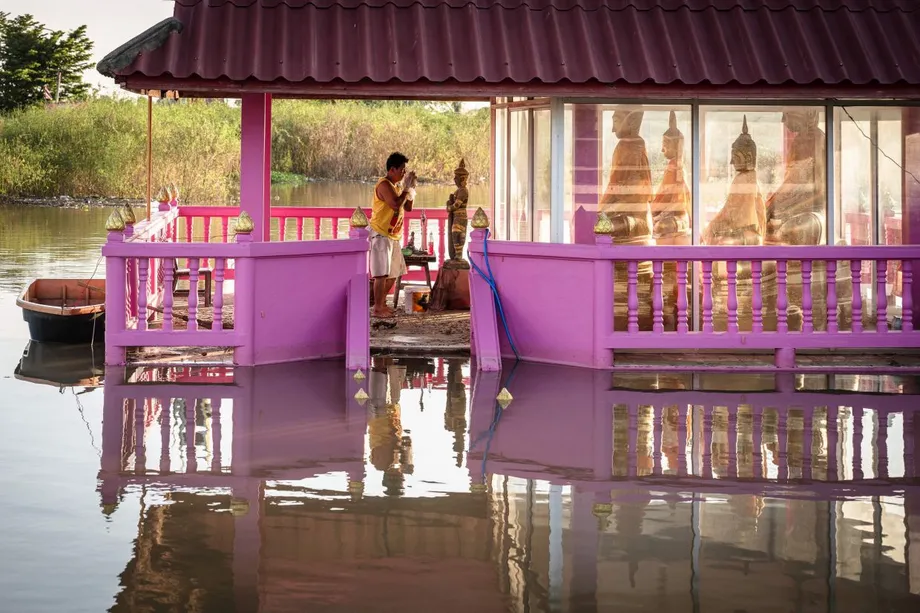
Homes raised above three metres are still flooding
Kamonchanok Sathaphonamonwut's home in Thailand's Ayutthaya province stands more than three metres above the ground. It is still not high enough. Floodwater has entered the house for six consecutive years, leaving her family of three sleeping on makeshift platforms, unable to use their waterlogged toilet and dependent on a boat to travel.
Contents
- Homes raised above three metres are still flooding
- Protection has concentrated the burden
- Why water arrives even after local rain stops
- Protests followed months of inundation
- Lower releases do not bring immediate relief
- Not every flooded neighbourhood was deliberately selected
- The cost of adapting falls on families
- A proposal to make protected areas contribute
- A diversion canal is expected by 2030
- Key Points
Her community is among the riverside settlements bearing the cost of efforts to protect Bangkok, Ayutthaya's historic centre and industrial areas along the Chao Phraya River. Embankments, gates and diversions have largely protected those economic centres, while some exposed villages endure deeper water that takes months to drain.
Kamonchanok, a resident whose family has already raised its house twice, described the limits of those adaptations:
Our area simply cannot cope with this much water anymore.
The pressure extends beyond one village. On November 7, 2025, about 300 residents gathered in Sena district to protest prolonged flooding and demand changes to water management. A report dated November 8 described parts of Ayutthaya as inundated for more than three months, with river overflows affecting Sena, Bang Ban and Phak Hai since May.
A separate Monday update from the Department of Disaster Prevention and Mitigation put the number affected by continuing flooding in parts of Bangkok and 20 provinces at 2.46 million. That update does not establish a calendar date, so it should not be treated as a direct measure of conditions on November 8.
Protection has concentrated the burden
After Thailand's devastating 2011 floods, the government expanded embankments, water gates and other infrastructure to steer water away from the capital, the historic city of Ayutthaya and industrial zones. The defences reduced exposure in those protected areas, but residents outside them say their communities have been neglected.
Environmental conservationist Sasin Chalermlarp argues that floodwater which once spread across much of Ayutthaya is now concentrated in just 5 to 10 per cent of the province. That is his assessment, rather than a measured provincial figure released by irrigation authorities. It nevertheless describes the central dispute: successful protection in one place can leave a smaller area carrying a heavier burden.
About 20 kilometres from Ayutthaya's centuries old temple ruins, residents describe floods that once reached their knees now rising above their heads in some locations. Some homes have been abandoned; others have been submerged up to their roofs.
Sasin credits the government with managing floods effectively across the central plains, while calling the consequences cruel for people in the areas receiving the water. The distinction is between reducing damage across a river basin and making life tolerable for the households absorbing the remaining floodwater.
Why water arrives even after local rain stops
Ayutthaya sits on a low, flat floodplain downstream in the Chao Phraya basin. Rain falling farther north enters rivers and tributaries, then moves south toward the province, Bangkok and the Gulf of Thailand. A dry day in Ayutthaya therefore does not mean its rivers will stop rising.
The Chao Phraya Dam and barrage in Chai Nat control and distribute flows upstream of Ayutthaya. Adjusting the amount of water passing through affects downstream levels, but cannot eliminate the runoff entering the basin. Officials must balance the water accumulating upstream against the capacity of rivers, canals and floodplains below.
Flat terrain also slows drainage. When a river is higher than a nearby canal or flooded field, water cannot simply flow back into it. Gates and pumps may be needed, and repeated rainfall leaves less room for new water to soak into the ground.
Royal Irrigation Department spokesman Thanet Somboon has identified climate change, the area's low elevation and recently built embankments that changed the river's natural flow as contributors to more severe downstream flooding. He said a release at the same rate as in the past can now have a greater impact. Once diversion channels are full, remaining water has to continue downstream.
Protests followed months of inundation
The November 2025 protests brought those operating decisions into public view. Residents gathering in Sena asked the Royal Irrigation Department to reconsider discharge rates and speed up measures to relieve their hardship. Some affected families had left their homes and were sheltering along roadsides.
Officials were also responding to warnings about Storm Kalmaegi. The irrigation department increased discharge at the Chao Phraya barrage in Chai Nat, with downstream river levels expected to rise by 60 to 90 centimetres. For a household already living close to the waterline, such an increase can remove the remaining dry space.
The sequence of events shows how planned diversions and infrastructure damage affected communities at the same time:
- Since May 2025: River overflows affected Sena, Bang Ban and Phak Hai districts.
- November 6: The Department of Disaster Prevention and Mitigation warned of possible flooding across much of Thailand because of Storm Kalmaegi.
- November 7: About 300 residents protested in Sena, calling for discharge decisions to be reconsidered.
- Late November 7: A floodgate at Khlong Ta Nguen in Bang Ban subsided, allowing water into nearby areas and a community in Phak Hai.
- November 8: Authorities continued drainage work and efforts to seal breached barriers as the river rose.
Officials opened gates at Khlong Kamonchin and Chao Chet to redirect water toward other designated areas. Water reportedly receded slightly in some places after more flowed through the damaged Khlong Ta Nguen gate. That local relief did not mean the failure was harmless: the same opening allowed flooding elsewhere.
Lower releases do not bring immediate relief
In the separate Monday update, deputy government spokeswoman Lalida Persvivatana said discharge at the Chao Phraya barrage had been reduced from 2,000 to 1,900 cubic metres per second. That is a reduction of 100 cubic metres per second, or 5 per cent.
The irrigation department spokesman, whose name was rendered Thanes Somboon in that update, said the slower release should reduce downstream flood levels. The affected river corridor includes Chai Nat, Sing Buri, Ang Thong, Ayutthaya, Nonthaburi, Pathum Thani, Samut Prakan and Bangkok.
Disaster prevention department director general Nirat Pongsitthithaworn attributed the flooding to accumulated heavy rainfall and runoff from the North. The department described falling water in Ayutthaya and several other central provinces, but stable conditions elsewhere and rising levels in Phetchaburi.
Those differences matter. A lower barrage release does not drain every flooded community at once, and a falling river does not mean a house is habitable again. Water may remain trapped behind roads or embankments, while receiving waterways remain too high for drainage.
Other basins faced different constraints. High tides slowed drainage from the Bang Pakong River in Chachoengsao, prompting deployment of boats designed to propel water downstream. Irrigation authorities also reduced releases from Kaeng Krachan dam to limit flooding in central Phetchaburi. These measures address separate waterways, rather than a single national flood moving uniformly toward the sea.
Not every flooded neighbourhood was deliberately selected
Some low areas hold water temporarily or carry it along managed routes, reducing pressure farther downstream, including around Bangkok. That does not mean every flooded property was deliberately chosen for inundation. River overflows, local rain, damaged barriers and limited drainage can all contribute.
Flood exposure also varies within districts. Vulnerable areas exist in Sena, Phak Hai, Bang Ban, Phra Nakhon Si Ayutthaya, Bang Pa-in and Bang Sai, but not every neighbourhood in those districts floods together or to the same depth.
A home's ground elevation, its proximity to a river or canal, the position of nearby embankments and the condition of drainage routes all affect its risk. A raised road can remain usable while nearby houses flood; a building can remain dry while its only access route disappears beneath the water.
The 2011 disaster is a benchmark for an exceptional basinwide event, rather than a description of an ordinary year. A World Bank assessment recorded more than 13 million people affected nationwide. An unusually high flood peak at Nakhon Sawan illustrated how intense upstream rainfall could translate into prolonged damage farther south. Today's village complaints concern repeated exposure as well as the threat of another exceptional disaster.
The cost of adapting falls on families
Raising a house has become a recurring expense rather than a permanent solution. Residents estimate costs ranging from 100,000 to one million baht, depending on the building's size and how far it must be lifted. Some families have paid for the work twice within a few years, using savings and taking on debt.
Kamonchanok's family raised its home twice in the 1990s, lifting it another 1.5 metres on the second occasion. Water reached the house in 2011 and has entered it during each of the past six consecutive years. She now hoists appliances and possessions above the waterline while travelling by boat.
Describing what repeated flooding has left her household able to do, Kamonchanok said:
All we can do is deal with the consequences. There's only so much we can do to adapt.
Sawong Raksri, an 87 year old resident, has spent more than one million baht raising her home. Her response conveys resignation rather than confidence that the investment will end the problem:
It floods like this every year recently. What's the point of complaining?
These expenses do not address every loss. A higher floor cannot by itself restore a flooded toilet, make a submerged road usable or shorten the months needed for surrounding water to drain.
A proposal to make protected areas contribute
Sasin has proposed a tax on people who benefit from flood defences, with the proceeds used to help affected families raise their homes and repair damage. His argument is that communities accommodating floodwater provide a benefit to places that remain dry, and should receive support for doing so.
The proposal is not an adopted policy. Thanet said it warranted further study to determine how to assist people who sacrifice their land to accommodate water. No tax rate, collection mechanism, eligibility rules or implementation date has been announced in the accounts of the proposal.
Thanet also said officials may need to review infrastructure to keep floodwater within intended limits. That acknowledgement connects household complaints with the design and operation of the defences, rather than treating house raising as the only response.
Kamonchanok's community is not demanding that intentional flooding end entirely. Its request is more specific: cap water levels and provide financial help to people whose homes sit below the flood line. The distinction leaves room for flood retention while seeking limits on the damage residents must absorb.
A diversion canal is expected by 2030
The government's main infrastructure response is a US$780 million diversion canal designed to carry 1,200 cubic metres of water per second around the bottleneck where the Chao Phraya narrows through Ayutthaya. Completion is expected by 2030.
The capacity describes a volume of water passing each second, not a promised reduction in flood depth at an individual home. Whether a village benefits will depend on how the canal connects with the river, how it is operated and how much water arrives during a particular flood.
The canal's stated purpose is to bypass a constrained river reach. Its projected completion date does not settle the immediate questions of household support, acceptable water levels or how existing gates and embankments should be managed before it opens. No earlier completion date or firm deadline for deciding the proposed tax has been identified.
Kamonchanok framed her request around the ability to remain in her own home, rather than a demand that her community never receive floodwater:
All we're asking for is to be able to live comfortably in our own homes. Why can't they give us that?
Key Points
- Some Ayutthaya villages face deeper, prolonged flooding while defences protect Bangkok, historic areas and industrial centres.
- About 300 residents protested in Sena on November 7, 2025, after months of inundation.
- A separate disaster department update reported 2.46 million people affected in parts of Bangkok and 20 provinces.
- Residents estimate that raising a house costs between 100,000 and one million baht, with some families paying repeatedly.
- A proposed tax on beneficiaries of flood protection has not been adopted.
- A US$780 million diversion canal, designed for 1,200 cubic metres per second, is expected to be completed by 2030.