One sampling point records 114,860 milligrams per litre
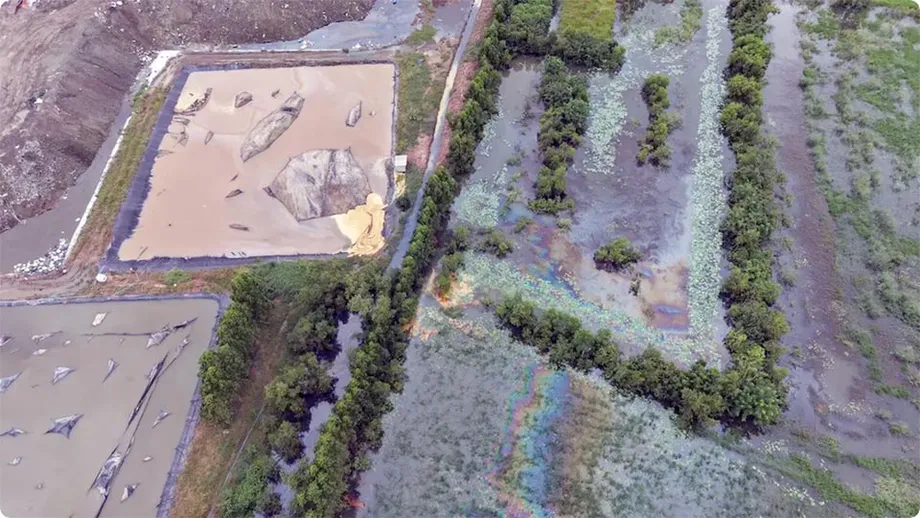
Water collected about 65 metres from a leaking embankment near an industrial waste landfill in Hua Wa, Si Maha Phot district, Prachin Buri, contained petroleum hydrocarbons at a reported concentration of 114,860 milligrams per litre. Two other samples, taken approximately 435 and 850 metres away, each recorded less than 3 milligrams per litre, revealing a sharp difference between the three locations.
Contents
- One sampling point records 114,860 milligrams per litre
- What the three water samples show
- Health screening finds exposure risks, not confirmed poisoning
- How the response moved from repairs to suspension
- Which operations are under investigation?
- Oil recovery continues while floodwater limits access
- Why reassurance about the oil needs limits
- Residents fear for groundwater and rice fields
- What residents are advised to avoid
- Sediment tests and legal decisions are still pending
- Key Points
The results from Environmental and Pollution Control Office 7 in Saraburi confirm substantial petroleum contamination at the nearest downstream sampling point. They do not establish that floodwater across the district has the same concentration, or that more distant water sources are safe for every use.
The investigation centres on Green Environment Technology Co., Ltd., where officials identified traces of liquid draining from industrial waste disposal and treatment areas into surrounding floodwater. The Department of Industrial Works ordered operations stopped and suspended incoming industrial waste while corrective work proceeds.
A separate health investigation has already screened 73 residents across eight community locations. Thailand's Department of Disease Control classified 34 as having high exposure risk, although it found no emergency patients. Urine samples from 11 people in that group were collected for arsenic and cadmium testing.
The combined findings make this more than a question of removing a visible oil film. Authorities must establish where contamination travelled, whether community water supplies were affected, and what remains in soil and sediment after the floods recede. The reported dates use Thailand's Buddhist calendar year 2569, equivalent to 2026.
What the three water samples show
Petroleum hydrocarbons are a broad group of chemicals associated with petroleum products, including oils and fuels. A measurement for the group indicates petroleum contamination, but does not by itself identify every chemical present or provide a complete assessment of health risk.
The three samples contained the following reported concentrations. All figures are in milligrams per litre:
- Point 1, about 65 metres away: petroleum hydrocarbons 114,860; iron 0.98; aluminium 1.146; barium 0.041; copper 0.01.
- Point 2, about 435 metres away: petroleum hydrocarbons below 3; iron 1.0; aluminium 1.294; barium 0.038; copper below 0.01.
- Point 3, about 850 metres away: petroleum hydrocarbons below 3; iron 0.70; aluminium below 0.5; barium 0.051; copper below 0.01.
The petroleum result at Point 1 is more than 38,000 times the reporting threshold of 3 milligrams per litre used for the other two points. This is a comparison with that threshold, not an exact ratio between measured concentrations, because the actual values at Points 2 and 3 were not specified.
A report dated October 12 described high contamination within 10 metres of the factory and conditions at 300 metres as within criteria considered not to cause an impact. Those distances differ from the 65, 435 and 850 metres recorded for the three detailed samples. Without matching sampling maps, dates, substances and comparison standards, the accounts cannot be treated as a single survey or used to draw a firm safety boundary.
Health screening finds exposure risks, not confirmed poisoning
The Department of Disease Control's October 8 statement, drawing on its Emergency Operations Center, describes a response to reports of landfill overflow and a rainbow sheen extending more than 3 kilometres along waterways near farmland and communities.
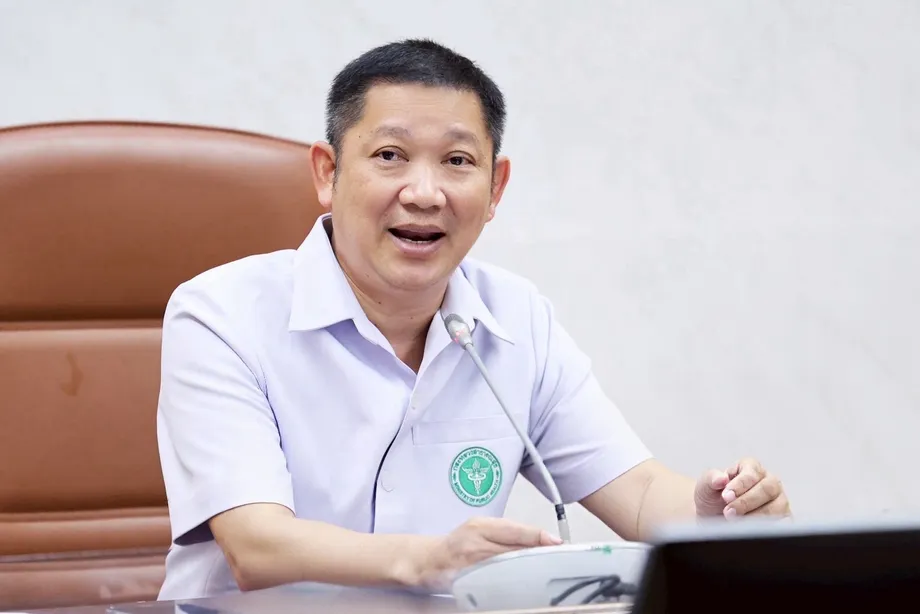
Director General Dr Montien Kanasawat described the field operation on October 6. Teams interviewed 73 residents at eight community locations and assigned 34 to the high risk category, 23 to moderate risk and 16 to low risk under the department's ASDR assessment criteria. The high risk group represented about 47% of those screened.
These are risk classifications, not diagnoses of chemical poisoning. The department reported no emergency patients, but that finding does not answer whether residents experienced exposure that requires follow up. Urine testing for total arsenic and cadmium in 11 people was intended to help assess exposure to those substances. The statement did not give the laboratory results.
Air was also checked at six locations for seven chemicals: hydrogen sulfide, 1,3-butadiene, benzene, toluene, ethylbenzene, xylene and styrene. Preliminary concentrations were too low for the equipment to detect. That finding concerns the substances, locations and times tested. It does not establish that contaminated water or sediment poses no risk.
The health statement described the overflow location as a hazardous waste landfill. Several industrial inspection accounts described the relevant landfill operation as handling waste that was not hazardous, while another described its licence more broadly. These descriptions differ, making the actual permits and waste acceptance records important to the investigation.
How the response moved from repairs to suspension
The public record shows an escalation from complaints and corrective orders to suspension of factory operations. Reports differ on whether the suspension should be dated October 5 or October 6: some describe an order issued on October 5, while accounts published on October 6 announce or describe the shutdown.
- September 29: the Ecological Alert and Recovery Thailand foundation circulated aerial photographs of a rainbow film on floodwater and raised concerns about a possible connection to the landfill.
- October 2: provincial industrial officials issued a corrective order under Section 37, paragraph one, of the Factory Act B.E. 2535 (1992). Police also recorded a report concerning traces of used lubricating oil and solvents.
- October 4: Deputy Governor Chanathip Khokmanee chaired a provincial meeting with agencies and affected residents.
- October 5 and 6: accounts described the suspension of all operations under Section 39, paragraph one, alongside containment work and preparations for legal proceedings.
- October 8: the Department of Disease Control published its health screening and preliminary air monitoring findings.
- October 10: officials inspected a separate recycling company in Kabin Buri district.
- October 12: updates described vacuum recovery of oil outside Green Environment Technology and enforcement action at the separate recycling facility.
Before the suspension, residents had challenged the use of a corrective order alone. Provincial industry official Apirak Amsuriya explained that Section 37 allowed instructions to repair or improve a factory, while Section 39 suspension powers required action through the relevant ministry authority.
Which operations are under investigation?
Green Environment Technology held permissions for factory categories 105 and 106. Inspection accounts described category 105 operations as sorting and landfilling discarded materials or waste that was not hazardous.
The category 106 operation processed used lubricating oils or solvents into alternative or blended fuels. Its activities also included repairing and washing containers, shredding electronic components, and making concrete blocks and paving blocks from discarded materials described as not hazardous.
General Nakrob Boonbuathong, head of the industry's Top Gun special operation team, said floodwater inside the premises stood approximately 3 metres above the surrounding rice field level. That is a reported difference in water elevation, not necessarily a uniform flood depth throughout the factory.
Officials first used Section 35(4) of the Factory Act to require an explanation of factory conditions and measures to prevent contaminated drainage. The Section 37 order then required landfill pits to be covered and contamination inside and outside the premises to be investigated and addressed. The later Section 39 order stopped all operations pending improvements.
After the aerial photographs appeared, the company said agency tests had not yet confirmed the allegations and asked for assumptions to be distinguished from facts. Subsequent inspection findings and water results provide evidence for the investigation, but a suspension order is not a court finding of criminal liability.
Oil recovery continues while floodwater limits access
Nontanat Bunnag, spokesperson for the Top Gun team, described a response in three stages: contain the spread immediately, inspect affected areas when water levels fall, and coordinate restoration.
The immediate measures included floating oil booms, absorbent pads and sandbag barriers around suspected release points. Teams also used surfactants, chemicals that change how oil and water interact, as part of the reported collection process. Used absorbent materials were to be recovered for proper disposal.
Industry Minister Varawut Silpa-archa said excavators built an earth barrier behind the factory and sandbags were placed around recycling areas to restrict further leakage. Covering pits and waste piles was intended to prevent rain and floodwater from washing additional material out.
An October 12 update said vacuum pumping equipment had been installed to remove oil floating outside the factory. The update did not state the quantity recovered or provide results confirming that the surrounding water had been restored to safe conditions.
Varawut acknowledged that high water prevented access to some locations. Orders also called for improvements to wastewater treatment and storage of raw materials and waste. Department of Industrial Works Director General Pornyot Klankrong said incoming industrial waste would remain suspended until all required corrective work was completed.
Why reassurance about the oil needs limits
Varawut said preliminary analysis identified oil and found no other toxic substances mixed into it. Health officials nevertheless called for monitoring of solvents, metals and other chemicals that could be associated with waste handling activities.
These positions need to be distinguished carefully. A preliminary finding about the oil samples tested is narrower than a conclusion that every affected waterway is free of harmful substances. The detailed water results identify petroleum hydrocarbons and several metals, but do not include comparison standards sufficient to judge every concentration or intended water use.
Dr Thiti Sawaengtham, director general of the Department of Health, identified benzene and toluene as possible chemicals associated with used oils and solvents. He also named cadmium, lead, mercury and chromium as metals requiring attention, particularly where electronic waste is handled. Acids, alkalis and other corrosive chemicals were additional concerns.
Those warnings identify substances to investigate, not proof that each has been detected in this incident. Benzene carries a cancer risk, while exposure to certain solvents can affect the nervous system. Actual risk depends on the chemical, its concentration, how a person encounters it and the duration of exposure.
Professor Siwatt Pongpiachan, director of NIDA's disaster prevention and management research centre, argued that unusual colour and smell are warning signs rather than reliable measures of chemical identity, concentration or origin. He called for repeated testing and publication of sampling locations, results and the standards used for comparison.
Residents fear for groundwater and rice fields
Community concerns extend beyond the visible slick. Sunthorn Koonwat, a resident of Ban Hua Sa whose home was reported to be about 1.9 kilometres from the waste site, said the community relied on groundwater through a local water supply system rather than the Provincial Waterworks Authority network. Flooding of several supply wells raised concerns about water used in homes.
He described recurring illness in his young son and respiratory complaints among some children, while acknowledging that residents could not confirm a direct link to factory pollution. Other residents reported itching, rashes and red bumps after entering flooded agricultural areas. These accounts call for medical assessment, but do not establish a chemical cause.
Sumalee Anthaphit, a resident of Sa Makhuea village in nearby Si Mahosot district, described skin symptoms after working in rice fields and fears for local livelihoods. In remarks translated from Thai, she said:
Prachin Buri is not a dumping ground for the world's waste. Prachin Buri is where we make a living. There are fruits, rice, fields, fish, everything to sustain the people of Prachin Buri.
Sunthorn Khomkhai of the Prachin Strong network also said residents opposed a proposed capacity increase of 500,000 tonnes. The reported figure did not specify a time period, so it should not be read as annual capacity. He described complaints about odours over approximately three years.
The dispute also included an alleged confrontation. Network member Sumet Rianphongnam said a masked man pushed him and raised a fist outside the factory at about 4 p.m. on October 5. He reported no injury. The account does not establish the man's identity or any company responsibility.
What residents are advised to avoid
Dr Montien urged residents not to swim in suspected contaminated water or use it for bathing or cooking without appropriate treatment. The Department of Disease Control also advised against catching, preparing or eating aquatic animals from potentially contaminated standing floodwater.
People should avoid prolonged contact with suspicious water and sediment. Where entry into flooded areas is unavoidable, health officials recommended protective equipment such as rubber boots, followed by washing with soap. Skin irritation, stinging eyes, nausea, vomiting, dizziness or breathing problems should prompt medical attention and disclosure of the exposure history.
The Department of Health urged particular attention to children, older people, pregnant women and people with chronic illnesses. It advised leaving areas with strong chemical smells for a place with good ventilation, and withholding use of potentially affected natural water sources, groundwater and floodwater for household activities or farming until laboratory testing confirms safety.
Boiling or adding disinfectant can address some biological hazards, but does not remove heavy metals and most chemical contaminants. Ordinary filtration should not be assumed to make chemically contaminated water safe. Local authorities were urged to provide clean drinking water and water for household use while testing proceeds.
Reports described mobile medical teams being proposed and later formed with provincial health services. Residents can seek health information through the Department of Disease Control hotline at 1422. Suspected illegal wastewater discharge, waste dumping or factory odours can be reported to the Industry Ministry at 1564, available around the clock.
Sediment tests and legal decisions are still pending
The Pollution Control Department plans to work with the Department of Industrial Works to assess effects inside the factory and surrounding areas, then collect soil sediment samples after the water dries. This matters because a reduction in visible oil or water contamination does not necessarily show what has settled into fields, drains or household mud.
Siwatt cited studies from other floods to explain why testing must follow the water's route. A Hurricane Katrina model estimated added contamination in Lake Pontchartrain sediment at roughly ten times the amount under an ordinary rainwater drainage scenario, while noting that added metals were small compared with existing levels. The finding did not mean all pollution increased tenfold.
Research following Hurricane Florence examined soil at 12 North Carolina locations and found estimated cancer risks from certain petroleum related compounds above a screening level in some areas. Research in Zhanjiang Bay found copper and lead inputs increased by 127% and 136% after a typhoon. These examples explain possible movement and persistence of contaminants, not conditions proven in Prachin Buri.
Evidence gathering also needs a clear sampling record. Several accounts describe six factory investigation samples, four inside and two outside, sent to the Eastern Industrial Pollution Research and Warning Center. Another description places all six inside, although its detailed account gives the four and two split. These samples should not be confused with the three samples carrying the detailed petroleum results.
Officials were instructed to gather evidence and lodge a complaint with Si Maha Phot police. Broader enforcement included seizure of materials and machinery at G.K.C. Recycle Co., Ltd. in Bo Thong, Kabin Buri, after an October 10 inspection reportedly found several violations. That is a separate facility, with no established connection to the Hua Wa oil release.
Varawut also described proposed Factory Act changes to treat toxic releases as financial cases and seek asset seizure cooperation from the Anti Money Laundering Office. This was a proposal under consideration, not a completed amendment or announced asset seizure against Green Environment Technology.
The contamination response is occurring amid a wider flood emergency affecting 55,286 households across seven declared disaster districts. Nine deaths were attributed to drowning or electrocution, not chemical exposure. No firm dates have been announced for release of the urine results, completion of sediment testing, reopening of the factory or a court hearing.
Key Points
- A sample about 65 metres from a leaking landfill embankment contained petroleum hydrocarbons at a reported 114,860 milligrams per litre.
- Two samples about 435 and 850 metres away each recorded below 3 milligrams per litre.
- Green Environment Technology was ordered to suspend operations and stop accepting industrial waste pending corrective work.
- Health teams screened 73 residents, classified 34 as high risk and collected urine from 11 for arsenic and cadmium testing.
- Preliminary air readings were below equipment detection limits, but water and sediment safety require separate assessment.
- Oil recovery, evidence gathering and plans for sediment testing continue. Several laboratory results and legal decisions remain unannounced.