Two constitutional powers, one displaced government
Governor Faisal Karim Kundi is administering Khyber Pakhtunkhwa with an 11 member advisory council after President Asif Ali Zardari imposed emergency and governor’s rule on the advice of Prime Minister Shehbaz Sharif. The federal government has also established a separate administrative mechanism for 12 districts it describes as the worst affected by militancy. Chief Minister Sohail Afridi is in government custody, while his Pakistan Tehreek-e-Insaf party prepares a court challenge.
Contents
- Two constitutional powers, one displaced government
- Who is now running the province?
- What Articles 232 and 234 require
- Six months does not settle the duration dispute
- Earlier rulings distinguish unrest from constitutional failure
- Security figures show an increase, but leave gaps
- Militant links remain allegations
- Detentions and a smaller protest response
- Failed talks lead to Parliament and court
- Past interventions carry a political warning
- Key Points
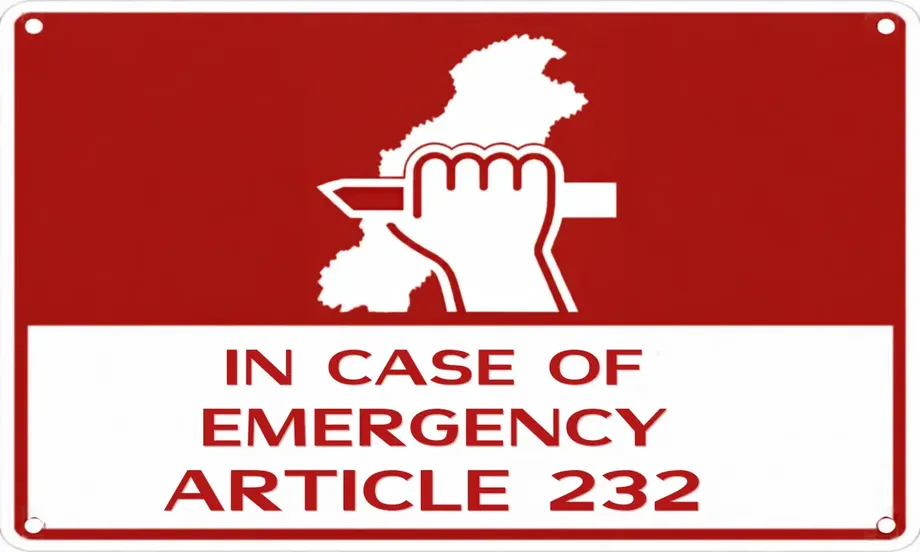
The intervention combines Articles 232 and 234 of Pakistan’s Constitution, provisions that address different emergencies and carry different limits. Federal ministers say deteriorating security and a failure of constitutional governance justified invoking both. PTI rejects that explanation, arguing that the decision targeted its elected provincial government as supporters prepared to march toward Islamabad over the imprisonment of party founder Imran Khan.
The central dispute is bigger than whether Islamabad can improve security. It concerns the evidence required to displace a provincial administration, the duration of that displacement, and whether an emergency can keep elected officials out of power after the separate authority for governor’s rule expires.
Law Minister Azam Nazeer Tarar says Article 232 has no fixed time limit. He also says restoring the provincial assembly’s legislative powers after six months would not automatically restore the government. That interpretation sits uneasily alongside the constitutional argument that Afridi’s ministry has been temporarily displaced rather than lawfully dismissed.
Neither a date for ending the emergency nor a scheduled court hearing has been announced in the accounts of the intervention. Parliamentary approval, the promised legal challenge and the government’s evidence of alleged militant links will determine how the competing claims are tested.
Who is now running the province?
Kundi’s advisory council is assisting the governor in exercising provincial authority. The separate arrangement for 12 districts includes an additional chief secretary and another council intended to coordinate security, administration and development. The districts have not been individually identified in the descriptions of that arrangement.
The government presents these changes as a way to bring security forces and civilian administration under a more coordinated command. Federal ministers accuse the former provincial administration of failing to equip police, strengthen units fighting terrorism and cooperate adequately with Islamabad.
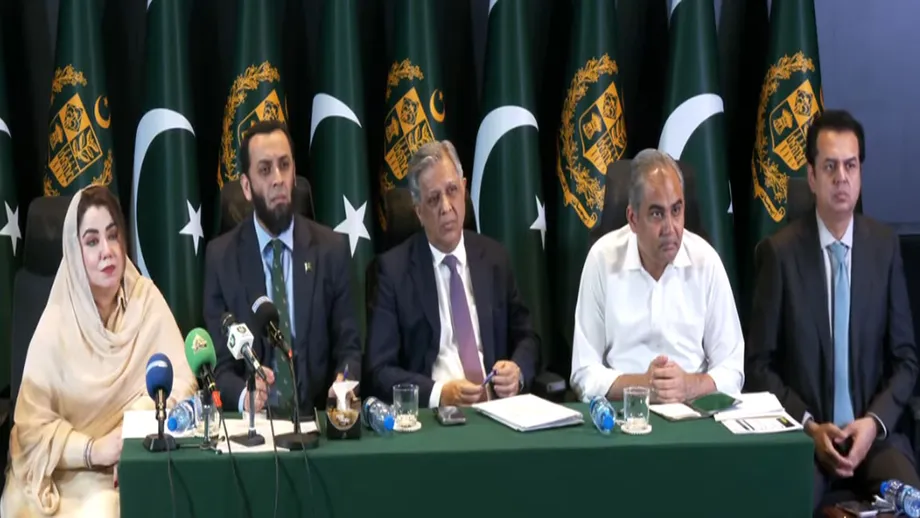
Minister of State for Law and Justice Barrister Aqeel Malik says both emergency and governor’s rule are operating, the provincial assembly is inactive and its speaker is in protective custody. Those statements describe a broad interruption of elected provincial institutions, rather than a change confined to security operations.
The two councils also create distinct levels of administration within the province. Their detailed powers, their relationship with each other and the arrangements for public accountability have not been explained in the reported announcements.
What Articles 232 and 234 require
Article 232 provides for emergency when Pakistan faces war, external aggression or an internal disturbance beyond a provincial government’s power to control. Article 234 addresses a different condition: a provincial government that cannot function in accordance with the Constitution. A serious security problem and a breakdown of constitutional government are therefore not interchangeable legal findings.
Under Article 232, the provincial assembly retains a legislative role, although federal authority expands. Article 234 permits the assumption of provincial functions and the transfer of legislative authority away from the assembly. Using both provisions combines a security emergency with direct intervention in provincial government.
The Eighteenth Amendment added a consent safeguard for an emergency based on internal disturbance. A provincial assembly resolution is required; without one, both houses of Parliament must approve the proclamation within 10 days. KP did not consent through such a resolution.
Political opposition or a planned march does not, by itself, establish either constitutional condition. The federal government must connect its security allegations to the relevant legal test. PTI’s electoral strength, described as a two thirds majority in the provincial assembly, makes the intervention politically consequential, but the legal dispute turns on constitutional conditions rather than the size of that majority.
Six months does not settle the duration dispute
Azam Nazeer Tarar, the federal law minister, explained the government’s interpretation during a briefing for foreign media representatives:
The constitution provides no time limit under 232," Tarar said. "However, for 234, as far as the provincial assembly and its powers to legislate are concerned, those would be revived after a period of six months.
His position separates three questions: how long emergency continues, when the assembly regains legislative powers, and when the provincial cabinet returns. He says the second event would not automatically produce the third. He has also described the provincial government as suspended for at least six months, without specifying an emergency end date.
Malik has gone further in public discussion, saying emergency and governor’s rule can continue beyond six months, depending on conditions of law and order. That statement conflicts with the constitutional interpretation that Article 234 authority cannot extend beyond six months. Continuing Article 232 emergency is a separate matter and remains subject to parliamentary requirements.
An absence of a fixed outer limit under Article 232 does not mean an absence of legal controls. The grounds for emergency, parliamentary approval and judicial scrutiny remain relevant. The government has not explained what measurable improvement in security would be sufficient to end the current arrangement.
The status of Afridi’s cabinet is another unresolved issue. In Pir Sabir Shah v. Federation in 1994, a Supreme Court concurrence held that Article 234 did not empower the president to dismiss a chief minister and provincial cabinet. A concurrence is a judge’s separate opinion supporting the result; its precise authority must be distinguished from the court’s binding holding. The argument drawn from that opinion is that displacement under governor’s rule does not itself end a ministry’s constitutional existence.
Earlier rulings distinguish unrest from constitutional failure
The 1994 litigation arose from an effort by the Bhutto and Zardari government to remove a provincial chief minister. Members of Shehbaz Sharif’s party helped secure the verdict. Its relevance today is the distinction between temporarily assuming provincial functions and permanently removing a government that retains legislative confidence.
A year later, when the Pakistan Peoples Party sought to remove Punjab Chief Minister Manzoor Wattoo, the Lahore High Court held that Article 234 required a breakdown of constitutional machinery. It found that condition absent in Punjab. The ruling supplies a test for the present dispute, but does not itself decide whether current conditions in KP satisfy it.
The 1998 emergency litigation offers a separate warning about rights. Prime Minister Nawaz Sharif invoked Article 232 after the Indian and Pakistani nuclear tests and suspended fundamental rights under Article 233. Former president Farooq Leghari and Imran Khan challenged the measures.
The Supreme Court upheld the emergency because of an imminent danger of external aggression. It rejected lawlessness in Sindh and sectarian killings in Punjab as sufficient internal disturbances for that purpose, and struck down the suspension of fundamental rights. Chief Justice Ajmal Mian’s reasoning placed the existence of the nation at the center of the Article 232 test.
That history matters because Article 233 provides a route to restricting rights protections during emergency. Such restrictions are not automatically valid merely because an emergency exists. The current announcements do not establish which, if any, rights protections have been separately suspended or restricted under Article 233.
Security figures show an increase, but leave gaps
Information Minister Attaullah Tarar says recorded terrorist incidents in KP rose from 2,911 during 2021 to 2024 to approximately 8,600 during 2024 to 2026. He describes the increase as 195 percent. Using those totals, the increase is approximately 195.4 percent, so the stated percentage is arithmetically consistent.
The comparison nevertheless has limits. The periods differ in length and both include 2024 in their stated labels. Exact start and end dates, definitions of an incident and the underlying dataset have not been specified. These totals cannot establish a reliable annual trend without those details.
The information minister also cites 3,774 incidents across Pakistan in 2025 and 2,857 in September 2026. It is unclear whether the latter figure refers to September alone or a cumulative total through that month. Comparing it directly with a full year would risk giving readers a misleading picture.
Malik says incidents increased after Afridi became chief minister and argues for operations guided by intelligence in affected areas. The figures presented do not isolate that period, however. They support the government’s claim of a serious security problem, but do not by themselves demonstrate that Afridi’s appointment caused an increase or that elected provincial government had become constitutionally impossible.
Militant links remain allegations
Attaullah Tarar alleges that the provincial administration worked with the banned Tehreek-e-Taliban Pakistan, or TTP. He also alleges that PTI supporters received militant assistance while traveling through areas near the Afghan border. PTI spokesman Zulfiqar Bukhari rejects the accusations and says the party’s lawyers are preparing challenges to the emergency decree.
The information minister described the government’s position at a news conference:
"You cannot have a provincial government in the country which sympathizes with the terrorists, or which supports terrorists," he said.
Tarar says the government has evidence and has promised to disclose material concerning alleged PTI contacts with the TTP. No disclosed evidence described in these announcements establishes the alleged cooperation. The accusations should therefore remain distinct from proven findings.
The TTP is separate from, though closely allied with, the Afghan Taliban. Islamabad accuses Afghanistan’s Taliban authorities of sheltering TTP militants; Kabul denies that allegation. Federal ministers say disagreements with KP over Afghanistan and militancy obstructed a unified policy against terrorism. PTI says the federal policy is flawed and that securing Khan’s release is a separate issue from provincial security.
Detentions and a smaller protest response
Attaullah Tarar confirms that Afridi is in preventive custody, while saying that no arrest has taken place. Preventive detention means holding someone to avert an anticipated threat rather than necessarily following an ordinary criminal arrest. The distinction in terminology does not establish the legal basis, authorized duration or safeguards applying to Afridi’s confinement.
Two police officials gave a total of 278 PTI members detained in KP since the emergency was imposed. PTI Secretary General Salman Akram Raja separately says hundreds of party workers have been arrested. Those accounts are broadly compatible in scale, although the officials describe detentions and the party describes arrests.
PTI also alleges that police fired at peaceful demonstrators. That allegation has not been independently established in the accounts of the immediate aftermath. Authorities closed provincial schools for one day as a precaution, while roads and markets were described as busy and open.
The protest response was smaller than Afridi had predicted. Reports differ on his threatened turnout, giving either one million or two million people if his government were suspended. These were political forecasts, not observed attendance figures. Demonstrations after the announcement were limited to scattered groups, most gathered supporters dispersed, and no PTI protests were reported in Islamabad on Monday.
Failed talks lead to Parliament and court
The federal government and PTI give different explanations for negotiations that ended without agreement. Azam Nazeer Tarar says officials did not ask PTI to cancel its Islamabad march, but sought assurances that Afridi would prioritize provincial security. He says PTI representatives concentrated instead on Khan’s release.
PTI also wants Khan, imprisoned since August 2023, to receive medical care at a private hospital. The government says he is medically fit and does not need hospitalization. Khan and his legal team reject the corruption and other charges against him as politically motivated.
Raja says Prime Minister Sharif and Maulana Fazlur Rehman had settled matters concerning the discussions, including postponing a cabinet meeting, before the government informed Fazlur Rehman during the meeting that it was proceeding. Raja also says there was never agreement on every issue and accuses the government of changing the negotiating agenda. That account has not been confirmed by the other participants in these reports.
The immediate sequence is:
- During the preceding week, federal and PTI talks ended without agreement.
- On Sunday, the president imposed emergency and governor’s rule in KP.
- On Monday, ministers defended the intervention and discussed its duration; PTI announced legal challenges.
- For Tuesday at 6:15 p.m. local time, the president summoned National Assembly and Senate sessions in Islamabad.
Calendar dates for those days are not specified in the reports. The parliamentary sessions were announced for legislation and matters of national importance, without confirmation of a particular emergency approval vote. Raja says PTI intends to approach the courts within one day, but no completed filing or hearing date is established here.
PTI leader Shafqat Abbas Awan says resignations from the assemblies are not currently under party consideration. He says a final decision would rest with Khan. For now, the announced response centers on litigation rather than abandoning legislative seats.
Past interventions carry a political warning
In February 2009, Zardari imposed governor’s rule in Punjab, displacing a government led by Shehbaz Sharif. Sharif opposed that intervention. The same president has now acted on Sharif’s advice against a rival provincial administration, a reversal that illustrates how parties’ positions on federal intervention can change with political circumstances.
A more severe historical example dates to 1973, when Zulfikar Ali Bhutto dismissed the National Awami Party ministry in Balochistan, citing terrorism, disloyalty and support for hostile powers. The allied government in the then North-West Frontier Province, led by Mufti Mahmood, resigned in protest. A four year insurgency followed in Balochistan, alongside violence in the frontier province.
That sequence does not prove that KP will follow the same course, or that dismissal alone caused the earlier conflict. It does show that removing elected provincial leadership in a troubled region has previously coincided with deeper political alienation rather than a quick return to stability.
The present government promises better security coordination. Its constitutional case must still address why that objective required displacing elected institutions, what evidence supports the allegations against PTI and what conditions would permit a return to provincial rule. Those are concrete matters for Parliament and the courts, not questions resolved by declaring the intervention temporary.
Key Points
- KP is under both Article 232 emergency and Article 234 governor’s rule, with Governor Faisal Karim Kundi assisted by an 11 member council.
- The duration of emergency, the six month limit associated with Article 234 and the return of Afridi’s cabinet are distinct legal issues.
- The government alleges PTI links with the TTP; PTI denies the allegations and plans court challenges.
- Officials report 278 PTI members detained, while Afridi and the provincial assembly speaker are also reported in custody.
- The reported security totals imply a 195.4 percent increase, but overlapping periods and unclear definitions limit comparisons.
- No emergency end date, confirmed court hearing or specific parliamentary approval vote has been established.