A marina approval meets an unresolved land dispute
A Muslim fishing community of 41 households in northern Phuket is challenging an environmental approval for the Ao Kung Marina Cruise and Sports Port, arguing that unresolved public land claims and a proposed navigation channel put its fishing grounds, mangroves and access to a cemetery at risk. Residents took their complaint to Thailand's National Human Rights Commission on June 26, 2026, after an environmental expert committee approved the marina's environmental impact assessment in April.
Contents
- A marina approval meets an unresolved land dispute
- Two projects with a shared environmental footprint
- Why the existence of a channel matters
- Redacted documents and routes to the sea
- A dispute stretching across a decade
- Reef recovery gives conservation a measurable stake
- Residents differ over jobs and boat access
- Fishing as income, food and community support
- Luxury tourism and carbon policy face local scrutiny
- What to Know
The approval date is disputed in reports: an account of the community's May 17 statement gives April 20, 2026, while an account of the June complaint gives April 21. Both describe approval by the expert committee under the Office of Natural Resources and Environmental Policy and Planning. The distinction has not been resolved, but the central objection is the same: residents say approval went ahead before land and environmental disputes were settled.
Ban Ao Kung, in Pa Khlok subdistrict, Thalang district, has a history extending more than 250 years. Its conservation group protects 584 rai of mangrove forest within the Khlong Para Mangrove Forest National Forest Reserve and more than 547 rai of coral reefs, according to the Assembly of the Poor's Ao Kung community account, published by La Via Campesina.
Those areas equal about 93.4 hectares of mangroves and more than 87.5 hectares of reefs. A rai is a Thai land measurement equivalent to 1,600 square metres. For residents, the dispute concerns more than scenery or biodiversity: the forest and bay supply food, income and a fallback when tourism employment disappears or rough weather prevents fishing offshore.
Two projects with a shared environmental footprint
The contested development involves a privately proposed marina and a separate Marine Department channel project. An earlier proposal put the marina's cost at 120 million baht and its capacity at up to 72 yachts. Those figures describe that proposal, rather than a confirmed specification for the version approved in 2026.
A marina and sports complex assessment submitted in 2018 was withdrawn following conservation objections to its treatment of coral reefs and marine habitats. In 2019, plans returned as two projects: the marina and a departmental proposal for a channel approximately 1.2 kilometres long and two metres deep. The department described the channel as necessary for local boat transport.
Conservation campaigners argue that separating the projects obscures their practical connection. A marina requires navigable access to the sea, and they believe the publicly proposed channel would provide it. The Assembly of the Poor says the dredging route would cross 62 rai of shallow staghorn coral beds and 12 to 16 rai of rare red gorgonian coral beds, identified as Dichotella species.
Together, those coral areas amount to 74 to 78 rai, or approximately 11.8 to 12.5 hectares. These are campaigners' descriptions of the proposed route, not an independently established damage estimate. Their objection is that the marina and channel should be assessed for their combined effects rather than treated as unrelated works.
Why the existence of a channel matters
The Marine Department has argued that an existing water channel allows dredging without a further environmental assessment. Residents dispute the historical and physical basis of that claim. The Assembly of the Poor says aerial photograph interpretation was used to identify a natural channel 30 metres wide through an area the community regards as established mangrove forest.
Pradit Phuangket, leader of the Ban Ao Kung Mangrove Conservation Group, points to mature vegetation as evidence against that interpretation. He says a tree with a trunk almost two metres across stands within the claimed channel area. He also argues that currents and sediment would make repeated dredging necessary, potentially every three to four months. That frequency is his assessment, not a published departmental maintenance schedule.
The legal distinction is central to the community's challenge. The Assembly of the Poor describes restrictions on opening a new channel in mangroves for private benefit, alongside an exception for maintaining a natural channel that has become shallow. Residents allege that the maintenance category is being used to justify creating access where none existed. That allegation has not been established by a court finding described in the reports.
Residents also allege continuing mangrove destruction, including the felling of an old lamphaen tree regarded as a symbol of the community's history. Their May statement called for protection and restoration. Responsibility for that destruction, and its relationship to the proposed development, has not been determined in the reported proceedings.
Redacted documents and routes to the sea
The June complaint focuses on black bars covering parts of the environmental impact assessment, or EIA. An EIA examines a project's likely environmental effects and proposed measures to prevent or reduce harm. Residents say the concealed material concerns landholding, boundaries and use, precisely the issues they need to examine to challenge the project.
The report sent to the community cited the Personal Data Protection Act and trade secrets as reasons for redaction. The conservation group argues that information governing disputed public land and environmental effects should be open to public scrutiny. The legal question is not simply whether some information can be protected, but whether these particular redactions prevent meaningful examination of land rights and project impacts.
The allegedly overlapping land serves three purposes: reaching the Muslim cemetery, known locally as the kubor; reaching the shore for coastal fishing; and conducting mangrove restoration and monitoring. The community says access is especially important for women and poorer households without boats, who depend on resources they can gather from the shoreline.
A lawsuit brought by the project owner against community leaders in December 2019 was reportedly dismissed because the owner could not prove rights to the land. No judgment date or case number is identified. That reported dismissal does not, by itself, establish every boundary or determine the legality of the entire marina proposal. A separate fact finding process chaired by Phuket's governor was still unfinished when residents challenged the approval.
A dispute stretching across a decade
The latest complaint follows years of project revisions, conservation objections and government review. The community traces its coastal protection work to 1992, including action against illegal commercial fishing, charcoal cutting and mangrove clearance for shrimp ponds.
- 1992: Residents began sustained coastal conservation, restoration and monitoring with public agencies and other partners.
- 2016: The marina proposal emerged locally as Thailand pursued ambitions to become a regional marina hub.
- 2018: A marina and sports complex EIA was withdrawn after objections over reefs and marine habitats.
- 2019: The marina and separate Marine Department channel proposals reappeared. The project owner began litigation against community leaders in December.
- 2021: Residents say renewed efforts to advance dredging relied on private aerial photograph interpretation.
- April 9, 2024: The National Human Rights Commission adopted a resolution warning of environmental damage and risks to community rights from dredging.
- April 2026: The marina EIA received expert committee approval, reported as April 20 in one account and April 21 in another.
- May 17, 2026: The conservation group demanded cancellation of the approval and channel project.
- June 26, 2026: Residents submitted their complaint about the redacted EIA to the commission.
The April 2024 commission resolution is described as recommending mangrove restoration by the Department of Marine and Coastal Resources with community participation. Residents argue that advancing dredging conflicts with that recommendation. Their May statement also sought investigation through an Assembly of the Poor problem solving mechanism signed by Prime Minister Anutin Charnvirakul on May 14, 2026.
National Human Rights Commissioner Sayamon Kraiyurawong received the June complaint and said the commission would seek information from the provincial governor and conduct an investigation on site. No date for that visit, a subsequent hearing or a final decision is given.
Reef recovery gives conservation a measurable stake
The Phuket Marine Biological Center rated Ao Kung's reefs healthy in 2022, compared with severely damaged in 2003. That reported change provides a concrete reference point for residents' argument that restoration has produced results worth protecting.
The recovery has not been uninterrupted. Colonies of Acropora pulchra, a shallow water staghorn coral, suffered major losses in late 2019. Marine ecologists linked the damage to unusual low tides associated with the Indian Ocean Dipole, a pattern of changing sea temperatures across the Indian Ocean that can affect regional weather and ocean conditions.
Community restoration has included mangrove planting, artificial reefs and work with specialists to study marine animals. Fisherman Ood Sompit's photographs of coral, posted on Facebook, helped draw wider attention to the development plans. Residents disputed an earlier project claim that there were no reefs within one kilometre of Ao Kung Bay.
Mangrove estimates differ across accounts. The Assembly of the Poor identifies 584 rai under community protection, while an earlier report describes about 3,000 rai along the shoreline. Those figures may cover different boundaries, but they cannot be treated as interchangeable. The community also reports catches rising by about 30 percent through conservation, without specifying the measurement period or survey method.
Saisanit Pongsuwan, a professor in the Science and Environment Faculty at Phuket Rajabhat University, places Ao Kung within the wider Phang Nga Bay ecosystem, which includes more than 160 square kilometres of mangroves. She argues that changes in Ao Kung could affect marine animals and food chains beyond the immediate project area.
Residents differ over jobs and boat access
Opposition is substantial, but the record does not show unanimous local rejection. At a February 9 public hearing attended by 180 Ao Kung residents, some participants supported a deeper channel and the prospect of tourism jobs. The year of that hearing is not specified in the account.
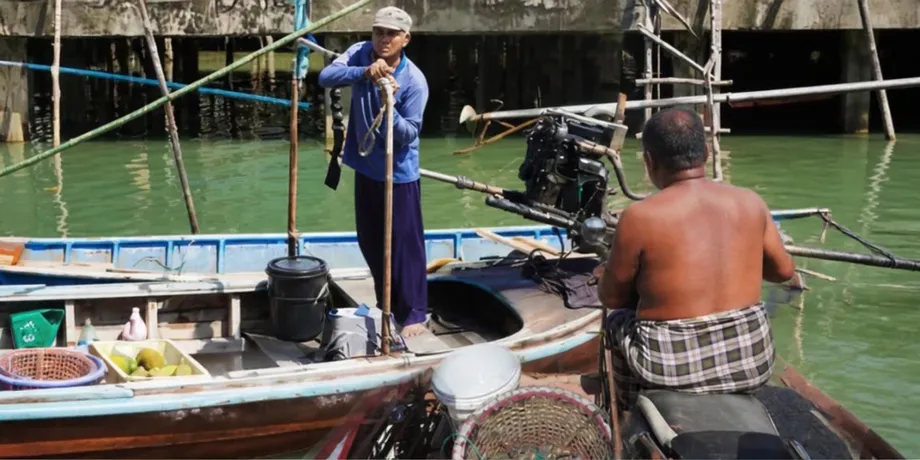
Fisherman Somchai Sinprai supported improved passage for larger vessels. Explaining why he favoured a deeper channel, he said:
it would be easier for big boats to travel there if there was a deeper water channel.
Marine Department officer Charan Damnoenpol said the selected dredging method would minimise impacts on mangroves. That assurance represents the department's position; it does not settle the disputed channel history, land boundaries or effects on coral habitats.
Pradit's objections also draw on earlier campaigns through the Southern Small Scale Fishers Federation and Assembly of the Poor. He recalls joining the movement around 1997 and campaigning to expand the coastal exclusion zone for trawlers and push net vessels from 1,500 to 3,000 metres. The proposed doubling aimed to protect nearshore ecosystems, fishing gear and livelihoods. His current complaint is that tourism development receives access to coastal space while traditional fishers face restrictions and disturbance, including jet skis around working boats.
Fishing as income, food and community support
Nusara Wongnui, a 33 year old single mother, describes why returning to the bay offered an alternative to service work. After jobs as a golf caddie and with transport company Kerry, she says she endured long commutes and shifts stretching to 14 or 15 hours for 460 baht a day. She returned to Ao Kung when the pandemic made outside employment increasingly uncertain.
Explaining the importance of that return, Nusara said:
When I couldn't cope with life outside anymore, I came back to fishing. There was food to eat.
With 20,000 baht in initial capital, she learned octopus fishing from her mother and adapted weighted crab traps known locally as luk kung king. She says fishing can earn 2,000 to 4,000 baht a day, approximately 4.3 to 8.7 times her stated 460 baht transport wage. The comparison describes reported daily amounts, not verified net profits or guaranteed earnings. Fishing costs, weather and days without a catch are not quantified.
Her operation shares income with residents who set and retrieve gear, including young people outside education and single fathers. The Assembly of the Poor says participants receive at least 400 baht a day. Younger crews with stronger boats work farther offshore, while fishers aged 60 to 70 use sheltered waters nearer the bay entrance and coast.
The mangroves also provide shellfish when boats cannot leave shore. Nusara credits them with reducing wave force during the 2004 tsunami. Her account explains why residents value the forest as protection, although it does not establish how much damage mangroves prevented compared with other local conditions.
Luxury tourism and carbon policy face local scrutiny
The Assembly of the Poor connects Ao Kung's dispute to the World Bank Group's 2026 report Building Thailand's Future Today. Its account cites annual forest and coastal ecosystem services worth US$33.3 billion, equivalent to 6.1 percent of Thailand's GDP, and a 32 percent loss of Phuket forest area between 2001 and 2020. Ecosystem services are benefits nature supplies, including food, coastal protection and habitats.
The organisation also describes the report as promoting a shift from visitor volume toward higher spending through wellness and luxury tourism. It argues that this strategy can encourage projects that displace the livelihoods conservation is supposed to protect. These figures and policy descriptions are presented through the organisation's reading of the report; they do not establish World Bank support for the Ao Kung marina.
The same account attributes to the report a finding that more than 80 percent of Thai tourism and service employment is informal, poorly paid and of low productivity. Separately, Saisanit says more than 90 percent of Phuket households work in tourism and that the island received over 10 million visitors annually before the pandemic. Those figures concern different populations, but together explain the concern about replacing another source of income with greater reliance on tourism.
Pradit also challenges carbon credit policies involving mangroves. Blue carbon refers to carbon stored in coastal ecosystems; credits can represent measured emissions reductions or removals. His objection concerns who controls those ecosystems and whether corporate environmental claims protect residents' access. There is no identified Ao Kung carbon credit contract, buyer or exclusion order in the reported dispute.
Pradit, speaking as the community's conservation leader, argues for continued local stewardship:
If we take care of our own forests, use them ourselves, and preserve them ourselves, that will be more sustainable.
The immediate decisions remain concrete: whether to reconsider the EIA approval, release disputed land information, resolve public access claims and proceed with or cancel dredging. Residents have requested cancellation and restoration. The commission has promised further investigation, but no final outcome or construction start date is established.
What to Know
- Ao Kung residents challenged the marina's redacted EIA before the National Human Rights Commission on June 26, 2026.
- Reports differ on whether environmental approval occurred on April 20 or April 21, 2026.
- The dispute links a private marina to a separate Marine Department channel proposal approximately 1.2 kilometres long.
- Residents allege overlap with public routes to fishing grounds, a Muslim cemetery and mangrove conservation areas.
- The community protects 584 rai of mangroves and more than 547 rai of reefs, according to the Assembly of the Poor.
- Some residents support deeper boat access and tourism jobs; conservation campaigners seek cancellation and restoration.
- Land review and human rights investigations have no reported final outcome or next hearing date.