A shrinking lead in a market short of computing power
Nvidia shipped 678,000 artificial intelligence accelerators in China in the first half of 2026, down 44% from a year earlier, while Huawei shipped 572,000. IDC figures described in reports published on October 13 put their market shares at 34% and 28%, leaving a gap of six percentage points and 106,000 chips.
Contents
- A shrinking lead in a market short of computing power
- How far has Huawei closed the gap?
- The advance includes several Chinese suppliers
- Non-GPU accelerators take the volume lead
- Why the market share claims do not all agree
- The contest is moving from chips to clusters
- Software keeps training and inference on different tracks
- Shortages leave room for other Nvidia hardware
- Nvidia’s global growth and the next supply tests
- Key Points
The shift extends beyond the two companies. China received 2.008 million AI accelerators between January and June, and shipments of processors outside the graphics processing unit category exceeded GPU shipments for the first time. Nine of the 11 Chinese chipmakers tracked by IDC increased shipments from a year earlier.
AI accelerators are specialized processors used to train models and run them after training. Shipment counts measure the number of processors entering the market, not their computing performance, sales value or actual use. Huawei closing the volume gap therefore does not establish that it has matched Nvidia in every kind of AI work.
US export controls have limited Nvidia’s eligible products, while Beijing has promoted domestic alternatives and required Chinese companies to obtain approval before importing Nvidia chips that comply with American restrictions. Those policies are changing purchasing decisions in a market where demand still exceeds supply.
Other evidence complicates any claim that Nvidia is disappearing from China. Chinese companies reportedly bought more than one million Nvidia gaming and workstation chips this year, and some are seeking access to advanced processors in overseas data centers. The central change is a redistribution of chip shipments, alongside continued demand for Nvidia hardware that buyers cannot always obtain through conventional channels.
How far has Huawei closed the gap?
Huawei’s 572,000 shipments compare with more than 300,000 in the same period of 2025. That represents substantial growth, although the earlier figure is not precise enough to calculate an exact percentage increase. One account describes the starting point as 300,000 and calls the increase nearly a doubling; the more cautious comparison is with more than 300,000.
A separate IDC account covering the whole of 2025 put China’s AI accelerator card market at approximately four million units. Nvidia held 55%, while Chinese chipmakers together shipped about 1.65 million cards, representing roughly 41%. Huawei shipped 812,000 cards that year.
Against that annual benchmark, Nvidia’s reported share of 34% in the first half of 2026 is 21 percentage points lower. Huawei’s 2025 shipments were about 20.3% of the four million total, compared with its reported 28% share in the latest half year. These are comparisons between different periods, not a direct measurement of the change between the first halves of 2025 and 2026.
Huawei’s first six months of 2026 also amounted to about 70% of its entire reported 2025 shipment volume, using 572,000 and 812,000 as the inputs. That shows the pace of its expansion without assuming the second half will repeat the first.
The advance includes several Chinese suppliers
Alibaba’s chip design subsidiary T-Head held 7% of China’s market in the first half of 2026. Cambricon followed with 5%, Baidu’s Kunlunxin with 4%, and Hygon with 3%. Together with Huawei, those five suppliers accounted for 47% using IDC’s rounded shares.
The breadth of the increase matters. With nine of 11 tracked Chinese manufacturers shipping more than a year earlier, the movement is not confined to Huawei winning orders from Nvidia. Several domestic suppliers are expanding at the same time.
The 2025 figures offer another reference point: T-Head shipped 265,000 cards, AMD shipped 160,000, and Kunlunxin and Cambricon each shipped 116,000. Those annual volumes cannot be directly compared with the latest market shares without matching periods and product definitions.
Cambricon’s expansion follows its 2025 revenue surge, when first half revenue reached 2.88 billion yuan amid restrictions on Nvidia sales. Revenue and shipment share measure different things, but both developments show domestic suppliers gaining commercial ground.
Non-GPU accelerators take the volume lead
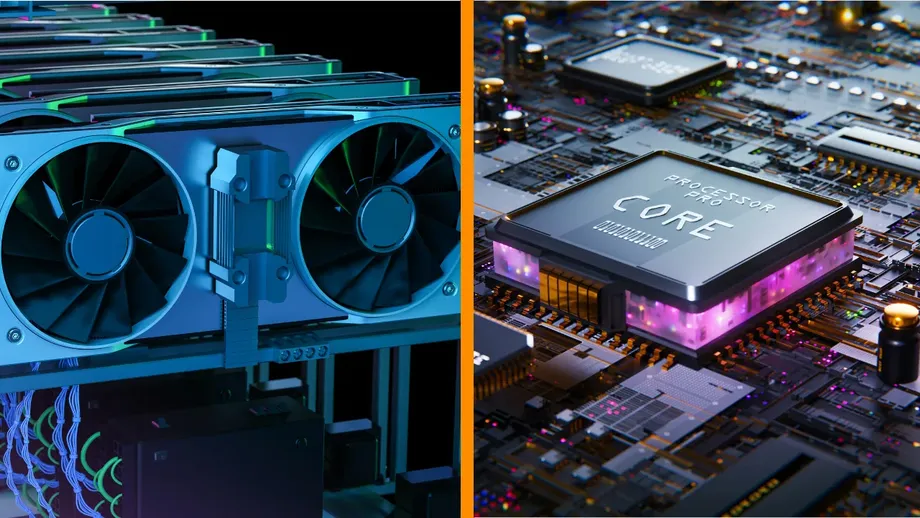
IDC recorded 991,000 GPU shipments in the first half of 2026, a decline of 26%. Shipments of other AI accelerators rose nearly 80% to 1.016 million, putting that category about 25,000 units ahead.
GPUs are widely used for model training because they perform many calculations in parallel. Other accelerators can be designed around particular AI operations, including inference, the process of using a trained model to produce an answer, classification or prediction.
The two category figures add up to 2.007 million, slightly below the reported total of 2.008 million. The accounts do not explain that 1,000 unit difference. It does not alter which category led, but the figures should not be presented as an exact reconciliation.
Huawei, T-Head, Kunlunxin and Cambricon together accounted for 95% of the non-GPU segment. IDC identified government agencies, internet companies and telecommunications providers among the organizations adopting these processors.
The change does not mean GPUs have lost their role in advanced model training. It shows that the market is buying more processors outside that category, including hardware suited to running models. Counting chips alone cannot establish which group delivered more usable computing capacity.
Why the market share claims do not all agree
Huawei has made a stronger claim than the IDC figures support. Eric Xu, the company’s rotating chairman, said during a September media roundtable that Ascend’s share in China had already exceeded Nvidia’s, according to data Huawei could count. Accounts in October also described Huawei as claiming that Ascend chips had outsold Nvidia.
IDC’s first half figures still place Nvidia ahead, at 34% against Huawei’s 28%. Huawei did not provide a percentage measured on the same basis. The statements may cover different periods, products or channels, but their precise relationship has not been established.
Another account projects Nvidia’s share falling from about 40% in 2025 to around 8% in 2026, with domestic manufacturers reaching approximately 50%. Its starting figure differs from IDC’s reported 55% for 2025, and the 8% projection is not an observed result comparable with the first half figure of 34%.
IDC also did not identify which Nvidia products were included, or whether its count covered B200 and B300 processors. Those chips are barred from export to China but have reportedly entered through smuggling. Nvidia had not responded to a request for comment when the October 13 reports appeared.
The contest is moving from chips to clusters
IDC says competition is shifting from individual processor performance toward the capabilities of complete computing systems, including how effectively chips work together in a large cluster. A powerful processor can spend time waiting for data if the connections between processors cannot keep pace.
Huawei’s approach was visible in its Shanghai hardware showcase in July 2025, when it presented CloudMatrix 384, built around 384 Ascend 910C processors. That strategy uses many interconnected chips to compensate for limits at the individual processor level.
At the September roundtable, Xu and HiSilicon chief scientist Liao Heng described Huawei’s Peerium computing architecture and UnifiedBus, or UB, connections. Huawei claimed bandwidth between cabinets of up to 800 gigabytes per second. Liao said transferring a data packet between different network scales using the unified protocol could take about 150 nanoseconds.
These are Huawei’s technical claims, not independent findings that its systems outperform Nvidia’s across workloads. Their relevance is the focus on communication: keeping many processors working together efficiently rather than comparing only the speed of one chip.
Huawei also described its Hi-ONE optical module, which places an optical engine about five centimeters from the main chip. It said this near package optics approach costs almost 40% less than a co-packaged optics alternative and allows an optical engine fault to be handled without discarding the AI processor. Both approaches move data using light; their placement creates different cost, maintenance and manufacturing tradeoffs.
Software keeps training and inference on different tracks
Nvidia’s position depends partly on CUDA, the software platform developers use to run calculations efficiently on its chips. Moving an existing training workload involves more than replacing hardware. Code, development tools and operating practices may also need to change.
Huawei offers CANN as an alternative. Liao argued that new programming approaches and compiler languages were reducing the software gap, and that frontier laboratories were less tied to CUDA than two years earlier. That is Huawei’s assessment, rather than proof that migration has become straightforward for every customer.
A separate account estimates that moving training workloads could require roughly 50% more time and cost. No detailed methodology accompanies that estimate, so it should not be treated as a universal penalty.
DeepSeek reportedly plans to deploy at least 160,000 Huawei Ascend 950DT chips for inference while retaining Nvidia hardware for training. This is a deployment plan, not confirmation that all those chips have been delivered. It also differs from Huawei’s description of 950DT systems as primarily intended for training and the 950 PR version as primarily aimed at inference. Product positioning does not necessarily dictate how a customer uses the hardware.
Xu said in September that 950DT training systems were still being tested, with volume supply expected at the end of the year or early the following year. That schedule is a forecast, not evidence of completed production or deployment.
Shortages leave room for other Nvidia hardware
Chinese groups reportedly purchased more than one million Nvidia gaming and workstation chips during 2026, including RTX Pro 6000D and RTX Pro 5000 products. These purchases provide computing capacity outside the restricted advanced accelerator category.
The processors can handle some simpler AI tasks, including inference prefill, when a model processes the input prompt before generating its answer. Their reported purchase volume should not be added directly to IDC’s first half accelerator total: the periods differ, and IDC did not disclose whether these products were counted.
Industry estimates put annual supply from China’s domestic AI chip industry at about 3.5 million units, including roughly one million manufactured overseas, against demand expected to exceed five million. That implies a gap of more than 1.5 million before considering other sources of hardware. The estimates do not establish that every gaming chip can substitute for an advanced accelerator.
Spending is rising alongside the shortage. Combined capital expenditure at Alibaba, ByteDance and Tencent could more than double to approximately 700 billion yuan, or $104 billion, this year. Morgan Stanley estimates China’s 2026 spending on computing power at $193 billion.
Tencent reportedly agreed to lease access to about 100,000 advanced AI chips through Oracle’s Southeast Asian data centers. Such access can support Chinese companies’ workloads without bringing the processors into mainland China. Separately, US authorities have arrested people accused of smuggling Nvidia chips into China, with cases still ongoing in October. Allegations in those cases should not be treated as convictions.
Nvidia’s global growth and the next supply tests
Nvidia’s reported August earnings comments suggest it was already planning around limited access to China. H200 shipments to China represented less than 1% of data center revenue in the preceding quarter, and its forward outlook included no China data center compute revenue.
Quarterly revenue was reported at approximately $96 billion, including $89 billion from data centers, with another account giving the total more precisely as $96.2 billion. Nvidia expected about $108 billion the following quarter. It also reportedly projected roughly 70% revenue growth in fiscal 2028, with supply limiting the outlook.
Those figures explain why lost Chinese shipment share need not translate into weaker global growth. They do not make China irrelevant. Revenue from customers headquartered in China, including Hong Kong, reportedly reached $7.88 billion in the July quarter, covering a broader category than mainland data center compute sales.
Demand also remains distinct from completed sales. The H200 production discussions concerned more than two million reported Chinese orders for 2026 against about 700,000 units of inventory. Orders express buying intentions; approvals, production and deliveries determine whether those intentions become shipments.
Xu expects global AI supply and demand to approach balance around 2029, potentially later in China. Huawei says it is prioritizing domestic customers and supplying only small quantities overseas. The relevant milestones are:
- January to June 2026: IDC records Nvidia at 34% and Huawei at 28% of China’s accelerator market.
- August 2026: Nvidia describes limited H200 revenue from China and excludes China data center compute revenue from its outlook.
- September 2026: Huawei discusses its supply constraints and expected 950DT production schedule.
- October 13, 2026: Reports describe IDC’s first half findings and continued Chinese purchases of other Nvidia hardware.
- Late 2026 or early 2027: Huawei expects volume supply of 950DT training systems.
IDC forecasts 19% growth in China’s total accelerator shipments for 2026, despite a 9% decline in GPUs. The next test is whether suppliers can deliver that expanding volume and whether customers can turn it into effective training and inference capacity.
Key Points
- Nvidia shipped 678,000 AI accelerators in China in the first half of 2026, compared with Huawei’s 572,000.
- IDC put their shares at 34% and 28%, a six percentage point gap.
- Non-GPU accelerators overtook GPUs by approximately 25,000 shipments.
- Nine of 11 tracked Chinese chipmakers increased shipments from a year earlier.
- Huawei’s claim that it has passed Nvidia is not measured on a disclosed basis comparable with IDC’s figures.
- Chinese buyers continue to seek Nvidia workstation chips and access to advanced hardware overseas.
- Software migration, import approvals and production capacity remain central constraints.
- IDC expects total Chinese accelerator shipments to grow 19% in 2026.