65.9 Million Transactions Put Youth Borrowing in Focus
Malaysians aged 30 and below made 65.9 million Buy Now, Pay Later (BNPL) transactions worth RM5.4 billion between January and June 2026, according to the Ministry of Finance. At June 30, this group still owed RM2.4 billion, including RM96.8 million classified as non-performing financing, or 4.0% of its outstanding balance.
Contents
- 65.9 Million Transactions Put Youth Borrowing in Focus
- What the Purchase Figures Actually Measure
- Unpaid Financing Requires a Separate Reading
- A Growing Market Before the Youth Disclosure
- Providers Must Assess Debt Across Platforms
- Licensing Deadline Follows the Consumer Credit Act
- A Fraud Complaint Does Not Automatically Pause Collection
- Account Freezes and Responsibility for Security
- Key Points
The figures place young consumers at the centre of Malaysia's expanding BNPL market. They accounted for 37.9% of the country's 173.9 million transactions during the six months and 36.7% of the RM14.7 billion in purchase value. The age category includes people who are 30, rather than only those under 30.
The ministry disclosed the numbers in a written parliamentary response to Datuk Dr Alias Razak, the Perikatan Nasional MP for Kuala Nerus. He asked how the Consumer Credit Commission, known as SKP, protects young people from excessive BNPL debt, particularly when borrowers have commitments across several platforms.
The response sets out requirements for providers to assess whether applicants can repay. A separate parliamentary answer also identifies a limit to consumer protection during fraud investigations: disputing a transaction does not automatically stop payment demands, late charges or debt collection.
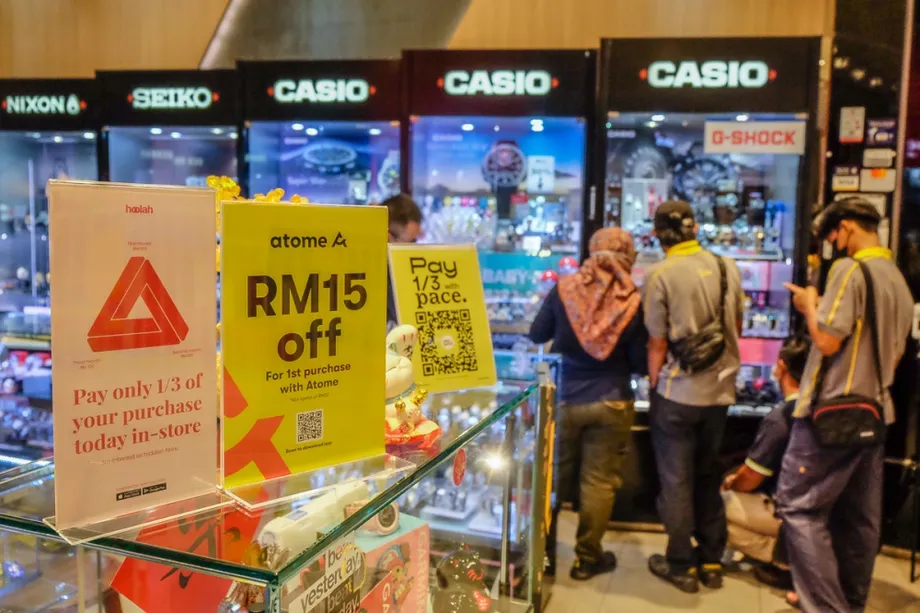
BNPL lets consumers make purchases with payment deferred or divided into instalments. That changes when money leaves a consumer's account, but it does not remove the obligation to pay. The ministry's answers address two distinct risks: borrowing beyond repayment capacity and being pursued for a transaction a consumer says was never authorised.
What the Purchase Figures Actually Measure
The RM5.4 billion represents transactions made during six months. The RM2.4 billion is the financing balance outstanding on June 30. These are different measures: one records activity over a period, while the other records debt remaining at a particular date.
Dividing RM5.4 billion by 65.9 million transactions gives an average youth purchase of approximately RM82. Nationwide, RM14.7 billion divided by 173.9 million transactions gives approximately RM85. Both calculations use rounded ministry figures, so they should be read as estimates.
Young consumers therefore made slightly smaller purchases on average than the national figure. Their share of transaction volume was 1.2 percentage points higher than their share of purchase value. The difference points to frequent, relatively small transactions rather than unusually large purchases.
Subtracting the youth figures from the national totals leaves about 108 million transactions worth RM9.3 billion attributable to consumers outside the age category. That implies an average transaction of approximately RM86 for people above 30.
None of these averages reveals an individual borrower's total commitments. Several modest purchases can generate overlapping repayments, while the transaction count does not establish how many different young people used BNPL. The ministry's figures do not provide a youth borrower count or a distribution of debt by income.
Unpaid Financing Requires a Separate Reading
The ministry described the RM96.8 million unpaid amount among young consumers as still manageable. It represented roughly RM4 for every RM100 of their outstanding BNPL financing. That assessment concerns the reported aggregate, not whether every borrower can comfortably meet repayments.
The entire RM2.4 billion outstanding balance should not be treated as overdue debt. It includes financing that remains to be repaid, while the RM96.8 million is the portion identified as non-performing or unpaid. Reports use both descriptions, but do not specify the number of days a payment must be late to enter that category.
An earlier disclosure put nationwide overdue BNPL financing at RM181 million, or 3.4% of the RM5.3 billion outstanding at the end of March 2026. The youth figure at June 30 was 4.0%, numerically 0.6 percentage points higher.
That is not a direct comparison of young and older borrowers at the same moment. The figures cover different dates and populations, and the descriptions of troubled financing are not identical. They do not establish that the national overdue rate rose between March and June or that age alone explains repayment problems.
The June disclosure also does not give the national outstanding balance for that date. It is therefore not possible to calculate young consumers' share of all outstanding BNPL debt at June 30 from these figures.
A Growing Market Before the Youth Disclosure
The earlier parliamentary figures show that outstanding BNPL financing nationwide increased from RM4.9 billion at the end of 2025 to RM5.3 billion at the end of March 2026. The RM400 million rise equals approximately 8.2% over three months.
There were eight million active BNPL account holders in the first quarter of 2026. The ministry also said approximately 40% of users were aged 30 and below. That user share is a different measure from the 37.9% share of transactions reported for young consumers during the first half.
In a question about consumer protection, Syerleena Abdul Rashid, the Pakatan Harapan MP for Bukit Bendera, cited RM9.3 billion in BNPL transactions during the first half of 2025. Against that figure, the RM14.7 billion reported for the first half of 2026 represents an increase of RM5.4 billion, or approximately 58%, assuming the periods use comparable coverage.
The ministry's earlier account said BNPL was generally used for purchases below RM100, including food, groceries, transport and services. That description is consistent with the approximately RM85 national transaction average calculated from the latest totals, although an average cannot show which goods dominated purchases.
Prime Minister Datuk Seri Anwar Ibrahim, who is also finance minister, addressed consumer protection in a written parliamentary reply dated July 15:
Accordingly, the government is of the view that the development of this sector must be accompanied by strong consumer protection to ensure that credit facilities continue to be used prudently and responsibly,
BNPL debt represented around 0.3% of total household debt at the end of 2025, according to the ministry. That small national share provides scale, but does not measure the pressure on a particular household with limited income and several repayment commitments.
Providers Must Assess Debt Across Platforms
The ministry said providers must assess both creditworthiness and affordability before granting BNPL financing. Creditworthiness concerns the likelihood that a person will repay; affordability concerns whether repayments fit within that person's financial capacity.
In its response to Alias, the Ministry of Finance explained the scope of the required assessment:
These assessments must take into account the consumer's overall financial commitments, including existing credit facilities from both bank and non-bank providers, as well as any new facilities being applied for,
The requirement matters because approval from one platform does not mean the consumer has room for another repayment elsewhere. A meaningful assessment must consider the combined commitments, rather than judging each purchase in isolation.
The commission's conduct standards also prohibit providers from granting or increasing credit facilities for consumers likely to struggle to meet repayment obligations. The responsibility therefore extends beyond deciding whether to open an account. It applies when a provider considers extending more credit.
The ministry warned that simultaneous use of several BNPL facilities can produce high repayment commitments and damage consumers' financial position. However, the parliamentary disclosures do not explain how providers obtain a complete view of borrowing across platforms, how quickly new commitments become visible, or how consistently the assessments operate in practice.
Licensing Deadline Follows the Consumer Credit Act
BNPL providers fall under the Consumer Credit Act 2025, also identified as Act 873. The Consumer Credit Commission has issued authorisation and conduct standards setting minimum requirements for providers, including governance, consumer protection and responsible lending.
The ministry said providers must obtain a commission licence. Applications opened on June 1, 2026, and existing providers were given until November 30, 2026, to submit them. The commission was engaging with providers to help them meet the licensing requirements.
The sequence of disclosures and regulatory dates is:
- December 31, 2025: National outstanding BNPL financing stood at RM4.9 billion.
- March 31, 2026: Outstanding financing reached RM5.3 billion, with eight million active account holders and RM181 million overdue.
- June 1, 2026: The provider licence application period opened.
- June 30, 2026: Young consumers' outstanding financing stood at RM2.4 billion, including RM96.8 million classified as non-performing or unpaid.
- July 15, 2026: A parliamentary reply detailed the earlier national balances and licensing arrangements.
- October 13 and 14, 2026: Reports described the parliamentary replies on youth debt and disputed transactions.
- November 30, 2026: Existing providers face the deadline to submit licence applications.
Reports differ on the publication date of the youth reply. Several place its appearance on Parliament's website on Tuesday, October 13, while others describe it as published or answered on Wednesday, October 14. The reporting period and June 30 balance date are consistent.
A Fraud Complaint Does Not Automatically Pause Collection
A separate parliamentary question from Lee Chuan How, also identified as Howard Lee, the Pakatan Harapan MP for Ipoh Timor, addressed transactions consumers say they did not authorise. He asked whether providers must temporarily stop payment demands, late charges, account restrictions and debt collection until investigations finish.
The ministry said neither Act 873 nor the conduct standards impose an automatic suspension of all those measures when a dispute is lodged. The transaction must first be investigated to determine whether it was unauthorised.
The Ministry of Finance explained that distinction in its response:
Neither the Consumer Credit Act 2025 nor the standards issued by the commission impose such a requirement, as disputed transactions must first be investigated to determine whether unauthorised activity occurred,
This means making a formal complaint is not, by itself, a legal guarantee that demands for payment or late charges will stop. It does not mean the disputed transaction has been proved valid, nor does the absence of an automatic suspension remove the provider's obligation to investigate.
Providers must handle complaints and disputes fairly, transparently and promptly. The ministry said failures to comply with Act 873 or the conduct standards can lead to supervisory and enforcement action by the commission.
Account Freezes and Responsibility for Security
The conduct standards require security measures to reduce unauthorised transactions, including identity verification and appropriate authentication of online transactions. Providers must also make an account freeze feature, described as a "kill switch", available when consumers suspect fraud or identity theft.
Freezing an account and suspending collection are separate actions. The account control addresses suspected misuse, while the ministry's answer makes clear that a dispute does not automatically pause collection of an existing claimed balance.
The ministry said consumers will not be held liable for losses from unauthorised transactions caused by failures in a provider's systems or security controls. Establishing how a transaction occurred therefore matters to the outcome of the complaint.
Consumers also have responsibilities to protect passwords, personal identification numbers, one time passcodes and account access credentials from misuse. These duties sit alongside provider security obligations rather than replacing them.
The replies do not specify a universal investigation deadline, explain whether late charges must be reversed after a complaint succeeds, or detail how disputed payments are treated while liability is assessed. They also do not disclose the number of fraud complaints or enforcement cases involving BNPL providers.
The ministry said it would continue monitoring the industry and the effectiveness of consumer protections. The next stated regulatory date is November 30, 2026, the application deadline for existing providers. That is a deadline to submit applications, not a stated date by which every licensing decision must be completed.
Key Points
- Consumers aged 30 and below made 65.9 million BNPL transactions worth RM5.4 billion in the first half of 2026.
- They accounted for 37.9% of national transaction volume and 36.7% of transaction value.
- Their outstanding financing reached RM2.4 billion at June 30, with RM96.8 million, or 4.0%, classified as non-performing or unpaid.
- Providers must consider commitments across banks, other lenders and new credit applications before approving financing.
- A disputed transaction does not automatically suspend payment demands, late charges or debt collection.
- Providers must offer account freeze controls and investigate complaints fairly and promptly.
- Existing BNPL providers have until November 30, 2026, to submit licence applications to the Consumer Credit Commission.